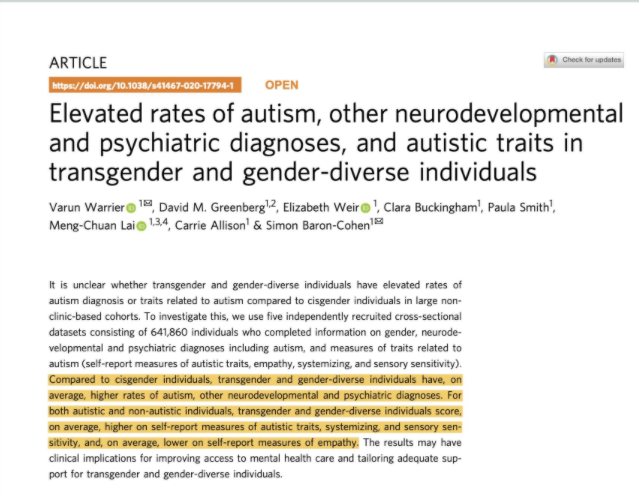
About “Vulva Owners” and Our Nomenclature Wars.

More and more people cannot bear to say words like "men" and "women" anymore. Talk about "objectifying" sexuality . . . Consider this recent article from Healthline:
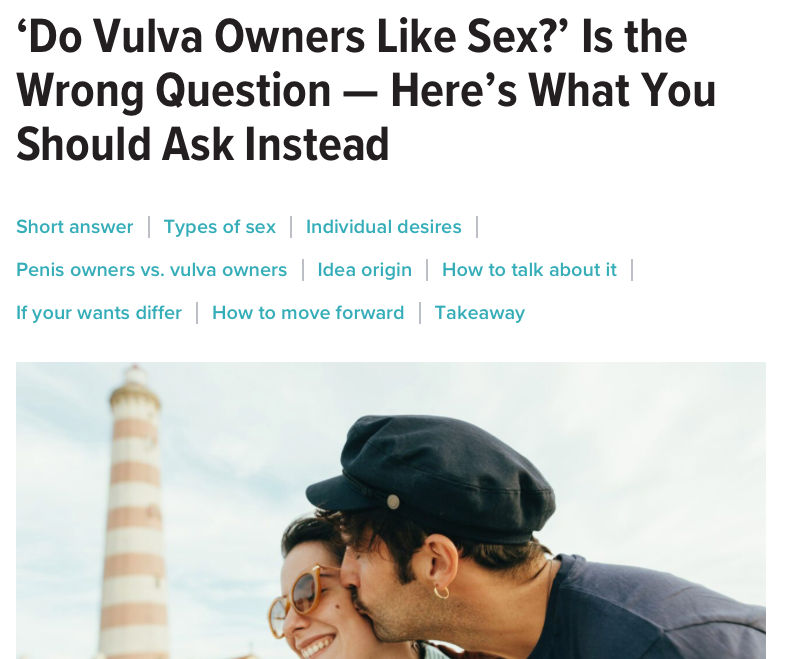
Here's an excerpt:

‘Do Vulva Owners Like Sex?’ Is the Wrong Question — Here’s What You Should Ask Instead. . . . Some do like sex and some don’t. Just like some penis owners like sex and some don’t.

This question, in and of itself, isn’t great, though. It makes some broad generalizations and assumptions about people and sex in general.

So instead of asking whether vulva owners like sex, you should really be focusing on the person you want to have sex with, and ask them how they feel, what they want, and what they need.
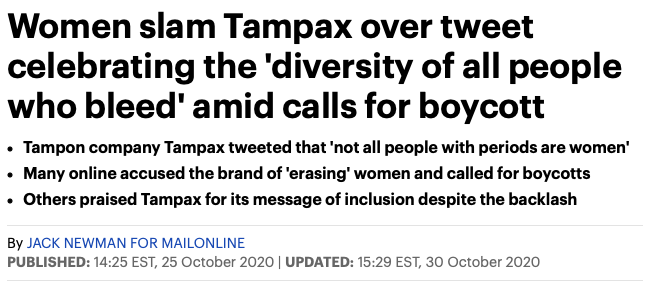
Here's an article about a recent ad by Tampa.  Same issue:

[More . . . ]

Continue ReadingAbout “Vulva Owners” and Our Nomenclature Wars.

Differential Investment in Procreating in Terms of Money and Risks

In her column at Psychology Today ("How to Train Your Boyfriend"), Evolutionary Psychologist Diane Fleischman illustrates the time investment differential in terms of money:

We know women have had to carry a baby for 9 months. But over our evolutionary history, a mother would have had to breastfeed for 3 years, on average, before the baby would be weaned. What's the minimum amount of investment a man could put in to have a baby? Let's be generous and say the minimum amount is an hour. This is called "minimum obligatory parental investment" and in human men and women, the asymmetry is bigger than in most other species. . . . If you think about the asymmetry between men and women in the minimum amount they would have to invest to make a baby in terms of dollar amount- a man would have to invest $1 and a woman would have to invest $32,000.

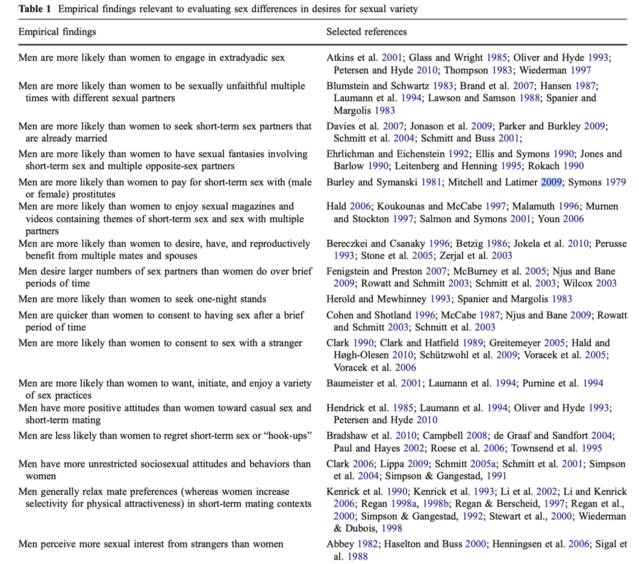
In her article, Fleishman points out many difference in behavior between men and woman (see the extensive list below), as well as reproductive risks, stemming from this procreation investment asymmetry.

Continue ReadingDifferential Investment in Procreating in Terms of Money and Risks

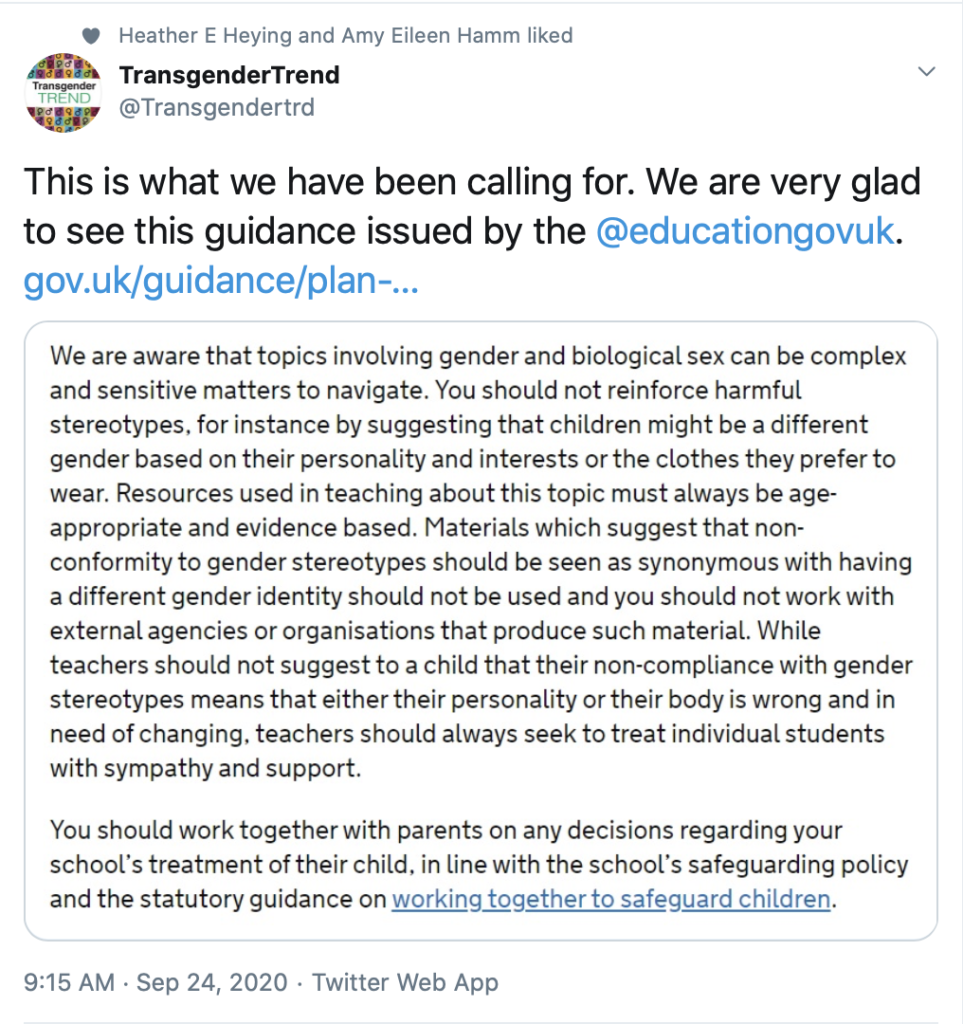
Updated Common Sense Advice on Transgender Issues re Children from the U.K. Department of Education

This advice from the U.K. Department of Education is long overdue. So much common sense here.  Perfect response to many bad arguments being made by transgender activists, for instance, if a girl likes to engage in activities that are stereotypically "for boys," she was born in the wrong type of body and thus needs surgery and hormones. It's now time to invest in some giant shredders to rip up massive amounts of pernicious trendy advice.

This is a list of things that are so obvious that they shouldn't need to be said at all, but we live in a world where these things do need to be said.

Continue ReadingUpdated Common Sense Advice on Transgender Issues re Children from the U.K. Department of Education

Sex Differences in Casual Sex and the Lack of Blank Slates

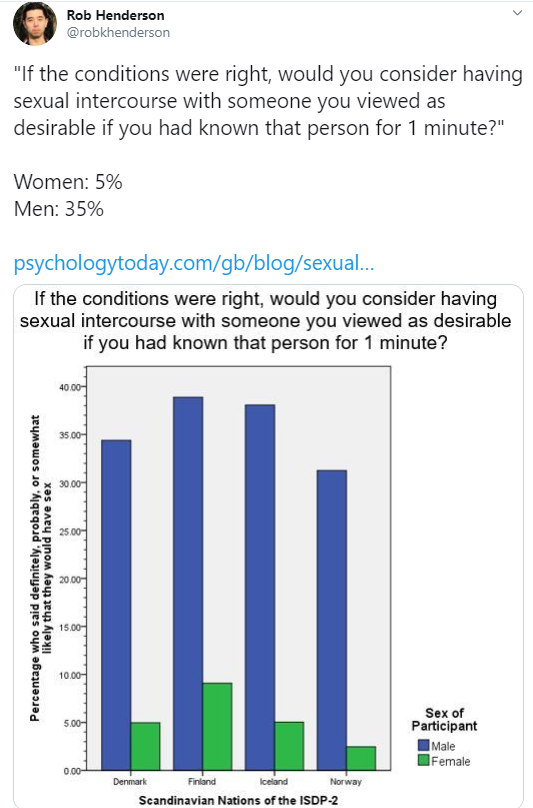
This Tweet links to a detailed article from 2017.  Men and women are similar in many ways, but they are extremely different when it comes to attitudes regarding casual sex.

From the cited article at Psychology Today:

Over the last few decades almost all research studies have found that men are much more eager for casual sex than women are (Oliver & Hyde, 1993; Petersen & Hyde, 2010). This is especially true when it comes to desires for short-term mating with many different sexual partners (Schmitt et al., 2003), and is even more true for wanting to have sex with complete and total strangers (Tappé et al., 2013).

In a classic social psychological experiment from the 1980s, Clark and Hatfield (1989) put the idea of sex differences in consenting to sex with strangers to a real-life test. They had experimental confederates approach college students across various campuses and ask, "I've been noticing you around campus. I find you to be very attractive. Would you go to bed with me tonight?" Around 75 percent of men agreed to have sex with a complete stranger, whereas no women (0 percent) agreed. In terms of effect size, this is one of the largest sex differences ever discovered in psychological science (Hyde, 2005).


Continue ReadingSex Differences in Casual Sex and the Lack of Blank Slates