If we are to take selection more seriously within humans, we may fairly ask what rigorous system would be capable of tying together an altered reality of layered falsehoods in which absolutely nothing can be assumed to be as it appears. Such a system, in continuous development for more than a century, is known to exist and now supports an intricate multi-billion dollar business empire of pure hokum. It is known to wrestling's insiders as "Kayfabe".
Because professional wrestling is a simulated sport, all competitors who face each other in the ring are actually close collaborators who must form a closed system (called "a promotion") sealed against outsiders. With external competitors generally excluded, antagonists are chosen from within the promotion and their ritualized battles are largely negotiated, choreographed, and rehearsed at a significantly decreased risk of injury or death. With outcomes predetermined under Kayfabe, betrayal in wrestling comes not from engaging in unsportsmanlike conduct, but by the surprise appearance of actual sporting behavior.
What makes Kayfabe remarkable is that it gives us potentially the most complete example of the general process by which a wide class of important endeavors transition from failed reality to successful fakery.
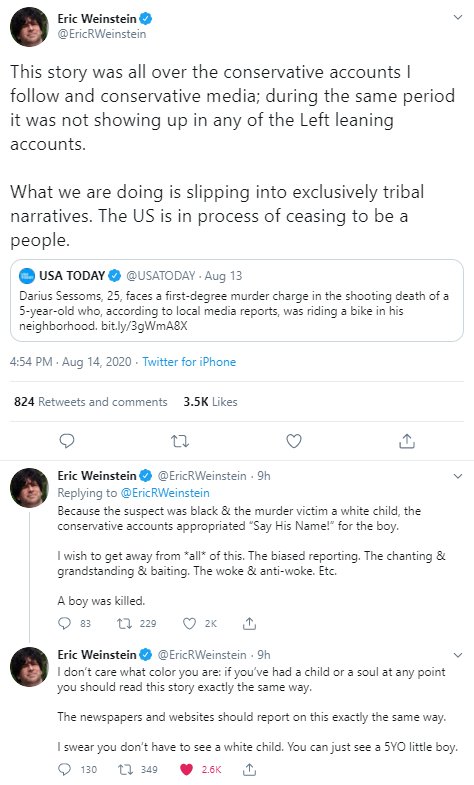
Eric Weinstein's Tweet isn't really about the "race" of this perpetrator and the "race" of this victim. Tomorrow there will be another incident in which the "races" will be reversed and then that news coverage (and lack thereof) will also be reversed. THAT is what is tragic. We are now divided so sharply that we refuse to see the humanity in members of outgroups.
To satisfy our selectively-blinded morality and to sell commercials, our respective teams of "news" media now look only for facts that fit predetermined narratives, ignoring everything that doesn't fit. In other words, our "news" stories are pre-written nuance free, with a few blanks left open for tonight's names and tonight's minor details. And since there is so much going on, they will easily find the stories they seek, the kinds of stories that are guaranteed to make us nod, then clench our fists, then vomit our anger at the opposing team on social media.
We and our teams of "news" media have trained each other so very well that these insane battle lines now seem inevitable. So much so that if Jesus, The Dalai Lama, Nelson Mandela and Martin Luther King all suddenly appeared and earnestly reminded us to love both our neighbors and our enemies, it would would unite us, if only for a moment. We would tell them all to go fuck off.
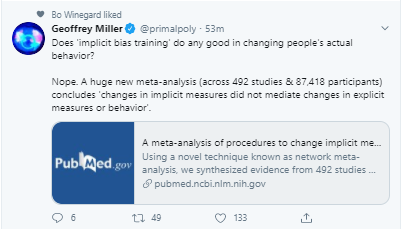
Using a novel technique known as network meta-analysis, we synthesized evidence from 492 studies (87,418 participants) to investigate the effectiveness of procedures in changing implicit measures, which we define as response biases on implicit tasks. We also evaluated these procedures' effects on explicit and behavioral measures. We found that implicit measures can be changed, but effects are often relatively weak (|ds| < .30). Most studies focused on producing short-term changes with brief, single-session manipulations. Procedures that associate sets of concepts, invoke goals or motivations, or tax mental resources changed implicit measures the most, whereas procedures that induced threat, affirmation, or specific moods/emotions changed implicit measures the least. Bias tests suggested that implicit effects could be inflated relative to their true population values. Procedures changed explicit measures less consistently and to a smaller degree than implicit measures and generally produced trivial changes in behavior. Finally, changes in implicit measures did not mediate changes in explicit measures or behavior. Our findings suggest that changes in implicit measures are possible, but those changes do not necessarily translate into changes in explicit measures or behavior. (PsycINFO Database Record (c) 2019 APA, all rights reserved).
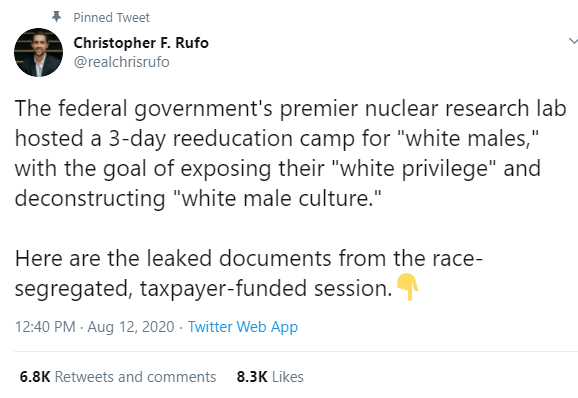
Compelled speech is increasingly being portrayed as "education." A recent illustration has come to light. Last year, Sandia National Laboratories sent its executives to reeducation camp: The training materials and the context for the training were reported by Christopher Rufo, a filmmaker, writer, and policy researcher. On his website, Rufo states (and I agree):
It’s time to expose this taxpayer-funded pseudoscience and rally the White House and legislators to stop these deeply divisive training sessions. My goal is simple: we must pass legislation to “abolish critical race theory” in the federal government. Let’s push as far as we can.
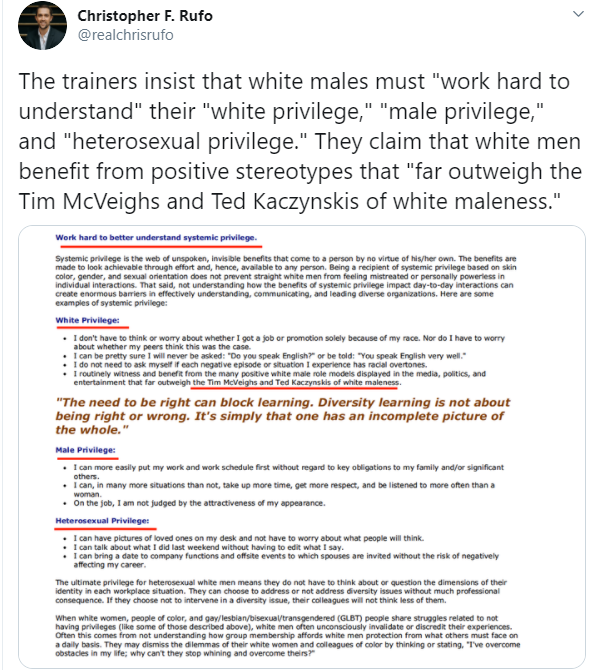
Under economic threat (the potential threat to employment that would be felt by any employee asked to attend), this camp required the employees to listen to, and in many cases publicly acknowledge, racist and sexist absurdities, including the following:
I've followed Social Psychologist Jonathan Haidt closely for many years (as you can see by searching for his name at DI). He is the author of several excellent books, including The Happiness Hypothesis, The Righteous Mind: Why Good People Are Divided by Politics and Religion and The Coddling of the American Mind. Haidt's thought process crosscuts the prevailing two wings of political thought in the United States. In this extended interview with Joe Rogan, Haidt dissects many topics, including identity politics. He urges that this phrase encompasses two separate approaches, "Common Enemy Politics" and "Common Humanity."
Haidt also distinguishes between two prevalent types of conversations, two types of "games" being played that often make conversations frustrating. Many of us insist upon playing the "truth seeking game," while others play a game that assumes a Manichean battle where A) no one gains except at the expense of someone else, B) where people are not seen as individuals but a members of groups, and C) you can tell who someone is merely by their appearance. Much of the fruitless dialogue on social media and elsewhere makes a lot more sense once we realize that these two approaches have virtually nothing in common--they serve entirely different purposes. Just because we exchange words does not mean we are, in any meaningful way, communicating.
In addition to embedding the video of the interview, I invested some time to create a transcript of several sections of this interview, from about Min. 33 - 55. I have cleaned up the wording to omit throat-clearings and false starts, but I have worked hard to be true to the substance of the conversation.
33:18
JH: You have to look at different games being played. Yale was a place that taught me to think in lots of different ways and it was constantly blowing my mind when I took my first economics course. It was like wow, here's a new pair of spectacles that I can put on and suddenly I see all these prices and supply. I never learned to think that way, where I learned about Freud in psychology or sociology. A good education is one that lets you look at our complicated world through multiple perspectives. That makes you smart. That's what a liberal arts education should do. But what I see increasingly happening, especially at elite schools, is the dominance of a single story, and that single story is life is a battle between good people and evil people, or rather good groups and evil groups, and it's a zero-sum game. So if the bad groups have more, it's because they took it from the good groups, so the point of everything is to fight the bad groups. Bring them down create equality and this is a terrible way to think in a free society. That might have worked you know in biblical days when you got the Moabites killing the Jebusites or whatever, but you know we live in an era in which we've discovered that that the pie can be grown a million-fold. So to teach students to see society as a zero-sum competition between groups is primitive and destructive.
34:22
JR: In your book, you actually identify the moment where these micro aggressions made their appearance and they were initially a racist thing.
JH: Yeah. The idea of a micro aggression really becomes popular in a 2007 article by Derald Wing Sue at Teachers College. He talks about this concept of microaggressions. There are two things that are good about the concept, that are useful. One is that explicit racism has clearly gone down--by any measure explicit racism is plummeted in American across the West—but there could still be subtle or veiled a racism.
37:27
JR It's ultimately for everyone's sake, I mean, even for the sake of the people that are embroiled in all this controversy and chaos. It would be fantastic across the board if there was no more sexism, there was no more racism, there was no more any of these things. It would be wonderful. Then we could just start treating humans as just humans. Like this is just who you are you're just a person. No one cares. What a wonderful world we would live in if this was no longer an issue at all.
JH: Beautifully put.
JR: How does that get through?
38:01
JH: We were getting there, okay? That's what the twentieth century was. We were shaped by the late 20th century. The late 20th century was a time in America in which, you know, earlier on there was all kinds of prejudice. I mean, when I was born, just right before you were born, it was legal to say you can't eat here because you're Black and so that changed in 1964-65. But it used to be that we had legal differentiations by race and then those were knocked down. But we still had social [discrimination] and it used to be that if you were gay that was something humiliating. It had to be hidden. If you look at where we were in 1960 or ’63, when I was born and then you look at where we got by 2000, the progress is fantastic on every front, so that's all I mean when I say we were moving in that direction.
Hello, I invite you to subscribe to Dangerous Intersection by entering your email below. You will have the option to receive emails notifying you of new posts once per week or more often.