No Real Teeth for “Anti-Discrimination” Efforts to Protect Asian-Americans
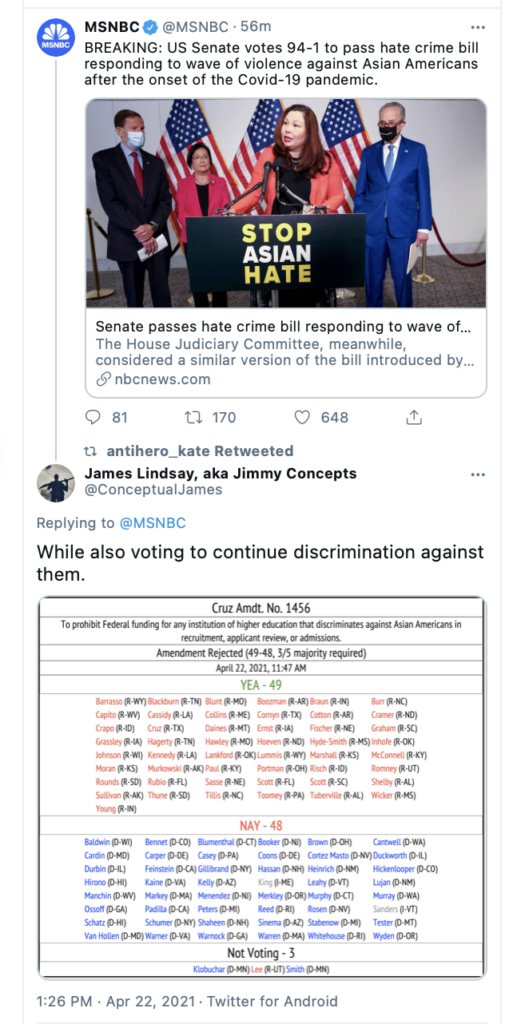
An amendment was offered to an "Asian hate crime" bill:
Texas Republican Senator Ted Cruz introduced a change to a Democrat-authored “Asian hate crime” bill making its way through Congress, expanding on the bill’s prohibitions against anti-Asian racism by stripping federal funding from colleges and universities that discriminate against Asians in their admissions process . . .Here is the vote on the Cruz Amendment:The bill, Cruz said, “is not designed to do anything to prevent or punish actual crimes. It is instead a Democratic messaging vehicle designed to push the demonstrably false idea that it is somehow racist to acknowledge that Covid-19 originated in Wuhan, China and that the Chinese Communist Party actively lied and suppressed information about the outbreak, allowing it to become a global pandemic.”
Democrats apparently have no problem with the fact that Ivy League Colleges are viciously and openly discriminating against Asian-Americans.
Enthusiastic Racism From the Academic Left
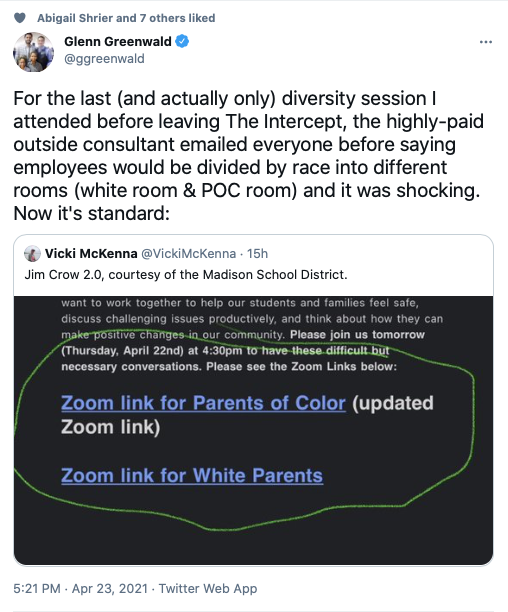
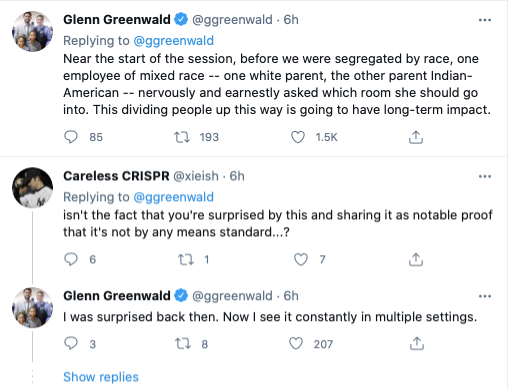
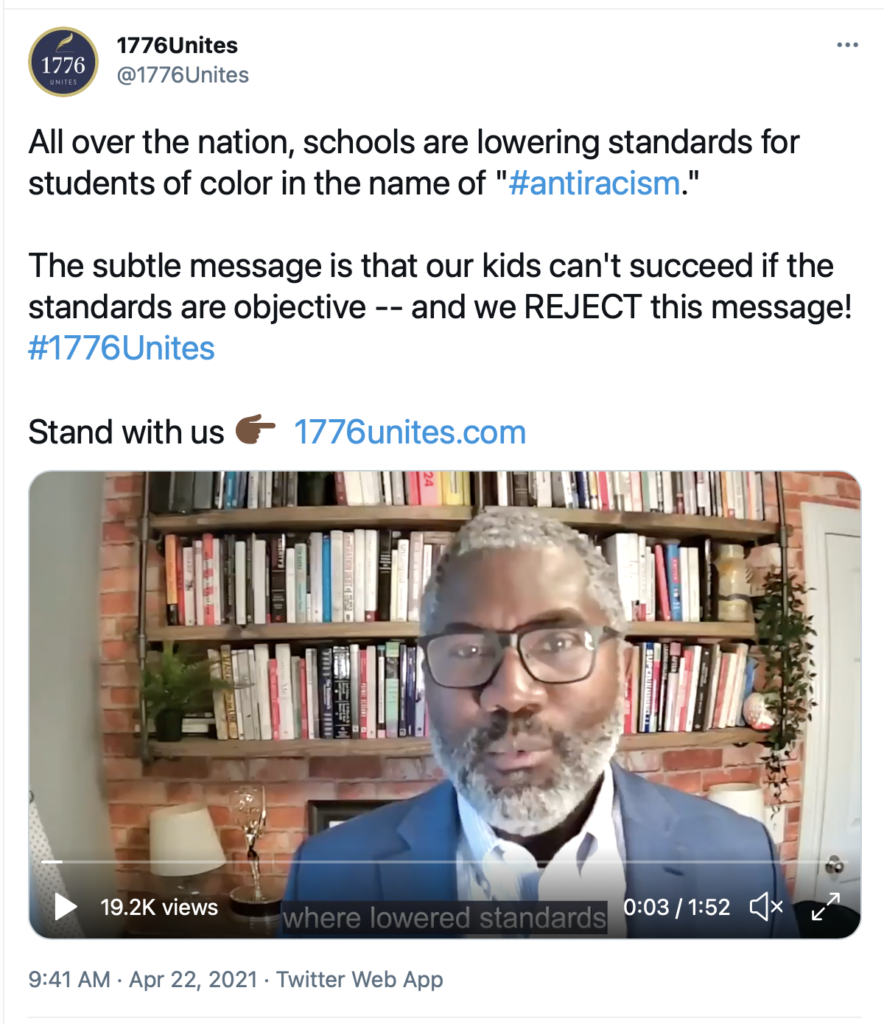
I agree with the message of this short video. I despair of the way that "anti-racism" is being implemented in many schools. What does it tell young people who identify as "black" that we need to lower standards for all "blacks" because they, as a group, cannot cut it? Two things:
1. This claim is false. "Black" students can cut it. If given high-quality education and parental involvement from the start, I believe that "blacks" are every bit as capable of educational achievement as any other "color" of student. Many "black" students are high performers.
2. This quick solution sends the same pernicious message that one would expect to hear from American slave-holders in the 1850s. This is not what students need to hear.
Let's give all students (and their families) the tools they need to succeed. And let's not shy away from inconvenient facts, including these the fact that 69% of "black" children were born outside of marriage (compared to 30% for "whites" and "15% for people categories as Asian. I don't bring this up to be moralistic, but only to suggest that many more "black" children lack some of the resources available, on average, to children of other "races." A two-parent household (whether or not married) can, on average, offer more resources to the children of that household. I also suspect that in some "black" communities (not all), education is approached differently than in some other communities (of all "races). John McWhorter has discussed this different approach on occasion (see, for example, the 30 min mark here). Both of these factors (and others) need to be addressed unflinchingly so that every child, including every single "black" child, gets the resources and encouragement he or she needs to excel as a student.
Nothing I have written here suggests that we should judge any child on any basis other than as an individual. Every child is unique and there are high achievers and low achievers of every so-called "race."
[I no longer use the term "race" or the colors referring to "races" without scare quotes. Use of these terms is horribly imprecise, unscientific and inherently divisive. Claiming that there are "races" is the first step on the slippery slope toward racism. We need a two-pronged attack: 1) We need to move away from claims that there are "races," as nothing good results from this divisive term. 2) At the same time, we need to ostracize and vigorously litigate against any person or organization that discriminates on the purported basis of "race." ]

Conversations versus Performances
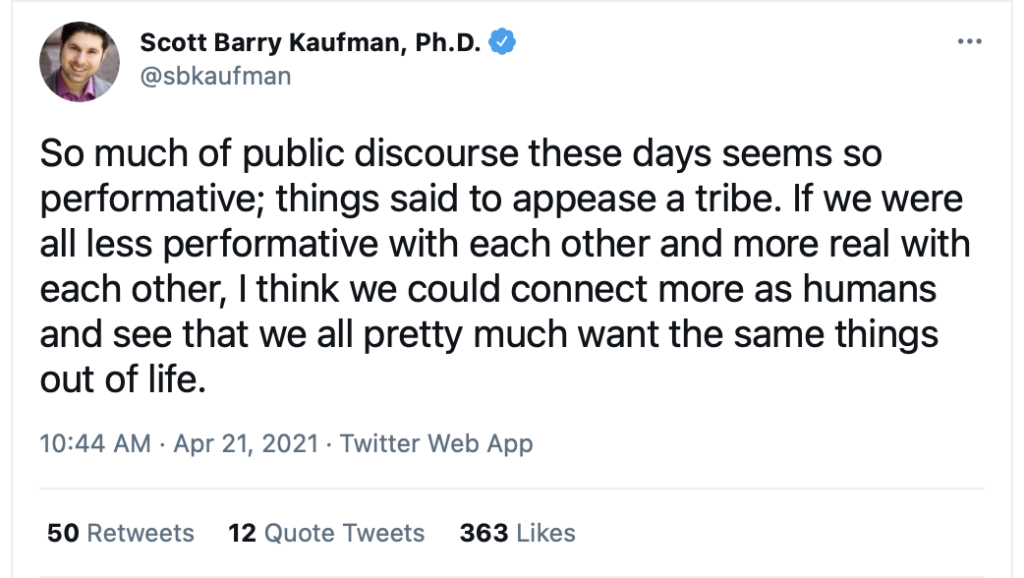
Scott Barry Kaufman says this well.
I have this exact same thought many times every day. It's like we are trapped in blue-dress-brown-dress argument every time we open our mouths.
One fruitful solution to this mess is to re-learn how to have conversations using Heterodox Academy's HxA Way:
- Make your case with evidence.
- Be intellectually charitable.
- Be intellectually humble.
- Be constructive.
- Be yourself.
The above five points are merely the headings - the HxA Way is carefully thought out. Here's a more detailed (yet succinct) description.
Then again, this solution of the HxA way assumes that both parties are interested in having a conversation, which is not the case with many of today's tribally charged performative chants that only pretend to be conversations.
Conversations and performative chants look similar in that they both involve two people talking in the presence of each other. The way I distinguish the two is that to be a conversation, one or both parties is/are at least potentially open to changing the way they understand some aspect of the world. This is often extremely difficult to tell. And the likelihood that we are witnessing a meaningful conversation diminishes greatly as 1) more and more people actively participate as speakers, 2) one or more of the parties fail to accurately restate the other side's position, 3) one of the sides refuses to give up the floor, or 4) voices get louder or more impassioned. In other words, one's best shot at having a real conversation involves one-on-one conversation where people listen closely to each other's words, restate those thoughts accurately and want their thoughts and world-view challenged--they both seek a new version of truth and neither seeks to "win" the interaction. The opposite of a conversation can be found in a religious sermon.
I'll close with this quote by Nietzsche:
"Madness is rare in individuals—but in groups, parties, nations and ages it is the rule."
--Beyond Good & Evil, Aphorism #156
Cities Face a Daunting Problem in Addressing Homelessness
What are the state of the art approaches for addressing homelessness in the U.S.? In his article, "The Limits of Housing First," Christopher Rufo offer lots of facts and figures but no optimism. Homelessness is a massively daunting problem and U.S. cities are struggling for answers. An excerpt:
In Los Angeles, this could spell disaster. In the most optimistic scenario laid out by the controller’s office, the city will build 5,873 supportive housing units at an initial cost of $1.2 billion, plus an estimated $88 million in annual service costs associated with the Housing First model. The recipients of this housing will not meaningfully improve their lives in terms of addiction, mental illness, and spiritual well-being — and there will still be 60,000 people on the streets across Los Angeles County. In other words, even under its own theoretical assumptions, Proposition HHH is doomed to fail.The City of Los Angeles did not return a request for comment.
- Go to the previous page
- 1
- …
- 67
- 68
- 69
- 70
- 71
- 72
- 73
- …
- 458
- Go to the next page