
About Friends and Trust

Brett Weinstein, speaking about the stress-testing of friendships (on the October 29, 2023 episode of his podcast with guest, Joshua Slouch):

I've now been through several of these events in my own life. And I've noticed a pattern, which is that in every case, these divisive crises reveal people's character. And each time I've seen the same pattern: there are people you thought you could trust who absolutely disappoint you. And then there are people that you never expected, maybe you didn't even know them ahead of time, who rise to the challenge and they shine. And you see that somebody, maybe you didn't know their name, but they turn out to have tremendous strength of character and insight, and they stand up at the right moment and defend you for no reason. Right? No reason other than that it's the right thing to do. And so each time I have lost friends, and it's painful. And I have gained people who are much higher quality. And I call this "painful upgrade," Right? It keeps upgrading your social circle.

And I now have to look back on the world. Before I had been through any of these and realized that I was walking around with trust in people that carried with them the ability to absolutely betray under the worst possible circumstances, and that that's dangerous. You are far better to know who actually has the strength of character to face these things. And to limit your significant interactions to that pool of people. Right? It is a gift to know who cannot be trusted with your well being. And I don't like to say that, but I think people need to be alerted to this. Because, you know, people are not labeled. They don't even know themselves whether they're capable of this until they're faced with the situation. It's the crisis that reveals it. And it's the silver lining of these terrible chapters that it does tell you who's really on your team.
Continue ReadingAbout Friends and Trust

Adolescents in the U.S. are Severely Distressed, Increasingly Suicidal.

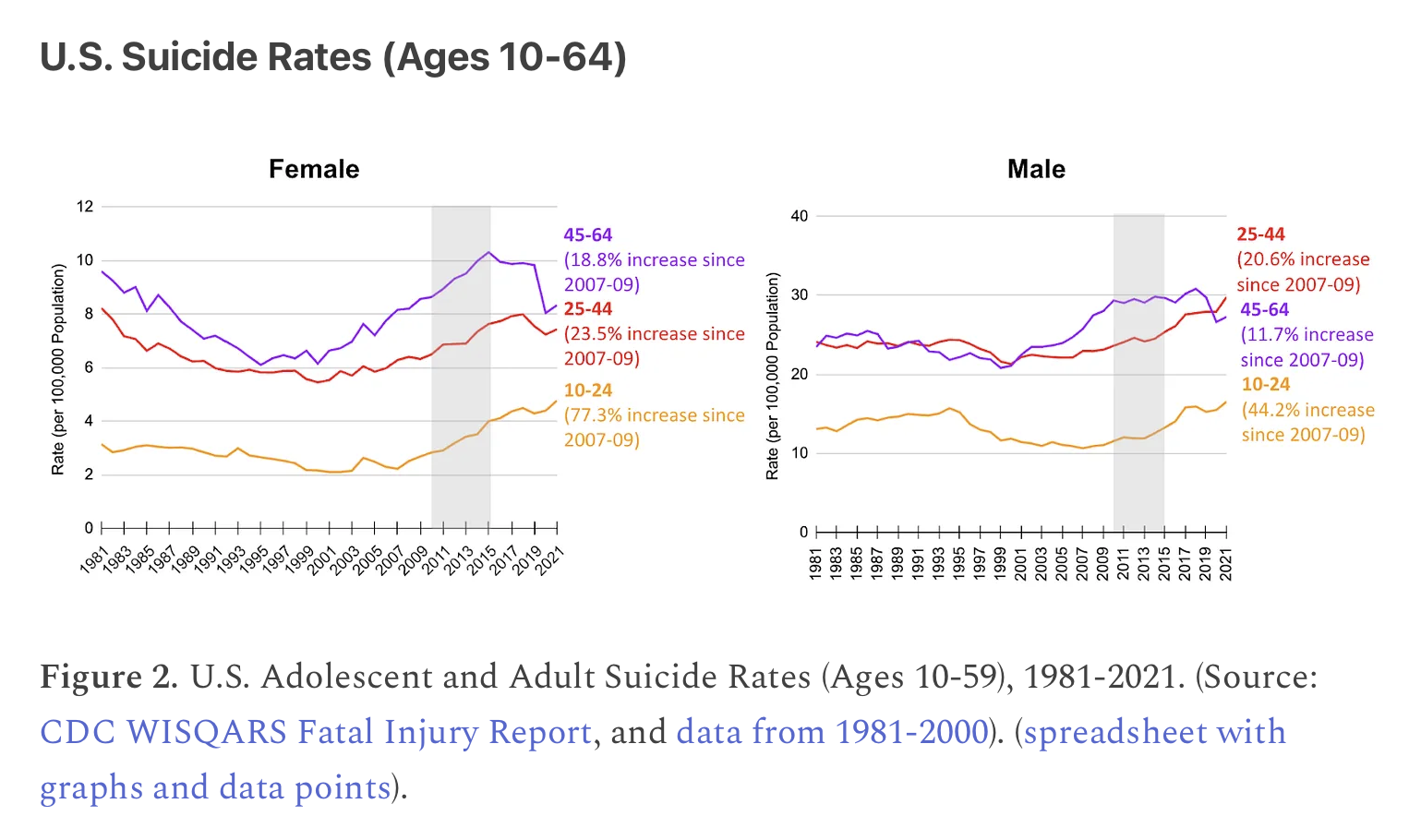
Adolescents in the U.S. are severely distressed, increasingly suicidal. Zach Rausch and Jonathan Haidt weigh in on causation: "The sudden switch from play-based childhood to phone-based childhood is—we believe—the leading candidate for being the major cause of the international collapse of adolescent mental health.8 The evidence of causation is particularly strong for girls. In fact, nobody has yet put forth an alternative theory—one that can explain why the same thing happened at the same time in so many countries. Jean Twenge recently considered thirteen such theories that have been proposed to explain trends in the U.S., and she showed that they don’t even work in the U.S., let alone internationally."

Continue ReadingAdolescents in the U.S. are Severely Distressed, Increasingly Suicidal.

That Feeling that One Must Inevitably Pass the Torch

Calendars don't lie. I've already used up most of the 1,000 months I'm ever going to have on the planet.

As an older dad, I took quite an interest in Rikki Schlott’s New York Post article about her relationship with her 84-year old dad. Reading this caused me to pause and hope that I’ve helped to give my two daughters (both now in their mid-20's) the tools they need to thrive in this insane world. Rikki, BTW, is, at the age of 22, co-author of a best-selling new book on the scourge of cancel culture: The Canceling of the American Mind. An excerpt:

My dad’s breadth of life experience and wisdom woke me to the transience of today’s fads and fallacies. It’s hard to humor my peers who demand safe spaces and trigger warnings when my best friend remembers the plights of World War II. It’s impossible to flirt with socialist politics when my father recalls the rise and fall of the USSR. It’s hard to spend my days scrolling through TikTok when my dad is a living testament to the wisdom a lifetime of reading can foster.

Having an older father also means it’s difficult to swallow the victim mentality of many of my contemporaries. While Generation Z indulges in identity politics and intersectionality, it’s an attitude my father would never accept from me. He’s a self-made man who pulled himself up by his bootstraps. Now that he’s provided me with an education and life beyond what he could imagine growing up on a goose farm, I won’t rest until I make the most of all the opportunities I’ve been given and do him proud.

Continue ReadingThat Feeling that One Must Inevitably Pass the Torch

17 Life-Learnings to Celebrate the 17th Birthday of Maria Popova’s “The Marginalian”

This morning I received 17 wonderful gifts. Maria Popova’s website has been one of my places of respite for many years. In her most recent article, she celebrates her 17 years of online writing at “The Marginalian” by crystallizing 17 lessons she has learned along the way. Here is Maria’s introduction to her 17 lessons:

The Marginalian was born on October 23, 2006, under an outgrown name, to an outgrown self that feels to me now almost like a different species of consciousness. (It can only be so — if we don’t continually outgrow ourselves, if we don’t wince a little at our former ideas, ideals, and beliefs, we ossify and perish.)

What follows are merely the titles to Popova's 17 lessons. She discusses each of these more fully at her website. Everything she writes is, somehow, both analytically precise and poetic. I've printed this list and it has gone up on my wall so that I have daily reminders:

1. Allow yourself the uncomfortable luxury of changing your mind.

2. Do nothing for prestige or status or money or approval alone

3. Be generous.

4. Build pockets of stillness into your life.

5. You are the only custodian of your own integrity.

6. Presence is far more intricate and rewarding an art than productivity.

7. “Expect anything worthwhile to take a long time.”

8. Seek out what magnifies your spirit.

9. Don’t be afraid to be an idealist.

10. Don’t just resist cynicism — fight it actively.

11. Question your maps and models of the universe, both inner and outer, and continually test them against the raw input of reality.

12 There are infinitely many kinds of beautiful lives.

13. In any bond of depth and significance, forgive, forgive, forgive. And then forgive again.

14. Choose joy.

15. Outgrow yourself.

16. Unself.

17.Everything is eventually recompensed, every effort of the heart eventually requited, though not always in the form you imagined or hoped for.

Continue Reading17 Life-Learnings to Celebrate the 17th Birthday of Maria Popova’s “The Marginalian”