
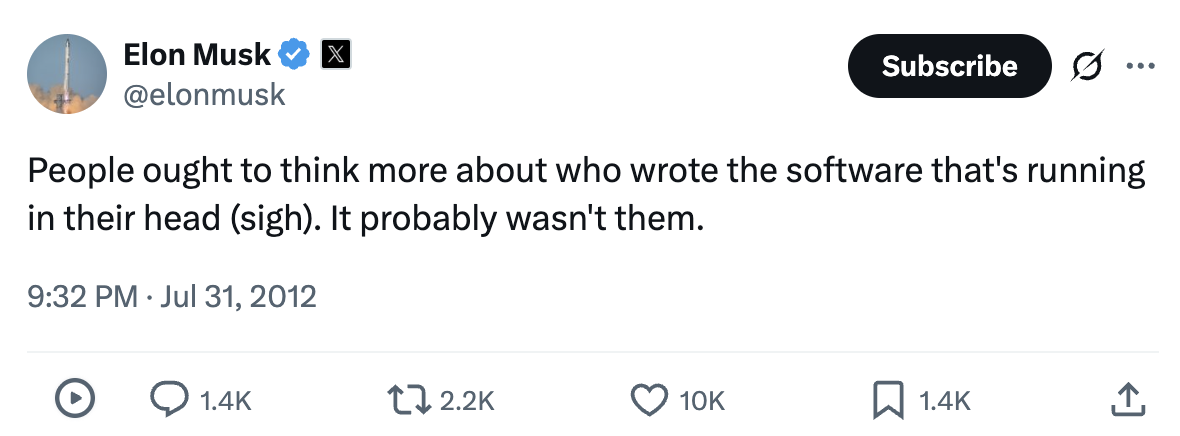
About “You”

If you are not aggressively doubting, investigating and fighting for your personal autonomy every hour, you are no longer the author of "your" thoughts. As Soloman Asch warned us, if you aren't pushing back hard against your own people, you will become a mere sock puppet.

For much more, see Robert Malone's new book, PsyWar. I'm half-way thorugh. This summary is by Grok (though I've tweaked it a bit:

* Robert W. Malone MD, MS, an mRNA technology pioneer and physician-scientist, and Jill Glasspool Malone PhD. Psywar delves into the mechanisms of modern psychological warfare, or "PsyWar," which the authors define as government-orchestrated campaigns using propaganda, censorship, and psychological operations (psyops) to manipulate public opinion and behavior.

* The book focuses on how these tactics have been deployed against the American people, drawing from historical contexts to contemporary applications. It argues that PsyWar is a tool for enforcing a "New World Order" through techno-totalitarianism and global control structures. Specifically addressing 5th generation psyops—often tied to fifth-generation warfare—the text explores asymmetric, information-based conflicts that blend psychological manipulation with technology, surveillance, and behavioral control to achieve dominance without traditional military engagement. Malone, known for his critiques of COVID-19 policies and vaccine mandates, frames these as examples of psychological bioterrorism and administrative state overreach.

* Key topics covered include:

* - **Propaganda and Behavioral Control**: Techniques for shaping public perceptions and actions through media and information manipulation.

* - **Psychological Bioterrorism**: The use of fear-based psyops in health crises to enforce compliance.

* - **Deep State Censorship and Surveillance Capitalism**: How government and corporate entities collaborate to monitor and suppress dissent.

* - **Fifth-Generation Warfare**: Non-kinetic strategies emphasizing psyops, cyber elements, and hybrid threats to undermine societies.

* - **PsyWar Tactics and Techno-Totalitarianism**: Modern tools like AI-driven censorship and data exploitation for totalitarian ends.

* - **The New World Order and Global Control**: Visions of centralized power structures enabled by these warfare methods.

* The authors emphasize the critical role of free speech in countering these threats, advocating for a return to constitutional principles to resist totalitarian creep and restore personal sovereignty. The book has been discussed in podcasts and reviews as a call to action against perceived government psyops, particularly in the context of recent global events.

Continue ReadingAbout “You”

Ubiquitous “News” Based on Classified Leaks

Well stated by Green Lives Matter and Tulsi Gabbard:

Tulsi Gabbard explains how the intelligence community uses leaks from "anonymous sources" to usurp the President of the United States and undermine the will of the people.

Coincidentally, The New York Times just published an article that cites "unidentified sources" from an alleged classified operation in North Korea that could tarnish Trump's relationship with Kim Jong Un and further diminish his image.

It's the same exact playbook every single time. Listen to Tulsi explain:

These people have gotten away with these kinds of activities for so long because they're protected by an entire system that is built to shield their nefarious activities. They do this with the assistance of the deep state and the propaganda media... This happens frequently.

Someone in the intelligence community leaks classified intelligence to their friends in the propaganda media. Those individuals in the media eagerly print this classified intelligence from "unnamed sources" then we see other people in the media talk about this "classified" intelligence. No one has verified it. No one has done any kind of vetting. No one has done any basic journalist work.

And then we see politicians repeating and talking about what was leaked to the media. We've seen how this tried and true playbook that is used over and over again to smear their opponents and, in President Trump's case, to be used as a basis for FBI raids on his home, lawfare, impeachments, endless investigations, and so forth. . . . 

This is what we are talking about when we talk about the deep state. It's not some grand conspiracy theory; it is a conspiracy to undermine the Constitution, but this is the reality we are operating in. It is important to be clear-eyed about it so we can combat it with the truth. This is why exposing the truth is so important to bring about that real transparency and accountability.

People have become well aware of the insidious nature of the mainstream media and the playbooks they use. Far more awake than ever before.

Continue ReadingUbiquitous “News” Based on Classified Leaks

About the Creation of the Peer Review Process

Eric Weinstein: "If you screwed up covid this badly by getting inside of the Lancet and Nature. Peer review is this fake thing that supposedly stretches back to the founding of the Royal Society. And it's very clear from the scholarship around it that it comes out of the period between 1965 and 1975 initiated by the Medicare Act, predicated on the need for editors for the journal expansion, founded by Pergamon Press and Robert Maxwell. By 1975 there's a giant battle between the [National Science Foundation] NSF and both fiscal and cultural conservatives against something called “Man: A Course of Study” (MACOS), where peer review was born in a Utah clinic. [It] came out of the medical literature because the federal government in 1965 with The Medicare Act picked up the need to pay for so many medical procedures. They wanted to say "Why are we assigning this many medical procedures?" The doctors circled the wagons and said, "We will peer review each other." Then in night, by 1975 the NSF was under the microscope, and they used peer review as a self defense of last resort to say we will be reviewing each other, right? Peer review is a myth."

Continue ReadingAbout the Creation of the Peer Review Process

It’s Time for NPR to Earn Its Own Funding With Respectable Reporting

I don't want to forced to fund NPR any more than want to be forced to fund Fox News. Uri Berliner served as the senior business editor at NPR from 1999 until his resignation in April 2024. What follows is an excerpt from his article, "Happy Independence Day, NPR." Anyone who has been paying attention knows that he not exaggerating the far-left slide of NPR:

Once fairly evenly divided between liberals, moderates, and conservatives, NPR’s news audience shifted sharply to the left. And by 2023, liberals outnumbered conservatives more than six to one. True to the tote bag cliché, NPR became an accessory for Whole Foods shoppers. Which is sad, because in another era, NPR, and public radio more broadly, developed some of the most creative and entertaining programming anywhere, from Car Talk to This American Life, Planet Money, Radiolab and A Prairie Home Companion.

Thanks in part to this ideological transformation, NPR botched major stories—and damaged its bond with the American people.

To name a couple of prominent examples: It repeatedly insisted that the lab leak theory of Covid had been debunked and it refused to cover Hunter Biden’s laptop. NPR’s reporting on the most contentious issues of the day—climate change, youth gender medicine, and the war in Gaza—leaned on moralizing and emotional certitude more than on rigorous factual analysis.

Embracing the mantras of the Great Awokening, NPR became a caricature of itself with headlines like these:

Microfeminism: The Next Big Thing in Fighting the Patriarchy

Which Skin Color Emoji Should You Use? The Answer Can Be More Complex than You Think

Black Women’s Groups Find Health and Healing on Hikes, But Sometimes Racism, Too

Bringing Diversity to Maine’s Nearly All-White Lobster Fleet

Diet Culture Can Hurt Kids. This Author Advises Parents to Reclaim the Word ‘Fat’

These Drag Artists Know How to Turn Climate Activism into a Joyful Blowout

Continue ReadingIt’s Time for NPR to Earn Its Own Funding With Respectable Reporting

Whitney Webb: What to Do About the Puppetmaster

Whitney Webb argues that the general public is unaware of the power structure of oligarch networks and their connection to the national security state. She argues that the CIA, created by Wall Street bankers with ties to organized crime, has historically served corporate interests. She calls for individuals to disengage from big tech companies, which are heavily interconnected with intelligence agencies and have unsavory associations. She advocates for independence from these systems to avoid being controlled by them, emphasizing the need for personal responsibility and action rather than relying on the political system. Transcript of Whitney Webb:

What I attempt to do. I mean, basically, at the end of the day, this into these entities and this power structure had been successful because people have not really been aware of what, what's been going on, and how interconnected a lot of these oligarch networks ultimately are, and how connected they are to our national security state. Because a lot of people, you know, if we're just talking about, back to my point earlier, talking about Mossad, talking about the CIA, who does the CIA work for? Who does Mossad work for?

In the case of the CIA, it's very clear that it was created by Wall Street bankers who entered into questionable alliances with organized crime, and bankers and organized crime are both ultimately interested in expanding their their rackets and is making as much money as possible. And so eventually you have certain economic networks and court you know, the this, these, these alliances dominated what is now corporate America, the multinational corporation that's who the CIA has throughout most of its history, conducted coups on behalf of so we have to go a level up if we really want to know what's going on and Look beyond CIA and Mossad and see, you know, who's really, at least at the scale up a key part of the power structure that's really running the show, because, you know, it's important for them that the public doesn't really look that high up, because then it just seems like We can't really do anything about it, but I think people ultimately can.

What I've argued a lot for a long time is that people need to try and extricate themselves from the biggest iteration of what this mob is today, which is really big tech, which is, again, connected to a lot of it. Connect a lot of these CEOs connected to figures like Epstein or other questionable associations, and also almost all of the big Silicon Valley companies today have their have origins or funding tied to the CIA or to DARPA or to entities like that and that.

We should boycott them as much as possible, and not use their services as much as possible, and not be dependent on these entities. Because if we're dependent then, you know, they can do whatever they want to us. Yeah, and so you know the best way to not give up is to work to be as independent of those systems as possible. Because if we're dependent on them you're basically a slave to these people at the end of the day, which is what I think most Americans do not want.

There's a lot of efforts being made to sort of keep people in in the box of where they think, Oh, well, if I vote for this party or this politician and this candidate, I don't have to do anything to ensure my independence from the system. I can remain dependent on the system and hope that politician XYZ will magically, you know, save the day and fix the country and, you know, ends this ruling power of 80 plus years of, you know, intelligence and organized crime. Yeah, I think it's really something that has to be sort of done on an individual level, and people need to take individual responsibility if they don't want to be part of the system, particularly as we move into this increasingly digital future that these very small handful of companies are going to completely control.

In sum, here is what we can do:

  • Boycott and avoid using services from big tech companies that have ties to the CIA and DARPA.
  • Encourage others to become more independent from the current power structure and not be dependent on the system.
  • Raise awareness about the interconnected nature of oligarch networks, intelligence agencies, and multinational corporations.
Who is Whitney Webb?  According to Grok:

[More . . . ]

Continue ReadingWhitney Webb: What to Do About the Puppetmaster