
Chris Rufo Assembles Profile of NPR CEO Katherine Maher Based on her thousands of Tweets

What can we tell about NPR CEO Katherine Maher based on a review of her tweets?  Chris Rufo notes that she has tweeted more than 29,000 times. He has found a few themes:

What you notice first about Maher’s public speech are the buzzwords and phrases: “structural privilege,” “epistemic emergency,” “transit justice,” “non-binary people,” “late-stage capitalism,” “cis white mobility privilege,” “the politics of representation,” “folx.” She supported Black Lives Matter from its earliest days. She compares driving cars with smoking cigarettes. She is very concerned about “toxic masculinity.”

On every topic, Maher adopts the fashionable language of left-wing academic theory and uses it as social currency, even when her efforts veer into self-parody. She never explains, never provides new interpretation—she just repeats the phrases, in search of affirmation and, when the time is right, a promotion.

Maher understands the game: America’s elite institutions reward loyalty to the narrative. Those who repeat the words move up; those who don’t move out.

This is the person in charge of NPR. As you can see from Rufo's article, she has also taken a hard stand in favor of censorship.

As CEO of the Wikimedia Foundation, Maher made censorship a critical part of her policy, under the guise of fighting “disinformation.” In a speech to the Atlantic Council, an organization with extensive ties to U.S. intelligence services, she explained that she “took a very active approach to disinformation,” coordinated censorship “through conversations with government,” and suppressed dissenting opinions related to the pandemic and the 2020 election.

In that same speech, Maher said that, in relation to the fight against disinformation, the “the number one challenge here that we see is, of course, the First Amendment in the United States.”

Rufo's article is titled, "Quotations from Chairman MaherNPR’s new CEO exemplifies the ideological capture of America’s institutions."
Continue ReadingChris Rufo Assembles Profile of NPR CEO Katherine Maher Based on her thousands of Tweets

Majority Democrat Position: The Government Should Decide What is True.

Glenn Loury's introduction to his podcast interview of Dan Shellenberger:

Maybe my least surprising political position is advocacy for free and open discourse. Without free speech as a bedrock principle, democracy would mean little. If we can’t, as private citizens, receive, judge, and debate ideas and information, the decisions we make on the basis of that information cannot themselves be considered “free” in any meaningful sense. If some central authority prevents me from discussing information—or even the possibility of the existence of information—that could change people’s minds about that authority’s course of action, all of our rights have been damaged.

But over the last five years, a whole raft of ideas potentially threatening to dominant media and government narratives have found themselves shut out of “legitimate” discourse. Having concerns about the side effects of COVID vaccines, advocacy for the chosen presidential candidate of the Republican Party, and opposition to funding Ukraine would seem, in another time, like normal positions any person in the US could hold. And yet many legacy media outlets treat those positions as anywhere from delusional to treasonous. Such positions are often labeled as sources of “misinformation,” dangerous ideas to which, we’re told, ordinary First Amendment protections may not apply.

In an age when almost all of us rely, to some degree, on web-based platforms for our information, the line between government censorship and platform terms of service can seem vanishingly thin. In fact, in this week’s episode, the journalist Michael Shellenberger suggests the line may not exist at all. In this clip, he draws my attention to a startling poll that finds a huge increase in the number of Democratic or Democratic-leaning voters who want to see the government censor “misinformation” online. But who decides what counts as misinformation? When platforms seek government guidance on that definition, we have good reason to ask whether the apparent freedom they offer is government censorship by another name.

Continue ReadingMajority Democrat Position: The Government Should Decide What is True.

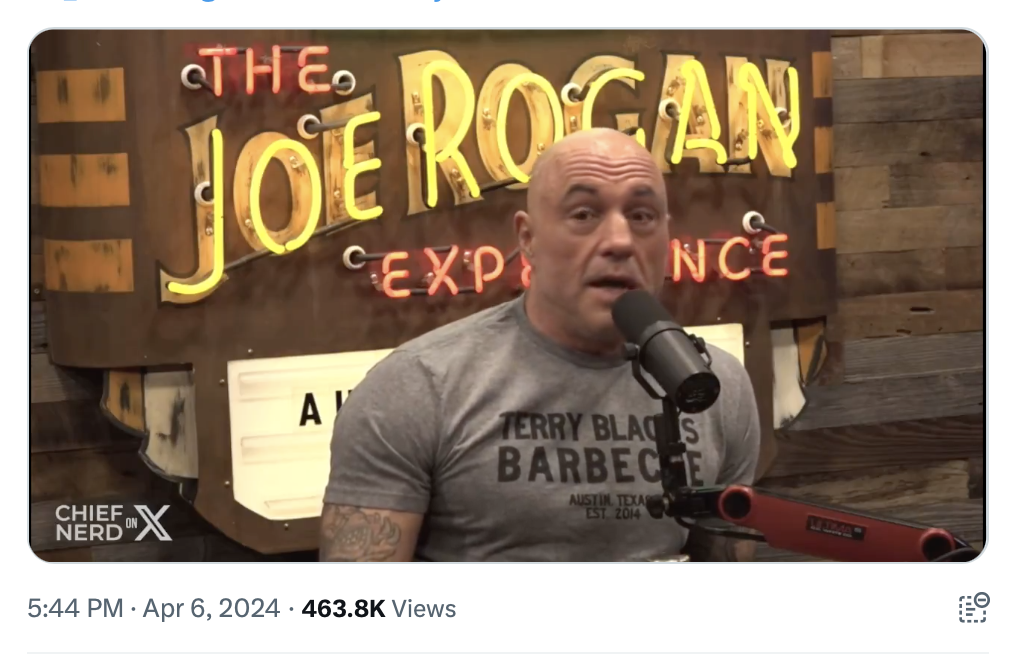
Joe Rogan and Andrew Schulz Discuss Lack of Truth Telling by “Journalists” and their Cadre of “Experts”.

Joe Rogan & Andrew Schulz on How Legacy Media 'Experts' Have Been Exposed Over the Past Few Years

“We're just assuming these people are truth tellers. They're not. We're assuming they're even journalists. They're not. Some of them are but most of them are just talking heads. Just pretty people who are good at reading...Not only that, we are sure they are highly motivated by money...And no one is listening, that's what's crazy...And the thing is, if it's not for a few brave people that stand up and tell you the truth...If there's no Peter McCullough, if there's no Robert Malone, if there's no RFK Jr, if there's no Pierre Kory, if there's none of these people that stand up and lose a sizable portion of their income, their careers get destroyed, their reputations get dragged through the mud, hit pieces get written about them, if it wasn't for these people that stand up and do that...It's wild"

https://twitter.com/TheChiefNerd/status/1776742874916286619

Continue ReadingJoe Rogan and Andrew Schulz Discuss Lack of Truth Telling by “Journalists” and their Cadre of “Experts”.

Fighting Against the Rip Tidal Pull of Digitized Conformity

Matt Taibbi, in his latest, "Maintain Your Brain," at Racket News:

I started to worry over what looked like the removal of multiple lanes from the Information Superhighway. Wikipedia rules tightened. Google search results seemed like the digital equivalent of a magician forcing cards on consumers. In my case, content would often not even reach people who’d registered as social media followers just to receive those alerts.

I was convinced the issue was political. There was clear evidence of damage to the left and right independents from companies like NewsGuard, or the ideologically-driven algorithms behind Google or Amazon ad programs, to deduce the game was rigged to give unearned market advantages to corporate players. The story I couldn’t shake involved video shooter Jon Farina, whose footage was on seemingly every cable channel after J6, but which he himself was barred from monetizing...

We’re entering a stage of history where, like the underground resistance in Bradbury’s book, we’ll have to build some consciousness as a movement to save the human mind. Because thinking for oneself has already been denounced as a forbidden or transgressive activity in so many different places (from campuses to newsrooms and beyond), it’s probably already true that membership in certain heterodox online communities is enough to put a person on lists of undesirables.

Twenty-five years ago, most of us thought it would be a great idea to digitize everything and connect it to everything else. It was a great idea. My most recent moment of demoralization: now that everything is digitized and connected, it gives too much power to anyone who can manage to control it all. To open the gates to some and close them to others. It wasn't so terrible when their were hundreds of media outlets, but that's not the case any more. Worse yet, a lot of the censoring is being don surreptitiously (e.g., shadow-banning, stealth editing and outright censoring). Increasing numbers of us are getting the sense that we are yelling into the void. I just don't know the extent of it. I don't know who is in charge. I don't know where this is leading, but if they can do this to Matt Taibbi, they can easily do it to small fish like me.

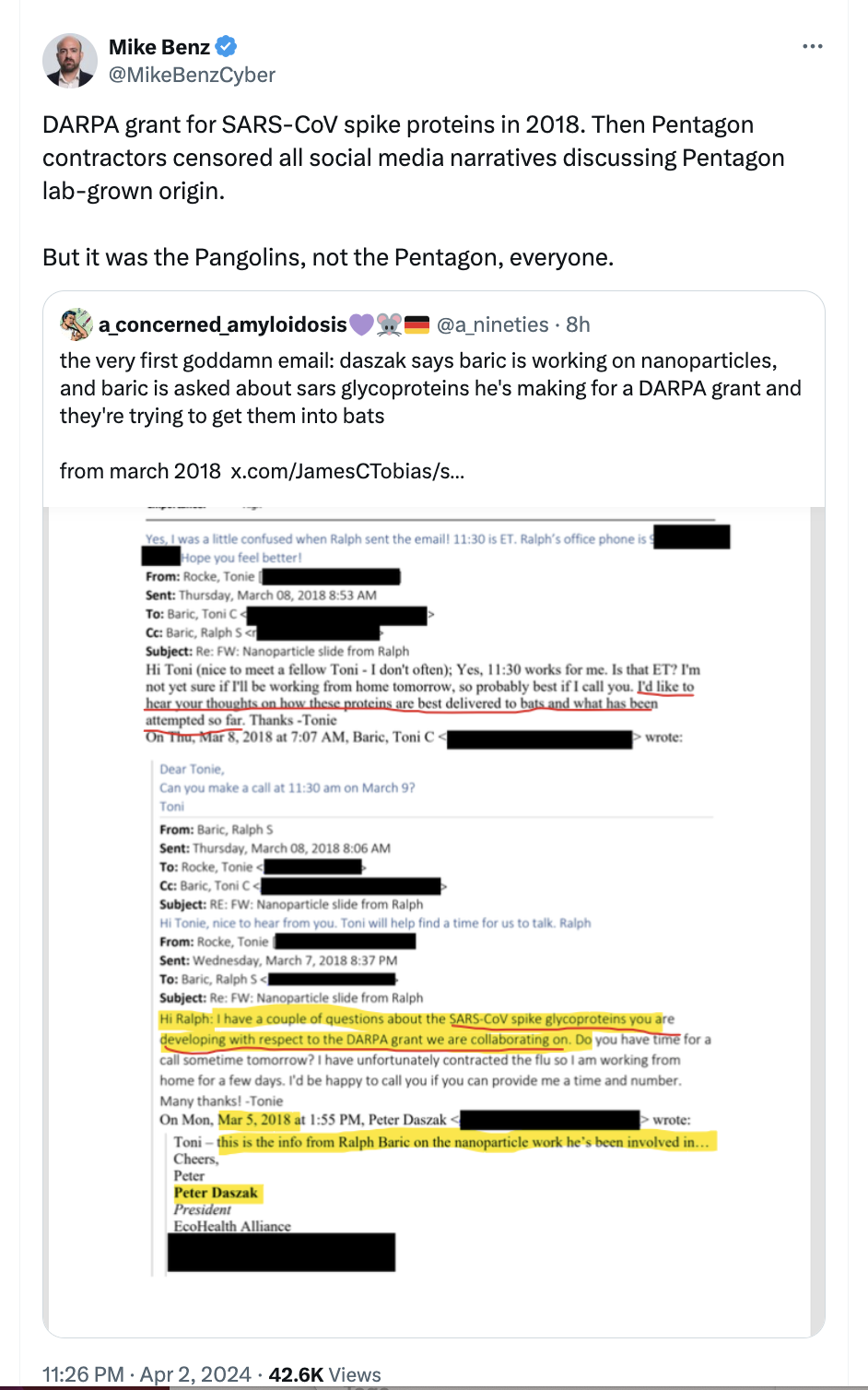
Matt urges: "We’ll eventually want to get to know each other a little more, be a little more interactive." I think that is the right approach, living and interacting significantly more locally, which will make it more difficult for power-hungry others, especially when well-intentioned (Mike Benz calls it "The Blob"; Brett Weinstein refers to this somewhat coordinated effort as "Goliath"), to intervene, to pit us against each other, to make us disappear, to generate yet another false consensus . . . .

Continue ReadingFighting Against the Rip Tidal Pull of Digitized Conformity