The U.K. Guardian Protects Us by Censoring Us
We can't afford to let people make up their own minds. Or perhaps we don't have confidence that our ideas will win the battle of ideas.
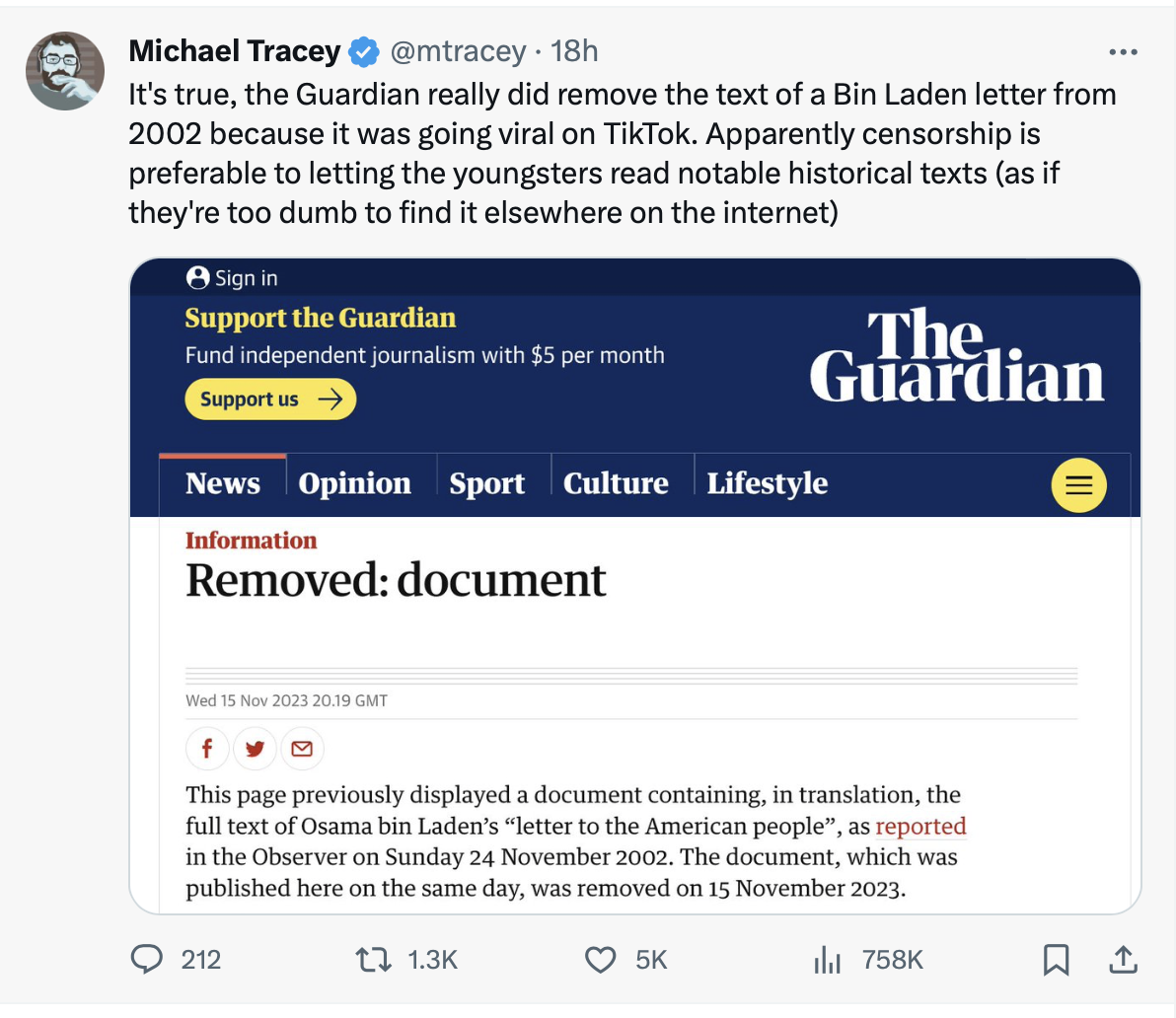

We can't afford to let people make up their own minds. Or perhaps we don't have confidence that our ideas will win the battle of ideas.
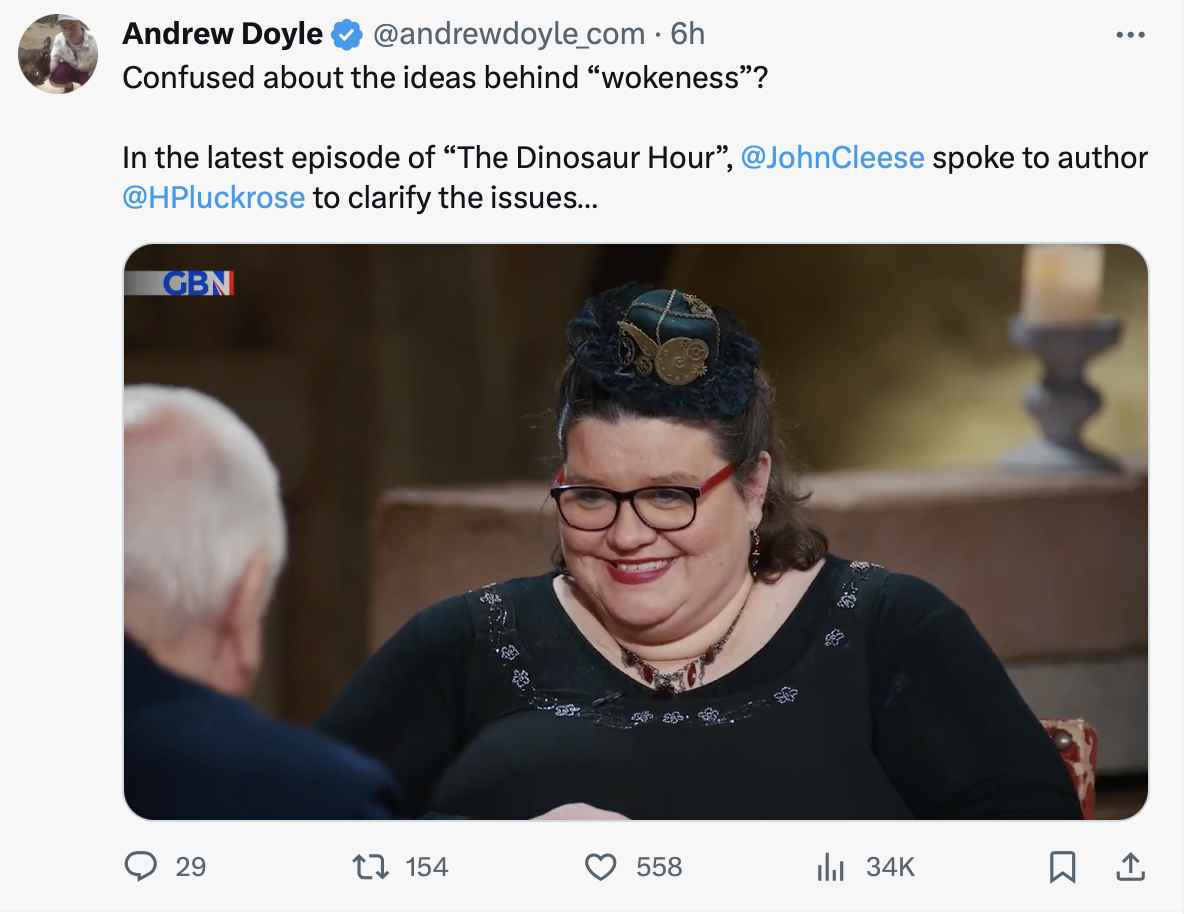
Helen Pluckrose offers an excellent wokeness primer to John Cleese:
When a school librarian removes a book from the school library, is it automatically considered to be censorship? The answer is no. See this new article by FIRE. Here's an excerpt
Like city or county public libraries, public school libraries overall enjoy significant discretion in deciding what to include on their shelves. Unlike public libraries, however, school libraries serve a specific part of the community — K-12 students. So public school libraries necessarily place greater emphasis on age appropriateness and may consider the material’s quality and how it supports the curriculum and the school’s educational goals, which are in turn subject to democratic oversight through locally elected (or appointed) school boards.As one court observed, public libraries are “designed for freewheeling inquiry.” When weeding materials, public school libraries may consider the same factors that public libraries do, such as accuracy, currentness, and physical condition. In addition, public school libraries may consider whether the materials are relevant to the curriculum, of interest to students, or age appropriate. But the government may not order books removed from school libraries out of sheer hostility to disfavored views or ideas.
Does banning books from school libraries violate the First Amendment?
When public school libraries remove books from their collections based on partisan or ideological disapproval of the book’s contents, they violate the First Amendment. The Supreme Court addressed this issue in the landmark case of Board of Education, Island Trees Union Free School District No. 26 v. Pico. A plurality of justices held that public schools have discretion to determine the content of their libraries based on factors like “educational suitability,” but “that discretion may not be exercised in a narrowly partisan or political manner.” The well-reasoned plurality opinion emphasized the importance of established and unbiased procedures for reviewing book challenges.
“We know that they are lying, they know that they are lying, they even know that we know they are lying, we also know that they know we know they are lying too, they of course know that we certainly know they know we know they are lying too as well, but they are still lying. In our country, the lie has become not just moral category, but the pillar industry of this country.” ― Aleksandr Solzhenitsyn
I'm catching up with an important court decision from September that I've been meaning to post. Here's the key quote from Missouri versus Biden, decided by the 5th Circuit Court of Appeals September 8, 2023:
[T]he Supreme Court has rarely been faced with a coordinated campaign of this magnitude orchestrated by federal officials that jeopardized a fundamental aspect of American life. Therefore, the district court was correct in its assessment—“unrelenting pressure” from certain government officials likely “had the intended result of suppressing millions of protected free speech postings by American citizens.” We see no error or abuse of discretion in that finding.Page 61 of the Opinion
This case, will be heard by the United States Supreme Court, where it has been renamed Murthy v. Missouri (Cause No. 23A243 (23-411).
Glenn Greenwald discussed the decision of the Fifth Circuit. Here's an excerpt from his video transcript at Locals:
Tonight: One of the most significant First Amendment victories in years. In July, we reported (you can read or watch it here! https://rumble.com/v2ybni6-system-update-show-110.html) on an extraordinary ruling from a federal district court in Louisiana which ruled that the Biden administration and several key components of it, including the White House, the FBI, the Department of Homeland Security and the Center for Disease Control, had engaged in a massive and grave violation of the First Amendment's guarantee of free speech by threatening and coercing Big Tech platforms to censor the speech of American citizens those government agencies and officials disliked. The district court enjoined – barred – all officials in those agencies from communicating threats or coercion of any further kind to tech platforms with the intent to have speech censored. The case is brought by several American citizens who had their speech prohibited or their accounts banned by Big Tech at the behest of their own government. Among them was Stanford School of Medicine, Doctor J. Jay Bhattacharya, who dissented from several of the most important COVID pronouncements of the health policy establishment and for that reason alone was barred by his own government from being heard on Facebook, Twitter and elsewhere.
The Biden DOJ, which has made clear that, like Democrats generally, they regard their ability to have the Internet censored as a top priority, immediately announced they would appeal this ruling. And they did. But on Friday, a three-judge appellate court composed of two Bush nominees and one Trump nominee upheld not all, but most of the ruling, including its most foundational parts. The appellate panel emphasized what a grave and unusually invasive free speech violation this was: “The Supreme Court has rarely been faced with a coordinated campaign” of censorship code “of this magnitude orchestrated by federal officials.” The result said the court was, “suppressing millions of protected free speech postings.” The ruling was based on the long-standing principle that the First Amendment free speech guarantee not only bars the state from directly censoring but also forcing or otherwise coercing private actors to censor for them.
The appellate court found that four agencies in particular were guilty of using threats to all but force social media platforms to censor at their command – the White House the FBI, the CDC and the surgeon general – and, as a result, ban them from engaging in such communications or threats going forward. We will discuss the broad and very significant implications of this decision. We'll also speak to one of the lead lawyers who represented the plaintiffs in this case: Jenin Younes.