Global Free Speech Threat
Michael Shellenberger explains that real progress is being made domestically to protect free speech, but the EU is actively working to impose its authoritarian speech controls over US social media:
Since taking office, President Donald Trump has moved swiftly to dismantle the federal censorship infrastructure. In his first week, he signed an executive order barring agencies from funding or facilitating the monitoring or removal of lawful domestic speech.
His administration has phased out censorship-related NSF grants, eliminated the State Department’s Global Engagement Center, which had coordinated with outside groups to shape online narratives, and shut down USAID, which funded censorship advocacy in Europe and Brazil.
And Trump’s 2026 budget proposes cutting $491 million from the Department of Homeland Security’s Cybersecurity and Information Security Agency, which oversaw election and Covid censorship in 2020 and 2021.
But the threat to free speech remains and has even grown stronger around the world, particularly in Europe. The UK is arresting 30 people per day for speech crimes. In Germany, 14 little-known state media agencies (SMAs) empowered by the 2020 “Media State Treaty” now monitor private journalists for compliance with vague “journalistic diligence” standards while exempting public broadcasters from the same scrutiny. French authorities want mandatory digital identification for users of social media platforms.
The European Commission appears to desire the power to ban or censor whole platforms, particularly Elon Musk’s X. And an Irish newspaper this week reported that the European Commission accused Ireland of “failing” to comply with laws regulating hate speech.
The wind remains at the back of free speech lovers. The change of government in the U.S. is already influencing Europe, where officials appear to be reconsidering some of the most aggressive censorship policies. In the UK, American negotiators have raised concerns about free speech tied to the Online Safety Act.
At the same time, in the EU, the Digital Services Act enforcement faces legal and logistical delays. France has drawn criticism for prosecuting satirical speech, and in Germany, a CBS 60 Minutes segment has fueled backlash against selective speech policing. Meanwhile, some in Brussels worry that the EU’s growing alignment with censorship risks its credibility as a champion of liberal democracy.
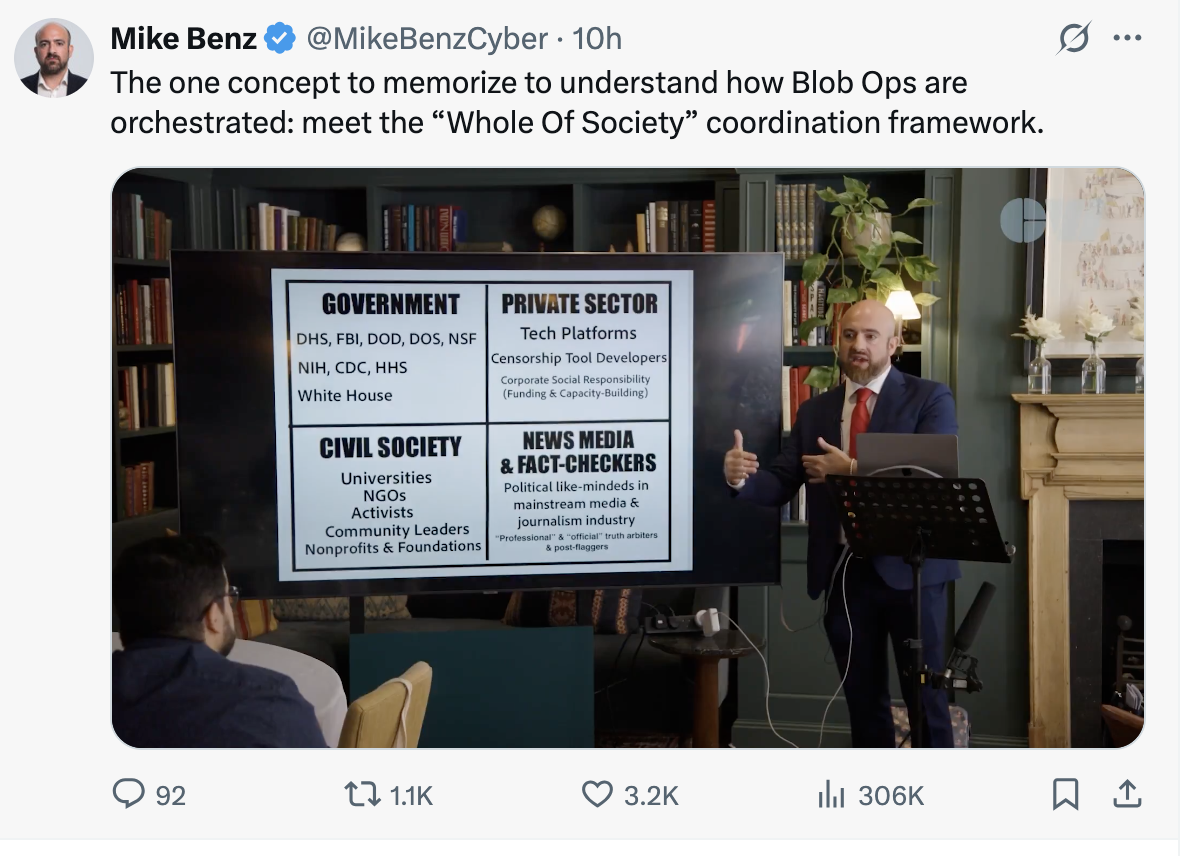
Even so, there is reason to be alarmed by what’s happening in Europe, says the Foundation for Freedom Online’s Mike Benz. “The most existential threats are now shifting around the international landscape and how that boomerangs back to the U.S.,” he said in a new podcast. American censorship leaders are working with European governments and NGOs to impose European censorship on social media platforms.
“The University of Cambridge Social Decisionmaking Lab works with the Global Engagement Center at the State Department,” he said. “It works with CISA at DHS. It works with the entire USAID network and USAID funds dozens of these funds — University of Cambridge’s censorship work, London School of Economics, King's College, Sheffield College, Oxford Internet Institute — the State Department and USAID fund all these. And they effectively are a foreign group that is paid for by taxpayers to subvert the agenda taxpayers voted for. It's an incredible scandal.”
And Europe is reacting to the Trump administration by seeking to replace the financing it cut for censorship. “Just this week,” Benz said, “the EU announced a a giant science research fund, $500 million, as an initial pool of funding and said they are actively recruiting researchers from the United States who USAID funded to come get their funds so they can continue their work by going to the EU. And this is happening in tandem with a tense standoff between the Trump administration and the EU over everything from Russia-Ukraine to tariff policy to tech regulation to you name it. And so the EU is basically pumping up the shadow diplomacy aspect of the US.”
All of this is happening at a time when the ruling parties in Germany, France, and Romania are resorting to increasingly undemocratic tactics in what appear to be desperate attempts to hold onto power as populist challengers surge in the polls. In Germany, the domestic intelligence service has officially labeled the AfD “extremist” a transparent response to the new government’s weakness and the AfD’s new status as the nation’s most popular political party. In France, prosecutors banned Marine Le Pen from running for president at a time where she too is polling first nationwide. And in Romania, the high court disqualified the leading opposition candidate from running for president, which most believe is a reaction to his opposition to a new NATO base in Romania.
“What's happening in Europe right now is simultaneously highly optimistic, white-pilling, inspiring, but also dark, twisted, sadistic, calamitous, catastrophic, and apocalyptic,” said Benz. Populist political success has caused NATO and the EU establishment to have “prosecutors and judges nullifying or barring candidates from running when they're winning, and prosecutors taking them out so they can't run again or can't make their voices heard or can't campaign because they're in prison or outright barred.”
Why is this happening? What can be done about it?