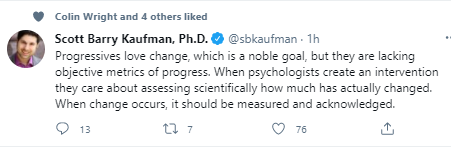
Progressives and Progressophobia

Steven Pinker coined the term Progressophobia as "hostility to the idea of progress and a fondness for narratives of decline, decadence, degeneration, and doom. As I say in the chapter, “Intellectuals hate progress. Intellectuals who call themselves progressive really hate progress." Bill Maher delivers the evidence.

Continue ReadingProgressives and Progressophobia

Twenty-Five U.S. Billionaire Tax-Evaders Face Propublica’s Sunlight

This will put me in a sour mood tonight, as I work on my taxes. The 25 richest people in the U.S. paid an effective tax rate of only 3.4% from 2014-2018. Krystal and Saager discuss this "phenomenal" reporting by Propublica (based on a "immense" secret trove of never-before-seen IRS records). They mention that the highest U.S. tax rate is officially 37%, for those making more than 628,000. My next stop will be Propublica to better understand how the super rich avoid paying taxes. Meanwhile, the median income U.S. household, often living paycheck to paycheck, pays an effective income tax rate of 14%. I assumed something like this, but these numbers are outrageous. This is stealing in broad daylight. This shouts: "Let them eat cake."

Here is a quote from Propublica that will be deflating for those who think that the Biden plan will be transformative regarding the tax burden on the wealthy:

The revelations provided by the IRS data come at a crucial moment. Wealth inequality has become one of the defining issues of our age. The president and Congress are considering the most ambitious tax increases in decades on those with high incomes. But the American tax conversation has been dominated by debate over incremental changes, such as whether the top tax rate should be 39.6% rather than 37%.

ProPublica’s data shows that while some wealthy Americans, such as hedge fund managers, would pay more taxes under the current Biden administration proposals, the vast majority of the top 25 would see little change.

Continue ReadingTwenty-Five U.S. Billionaire Tax-Evaders Face Propublica’s Sunlight

Krystal and Saagar’s “Breaking Points” Rockets to the Podcast Stratosphere

Only a week after splitting from The Hill's podcast, "Rising," Krystal and Saagar are celebrating. Their Independent Podcast, "Breaking Points," is already the #1 political podcast on Spotify and the #3 overall podcast. If you are tired of corporate-filtered news, give them a try. If you want open-ended conversation by inquisitive minds, this is a place for you. If you are distressed by newscasts that needlessly divide us from each other and put financial elites on pedestals, look no further. I'm attaching yesterday's clip of Krystal and Saagar celebrating their stunning news and explaining their mission.

Continue ReadingKrystal and Saagar’s “Breaking Points” Rockets to the Podcast Stratosphere

Lenore Skenazy Discusses Fearful Childhoods

For a child, is the world mostly a big playroom or mostly something to fear? Writer (and parent) Lenore Skenazy tells us how dramatically things have changed:

Kids are being treated like babies for even longer stretches. When Jonathan Haidt, co-author of The Coddling of the American Mind, gives lectures, he often asks audience members born before 1982 to shout out what age they were first allowed to leave the house on their own. Many in the crowd answer eight, seven, or even six. (Personally, I shout "Five!")

Then, skipping the mishmash of Generation X, he asks everyone born after 1995 to answer the same question, and most of the millennials respond in the 10-13 age range. "The effect is always huge," says Haidt, a co-founder with me of Let Grow, the nonprofit dedicated to making childhood independence easy, normal, and legal.

Continue ReadingLenore Skenazy Discusses Fearful Childhoods

Whether to Hire Ivy League Graduates

This article relies on some generalizations, so we need to be careful.  Chemistry majors are probably much different than graduates in the social sciences. And every student should be judges on his or her own merits, not on the Zeitgeist of their school.

That said, I'm now wondering whether corporations are changing their views on the plusses and minuses of hiring ivy league graduates.  Here's an excerpt from R.R.Reno's article: "Why I Stopped Hiring Ivy League Graduates." The author is concerned that ivy league graduates have been "socialized to panic over pseudocrises." Here's an excerpt:

Haverford is a progressive hothouse. If students can be traumatized by “insensitivity” on that leafy campus, then they’re unlikely to function as effective team members in an organization that has to deal with everyday realities. And in any event, I don’t want to hire someone who makes inflammatory accusations at the drop of a hat.

Student activists don’t represent the majority of students. But I find myself wondering about the silent acquiescence of most students. They allow themselves to be cowed by charges of racism and other sins. I sympathize. The atmosphere of intimidation in elite higher education is intense. But I don’t want to hire a person well-practiced in remaining silent when it costs something to speak up.

Continue ReadingWhether to Hire Ivy League Graduates