
Batya Ungar-Sargon: The Political Left Intentionally Cultivate Real Life Violence

Batya Ungar-Sargon makes a strong case that the violent killing of Charlie Kirk is not a "both sides" issue:
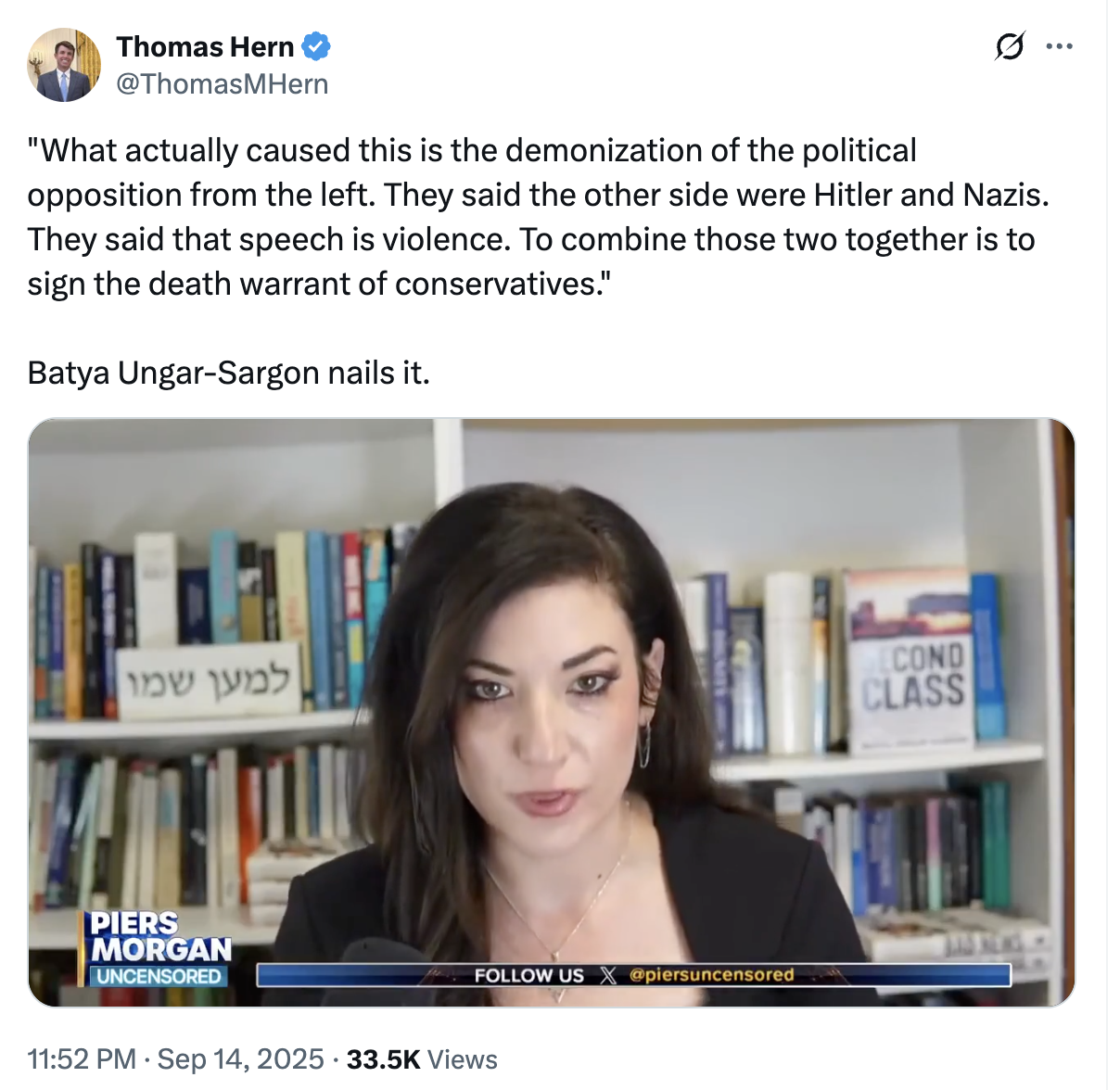
I'm finding myself very caught between, on the one hand, wanting to honor his legacy of unity through debate and coming together to take down the temperature, and then wanting to honor his legacy of telling the truth. And the truth is this is not a both sides issue. The killer killed him, according to police reports, because he found Charlie Kirk to be spreading hate. This is a view shared by every single prominent Democrat.

Yes, there are people on blue sky advocating for violence, but what actually caused this was the utterly quotidian, utterly ubiquitous demonization of the political opposition from the left, and it has just led to violence because they said the other side were Hitler and Nazis. They said that speech is violence. To combine those two things together is to sign the death warrant of prominent conservatives, and that is what we are seeing again and again and again.

And it is utterly facetious to suggest that there is any comparison between political violence on both sides. Every example they bring is not actually showing that, whether it's Governor Shapiro whose attempted assassination was from a free, Palestine leftist, or whether it was the Minnesota assassinations, which were from somebody who said he was operating at the behest of Democrat Governor Tim Walz. There is a culture among Democrats at the highest level to suggest that their political opposition are a danger, and that suggests that their lives are forfeit.

And I want to come together. I do. I love what Shanks said. It brought tears to my eyes. I reached for a tissue while you were playing Charlie's words. But at the same time, we cannot unite with people who are lying to our faces about who we are, who will not take responsibility for the fact that they suggested that we are Nazis because of totally legitimate views that reflect the majority of Americans.

So what I say is, let the left say we were wrong. It is legitimate to vote for Donald Trump. It is legitimate to be pro life. It is legitimate to believe that there are only two genders, and we were wrong to suggest that that was not the case. We were wrong to say that that is hateful. When they say that, I am waiting with open arms to take down the temperature.
Continue ReadingBatya Ungar-Sargon: The Political Left Intentionally Cultivate Real Life Violence

Our Class Problem. The Populism Problem of the Super-Rich

Ed Dowd, former BlackRock fund manager.

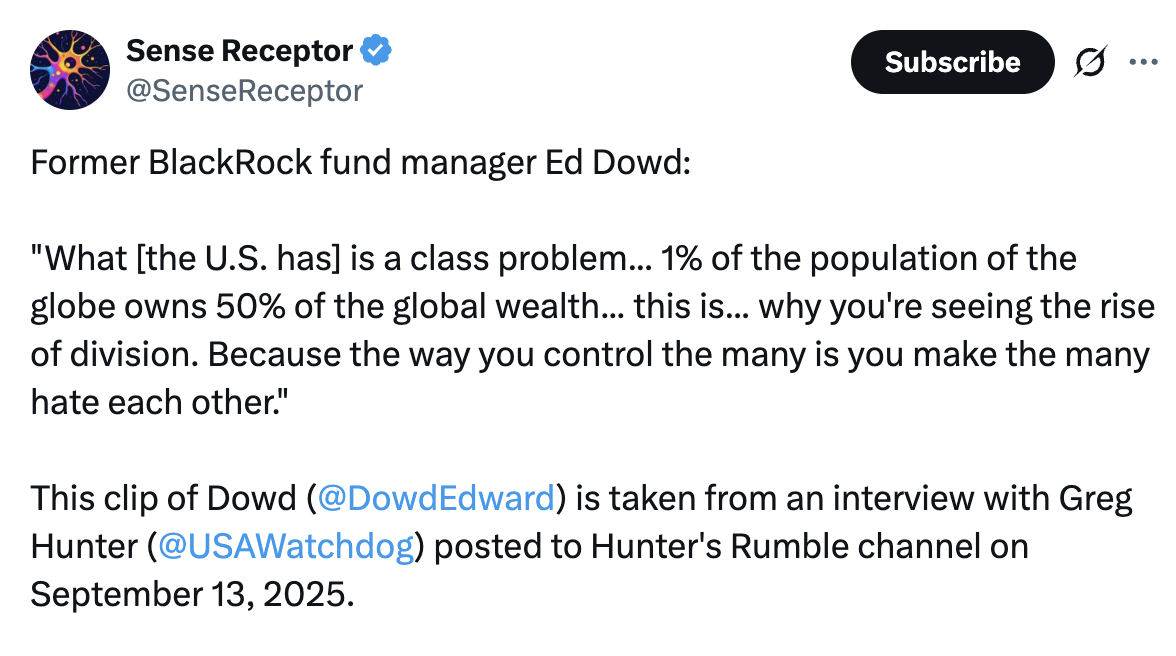
"What [the U.S. has] is a class problem... 1% of the population of the globe owns 50% of the global wealth... this is... why you're seeing the rise of division. Because the way you control the many is you make the many hate each other."

"What we have in this country is a class problem. We have, you know, 1% of global wealth is the 1% of the population of the globe owns 50% of the global wealth. So this is a class issue. It's been going on for a long time, since the great financial crisis and since 2000. And we have, And this is not just a US Problem. This is a global problem.

"And when we get to these types of situations they're cured one of two ways. The elites pay an existential price and or the system collapses and they're forced to share the wealth again. So this is how it's done.

"I'm not suggesting it's imminent, but this is why you're seeing the rise of populism, and this is also why you're seeing the rise of division. Because, the way you control the many is you make the many hate each other. You make the pitchfork guy look at the torch guy and say, hey, the torch guys are trying to take our pitchforks. And that's what's going on today. We got all this finger pointing. This is a class issue. It's not a black, white, Hispanic, left, right, Muslim. This is a class issue."

Continue ReadingOur Class Problem. The Populism Problem of the Super-Rich

The Words that Cultivate Free Speech

Samual Abrams:

“It’s a free country” signals that disagreement is permissible. “Everyone’s entitled to their own opinion” acknowledges dignity in dissent. “Sticks and stones” reminds us to meet speech with speech, not violence or censorship. Without such reminders, the civic muscle memory that protects a free society begins to atrophy. That last idiom in the table — “Address the argument, not the person” — may be the most telling of all. Only 30% of Americans even recognize it, and barely 1 in 10 say it often.

This absence shows up everywhere: in the pile-ons of cancel culture, the readiness to attack a person’s character rather than engage their reasoning and in why viewpoint diversity is so hard to come by on many college campuses. If you never learn the habit of separating people from their ideas, disagreement becomes personal and dissenters become enemies to be silenced.

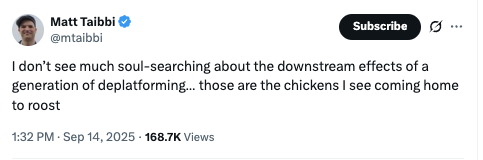
And in their place? New slogans, often adversarial and absolutist. We hear “words are violence” or “speech is harm” far more than “defend to the death your right to say it.” The FIRE/NORC survey found that a quarter of Americans now say the “words are violence” framing describes their own view “mostly” or “completely.”

Samuel J. Abrams is professor of politics at Sarah Lawrence College and a senior fellow at the American Enterprise Institute.

Continue ReadingThe Words that Cultivate Free Speech

Aaron Siri Introduces his New Book, Vaccines, Amen.

New post on X by Aaron Siri:

An excerpt from the intro to Vaccines, Amen:

Ever hear someone say, “I believe in cars” or “I believe in tools”? I cannot recall ever hearing anyone say they believe in a certain product. But I hear people say, “I believe in vaccines” all the time, especially in response to evidence regarding vaccines.

The expression “I believe in vaccines” carries a truism. The properties often attributed to vaccines require faith. Belief. This is because most claims about vaccines are not grounded in evidence. They are beliefs. It is why challenging claims about vaccines—meaning challenging beliefs—often results in an emotional, not logical, reaction.

This is also why wading into this topic is not for the faint of heart. Nor is it for anyone seeking to avoid controversy. Just the word “vaccines” evokes emotions for many.

Falling Into Vaccine Law

For this reason, among many others, I likely would have laughed if someone had told me eighteen years ago that I would be managing a law firm, with over 100 professionals, working on vaccine injury, exemptions, and policy. Back then, I was working on high-stakes, multi-billion-dollar lawsuits at one of the country’s premier law firms. Even after starting my own law firm over a decade ago, I continued to handle mostly high-stakes business litigation matters.

Then, one fateful day, I learned something I could not unlearn: of all the corporations I was defending, I would likely never have to defend a pharmaceutical company against claims that children were seriously injured or killed by a vaccine. Why? Because in 1986, Congress granted these companies financial immunity for injuries caused by childhood vaccines in a law titled the National Childhood Vaccine Injury Act (the 1986 Act).

I learned that, because of the 1986 Act, parents of seriously injured or deceased children must sue the federal government’s health department, instead of the company that profited from the product that harmed their children. From that one data point, my journey regarding vaccines began. What I have uncovered along the way has frequently been unbelievable.

This journey, spanning over a decade of litigating vaccine lawsuits of all stripes across the country, has been unique. This is partly because, unlike doctors, who can appeal to their credentials, I do not get to just say, “trust me.” I need to prove claims I assert with real data. Real proof. Something that will hold up in court. Non-authoritative science will not do. Unreliable data will not do. This means my vaccine litigation work requires me to study the primary sources and carefully review and scrutinize the studies and data that support each claim. v In the course of that legal work, I have worked with well over a hundred immunologists, infectious disease doctors, pediatricians, and other medical professionals. I have deposed these specialists as well, including the world’s leading vaccinologists. This work requires an understanding of vaccinology, immunology, infectious disease, and pediatrics, among other disciplines, with regard to these products. Want to talk about any other drug, medical procedure, etc.? I am not your man. But vaccines, those I know.

Incredibly, most of the information needed to understand vaccine safety is freely available on federal government websites and public databases. Most doctors and parents never bother to look or don’t know it exists. Those who do know and look often learn things they cannot unlearn.

Continue ReadingAaron Siri Introduces his New Book, Vaccines, Amen.