Miscellaneous

It's been a wonderful weekend. No theme to it. Just a steady stream of good experiences. The technological surprise was the Picasa's new face-matching feature. This will blow your mind, it is so good. The newest release of Picasa (I've extolled the virtues of Picasa before) produces thumbnails of most every face in your photo collection. For me, this meant that Picasa came up with more than 6,000 faces. They needn't be portraits, either. Picasa will find most any face in your collection, even group shots, and give you one or more cropped portraits from that photo. Then comes more magic. You give Picasa a name for one of those instant portraits and Picasa will go gather all the other photos you have of that person in your collection. evv-faces I labeled a few photos each of my daughters JuJu and Charlotte, and Picasa went to work, gathering almost 2,000 photos of each, getting it 99% correct. Quite often Picasa will place a "?" on the photos it gathers, meaning it is not certain it is the same person, but it was almost always correct. It picked out photos of JuJu from age 2 to 11. It picked her out even if she was standing in the shade, even if she had a unusual haircut or a hat, even if her eyes were closed, and even if her head was turned or she was looking down. The face-matching feature even did well in distinguishing between two 11-year old identical twins, who I sometimes struggle to keep straight. I'm using Picasa version 3.6.0 for Windows (a free program, BTW). It seems like magic. Maybe it's one of those military technologies trickling down. Whatever it is, I'm in awe. If you have a big collection and you don't want to take the time to label photos of your friends or family, this is something you should consider. What else happened this weekend? Here's something. There's a new exhibit on Race at the Missouri History Museum: Race: Are We So Different? The answer, of course, is no. [more . . . ]
Continue ReadingMiscellaneous

Simon Johnson finds tax-the-banks solution laughable

Barack Obama recently announced that the way to prevent future economic collapses is to put a new tax the big banks. For me, this was just one more in a long line of dreadful responses out of the White House. Who does he think is going to ultimately pay that tax? Further, how could a tax possibly keep big Wall Street banks from taking reckless gambles, and how is it that having a pool of tax money would mean that Washington DC wouldn't again jump in to "save the banks" with huge doses of tax dollars during the next cataclysmic crash? As long as there are banks that are "too big to fail," the federal government will jump in a most co-dependent of ways. I just read an FT.com article by economist Simon Johnson, who reassured me that my instincts were on target.

This week, the US Treasury pulled its latest rabbit out of the hat: a tax on the liabilities of large banks. The Obama administration argues that, by penalising large institutions with such taxes, we can limit their future risk-taking. This logic is deeply flawed. Why would higher funding costs mean you gamble less? If you know Tim Geithner is waiting to bail you out, you may gamble more heavily in order to pay the tax. The UK “reforms” look equally unpromising.
Johnson also spells out what IS needed:
First, we must sharply raise capital requirements at leveraged institutions, so shareholders rather than regulators play the leading role in making sure their money is used sensibly. This means tripling capital requirements so banks hold at least 20-25 per cent of assets in core capital. Second, we need to end the political need to bail out every institution that fails. This can be helped by putting strict limits on the size of institutions, and forcing our largest banks, including the likes of Goldman Sachs and Barclays, to become much smaller.
For reasons I truly don't understand, Obama is refusing to stand up and use his magnificent eloquence to make a case for meaningful financial reform. This has been a slow-motion train wreck for the past year, and he's about to allow the chance to create a CFPA slip away. He needs to join Elizabeth Warren in an almost constant assault on these highly monied amoral corporations (and their enablers in Congress) that it's time for real reform. As Warren (who IS out there fighting a good fight) says, "The problem is that a strong CFPA directly threatens the banks' ability to sell confusing, deceptive, fee-heavy financial products that generate huge profits, Warren said."

Continue ReadingSimon Johnson finds tax-the-banks solution laughable

Niece in Africa

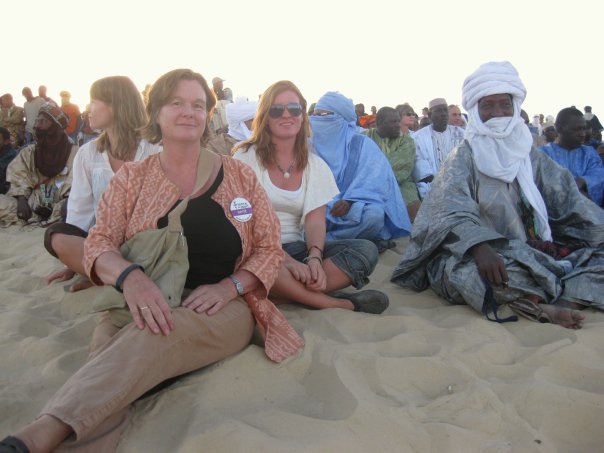
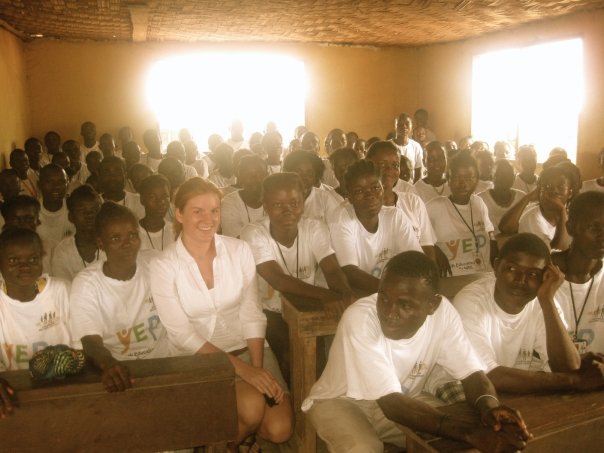
I have a charming niece named Katja Boye. She and her family are currently traveling, working and studying in various parts of West Africa. Katja recently sent my family some of her digital images; I really enjoyed the many scenes and textures and colors of Africa. I also enjoyed the contrast of seeing images of my very light-skinned relatives (they are Norwegian, with their permanent home in Norway) mingling with the many dark-skinned Africans. katja-in-class I asked Katja if she would grant me permission to share some of her photos on this website and she gave the go-ahead. I don't actually know these specific locations within West Africa yet - - perhaps Katja will write a comment and provide some further information. Katja (she stands out in the photo to the right) is the daughter of Alida Jay Boye (my wife's sister), who you can see at the left side of the sand dune photo below. Alida is the co-author of a beautifully written and photographed book describing the people and the ancient manuscripts of Timbuktu, located in the African country of Mali. Yes, Timbuktu is a real place, it is surrounded by sand dunes, and here is an aerial shot of of the city. The title Alida's book is The Hidden Treasures of Timbuktu: Rediscovering Africa's Literary Culture. For many years, Alida has been "commuting" from Norway to Mali work on these manuscripts under the auspices of the United Nations. Here's more information about Alida's work. alida-and-familyI don't claim to be able to read any of these manuscripts, but I do enjoy their physical beauty, which you can see here. Those who can read the manuscripts recognize them to be a vast literary treasure created by Africans and collected by various people and institutions in Timbuktu, which for centuries served as a commercial crossroads in Africa. For more on Timbuktu and its famous manuscripts, consider this informative video. Katja's father Thorvaldt (who works in a diplomatic capacity for the Norwegian government regarding several west African countries) and her sister Ebba (a student) have also spent considerable time working and studying in various parts of Africa. As you can see, the members of this family are quite comfortable traveling far from their cold homeland of Norway to warm Africa. Click on the title to this post for the permalink version, which will allow you to see all 18 images. Katja - thanks for letting me share these photos!

Continue ReadingNiece in Africa

Few privacy concerns regarding photographs of the Haitian dead

The United States has fiercely resisted allowing photographs of dead U.S. soldiers, allegedly because of "privacy concerns" regarding the families of the deceased. In February, 2009, the military finally lifted an 18-year old ban on taking photos of only the coffins of deceased U.S. soldiers. In October, 2009, The U.S. military banned photos of troops killed in action in Afghanistan. Amy Goodman has argued (correctly, in my opinion), that the Middle Eastern wars currently being fought by the U.S. would quickly be ended if only the public were allowed to see the devastating effects of these wars on U.S. troops and on the civilian populations. How believable is the excuse given by the U.S. and by many members of the U.S. media for severely limiting photos of our dead soldiers? Is it really out of respect for the grieving families? Are "privacy" concerns the real the reason the media acquiesces in this policy of showing only a highly sterilized version of the ongoing wars in Iraq and Afghanistan? I don't believe so. Why are the U.S. media so willing to freely discuss the horror of the Haitian deaths and to show graphic photos of Haitian people who have been severely injured or killed in the Haitian Earthquakes? And see here and here and here. There doesn't seem to be much concern about the "privacy" of the Haitian victims and their families. It seems that the decision to show (or not show) photos of injured and dead people has much more to do with politics than with privacy.

Continue ReadingFew privacy concerns regarding photographs of the Haitian dead

The craving for beer as the cause of civilization

According to archaeologist Patrick McGovern, the craving for beer might have caused people to decide to start farming. Humans turned from hunting and gathering to agriculture because of "our ancestors’ simple urge for alcoholic beverages." He points to evidence that humans were making beer as far back as 9,000 years ago.

Continue ReadingThe craving for beer as the cause of civilization