
More Lessons from National Geographic

I do love National Geographic. If you don't read it each month, you should! The January 2010 edition of National Geographic is loaded with articles that will transport you all over the world. You can learn about a sublime Scottish island, you can learn of the bionic limbs in cochlear implants, and you can learn how the clown fish is imperiled in the wake of the movie "Nemo." I'd like to report on two other articles today. The first one is about the island nation of Singapore, which achieved independence from the British in 1963. How did Singapore become modern-day Singapore, where the per capita income for its 3.7 million citizens is better than that of many Western countries? it's an exceedingly clean city where 90% of households own their own home. Its unemployment rate is only 3%. All of this was the plan long ago. Lee Kuan Yew, who has been officially or unofficially in charge of the country for more than 40 years. He was educated in London, and then came back home to make English the official language of Singapore--he also had a business plan and it paid off well. He is a hardliner in many ways, including cracking down on governmental corruption "until it disappeared." Now that sounds like a good idea. Consider, also, that anyone dropping even a cigarette butt or a candy wrapper in Singapore can be fined $200. If you are caught a second time, you will be sentenced to walk around picking up other people's trash. Now there's another good idea. Why do we tolerate people who dump their trash in public areas in America? Tthe Government of Singapore works very hard to make sure that its own citizens live outstanding moral lives. There is a new casino going up in Singapore, and the casino will roll out the red rug for foreign visitors (so that Singapore will make money off of them), but the casino charges a $70 fee to people from Singapore to discourage them from gambling. The National Geographic indicates that Singapore's population control program is "overly successful." Despite bonuses being offered by the government for having babies, the Singapore birth rate is at less than replacement value. It seems that they are too busy working. "Singapore's have less intercourse than almost any other country on earth" An influx of immigrants keep the population from shrinking, allowing the plant to continue: "giddy financial growth fueling never ending construction and consumerism." -- A separate article called "restless spirits" explores the beliefs many Chinese people have with regard to an afterlife. There is a lot of good information here. I found it interesting that among the valuables (such as a bottle of alcohol or a pack of cigarettes) some Chinese people have included "paper grave money for use in the afterlife, the bills bearing a watermark that said,'The Bank of Heaven Co., Ltd..'" I also learned that many Chinese believe that their their ancestors took on bureaucratic duties. They keep the dead busy in Chinese heaven! Back in the Shang dynasty (more than 1000 years ago), the Chinese sacrificed human victims to placate the ancestors. More than 1,200 sacrificial pits have been found, most of these containing human remains. Some of the inscriptions found in the graves indicate that the Chinese were asking their dead ancestors to make offerings of their own to even higher order powers. This article is full of interesting insights about Chinese police regarding the afterlife. I placed the NG links for the above articles. Beware, though, that the online versions of the articles are abridged versions of the print versions.
Continue ReadingMore Lessons from National Geographic

Judicial Temperment

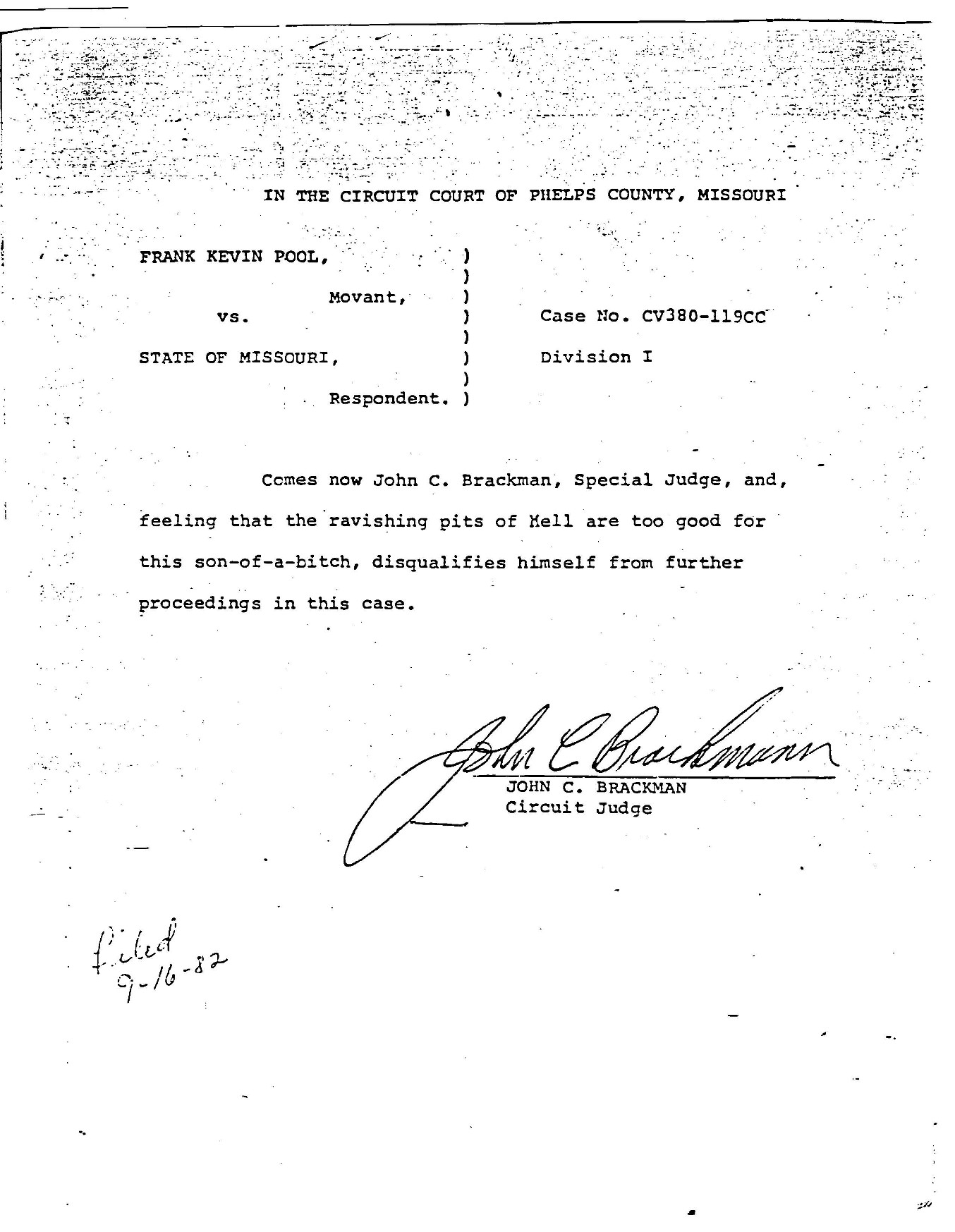
Judges are supposed to stay above the emotional fray. They are supposed to apply the law even-handedly. The attached court Order (which I recently found in some of my old paperwork) is a strikingly honest admission by one judge that he would have been unable to maintain judicial composure in a particular case.  It's an Order recusing himself from the case of a man that had been accused and convicted of murdering a police officer as that officer slept. This is not a case I handled, but it was a case of which I was aware.  I once met this judge (back in the 1980's), and he was a generally pleasant man. A clerk from the Phelps County, Missouri Court verified for me that this case was actually handled in that Court. I'm posting this Order signed by Judge John Brackman of Franklin County, Missouri, because I find it to be a stark reminder that most judges maintain their composure, despite what they might be feeling inside.  This Order is one of those glimpses inside one judge's psyche, reminding us that judges are capable feeling strong emotions, which reminds me of this earlier post on emotions and decision-making. brackman-order-1

Continue ReadingJudicial Temperment

Right to Link

We all know how nearly fastidious Erich has been about making sure that we don't violate any copyrights with the images we use on this blog. One way we manage this is by linking to content that we cannot properly copy or post. But now the issue of whether one can violate a copyright merely by linking to another web site is making legal rounds. I found out about the Right to Link movement via my WebProNews subscription. There is more information at www.right2link.org. What's stirring this up is Rupert Murdock blocking access to his content coming from certain legitimate url's. Here's a link to the story.

Continue ReadingRight to Link

Hope 2.0

In light of recent political events, including the fact that "we stand on the verge of passing a giant boon to health insurance companies and calling it 'reform,'" Arianna Huffington is advocating for an empathy-driven system shattering Hope 2.0, inspired by the civil rights movement of the 1960's:

One year ago, Hope was about crossing our fingers and electing leaders that we thought would enact real change. Hope 2.0 is about using the lessons of Dr. King to create the conditions that give them no other choice.

Continue ReadingHope 2.0

Google, China, and hypocrisy

You've probably heard the stories in the news. A superpower has been shamed, a totalitarian state has been outed. A tyrannical government has been spying on the private communications of its citizens, including that of activists and journalists. What they plan to do with the fruits of their techno-espionage is not well understood, but given their history they can hardly be up to any good. What is clear is that this government is fanatical about crushing any challenge to their perceived supremacy, whether those challenges are internal or external. They even demand that private companies aid them in censoring unfavorable news (with a stunning degree of success), and these private companies (mostly based in the United States) may even have helped them spy on their citizenry. You could be forgiven for thinking that this was just another blog posting about Google and China. It's actually a post about hypocrisy. First, if you haven't heard, Google is re-evaluating their decision to do business in China, ostensibly as a result of some cyber-attacks directed at the Gmail accounts of some human-rights activists. The U.S. State Department is planning to lodge a formal protest on the alleged attacks. Plenty of others have already analyzed this story. As usual, the real story is behind the headlines. The San Francisco Chronicle reported last week:

The Google-China flap has already reignited the debate over global censorship, reinvigorating human rights groups drawing attention to abuses in the country and prompting U.S. politicians to take a hard look at trade relations. The Obama administration issued statements of support for Google, and members of Congress are pushing to revive a bill banning U.S. tech companies from working with governments that digitally spy on their citizens.
To prevent United States businesses from cooperating with repressive governments in transforming the Internet into a tool of censorship and surveillance, to fulfill the responsibility of the United States Government to promote freedom of expression on the Internet, to restore public confidence in the integrity of United States businesses...
So far, so good. Restoring public confidence in the integrity of U.S. businesses might be a tall order for any bill, but whatever. The rest are all noble goals: preventing repressive governments from using the internet as a tool of censorship and surveillance, promoting freedom of expression, and so on. Just one problem: none of these provisions apply to the U.S. Government. You see, the U.S. Government is the tyrannical superpower from the first paragraph of this blog post. You might have asked yourself why it is that the Chinese people put up with having their private communications read by their government. The real question is this: Why do you put up with it? [More . . . ]

Continue ReadingGoogle, China, and hypocrisy