Ignorant Educators Disparaging IQ Facts

No, I don't like that some people are innately more intelligent than others. It doesn't seem fair. If I were the creator of the universe, I would have given everyone the same tools for learning and achieving. That said, I often read and hear people disparage IQ as a measurement. Without any basis, they claim that it is a poor measure of intelligence when IQ is actually one of the most valid and reliable measurements in all of psychology. Next time I hear that it is a poor measure, I'll ask the person: "Assume that you are about to start a new for-profit company in a competitive industry. You need to hire 100 employees. You can either hire 100 people with IQs of 90 or 100 people with IQs of 130. Now choose."

BTW, I don't know my own IQ. Therefore, I'm not writing this article from any sort of perch. And I guarantee that whatever my IQ might be, there are many people out there with significantly higher IQs than me.

I don't know what drives this belief among teachers, but it does seem to be another instance of social contagion, much like "phonics is bad" and "gender affirming care for children is good and necessary." Just because it's taught in school by well-meaning teachers doesn't mean that it's true.  There is also a vast literature disparaging IQ as an illegitimate measure. My first encounter with a strong attack on IQ was Stephen J. Gould's The Mismeasure of Man. 

What's the truth about IQ? Steve Stewart-Williams Recently commented on Education's Elephant in the Room, by Russell T. Warne (at Quillette), offering these excerpts:

The differences among students’ educational achievement start early and increase as children grow. By 5th grade, the average American classroom has children whose achievement in mathematics and reading ranges from the 2nd grade level to the 8th grade level or higher. It is simply impossible for a single teacher to prepare lessons in every subject that allow every student to learn new information. Some sort of ability grouping, in which students at similar levels of achievement are taught together, is necessary...

What causes these individual differences in intelligence and achievement that educators are so determined to deny, downplay, or ignore? …

This is where educators get really nervous, because the major cause of individual differences in intelligence seems to be genetics. The heritability of IQ varies, but in wealthy, industrialised countries, it approaches .80 in adults, which indicates that eighty percent of individual differences in IQ are associated with individual genetic differences. In young children, heritability of IQ is lower, but it hits .50 at about age ten and continues to increase into adulthood before levelling off…

In a British survey, only 29 percent of teachers thought that genes were one of the top three factors affecting student achievement. In other words, the scientific research shows that genes are usually more important than every environmental cause combined, and yet most teachers don’t even believe that genes rank in the top three causes of educational achievement…

I subscribe to the website of Steve Stewart-Williams, The Nature-Nurture Nietzsche Newsletter. He offers lots of rigorous research along with citations and his own insightful commentary. I highly recommend his work, including his article, "12 Things Everyone Should Know About IQ: here's a lot of IQ misinformation out there." '' He comments:

But like many ideas in psychology, IQ is the subject of a lot of misunderstandings and misinformation. Some believe that IQ tests are basically meaningless - that they don’t measure intelligence in any real sense or tell us anything about IQ-test takers except how good they are at taking IQ tests. Others go further, arguing that IQ research is malign pseudoscience aimed only at justifying discrimination.

None of these claims is true! Psychologists studying IQ have learned a great deal about this form of intelligence over the last century, and have an excellent track record of replicating their results. They know how to measure IQ; they know how nature and nurture help shape IQ; and they know how IQ helps shape people’s lives.

In this post, I’ll outline twelve key findings from IQ research that everyone ought to know. Whether you’re a fan of IQ or a skeptic, I hope you’ll find something here to surprise and challenge you!

His first topic (of the 12) dovetails with Warne's article:

1. IQ is one of the most heritable psychological traits – that is, individual differences in IQ are strongly associated with individual differences in genes (at least in fairly typical modern environments). IQ is nearly as heritable as physical traits like height. And the only other psychological traits with similar heritability levels are psychiatric conditions like autism and schizophrenia.

Below I am setting out the other eleven topics, but I recommend the article in its entirety:

2. The heritability of IQ increases from childhood to adulthood.

3. IQ scores have been increasing steadily for the last century or so, a phenomenon known as the Flynn effect.

4. IQ predicts many important real-world outcomes

5. Higher IQ is associated with a lower risk of death from most causes

6. Higher IQ is associated with lower rates of most forms of mental illness.

7. More generally, IQ tests are among the most reliable, predictive measures in psychology – one of the field’s crowning achievements.

8. Despite its excellent psychometric properties, many people are allergic to the concept of IQ. Ironically, this includes many intellectuals.

9. Perhaps as a result of the academic allergy to IQ, there’s some evidence that researchers are less likely to publish studies showing a link between IQ and students’ grades: the reverse of the usual publication bias for positive findings.

10. The antipathy to IQ is unfortunate.

11. IQ tests have other potential benefits.

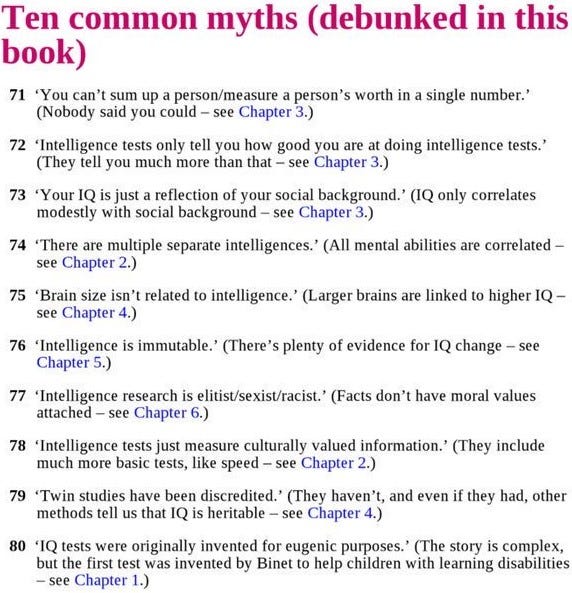
12. Last but not least, here’s a list of ten common myths about IQ, from Stuart Ritchie’s book Intelligence: All That Matters.
Continue ReadingIgnorant Educators Disparaging IQ Facts

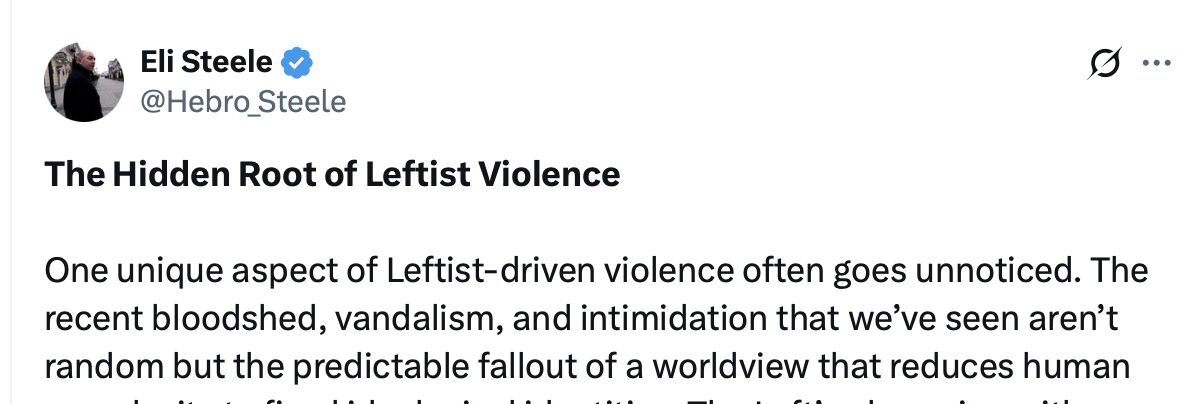
Eli Steele Identifies the Hidden Root of Leftist Violence

I'm concerned that Eli Steele has correctly pointed out a problem that has no obvious solution. Certainly no quick fix:

One unique aspect of Leftist-driven violence often goes unnoticed. The recent bloodshed, vandalism, and intimidation that we’ve seen aren’t random but the predictable fallout of a worldview that reduces human complexity to fixed ideological identities. The Left’s obsession with immutable traits -- race, gender, sex -- creates a victimhood hierarchy where dissent feels like an existential threat. When challenged, responses spiral into denial, defensiveness, or even violence from those unable to defend their dogma. This isn’t mere political disagreement, but the grim consequence of a belief system that rejects the Enlightenment’s focus on reason and individuality for rigid orthodoxy.

Recent events expose this pattern. The assassination of Charlie Kirk by Tyler Robinson, radicalized through Leftist politics and his transgender partner’s identity struggles, shows how loyalty to identity can turn lethal when faced with opposing views. School shootings like Audrey Hale’s 2023 Nashville attack and Robin Westman’s 2025 Minneapolis shooting reveal how issues with or challenges to gender identity can ignite rage. Elias Rodriguez’s 2025 murder of two Israeli Embassy employees, accompanied by cries of “shame on Zio-Nazi terror,” reflects a worldview -- shared by many pro-Hamas supporters -- that reduces Jews, Israeli or not, to whites and oppressors. The decade-long wave of Black Lives Matter protests, grounded in claims of systemic racial oppression, fueled riots that caused billions in damages, claimed lives, and pressured countless American institutions into adopting reductive racial identity politics as dogma.

Beyond violence, this ideology breeds intimidation, silencing dissent with threats of job loss or social ostracism. Rooted in identity determinism, this intellectual dead-end leaves no room for nuance or growth, increasing the potential for violence among those trapped in its logic -- a logic now taught to young minds through ethnic studies in K-12 schools.

If we cannot force the Left to retreat from its fixation on identity politics through the ballot box and all legal means, this ideology will only sow ever-increasing division and violence. This challenge is daunting because it demands stripping people of their very identities grounded in immutable characteristics and showing them their worth lies elsewhere -- their character. They will fight with everything they have.

To break this cycle, we must reject the notion that immutable traits dictate moral worth and recommit to reason and individuality. Until the Left abandons its dogma, it will continue to fuel conflict—a stark reminder of what happens when ideological orthodoxy drowns out dialogue.

One way to reject the notion that immutable traits dictate moral worth would be to make sure we remove all financial and social status incentives for enshrining immutable traits. But I am pessimistic that that we can make any headway by engaging in conversation. Where to start?

Continue ReadingEli Steele Identifies the Hidden Root of Leftist Violence

Does Treatment for People Who Claim to be Transgender Reduce Suicides?

?Would you rather have a live daughter or a dead son? Transgender activists would ask this question to incentivize parents to provide "gender affirming care" to their sexually confused children.

But is it true that medical interventions reduce the number of suicides?

Consider this excerpt from "ACLU Attorney Confesses: Transgender-Suicide Claim is a Myth." Arguing before the Supreme Court, the ACLU's Chase Strangio concedes that suicide is “thankfully and admittedly rare” among transgender-identifying people:

Unfortunately for Strangio, Justice Alito had done his homework. Citing the U.K.’s Cass Review, Alito observed that “there is no evidence that gender-affirmative treatments reduce suicide.”

Then came Strangio’s remarkable concession:

MR. STRANGIO: What I think that is referring to is there is no evidence in some—in the studies that this treatment reduces completed suicide. And the reason for that is completed suicide, thankfully and admittedly, is rare and we’re talking about a very small population of individuals with studies that don’t necessarily have completed suicides within them.

However, there are multiple studies, long-term longitudinal studies that do show that there is a reduction in—in suicidality . . .

Here, the ACLU’s star attorney on trans issues seems to be at odds with Solicitor General Prelogar, who had said that the “rates” of “suicide” among gender-dysphoric youth were “striking.” Strangio admits, under oath, that suicide is actually “rare,” and that the research purporting to demonstrate benefits from hormones concerns suicidality, not suicide. Strangio’s use of “admittedly” is also striking, as it suggests the attorney is aware that claims about suicide prevention through sex “change” are false.

Continue ReadingDoes Treatment for People Who Claim to be Transgender Reduce Suicides?

Gen Z and Gender Ideology by the Numbers

Excerpt from "Understanding and Saving Gen Z To Save America," by Scott Atlas:

Gen Z’s dysfunction is undeniable. They average nine hours daily on screens, over three hours on social media, eroding real-world connections. This fuels asocial behavior, surging loneliness, and poor mental health; only half favor personal over virtual interactions. Financially, they falter: 55% find homeownership harder, 44% struggle to secure jobs, and 55% see promotions as elusive, fostering underachievement. Employers note that 65% of recent college graduates feel entitled, 63% are easily offended, and 55% lack professionalism and work ethic. Mental health crises are rampant, with depression, anxiety, and hopelessness spiking, especially among liberal-leaning youth, driven by a victimhood culture amplified by social media.

With regard to Gender Ideology, Gen Z's staggering numbers suggest social contagion:

Gen Z’s psychological frailty sets the stage for unique vulnerability to social contagion, suggested by the explosion of gender confusion. Transgender identification among young adults surged from 0.59% in 2014 to 3.08% in 2023 – a 422% increase – with non-binary identities up 1260% and transgender men quadrupling (309%), driven by social media echo chambers and peer pressure. Gallup’s 2025 poll shows LGBTQ+ identification at 9.3% overall, nearly triple 3.5% in 2012, doubling in five years, with over 23% of Gen Z (born 1997-2006) identifying as such. The Williams Institute’s 2025 poll estimates over 724,000 transgender youth.

Continue ReadingGen Z and Gender Ideology by the Numbers

The Function of “Words Are Violence”

Translation of “Words are Violence”: A) You need to shut up and let ME talk. B) I am the sole judge of what words you are permitted to speak. C) I’m so fragile that I can’t bear to talk with people I disagree with. D) I forbid you to use facts, logic and persuasion while we talk. E) If you say anything I don't like, it will be blasphemy and sacrilege and it proves that you are a bad person engaged in "hate speech." F) I am justified ending our relationship and/or inflicting violence on you if your words piss me off.

The above attitude does not invite meaningful debate of anything of importance. Thus:

In "Bury the ‘words are violence’ cliché," Greg Lukianoff reminds us that words are not like bullets:

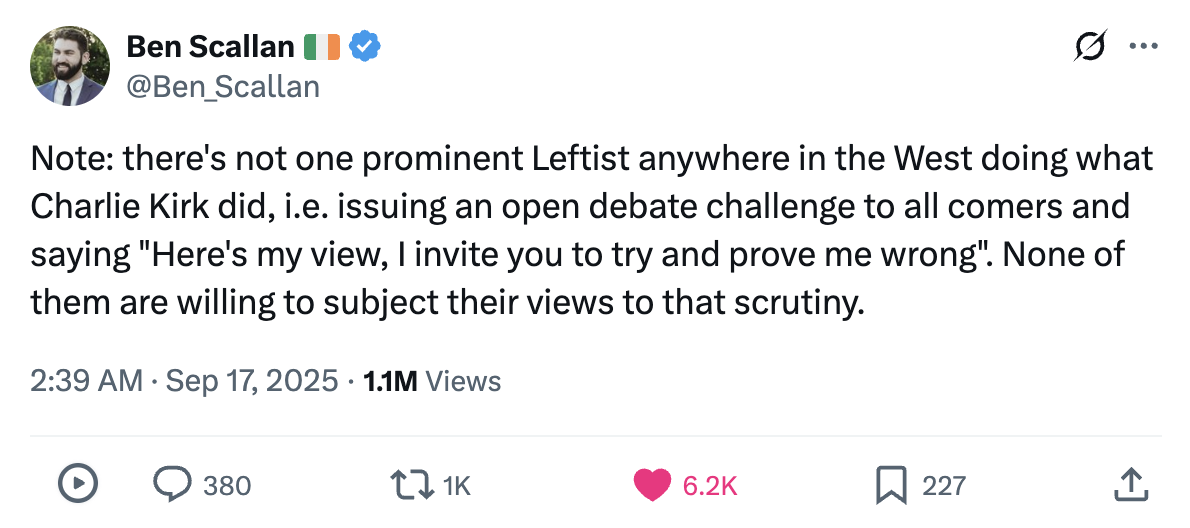
I had my disagreements with Charlie Kirk—sometimes sharp ones—but none of that matters right now. What I respected, and too many of his critics never noticed, was that he showed up. He stood in the quad, took hard questions, argued back, let students argue back at him. That takes time, patience, and courage. Our culture has been teaching young people to scorn that everyday civic courage and to treat contested speech as a kind of physical harm. On that Utah campus we received the final proof that “words are like bullets” is a poisonous and cruel metaphor.

In other words, what looks like a plea for civility is actually a threat. This pertains to both "Words are Violence" and claims of "Hate Speech."

Continue ReadingThe Function of “Words Are Violence”