Steve Stewart-Williams explains his aversion to the term “Gender.”

Steve Stewart-Williams explains "Why I'm not a Fan of Gender." Excerpt from his upcoming bok, "A Billion Years of Sex Differences":

Many social scientists draw a distinction between sex and gender where, roughly speaking, sex refers to biological aspects of female and male, and gender refers to social aspects. ... I’m not a fan of the concept of gender, which I think confuses more than it enlightens.

There are several reasons for this. The first is that the term has multiple meanings. Sometimes gender refers to female–male differences that are (supposedly) shaped by nurture rather than nature; sometimes it refers to masculinity and femininity; sometimes it refers to psychological profiles that are more common in one sex than the other; sometimes it refers to widely held stereotypes of the sexes; sometimes it refers to the roles that society provides for females and males; sometimes it refers to people’s gender identity (their sense of themselves as a boy or a girl or a man or a woman); and sometimes it’s just a polite synonym for sex: a term that makes it clear that you’re talking about biological sex rather than the fun kind of sex. The profusion of partially overlapping meanings makes it difficult to know what people using the term are actually talking about. It’s like trying to juggle jelly.

A second reason I prefer not to partake of gender is that, even if we could agree on a definition, most of those on offer are profoundly flawed. Take, for example, the idea that gender refers to female–male differences due to nurture rather than nature. An initial problem is that this is invariably assumed rather than demonstrated; indeed, describing a female–male difference as a gender difference often seems to be a way to settle the nature–nurture issue by definitional stipulation rather than arguments and evidence. . . .

Other definitions of gender face similar problems. Consider, for example, the idea that gender refers to psychological profiles loosely linked to sex: Men tend to be stoic and assertive, for instance, whereas women tend to be caring and emotional. This definition is assumed by people who argue that there are multiple distinct genders, rather than just the two vanilla options of man and woman. Again, this doesn’t strike me as a useful way to construe things. The problem is that it involves imposing categories – even if more than just two – on what is actually continuous psychological variation. No two human beings have exactly the same psychological profiles, so the logical endpoint of this approach is that there are as many genders as there are human beings – and we’re really just talking about personality.

I've subscribed to Steve's excellent Substack for the past year and highly recommend it.
Continue ReadingSteve Stewart-Williams explains his aversion to the term “Gender.”

The Euphemistic Treadmill

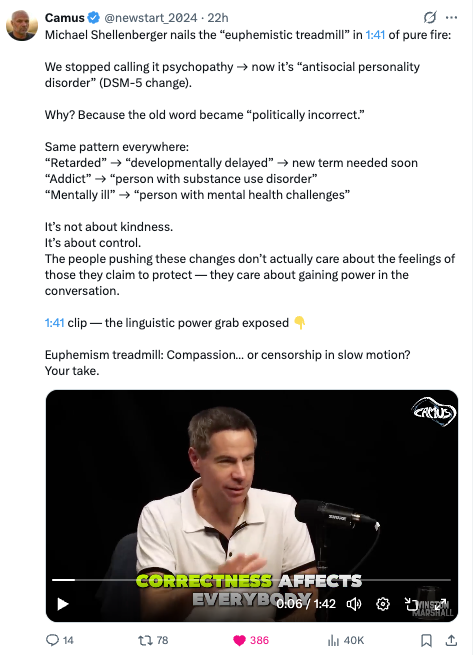
Michael Shellenberger discusses the euphemistic treadmill:

We stopped calling it psychopathy → now it’s “antisocial personality disorder” (DSM-5 change).

Why? Because the old word became “politically incorrect.”

Same pattern everywhere:

“Retarded” → “developmentally delayed” → new term needed soon

“Addict” → “person with substance use disorder”

“Mentally ill” → “person with mental health challenges”

It’s not about kindness.

It’s about control.

The people pushing these changes don’t actually care about the feelings of those they claim to protect — they care about gaining power in the conversation.

Continue ReadingThe Euphemistic Treadmill

Dismal Job Prospects for White Male Writers

I'm a race abolitionist. I think we should completely dispense with the categories of "black" and "white" and describe people in other, less destructive, terms. The only exception is that we should retain and enforce civil rights laws because some people enthusiastically categorize people in terms of "race," discriminating against some races and preferring others. I set forth my position in this acticle, ""Race" is Like Astrology."

I hope that someday, all of us will get back on track with the purpose of the original civil rights movement (rather than the absurd and destructive "anti-racism" movement) and that, someday, "race" will be the least useful or interesting thing we can say about people.

That said, "white" males are actively being discriminated against, especially against Millennials and beyond (Millenials were born between 1981-1996), especially in the creative fields, including writing. This oftentimes overt discrimination is well-documented by Jacob Savage in his article at Compact, "The Lost Generation." . Here's an excerpt:

In 2021, new hires at Condé Nast were just 25 percent male and 49 percent white; at the California Times, parent company of The Los Angeles Times and The San Diego Union-Tribune, they were just 39 percent male and 31 percent white. That year ProPublica hired 66 percent women and 58 percent people of color; at NPR, 78 percent of new hires were people of color.

“For a typical job we’d get a couple hundred applications, probably at least 80 from white guys,” the hiring editor recalled. “It was a given that we weren’t gonna hire the best person… It was jarring how we would talk about excluding white guys.” The pipeline hadn’t changed much—white men were still nearly half the applicants—but they were now filling closer to 10 percent of open positions.

Suddenly, in Andrew’s newsroom, everything was driven by identity. There were endless diversity trainings, a racial “climate” assessment—at one point, reporters were told they had to catalog, in minute detail, the identity characteristics of all their sources. Andrew had been instrumental in forming the union at his company, and objected when negotiations shifted from severance pay and parental leave to demands for racial quotas. “They wanted to do like ... emergency hires of black people,” he said.

When he questioned these new priorities, the response was swift. “On a Zoom call, women would clap back at something I was saying and other women would snap their fingers in the [chat] window,” he recalled. “It was this whole subcultural language being introduced wholesale.” ...

It’s striking how casual it all was. “Chicago Fire—the UL [upper level] can be [anyone], but we need diverse SWs [staff writers].” As in other industries, upper-level positions—writers with experience and credits—could still be filled by white men. But the entry-level jobs, the staff writer and co-producer positions that Matt and thousands of other aspiring writers were competing for, were reserved for others.

This is an excerpt from a much longer excellent article. I highly recommend reading the entire thing.

I would hope that these dire statistics don't dissuade any "white" male from pursuing their dream, of course. But this is a tough time for all creative writers, given the growing threat of AI. Grok offers these statistics showing that although Hollywood scrips are still largely being written by organics, publishers are caving to the bots: v Publishers' AI Reliance (Web, Books, Articles)

  • Web publishing: >50% of new articles AI-generated in 2025 (up from 5% in 2020), displacing freelancers in copywriting/editing; focuses on news, how-to, reviews, and SEO content.
  • Books/articles: Emerging displacement; survey of 258 UK novelists shows 51% fear full replacement, 39% report income losses (85% expect more), with 59% of genre authors' work used to train AI without permission.
  • Broader impacts: Google's AI Overviews cut traffic 34%, leading to layoffs; >25% of Americans use AI for info over traditional sources; 97% of novelists oppose AI writing full novels, citing originality/ethics losses.
  • Trend: AI replaces commoditized content/jobs, potentially making publishers obsolete; 33% of authors use AI for non-creative tasks, but mass displacement in low-creativity areas is ongoing.
Hollywood's AI Reliance for Screenplays

  • AI use is limited and experimental, mainly assistive for brainstorming, analysis, and rote tasks; full scripts remain ~100% human-written (study of 3,800 US TV episodes 2020-2023 showed 1.9% AI probability, no increase post-ChatGPT).
  • Tools like Largo.ai triple green-lighting rates and make focus groups 10x faster/cheaper; 71% of screenwriters use AI for editing by late 2025, with 76% of studios incorporating it to cut post-production time by 35%.
  • Backlash includes WGA protests over job displacement and copyright; 53% of audiences uncomfortable with AI-touched content; future seen as collaborative, not replacement.

Continue ReadingDismal Job Prospects for White Male Writers

Peak Non-Binary

is back with another episode of TGIF at The Free Press. I look forward to her column every Friday. She recaps the news quite well, along with plenty of links and humor. This week she mentioned the decline of non-binary designations:

Nonbinary identification is collapsing: The number of young people identifying as neither male nor female has fallen through the floor, which is crazy because I thought they were all born that way. An analysis of data from surveys by Brown University, Andover, and the Foundation for Individual Rights and Expression (FIRE) shows a massive drop-off among nonbinary students from the 2022–2023 peak. Maybe nonbinary was just another boarding school fad that has started to fade—pronouns are out, trust funds are back in (good thing polo shirts work for both vibes).

[Emphasis not in the original]

To me and most other people who don't cling to the corporate media, it was always clear that declaring oneself "non-binary" was a cheap-signalling fad fueled by social contagion and that it would eventually fade because it was not anchored to any reality in the physical or biological world. It will continue to fall the same way as bell-bottoms, pet rocks, disco music and the ice bucket challenge. I predict that "queerness" will soon follow suit.

Continue ReadingPeak Non-Binary