
Eli Steele Identifies the Hidden Root of Leftist Violence
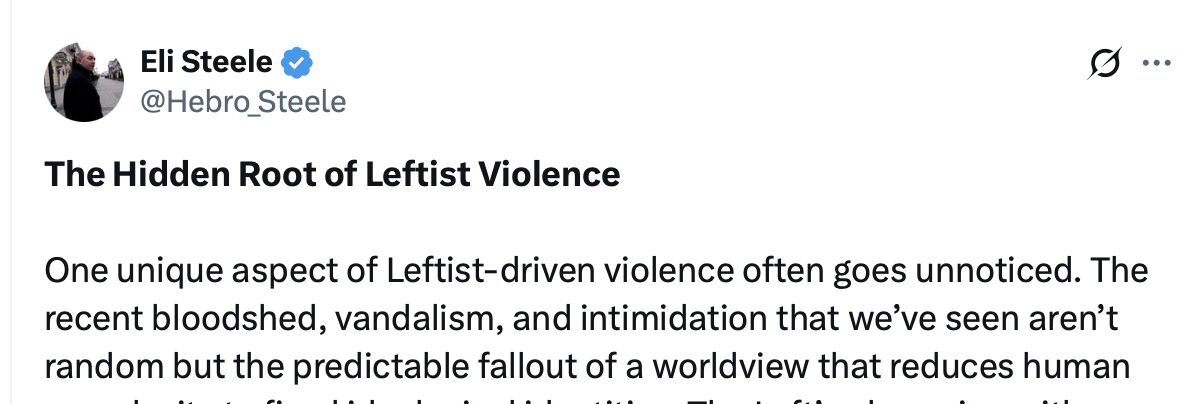
I'm concerned that Eli Steele has correctly pointed out a problem that has no obvious solution. Certainly no quick fix:

One unique aspect of Leftist-driven violence often goes unnoticed. The recent bloodshed, vandalism, and intimidation that we’ve seen aren’t random but the predictable fallout of a worldview that reduces human complexity to fixed ideological identities. The Left’s obsession with immutable traits -- race, gender, sex -- creates a victimhood hierarchy where dissent feels like an existential threat. When challenged, responses spiral into denial, defensiveness, or even violence from those unable to defend their dogma. This isn’t mere political disagreement, but the grim consequence of a belief system that rejects the Enlightenment’s focus on reason and individuality for rigid orthodoxy.

Recent events expose this pattern. The assassination of Charlie Kirk by Tyler Robinson, radicalized through Leftist politics and his transgender partner’s identity struggles, shows how loyalty to identity can turn lethal when faced with opposing views. School shootings like Audrey Hale’s 2023 Nashville attack and Robin Westman’s 2025 Minneapolis shooting reveal how issues with or challenges to gender identity can ignite rage. Elias Rodriguez’s 2025 murder of two Israeli Embassy employees, accompanied by cries of “shame on Zio-Nazi terror,” reflects a worldview -- shared by many pro-Hamas supporters -- that reduces Jews, Israeli or not, to whites and oppressors. The decade-long wave of Black Lives Matter protests, grounded in claims of systemic racial oppression, fueled riots that caused billions in damages, claimed lives, and pressured countless American institutions into adopting reductive racial identity politics as dogma.

Beyond violence, this ideology breeds intimidation, silencing dissent with threats of job loss or social ostracism. Rooted in identity determinism, this intellectual dead-end leaves no room for nuance or growth, increasing the potential for violence among those trapped in its logic -- a logic now taught to young minds through ethnic studies in K-12 schools.

If we cannot force the Left to retreat from its fixation on identity politics through the ballot box and all legal means, this ideology will only sow ever-increasing division and violence. This challenge is daunting because it demands stripping people of their very identities grounded in immutable characteristics and showing them their worth lies elsewhere -- their character. They will fight with everything they have.

To break this cycle, we must reject the notion that immutable traits dictate moral worth and recommit to reason and individuality. Until the Left abandons its dogma, it will continue to fuel conflict—a stark reminder of what happens when ideological orthodoxy drowns out dialogue.

One way to reject the notion that immutable traits dictate moral worth would be to make sure we remove all financial and social status incentives for enshrining immutable traits. But I am pessimistic that that we can make any headway by engaging in conversation. Where to start?
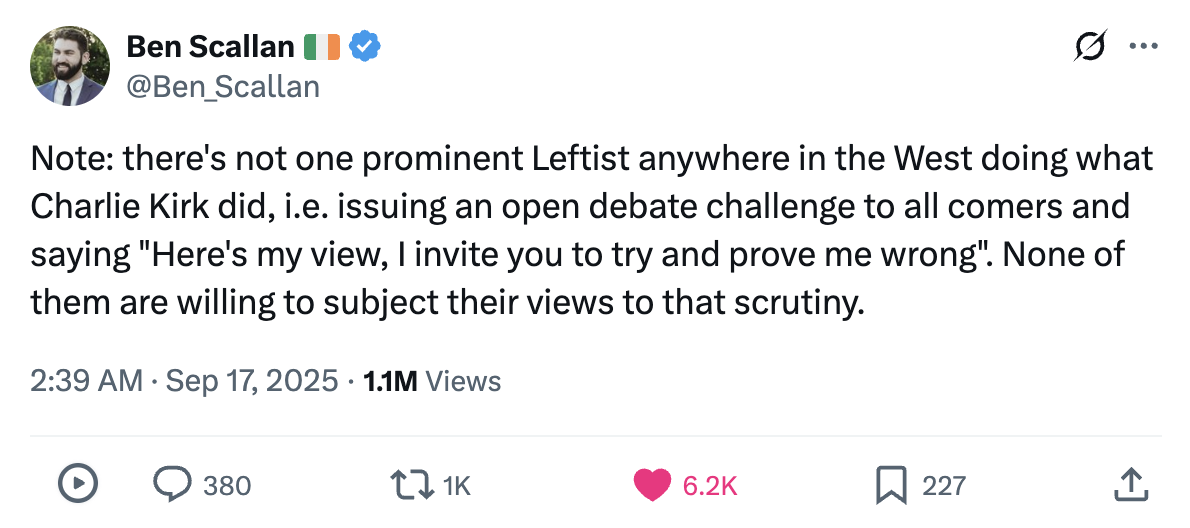
Continue ReadingEli Steele Identifies the Hidden Root of Leftist Violence

Does Treatment for People Who Claim to be Transgender Reduce Suicides?

?Would you rather have a live daughter or a dead son? Transgender activists would ask this question to incentivize parents to provide "gender affirming care" to their sexually confused children.

But is it true that medical interventions reduce the number of suicides?

Consider this excerpt from "ACLU Attorney Confesses: Transgender-Suicide Claim is a Myth." Arguing before the Supreme Court, the ACLU's Chase Strangio concedes that suicide is “thankfully and admittedly rare” among transgender-identifying people:

Unfortunately for Strangio, Justice Alito had done his homework. Citing the U.K.’s Cass Review, Alito observed that “there is no evidence that gender-affirmative treatments reduce suicide.”

Then came Strangio’s remarkable concession:

MR. STRANGIO: What I think that is referring to is there is no evidence in some—in the studies that this treatment reduces completed suicide. And the reason for that is completed suicide, thankfully and admittedly, is rare and we’re talking about a very small population of individuals with studies that don’t necessarily have completed suicides within them.

However, there are multiple studies, long-term longitudinal studies that do show that there is a reduction in—in suicidality . . .

Here, the ACLU’s star attorney on trans issues seems to be at odds with Solicitor General Prelogar, who had said that the “rates” of “suicide” among gender-dysphoric youth were “striking.” Strangio admits, under oath, that suicide is actually “rare,” and that the research purporting to demonstrate benefits from hormones concerns suicidality, not suicide. Strangio’s use of “admittedly” is also striking, as it suggests the attorney is aware that claims about suicide prevention through sex “change” are false.

Continue ReadingDoes Treatment for People Who Claim to be Transgender Reduce Suicides?

Gen Z and Gender Ideology by the Numbers

Excerpt from "Understanding and Saving Gen Z To Save America," by Scott Atlas:

Gen Z’s dysfunction is undeniable. They average nine hours daily on screens, over three hours on social media, eroding real-world connections. This fuels asocial behavior, surging loneliness, and poor mental health; only half favor personal over virtual interactions. Financially, they falter: 55% find homeownership harder, 44% struggle to secure jobs, and 55% see promotions as elusive, fostering underachievement. Employers note that 65% of recent college graduates feel entitled, 63% are easily offended, and 55% lack professionalism and work ethic. Mental health crises are rampant, with depression, anxiety, and hopelessness spiking, especially among liberal-leaning youth, driven by a victimhood culture amplified by social media.

With regard to Gender Ideology, Gen Z's staggering numbers suggest social contagion:

Gen Z’s psychological frailty sets the stage for unique vulnerability to social contagion, suggested by the explosion of gender confusion. Transgender identification among young adults surged from 0.59% in 2014 to 3.08% in 2023 – a 422% increase – with non-binary identities up 1260% and transgender men quadrupling (309%), driven by social media echo chambers and peer pressure. Gallup’s 2025 poll shows LGBTQ+ identification at 9.3% overall, nearly triple 3.5% in 2012, doubling in five years, with over 23% of Gen Z (born 1997-2006) identifying as such. The Williams Institute’s 2025 poll estimates over 724,000 transgender youth.

Continue ReadingGen Z and Gender Ideology by the Numbers

The Function of “Words Are Violence”

Translation of “Words are Violence”: A) You need to shut up and let ME talk. B) I am the sole judge of what words you are permitted to speak. C) I’m so fragile that I can’t bear to talk with people I disagree with. D) I forbid you to use facts, logic and persuasion while we talk. E) If you say anything I don't like, it will be blasphemy and sacrilege and it proves that you are a bad person engaged in "hate speech." F) I am justified ending our relationship and/or inflicting violence on you if your words piss me off.

The above attitude does not invite meaningful debate of anything of importance. Thus:

In "Bury the ‘words are violence’ cliché," Greg Lukianoff reminds us that words are not like bullets:

I had my disagreements with Charlie Kirk—sometimes sharp ones—but none of that matters right now. What I respected, and too many of his critics never noticed, was that he showed up. He stood in the quad, took hard questions, argued back, let students argue back at him. That takes time, patience, and courage. Our culture has been teaching young people to scorn that everyday civic courage and to treat contested speech as a kind of physical harm. On that Utah campus we received the final proof that “words are like bullets” is a poisonous and cruel metaphor.

In other words, what looks like a plea for civility is actually a threat. This pertains to both "Words are Violence" and claims of "Hate Speech."

Continue ReadingThe Function of “Words Are Violence”

Eli Steele is Over it

Eli Steele (son of Shelby Steele) is "over it":

We are over black power

We are over white guilt

We are over white privilege

We are over respectability politics

We are over white fragility

We are over white-adjacent

We are over inclusivity/belonging

We are over BIPOC

We are over victimhood

We are over oppressor vs. oppressed

We are over cancel culture

We are over antisemitism

We are over cultural appropriation

We are over systemic racism

We are over Black Lives Matter

We are over DEI

We are over systems of oppression

We are over reparations

We are over Uncle Tom

We are over performative allyship

We are over ideology

We are individuals.

Who is Eli Steele?

[From Grok] Eli Steele is an award-winning American filmmaker, writer, and commentator known for his documentaries that critically examine race, identity, and social issues in the United States. Born around 1974, he is Black, Jewish, and deaf (relying on cochlear implants and lip-reading), and he lives in Los Angeles with his two children. He is the son of Shelby Steele, a prominent Black conservative author and senior fellow at the Hoover Institution, with whom Eli has frequently collaborated on projects.Background and HeritageSteele's family history reflects resilience and diverse experiences: his paternal great-grandfather was born into American slavery, while his maternal grandmother escaped Nazi persecution in Europe before returning to rescue her family. These roots inform his perspective on identity and freedom, often framing his work around themes of individual agency over group-based ideologies.

I'm not over the modern versions of these things because I immediately recognized these things to be the grifts they are, performative grabs for money and power.

Continue ReadingEli Steele is Over it