
Senator Ted Cruz Invites Eric Weinstein to Diagnose the United States

It is critically important for you to watch this one-hour video, "The Verdict," Hosted by Senator Ted Cruz. If you are thinking "Why the fuck would I want to see any show hosted by Ted Cruz, you are a big part of the problem, because on this show (released July 23) Cruz has reached far from his comfort zone, inviting Eric Weinstein as a guest. If you are worried about the future of the United States, I guarantee that you have an hour for this.

I follow Eric Weinstein on Twitter and on the "Dark Web" because he is consistently brilliant. I found this video on Weinstein's Twitter feed. I didn't quite know what to expect if you put Eric in the same room as Ted Cruz, but it was riveting, and I respect Cruz for giving Weinstein lots of space to present ideas that are highly critical of both the left and the right. The resulting conversation was not out of any typical political playbook and it offers promising new ways to conceptualize intransigent national conundrums.

Topics included the abject failure of both political parties. The rise of the Maoists on the Left. The fact that the moderates of the two dominant parties need to jettison their extremes and come together. "WTF happened in 1971?" The fact that "rent-seeking" (the practice by which the source of one's wealth is non-productive) has destroyed national growth; the resulting economic stress is exposing social pathogens that have always been around, but they are now more visible. The modern media as Shakespeare's character of Iago, poisoning our national dialogue at every turn. "Russell Conjugations" (referencing Bertrand Russell). Our failure to practice "Critical Feelings" (as opposed to critical thinking) ("Most of our feelings are not OUR feelings, but feelings that we inherit through daily programming, convincing us that those people that think differently than us are evil." The failures of universities. The lies about immigration that are a cover-up to a scheme to exchange citizenship for free university labor. That a successful national response to COVID-19 should have been a "layup," and what this failure says about us (our entire leadership class of both parties is "unworkable").

[Ted Cruz]: How do we get from Othello to midsummer night's dream?

[Eric Weinstein]:

The key issue is that we have to start talking about our own failures. What I hope you've heard is that I'm willing to call out the Left, the right, and the libertarian. The libertarian problem is that it doesn't work to pretend that we're all atomistic. We see that with respect to contagion and masks and the like. Arnold Kling has this beautiful description. He says that you have three Groups: progressives conservatives and Libertarians. Libertarians are animated principally by hating coercion, progressives are animated principally by hating oppression, and conservatives are principally animated by needless loss of hard-won traditions and gains over past generations. The answer is that any sensible person should want to make sure that they're optimizing among the three, and not to become part of a simplistic situation whereby they so hate coercion or so hate oppression that they lose sight of the entire picture and therefore lose the plot of the American Project.
Continue ReadingSenator Ted Cruz Invites Eric Weinstein to Diagnose the United States

Dr. Diana Fleischman Discusses Sex Differences Between Men and Women

You are invited to join this lively discussion with Dr. Diana Fleischman. The topic: significant biological and psychological sex differences between men and women.

One of the most stunning differences discussed in this video was described in Attraction Explained: The science of how we form relationships, By Viren Swami:

In classic studies conducted by Russell Clark and Elaine Hatfield between 1978 and 2003, college students were approached by a fairly attractive member of the opposite sex, who was really a confederate of the researchers. This confederate would hang around campus and, once a target had been selected, she or he would walk up to the target and say, ‘I have been noticing you around campus. I find you to be very attractive’. Next, the confederate would ask one of three questions: (l) Will you go on a date with me? (2) Will you come back to my apartment? or (3) Will you have sex with me?

For the first question, there was no clear sex difference - across studies, 56 per cent of women and 50 per cent of men accepted the date. But for the other questions, which could be interpreted as questions about casual sex, there were clearer sex differences. For the question about going back to the confederate’s apartment, 69 per cent of men consented compared to only 6 per cent of women. And for the final, 75 per cent of men agreed to sex, while not a single woman said yes to sex. In fact, every time the study was repeated, not a single woman agreed to sex at any time. In a more recent study, fairly attractive psychology students approached a member of the opposite sex in public places in four cities in Denmark and asked: (l) Would you go on a date with men tonight or during the week/weekend? (2) Would you come over to my place tonight or during the week/weekend? or (3) Would you go to bed with me tonight or during the week/weekend? When individuals in relationships were excluded from the count, 68 per cent of men and 43 per cent of women agreed to a date, 40 per cent of men and 21 per cent of women agreed to go to the student’s place, and 59 per cent of men but none of the women agreed to casual sex.

There are many other differences between the sexes discussed by Dr. Fleishman. It's important to add some context to these sex difference studies, however.  Yes, there are differences, and many of these seem dramatic, but men and women are not from different planets.  They are extremely similar in many ways.  How many?  Hundreds of ways, as documented by Donald E. Brown.  All of us are mostly the same. 

Continue ReadingDr. Diana Fleischman Discusses Sex Differences Between Men and Women

Bret Weinstein and Heather Heying Discuss the Intersection of Transgendering and Biology

I've been struggling to understand the contours of the recent dispute involving J.K.Rowling's tweets regarding transgendered persons. This issue caught my interest in that I know several people who transitioned and one who is transitioning as a 30 year old adult after being in a marriage. In the process of trying to understand the issues, I've read about a dozen articles from varying perspectives plus hundreds of tweets, many of them claiming to be authored by transgendered persons.

Interestingly, those postings claiming to be authored by transgendered persons seem to be much more sympathetic to J.K. Rowling. Many of the postings on social media are intense reads, leading me to wonder whether there is any way to satisfy all of the sides to the dispute. I doubt it and I think I now better understand why after watching the attached video featuring two evolutionary biologists, Bret Weinstein and Heather Heying. I found their comments on gender ideology and biology quite helpful to understanding these issues. I especially appreciate that their comments are well founded on biology, but also sensitive to the need to treat transgendered persons with kindness. I also appreciate that they both deal head-on with the political aspects of this issue, including the need to recognize over-stepping by the authoritarian left.

Continue ReadingBret Weinstein and Heather Heying Discuss the Intersection of Transgendering and Biology

About the Sex Organs of Eels.

I never know what I'm about to learn when my weekly email digest arrive from The New Yorker.  Today's lesson is about the non-existent sex organs of eels, in this article, "Where Do Eels Come From," by Brooke Jarvis.  The bottom line is that the sex organs do exist, if you are patient enough to wait for them through four metamorphoses:

Careful observers discovered that what had long been taken for several different kinds of animals were in fact just one. The eel was a creature of metamorphosis, transforming itself over the course of its life into four distinct beings: a tiny gossamer larva with huge eyes, floating toward Europe in the open sea; a shimmering glass eel, known as an elver, a few inches in length with visible insides, making its way along coasts and up rivers; a yellow-brown eel, the kind you might catch in ponds, which can move across dry land, hibernate in mud until you’ve forgotten it was ever there, and live quietly for half a century in a single place; and, finally, the silver eel, a long, powerful muscle that ripples its way back to sea. When this last metamorphosis happens, the eel’s stomach dissolves—it will travel thousands of miles on its fat reserves alone—and its reproductive organs develop for the first time. In the eels of Europe, no one could find those organs because they did not yet exist.

Continue ReadingAbout the Sex Organs of Eels.

You Are a Pulsating Universe

Human animals are amazing on many levels. Have you recently contemplated the beauty of your hand? Have you marveled at the fact that you can open it, grab something tightly, sense temperature, gently touch your lover's hair? And if you burn it or bruise it, it will usually heal all by itself. All of those things are so natural that it's easy to forget how miraculous hands are. You would never be able to create a device that replicates all of these extraordinary functions.

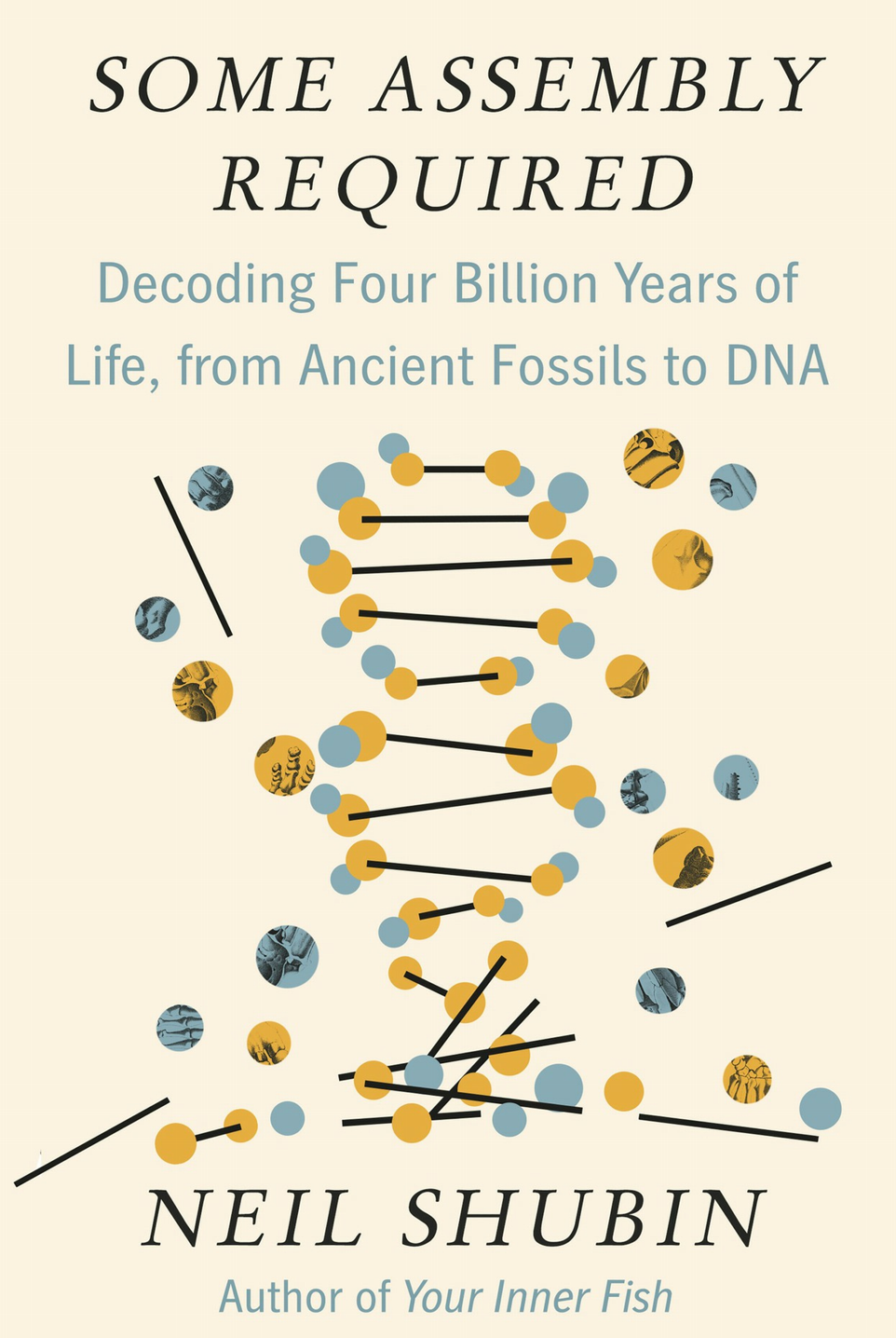
But let's dig a bit deeper by reading Neil Shubin's new book,Some Assembly Required: Decoding Four Billion Years of Life, from Ancient Fossils to DNA (2020).  The hand is made of cells, and there are parts to each of those cells, and the genetic code for you can be found in each of those cells.  But how does that information contained in your DNA become you?  How is it possible for your genetic blueprint to build and maintain your body?  Shubin's book describes this process beautifully.  I offer the following excerpt.  If this kind of writing inspires you like it does me, I urge you to obtain a copy of Some Assembly Required and find a quiet place to allow your DNA powered body to read your biography. This book is about inspiring science and scientists, but it is, at bottom, about who you are.

New microscopes that allow us to see DNA molecules themselves also let us see what happens as genes turn on and off. For a gene to become active, a molecular game of Twister needs to happen. Inactive regions of the genome are tightly coiled upon themselves, bundled around other small molecules to fit inside the nucleus. These regions are closed off and so are relatively inert. Before a region of the genome can become active, it needs to uncoil and open itself up to make a protein. These are only the first steps in a finely choreographed dance that turns genes on and off. For a gene to activate, its switch needs to contact other molecules and attach to an area adjacent to the gene itself. . . .

So here are the full steps of the dance that goes on when genes turn on: the genome opens, revealing the gene and its control region, parts attach, and a protein is made. This happens in every cell, with every protein. A six-foot-long string of DNA is coiled until it is smaller than the size of the head of a pin. Conjure the image of it opening and closing in microseconds, writhing and turning to activate thousands of genes every second. From the moment of conception and throughout our adult lives, our genes are continually being switched on and off. We begin as a single cell. Over time, cells multiply, while batteries of genes are activated to control their behavior to form the tissues and organs of our bodies.

As I write this book, and as you read it, genes are switching on in all four trillion of our cells. DNA contains many supercomputers’ worth of computing power. With these instructions, a relatively small parts list of twenty thousand genes can build and maintain the complex bodies of worms, flies, and people using control regions spread across the genome. Changes to this incredibly complex and dynamic machine underlie the evolution of every creature on Earth. Always coiling, uncoiling, and folding, our DNA is like an acrobatic maestro, a conductor of development and evolution.

Shubin, Neil. Some Assembly Required (p. 73).

Continue ReadingYou Are a Pulsating Universe