
Sons’ DNA Found in Mothers’ Brains

Amazing!
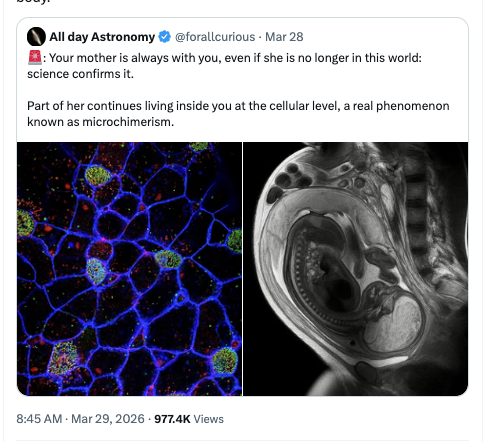
Anish Moonka:

You have your mother's cells in your brain right now. If she ever carried you, yours are in hers. Scientists looked at the brains of 59 women after they died, ages 32 to 101. In 63% of them, they found their sons' DNA scattered across different brain regions. The cells had traveled from the womb, through the blood, past the wall that normally keeps foreign material out of the brain, and settled in. The oldest woman still carrying her son's cells in her brain was 94. In mice, those cells became functional brain cells. The transfer starts as early as 7 weeks into pregnancy. Your cells slip through the placenta into your mother's body. Hers slips into yours. One study found a mother still had her son's cells in her blood 27 years after giving birth. After delivery, between 50 and 75% of women carry their child's cells. During pregnancy, up to 6% of a woman's blood DNA comes from the baby.
Continue ReadingSons’ DNA Found in Mothers’ Brains

The Efficiency of the Human Brain and AI

Fascinating post quoting Elon Musk on the efficiency of the brain and the potential efficiency of AI:

Well, we have a clear example of efficient power, efficient compute, which is the human brain. Our brains use about 20 watts of power, and only about 10 watts is higher brain function. Half of it is just housekeeping, keeping your heart going and breathing.

So you’ve got maybe 10 watts of higher brain function in a human, and we’ve managed to build civilization with 10 watts of a biological computer. Given that humans are capable of inventing general relativity and quantum mechanics, inventing aircraft, lasers, the internet, and discovering physics with a 10-watt meat computer, there’s clearly a massive opportunity for improving the efficiency of AI compute. Right now, even a hundred-megawatt or gigawatt AI supercomputer can’t do everything a human can do. But we already have the proof that true intelligence can emerge from just 10 watts. That should lead you to one conclusion, AI can get a lot more efficient.

Continue ReadingThe Efficiency of the Human Brain and AI

Steve Stewart-Williams explains his aversion to the term “Gender.”

Steve Stewart-Williams explains "Why I'm not a Fan of Gender." Excerpt from his upcoming bok, "A Billion Years of Sex Differences":

Many social scientists draw a distinction between sex and gender where, roughly speaking, sex refers to biological aspects of female and male, and gender refers to social aspects. ... I’m not a fan of the concept of gender, which I think confuses more than it enlightens.

There are several reasons for this. The first is that the term has multiple meanings. Sometimes gender refers to female–male differences that are (supposedly) shaped by nurture rather than nature; sometimes it refers to masculinity and femininity; sometimes it refers to psychological profiles that are more common in one sex than the other; sometimes it refers to widely held stereotypes of the sexes; sometimes it refers to the roles that society provides for females and males; sometimes it refers to people’s gender identity (their sense of themselves as a boy or a girl or a man or a woman); and sometimes it’s just a polite synonym for sex: a term that makes it clear that you’re talking about biological sex rather than the fun kind of sex. The profusion of partially overlapping meanings makes it difficult to know what people using the term are actually talking about. It’s like trying to juggle jelly.

A second reason I prefer not to partake of gender is that, even if we could agree on a definition, most of those on offer are profoundly flawed. Take, for example, the idea that gender refers to female–male differences due to nurture rather than nature. An initial problem is that this is invariably assumed rather than demonstrated; indeed, describing a female–male difference as a gender difference often seems to be a way to settle the nature–nurture issue by definitional stipulation rather than arguments and evidence. . . .

Other definitions of gender face similar problems. Consider, for example, the idea that gender refers to psychological profiles loosely linked to sex: Men tend to be stoic and assertive, for instance, whereas women tend to be caring and emotional. This definition is assumed by people who argue that there are multiple distinct genders, rather than just the two vanilla options of man and woman. Again, this doesn’t strike me as a useful way to construe things. The problem is that it involves imposing categories – even if more than just two – on what is actually continuous psychological variation. No two human beings have exactly the same psychological profiles, so the logical endpoint of this approach is that there are as many genders as there are human beings – and we’re really just talking about personality.

I've subscribed to Steve's excellent Substack for the past year and highly recommend it.

Continue ReadingSteve Stewart-Williams explains his aversion to the term “Gender.”