How Much ATP Does a Human Body Produce Every Day?

Today I learned that the human body makes its weight in ATP (a key component of the Krebs cycle") every day. When I read this I wondered if it could possibly be true. Here's what Grok had to say:

My Query to Grok: Is it true that we make our body weight worth of ATP every day?

Yes, it's true. The human body turns over (produces and consumes) an amount of ATP roughly equivalent to its own body weight each day, though the exact figure varies by activity level and individual.

At any given moment, the body contains only about 250 grams of ATP (plus some ADP). However, ATP is rapidly recycled: it's hydrolyzed to ADP + phosphate to release energy, then resynthesized using energy from food. This cycle happens thousands of times per day per molecule.

Reliable sources estimate daily ATP turnover as:

    • 50–75 kg for an average adult (often cited as ~100–150 moles of ATP hydrolyzed and regenerated daily).
    • Around 50 kg in sources like Wikipedia.
    • ~60 kg in BioNumbers database.
    • Up to 100 kg or more during high activity in some physiology texts.

For a typical 70 kg person, this is approximately one body weight's worth per day at rest or moderate activity. During intense exercise, the rate can increase dramatically (e.g., up to 0.5–1 kg per minute). The key point is the enormous flux: even though net ATP storage is tiny—your cells are constantly churning through it to power everything from muscle contraction to brain function.

This fact is widely accepted in biochemistry and physiology textbooks and is often used to illustrate how dynamic cellular energy metabolism is.

Tutorial on the Krebs Cycle (Also from Grok):
The Krebs cycle, also known as the citric acid cycle or tricarboxylic acid (TCA) cycle, is a central metabolic pathway in cellular respiration that occurs within the mitochondria of eukaryotic cells, efficiently converting nutrients from carbohydrates, fats, and proteins into usable energy. It begins when acetyl-CoA—derived primarily from the breakdown of glucose via glycolysis—combines with oxaloacetate to form citrate, initiating a series of eight enzymatic reactions that systematically oxidize the molecule, releasing carbon dioxide as a byproduct (which we exhale) and generating high-energy electron carriers like NADH and FADH2, along with a small amount of ATP directly through substrate-level phosphorylation. These electron carriers then feed into the electron transport chain to produce the bulk of the cell's ATP via oxidative phosphorylation, yielding up to 38 ATP molecules per glucose molecule overall. The cycle is highly efficient, regenerating oxaloacetate to allow continuous operation, and it's tightly regulated by factors like ATP levels and enzyme inhibitors to match the cell's energy demands, playing a crucial role not only in energy production but also in providing intermediates for biosynthesis of amino acids, nucleotides, and other essential compounds.
 

Continue ReadingHow Much ATP Does a Human Body Produce Every Day?

Determining One’s Sex Requires Requires One to Consider Anisogamy

Paul Griffith explains in a letter to Nature:

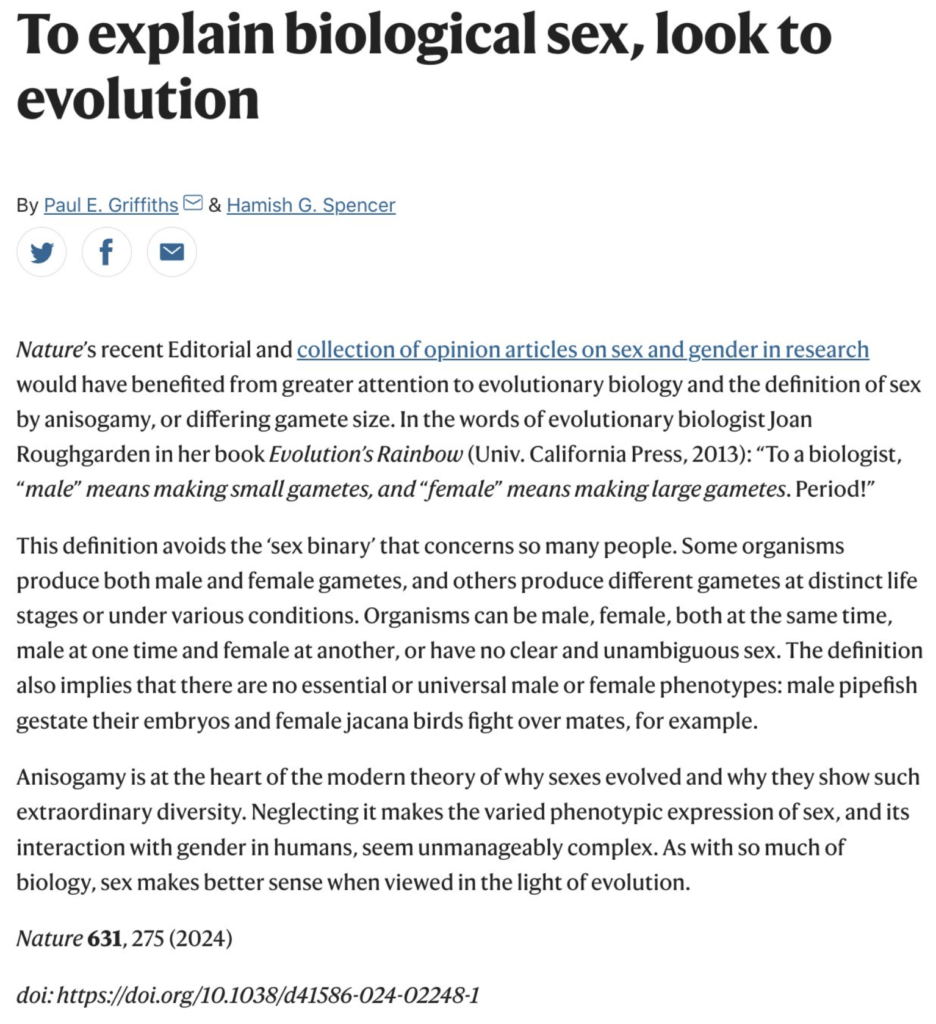
Nature's recent Editorial and collection of opinion articles on sex and gender in research would have benefited from greater attention to evolutionary biology and the definition of sex by anisogamy, or differing gamete size. In the words of evolutionary biologist Joan Roughgarden in her book Evolution's Rainbow (Univ. California Press, 2013): "To a biologist, "male" means making small gametes, and "female" means making large gametes. Period!"

This definition avoids the 'sex binary' that concerns so many people. Some organisms produce both male and female gametes, and others produce different gametes at distinct life stages or under various conditions. Organisms can be male, female, both at the same time, male at one time and female at another, or have no clear and unambiguous sex. The definition also implies that there are no essential or universal male or female phenotypes: male pipefish gestate their embryos and female jacana birds fight over mates, for example.

Anisogamy is at the heart of the modern theory of why sexes evolved and why they show such extraordinary diversity. Neglecting it makes the varied phenotypic expression of sex, and its interaction with gender in humans, seem unmanageably complex. As with so much of biology, sex makes better sense when viewed in the light of evolution.

Nature 631, 275 (2024)

doi: https//doi.org/10.1038/d41586-024-02248-1

Continue ReadingDetermining One’s Sex Requires Requires One to Consider Anisogamy

J.K. Rowling Explains Why She Stood Up for Women

Why did J.K. Rowling take a strong stand in support of women, exposing herself to "a tsunami of death and rape threats"? See the following excerpt from J.K. Rowling's new book, The Women Who Wouldn’t Wheesht:

The thing is, those appalled by my position often fail to grasp how truly despicable I find theirs. I’ve watched “no debate” become the slogan of those who once posed as defenders of free speech. I’ve witnessed supposedly progressive men arguing that women don’t exist as an observable biological class and don’t deserve biology-based rights. I’ve listened as certain female celebrities insist that there isn’t the slightest risk to women and girls in allowing any man who self-identifies as a woman to enter single-sex spaces reserved for women, including changing rooms, bathrooms or rape shelters. . . . I’ve asked people who consider themselves socialists and egalitarians what might be the practical consequences of erasing easily understood words like “woman” and “mother”, and replacing them with “cervix-haver”, “menstruator” and “birthing parent”, especially for those for whom English is a second language, or women whose understanding of their own bodies is limited. They seem confused and irritated by this question. Better that a hundred women who aren’t up to speed with the latest gender jargon miss public health information than that one trans-identified individual feels invalidated, seems to be the view.

Continue ReadingJ.K. Rowling Explains Why She Stood Up for Women

Facts First on Sex

Alan Sokal discusses "sex is assigned at birth" as Exhibit A on how well-intentioned science can run off the rails when it fails to put facts first. His article at The Critic is titled: "Woke invades the sciences: The intrusion of irrational ideology is distorting and censoring science."

Fast forward four decades. Now the entire American medical establishment, from the American Medical Association and the American Academy of Pediatrics to the American Psychological Association and the American Psychiatric Association and even the Centers for Disease Control and Prevention, insists that sex — as in male or female — is, in the AAP’s words, “an assignment that is made at birth”. What could this mean?

What are the indisputable facts?

The facts about sex are straightforward, and are taught in any half-decent high-school course in biology. Nearly all animals, as well as many plants, reproduce sexually. In almost all sexually reproducing multicellular species this occurs by combining a large gamete, called an ovum (or egg), with a small gamete, called a sperm. Though some (“hermaphrodite”) plants and animals produce both ova and sperm, there are no hermaphrodite mammalian species. In mammals, each individual produces only one kind of gamete. Those individuals that produce (relatively few) ova are called female; those that produce (large numbers of) sperm are called male. Whether a mammal embryo develops into a male or a female is determined (at least when things go right, which is nearly all the time) by a pair of sex chromosomes: XX for females, XY for males. In short, sex in all animals is defined by gamete size; sex in all mammals is determined by sex chromosomes; and there are two and only two sexes: male and female.

I've had this discussion with several people who want to claim that there are more than two sexes (or that sex is "fluid") "because some people are intersex." This is an extraordinarily misguided claim because only a tiny percentage of people who claim to be transgender have intersex conditions. The same is true of the general population. Very few people have intersex conditions:

For sure, quirks of mutation or prenatal development may leave some individuals unable to produce viable gametes at all. But an infertile individual with a Y chromosome is still male, just as a one-legged person remains a full member of our bipedal species.

Much is speciously made of the fact that a very few humans are born with chromosomal patterns other than XX and XY. The most common, Klinefelter syndrome (XXY), occurs in about 0.1 per cent of live births; these individuals are anatomically male, though often infertile. Some extremely rare conditions, such as de la Chapelle syndrome (0.003 per cent) and Swyer syndrome (0.0005 per cent), arguably fall outside the standard male/female classification. Even so, the sexual divide is an exceedingly clear binary, as binary as any distinction you can find in biology.

See also, this article on intersex, pointing to the work of biologist Colin Wright. Consequently, almost all newborn babies are obviously male or female. It's the same whether we are talking about human animals, dog, cats or any other mammal.

A baby’s name is assigned at birth; no one doubts that. But a baby’s sex is not “assigned”; it is determined at conception and is then observed at birth, first by examination of the external genital organs, and then, in cases of doubt, by chromosomal analysis[1]. Of course, any observation can be erroneous, and in rare cases the sex reported on the birth certificate is inaccurate and needs to be subsequently corrected. But the fallibility of observation does not change the fact that what is being observed — a person’s sex — is an objective biological reality, just like their blood group or fingerprint pattern, not something that is “assigned”. The medical associations’ pronouncements are social constructivism gone amok — this time about a subject that has been more-or-less accurately understood by humans (albeit without all the scientific details) ever since the beginning of our species. Sex, unlike quarks, is not subtle.

How can all of these formerly prestigious medical organizations suddenly (at the same time) forget the basic facts regarding sex?

The cause is evidently political. The medical establishment’s new-found reluctance to speak honestly about biological reality — and its insouciance in speaking dishonestly about it — presumably stems from a laudable desire to defend the human rights of transgender people. But while the goal is praiseworthy, the chosen method is misguided. Protecting transgender people from discrimination and harassment does not require pretending that sex is merely “assigned”.

Continue ReadingFacts First on Sex