About the “M” Word: “Merit”

Pamela Paul writes in the NYT:

Is a gay Republican Latino more capable of conducting a physics experiment than a white progressive heterosexual woman? Would they come to different conclusions based on the same data because of their different backgrounds?

For most people, the suggestion isn’t just ludicrous; it’s offensive.

Yet this belief — that science is somehow subjective and should be practiced and judged accordingly — has recently taken hold in academic, governmental and medical settings. A paper published last week, “In Defense of Merit in Science,” documents the disquieting ways in which research is increasingly informed by a politicized agenda, one that often characterizes science as fundamentally racist and in need of “decolonizing.” The authors argue that science should instead be independent, evidence-based and focused on advancing knowledge.

This sounds entirely reasonable.

Yet the paper was rejected by several prominent mainstream journals, including The Proceedings of the National Academy of Sciences. Another publication that passed on the paper, the authors report, described some of its conclusions as “downright hurtful.” The Proceedings of the National Academy of Sciences took issue with the word “merit” in the title, writing that “the problem is that this concept of merit, as the authors surely know, has been widely and legitimately attacked as hollow as currently implemented.”

Instead, the paper has been published in a new journal called — you can’t make this up — The Journal of Controversial Ideas.

Here is the abstract to the excellent article to which Paul was referring, co-authored by 29 scientists, "In Defense of Merit in Science":

Merit is a central pillar of liberal epistemology, humanism, and democracy. The scientific enterprise, built on merit, has proven effective in generating scientific and technological advances, reducing suffering, narrowing social gaps, and improving the quality of life globally. This perspective documents the ongoing attempts to undermine the core principles of liberal epistemology and to replace merit with non-scientific, politically motivated criteria. We explain the philosophical origins of this conflict, document the intrusion of ideology into our scientific institutions, discuss the perils of abandoning merit, and offer an alternative, human-centered approach to address existing social inequalities.

Continue ReadingAbout the “M” Word: “Merit”

Scientific Journals Mass-Reject Article Promoting Merit in Science

Jerry Coyne and Anna Krylov, writing at the WSJ, "The ‘Hurtful’ Idea of Scientific Merit Ideology now dominates research in the U.S. more pervasively than it did at the Soviet Union’s height." They note: "Merit isn’t much in vogue anywhere these days." This was amply demonstrated in this video narrated by Lawrence Krauss, criticizing woke science and the damage being done to science by DEI departments.

Here is an excerpt from the article by Coyne and Krylov:

Yet a wholesale and unhealthy incursion of ideology into science is occurring again—this time in the West. We see it in progressives’ claim that scientific truths are malleable and subjective, similar to Lysenko’s insistence that genetics was Western “pseudoscience” with no place in progressive Soviet agriculture. We see it when scientific truths—say, the binary nature of sex—are either denied or distorted because they’re politically repugnant.

We see it as well in activists’ calls to “decolonize” scientific fields, to reduce the influence of what’s called “Western science” and adopt indigenous “ways of knowing.” No doubt different cultures have different ways of interpreting natural processes—sometimes invoking myth and legend—and this variation should be valued as an important aspect of sociology and anthropology. But these “ways of knowing” aren’t coequal to modern science, and it would be foolish to pretend otherwise.

In some ways this new species of Lysenkoism is more pernicious than the old, because it affects all science—chemistry, physics, life sciences, medicine and math—not merely biology and agriculture. The government isn’t the only entity pushing it, either. “Progressive” scientists promote it, too, along with professional societies, funding agencies like the National Institutes of Health and Energy Department, scientific journals and university administrators. When applying for openings as a university scientist today, job candidates may well be evaluated more by their record of supporting “social justice” than by their scientific achievements.

But scientific research can’t and shouldn’t be conducted via a process that gives a low priority to science itself. This is why we wrote our paper, which was co-authored by 27 others, making for a group as diverse as you can imagine. We had men and women of various ages, ethnicities, countries of origin, political affiliations and career stages, including faculty from community colleges and top research universities, as well as two Nobel laureates. We provided an in-depth analysis of the clash between liberal epistemology and postmodernist philosophies. We documented the continuing efforts to elevate social justice over scientific rigor, and warned of the consequences of taking an ideological approach to research. Finally, we suggested an alternative humanistic approach to alleviating social inequalities and injustices.

But this was too much, even “downright hurtful,” as one editor wrote to us. Another informed us that “the concept of merit . . . has been widely and legitimately attacked as hollow.” Legitimately?

In the end, we’re grateful that our paper will be published. But how sad it is that the simple and fundamental principle undergirding all of science—that the best ideas and technologies should be the ones we adopt—is seen these days as “controversial.”

Continue ReadingScientific Journals Mass-Reject Article Promoting Merit in Science

“Anti-Racism” Versus Real Life Statistics

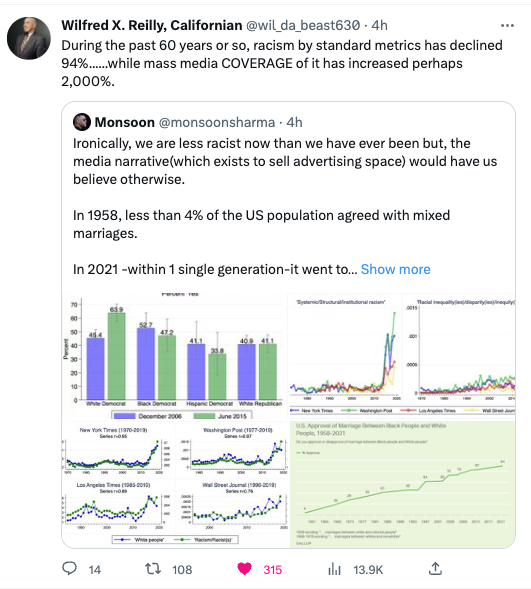
Modern "antiracism" (= CRT = Wokeness) is the opposite of Civil Rights. Dividing people by "color" is as absurd as trying to do surgery with a chainsaw. It also ignores the progress shown by Wilfred Reilly's chart re inter-racial marriage. I abhor any movement that judges people based on immutable traits.

Continue Reading“Anti-Racism” Versus Real Life Statistics

Hollowed-Out

I propose this as a metaphor for a large country whose institutions are being hollowed out.

Continue ReadingHollowed-Out

MLK: Waging Wars Abroad is Inconsistent with Insisting on Non-Violent Protest

Martin Luther King:

As I have walked among the desperate, rejected, and angry young men, I have told them that Molotov cocktails and rifles would not solve their problems. I have tried to offer them my deepest compassion while maintaining my conviction that social change comes most meaningfully through nonviolent action. But they ask — and rightly so — what about Vietnam? They ask if our own nation wasn’t using massive doses of violence to solve its problems, to bring about the changes it wanted. Their questions hit home, and I knew that I could never again raise my voice against the violence of the oppressed in the ghettos without having first spoken clearly to the greatest purveyor of violence in the world today — my own government. For the sake of those boys, for the sake of this government, for the sake of the hundreds of thousands trembling under our violence, I cannot be silent.

"Beyond Vietnam: A Time to Break Silence," given at Riverside Church in New York City on April 4, 1967.

Continue ReadingMLK: Waging Wars Abroad is Inconsistent with Insisting on Non-Violent Protest