The Illusory Truth Effect

Why do we believe things that aren't true? Sometimes, it's a matter of the Illusory Truth Effect: Repeated Exposure to (even false) information becomes easy to process in our brains and that easy processing makes it seem true.

Shane Parish discusses this in his latest post, "The Illusory Truth Effect: Why We Believe Fake News, Conspiracy Theories and Propaganda." Here's an excerpt:

This is how the illusory truth effect works: we all have a tendency to believe something is true after being exposed to it multiple times. The more times we’ve heard something, the truer it seems. The effect is so powerful that repetition can persuade us to believe information we know is false in the first place. . . . [W]e’re often far outside our circle of competence, reading about topics we don’t have the expertise in to assess accuracy in any meaningful way. This drip-drip of information pollution is not harmless. Like air pollution, it builds up over time and the more we’re exposed to it, the more likely we are to end up picking up false beliefs which are then hard to shift. For instance, a lot of people believe that crime, especially the violent kind, is on an upward trend year by year—in a 2016 study by Pew Research, 57% of Americans believed crime had worsened since 2008. This despite violent crime having actually fallen by nearly a fifth during that time. This false belief may stem from the fact that violent crime receives a disproportional amount of media coverage, giving it wide and repeated exposure. When people are asked to rate the apparent truthfulness of news stories, they score ones they have read multiple times more truthful than those they haven’t.

It seems like the repeated exposure creates a slippery path that runs that information quickly and easily through the brain. William James used this type of metaphor of a "path" in his discussion of memory (this is from "Talks to Teachers, Chapter 12, Memory):

Reflection will show you that there are peculiarities in your memory which would be quite whimsical and unaccountable if we were forced to regard them as the product of a purely spiritual faculty. Were memory such a faculty, granted to us solely for its practical use, we ought to remember easiest whatever we most needed to remember; and frequency of repetition, recency, and the like, would play no part in the matter. That we should best remember frequent things and recent things, and forget things that are ancient or were experienced only once, could only be regarded as an incomprehensible anomaly on such a view. But if we remember because of our associations, and if these are (as the physiological psychologists believe) due to our organized brain-paths, we easily see how the law of recency and repetition should prevail. Paths frequently and recently ploughed are those that lie most open, those which may be expected most easily to lead to results. The laws of our memory, as we find them, therefore are incidents of our associational constitution; and, when we are emancipated from the flesh, it is conceivable that they may no longer continue to obtain.

In his incredible opus, The Principles of Psychology, Williams James elaborates this metaphor, writing about the path along with a marble that rolls down the path. Each time the marble rolls down, it smoothens the path a bit more, making it a more and more fast and direct path.

The psychological law of association of objects thought of through their previous contiguity in thought or experience would thus be an effect, within the mind, of the physical fact that nerve-currents propagate themselves easiest through those tracts of conduction which have been already most in use. Descartes and Locke hit upon this explanation, which modern science has not yet succeeded in improving. "Custom," says Locke, "settles habits of thinking in the understanding, as well as of determining in the will, and of motions in the body; all which seem to be but trains of motion in the animal spirits[Pg 564] [by this Locke meant identically what we understand by neural processes] which, once set agoing, continue in the same steps they have been used to, which by often treading are worn into a smooth path, and the motion in it becomes easy and, as it were, natural."[476]

This is a good metaphor for the process of memory, whether or not the memory is about something real in the world or whether the thing remembered is fake news."

I like this phrase Shane Parrish uses in his quote: "information pollution." I'm going add that to my vocabulary.
Continue ReadingThe Illusory Truth Effect

The Hidden Jazz of Groups

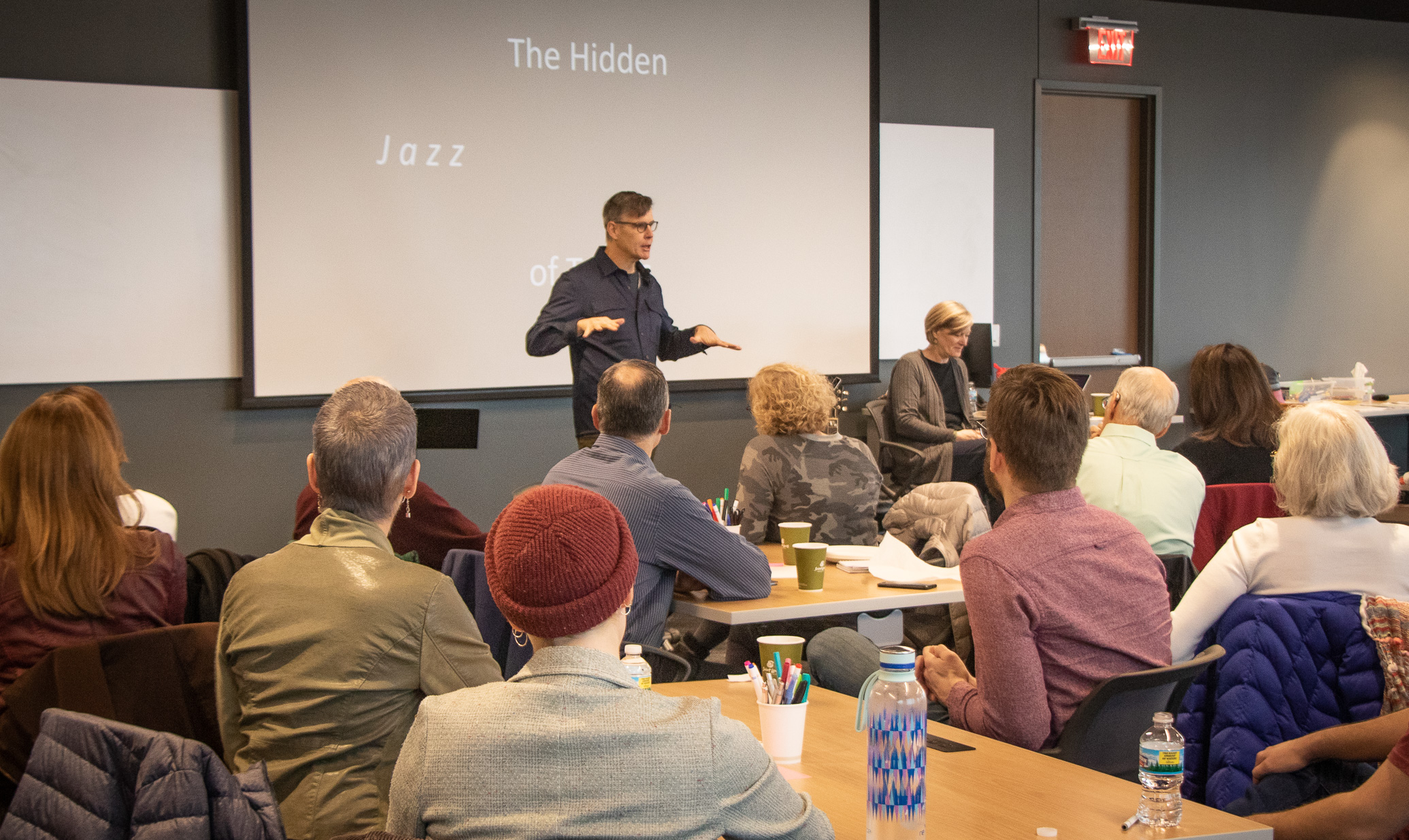
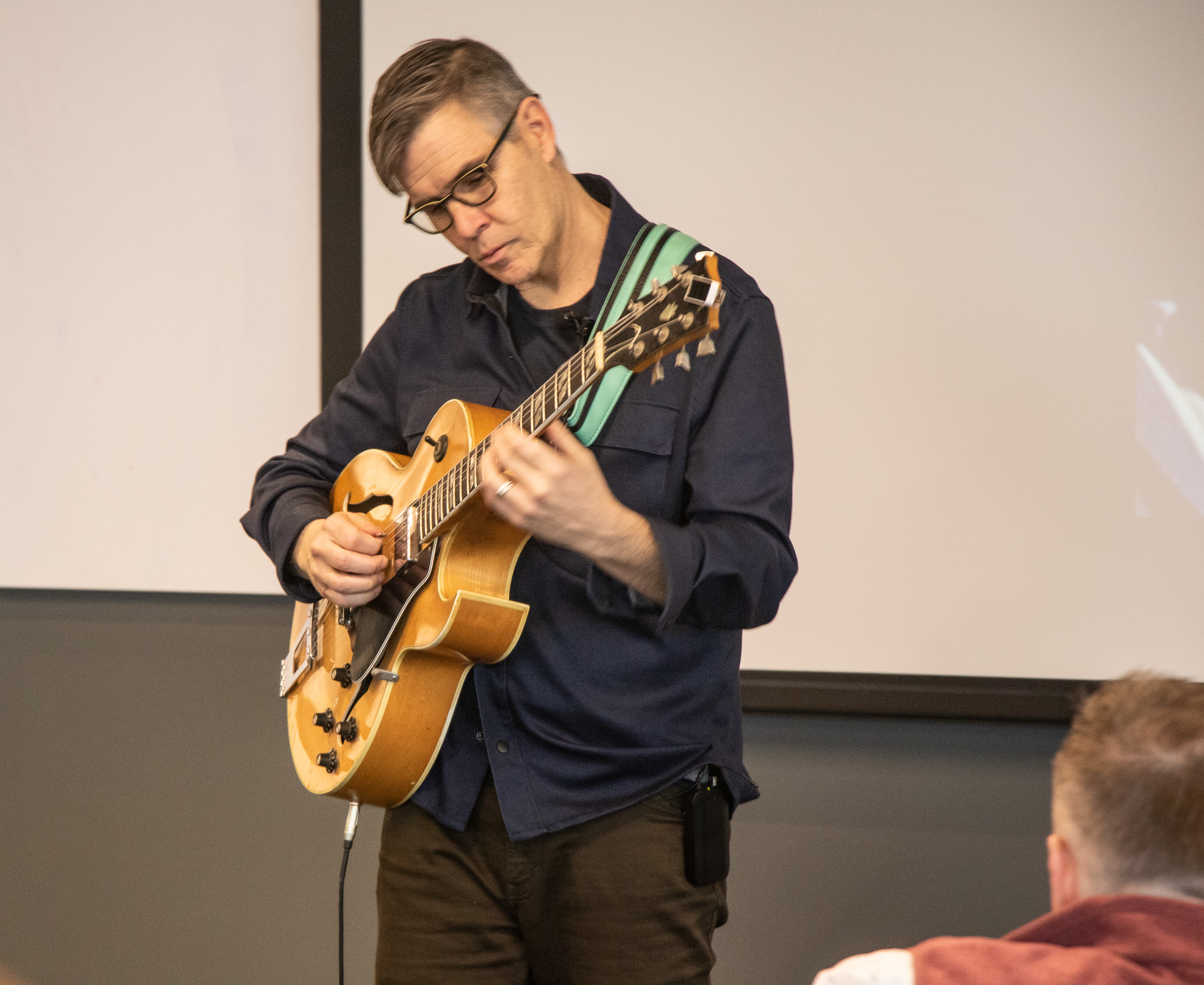
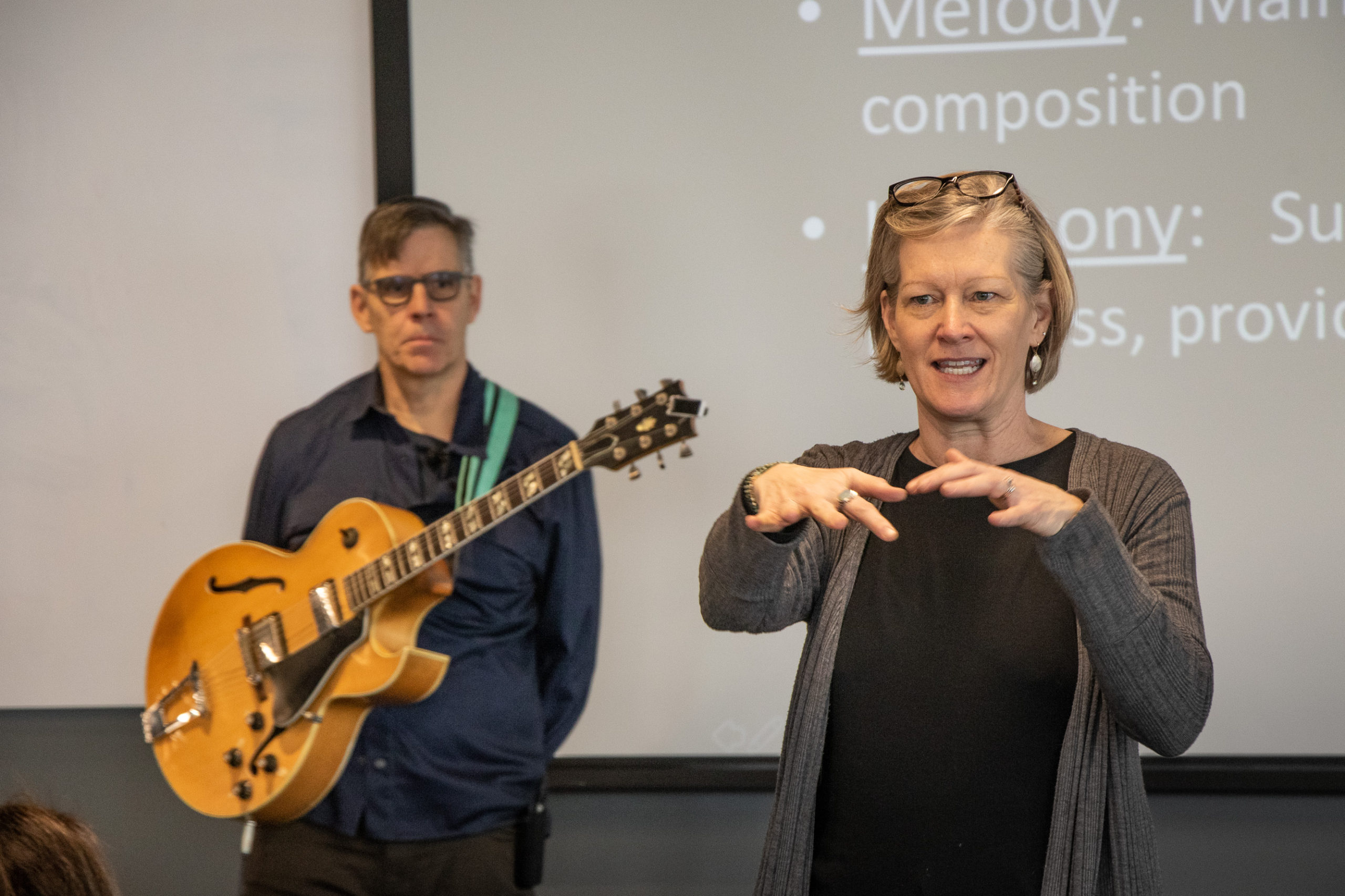
I wore two hats today at a presentation by two of my friends, Dan Rubright and Leslie Peters. I was already planning to attend the “The Hidden Jazz of Groups” presented in the Cortex District of St. Louis. Dan asked me whether I could also shoot some photos of the presentation, which sounded like fun.

Dan and Leslie, who are married to each other, have combined their skillsets into a way that celebrates both individual differences and the magic of collaboration. Dan, who is both an exquisite musician and an educator, began the session by giving his insight into the process of creating jazz, and then moved on to discuss the wide variety of creating and combining sounds to create music. Leslie, an author and speaker on group dynamics, then joined in. It was a smart and unintimidating way to broach the topic of efficient group dynamics. These are a few of my photos from the presentation.

If you click on the video, you'll hear Dan’s impromptu performance of some of his music. His style is truly his own. I’m always delighted by the amount of music he can coax out of a single guitar.

Continue ReadingThe Hidden Jazz of Groups

Kahneman’s Inevitable Heuristics and Powerful Optical Illusions

Today, I was thinking about Daniel Kahneman's Thinking Fast and Slow. I think of this book at least several times each week. It's got to be one of the most important books I have ever read, in that it identifies numerous ways in which people are unwittingly mislead by mental heuristics, i.e., by their intuitions and shortcuts. You might be a bigger threat to yourself than any outsider.

The solution to Kahneman's heuristics is seemingly that we should be more careful or that we should train ourselves so that we are not mislead by these heuristics. Kahneman concludes, unfortunately, that heuristics are too strong to recognize in real time. He characterizes them to be like optical illusions. When we look at them over and over we will be fooled over and over.

Here is one of my favorite optical illusions: The Ames Window. My mind is intransigent. I can't unsee this illusion even though I know exactly what is going on.

Many (e.g., I've heard interviews by Sam Harris and Shane Parrish) have suggested to Kahneman that since we know about these systematic ways in which the mind runs off the rails, we can make adjustments. Kahneman will have none of it. "“The question that is most often asked about cognitive illusions is whether they can be overcome. The message … is not encouraging.”  Kahneman writes further: "Kahneman writes. “We would all like to have a warning bell that rings loudly whenever we are about to make a serious error, but no such bell is available.”

Or consider that Kahneman and Richard Nisbett seem to disagree on whether we can train out our systematic mistakes, yet this article ("The Cognitive Biases Tricking Your BrainScience suggests we’re hardwired to delude ourselves. Can we do anything about it?") suggests that we seem to be more easily trainable with regard to "easy problems."

This is nonetheless, discouraging, right?  Maybe that's why it is a good idea to work with groups of people.  Maybe someone else will catch your mistakes.  And if not, maybe you can catch your mistakes in a post-mortem and then add your mistakes on your check list to help you for the next time the situation arises.

Continue ReadingKahneman’s Inevitable Heuristics and Powerful Optical Illusions

Stinky Farts, Stinky Thoughts

The impeachment hearings offer daily fodder to those who struggle to understand how the human mind works. Many people keep expressing frustration about the lies being told by the politicians. That raises the question: Did the brain evolve as a truth-seeking organ? What if the brain's main function is survival, not truth? What if the brain's main function centers on the "Four F's": Feeding, Fleeing, Fighting and Reproduction?  What if Truth is only a fragile, occasional, happenstance by-product of the brain's main evolved function?

That brought this Scientific American article front and center: "Did Humans Evolve to See Things as They Really Are? Do we perceive reality as it is?" Here's an excerpt:

One of the deepest problems in epistemology is how we know the nature of reality. Over the millennia philosophers have offered many theories, from solipsism (only one's mind is known to exist) to the theory that natural selection shaped our senses to give us an accurate, or verdical, model of the world. Now a new theory . . . is garnering attention . . . Grounded in evolutionary psychology, it is called the interface theory of perception (ITP) and argues that percepts act as a species-specific user interface that directs behavior toward survival and reproduction, not truth.

Lindsey Graham is now taking the position that the Impeachment is improper because not actual crimes were committed. The Democrats then carted out Graham's 1999 video where he said the opposite.  Every human being watching this drama unfold knows all of the following with a certainty:

  1. Graham meant what he said in 1999.
  2. Graham means the opposite today.
  3. Graham won't have much trouble doing some mental gymnastics to justify both positions.
  4. If a Democrat is impeached in the near future, Graham will revert to his 1999 position.

How is it possible for Graham to justify these diametrically opposite positions? The function of the human brain is well beyond my understanding, of course.  At this time, I would simply point out that one's own farts smell OK, whereas the farts of others are unpleasant. There's actually some science on why our own farts smell OK. I would simply extrapolate: Both our farts and our own dysfunctional thoughts get free passes.  Why?  Because they are our farts and our thoughts, not those of others.  And where our entire tribe farts, that's OK too, because it's our tribe and not some other tribe. Our crappy thoughts constitute our theories, meaning that the confirmation bias kicks in like a powerful optical illusion to help us ignore conflicting evidence.

Hypocrisy is an ancient problem, of course.  It goes back at least to biblical times:

Thou hypocrite, first cast out the beam out of thine own eye; ... You hypocrite! First, remove the beam out of your own eye, and then you can see clearly to remove the speck out of your brother's eye.

This hypocrisy continues to modern times:

Morality is difficult. As [psychologist Johnathan] Haidt writes on his website, "It binds people together into teams that seek victory, not truth. It closes hearts and minds to opponents even as it makes cooperation and decency possible within groups. . . . Morality binds and blinds. The metaphor [Haidt] uses to describe this idea is that we are 90 percent chimp 10 percent bee. That is to say, though we are inherently selfish, human nature is also about being what he terms "groupish."

The hypocrisy we are witnessing might be a little less distressing to the extent that we can accept the fact that the brain did not evolve for truth, but rather for assimilating resources to assist survival, utilizing the power of one's tribe whenever useful. If we can wrap our heads around this scary fact that the brain is much more geared for social power than truth, the impeachment hearings are nothing extraordinary. These hearings are merely more episodes of watching people gathered in tribes fighting for evolutionary fitness.

That said, this is an enormous and distressing price to pay in exchange for understanding.  But maybe it's . . . . true.   Maybe those moments where human minds transcend daily survival pressures to seek consistent principled truth are extraordinarily precious moments that need to be noted and celebrated.  Maybe we will never have a society based on truthful principles unless we work hard together.

Nietzsche pointed that being able to see truthfully is a moral issue. He wrote that one is truthful only to the degree that one is courageous. Maybe those fragility of those moments where people work hard and self-critically to embrace truth should remind us to appreciate what we have when politicians show the moral courage to act on principle.

Continue ReadingStinky Farts, Stinky Thoughts