How to Be a Human Animal, Chapter 26: The Magic of Tuna Acceleration and Workspaces

This is Chapter 26 of my advice to a hypothetical baby. And yes, what I'm really doing is acting out the time-travel fantasy of going back give myself some pointers on how to navigate life. If I only knew what I now know . . .  All of these chapters (soon to be 100) can be found here.

You are only 26 days old, but you will someday escape your crib and your room with the same aplomb with which you escaped your mother's womb. And at some point in your adventures as a bipedal ape, you might be lucky enough to see some fish. One thing that I always found amazing is how fast a fish can go from zero to some absurdly fast speed. It turns out that this was explained in Andy Clark's excellent book, Being There: Putting Brain, Body, and World Together Again (1998). I had the opportunity to take four graduate seminars with Andy at Washington University and he excelled at filled our heads with non-stop counter-intuitive observations and explaining them in clear English. Here's how fish can take off like rockets:

The swimming capacities of many fishes, such as dolphins and bluefin tuna, are staggering. These aquatic beings far outperform anything that nautical science has so far produced. Such fish are both mavericks of maneuverability and, it seems, paradoxes of propulsion. It is estimated that the dolphin for example, is simply not strong enough l to propel itself at the speeds it is observed to reach. In attempting to unravel this mystery, two experts in fluid dynamics, the brothers Michael and George Triantafyllou, have been led ro an interesting hypothesis: that the extraordinary swimming efficiency of certain fishes is due to an evolved capacity to exploit and create additional sources of kinetic energy in the watery environment. Such fishes, it seems, exploit aquatic swirls, eddies, and vortices to " rurbocharge" propulsion and aid maneuverability. Such fluid phenomena sometimes occur naturally (e.g., where flowing water hits a rock). But the fish's exploitation of such external aids does not stop there. Instead, the fish actively creates a variety of vortices and pressure gradients (e.g. by flapping its tail) and then uses these to support subsequent speedy, agile behavior. By thus controlling and exploiting local environmental structure, the fish is able to produce fast starts and turns that make our ocean-going vessels look clumsy, ponderous, and laggardly. " Aided by a continuous parade of such vortices," Triantafyllou and Triantafyllou (1995, p. 69) point out," it is even possible for a fish's swimming efficiency to exceed 100 percent." Ships and submarines reap no such benefits: they treat the aquatic environment as an obstacle to be negotiated and do not seek to subvert it to their own ends by monitoring and massaging the fluid dynamics surrounding the hull.

The tale of the tuna reminds us that biological systems profit profoundly from local environmental structure. The environment is not best conceived solely as a problem domain to be negotiated. It is equally, and crucially, a resource to be factored into the solutions. This simple observation has, as we have seen, some far-reaching consequences. First and foremost, we must recognize the brain for what it is. Ours are not the brains of disembodied spirits conveniently glued into ambulant, corporeal shells of flesh and blood. Rather, they are essentially the brains of embodied agents capable of creating and exploiting structure in the world.

This passage brings me to today's advice: Don't just "Do," as Yoda suggests. Prepare your workspace and then "Do" with apparent super powers! Tuna prepare the nearby water by setting up their own currents before tapping into them. Ka-Bang!  Reminds me of the acceleration technique of the cartoon Roadrunner, but tuna acceleration is not fiction.

Continue ReadingHow to Be a Human Animal, Chapter 26: The Magic of Tuna Acceleration and Workspaces

Matt Taibbi: Moral Panics Erase Memories

In "Orwell Was Right: From free speech to "spheres of influence" to our passion for endless war, we've become the doublethinkers 1984 predicted," Matt Taibbi points out how our hair-trigger rage makes us fickle. We are consumed with one thing after the other and we no longer have time to consider nuances or our own contradictions.I have read Taibbi's brilliant analysis three times. I can't stop worrying. Not only about the war, but about the willingness of Americans to enthusiastically embrace double-standards. And then, when they no longer work, we ignore them and embrace new double-standards.

Moral panics erase memories. It’s their primary function. 9/11 wiped the national hard drive of everything from the third degree to My Lai to Operations Phoenix and Condor to the Church Committee to the School of the Americas to countless other shameful episodes, and the lessons learned from them. The Trump-Russia scandal blotted out Snowden, made the spooks the good guys again. 2016 rehabilitated neoconservatives, now reinvented as never-Trumpers, cleaning away the shame of Iraq, Abu Ghraib, Afghanistan, etc.

The “misinformation” panic wiped out the WMD fiasco, restoring honor to credentialed press. The DNC leak erased “Collateral Murder.” After George Floyd we hated cops, after January 6th we loved them. Ukraine now is openly being sold as a blue-pill cure for everything that went wrong during the War on Terror, including the recent defeat in Afghanistan. “Realism” is in disgrace, and “leadership,” “regime change,” and the “universal appeal of freedom” are back, only this time their primary backers are the upper-class cosmopolitan Democrats who marched against the simplistic “freedom against evil” plot neoconservatives tried to sell them twenty years ago.

We’re at the end of a twenty-year cycle that has taken what was once the oppositional-skeptic portion of the American population and seen them rallied behind the people they once hated the most. This has been accomplished by keeping us in a rage that always escalates and is never watered down by contradictions, thanks to mastery of “reality control” via “an unending series of victories over your own memory.”

The relentless parade of panics listed above (just a small sample; we’ve had dozens just in the last few years) makes those victories easy, and every time we switch targets, from Russians to neo-Nazis to cops to transphobes to insurrectionists to the unvaccinated to truckers and back to Russians again, the Church of Forgetting picks up new converts.

I know plenty of people, many of them friends and many of them quite well educated, who now seem to be determining their heartfelt opinions by checking to see what way the wind blows around their social network. It has become extremely disappointing over the past couple of years. It's like their self-critical modules have somehow been flipped to the off position en masse.  For the most part, these are very smart people who have lost their ability to be curious and to make sense of the world around them on their own terms. It's like they've all been dusted with intellectual-coward dust. They no longer have time time or interest to listen to different thinking others. They listen to their own news sources, because other news sources are evil.

They have become hyper-vigilant to identity and difference. They write others off for the tiniest differences of opinion. Nothing less than moral purity will work if you want to be their friend in public. In private, it's somewhat different. In private you'll sometimes hear a different tune, a more measured perspective. I grew up Catholic. It reminds me of Catholics who chant in public that dead people can be alive again and that a virgin can have a baby. In private, they don't bring this stuff up because the chants served their purpose in public as cheap signaling so that they could bask in the social warmth of their group, not as meaningful information.

Productive political conversations are harder to find these days. I'm increasingly hearing the crowd-pleasing emotion-laden bluster leak into private conversations too.  I'm hearing this from people who had been staunch pacifists all their life, people who despised George W. Bush for the deaths he caused with his discretionary and deceitful war. From these same lifelong peace-niks, I am hearing calls to directly confront the Russian military. These are people who were terrified that when Trump did his bravado schtick regarding North Korea, a country that might have had a nuclear bomb or two and might have had a missile or two.  A couple years later, no problem! Ukraine is somehow worth it, even though we are cornering a man who they admit is a megalomanic nihilistic, arrogant hothead with thousands of nuclear bombs and thousands of missiles. Somehow, there is no need to do a cost-benefit analysis regarding Ukraine. And their getting lots of this aggressive talk from news media that leans to the political Left, media that hosts an unending stream of military generals and cheerleaders for the surveillance apparatus. Go figure.

Taibbi's article makes many excellent points. I encourage readers to sit down in a quiet place and to take it in line by line. One of Taibbi's points is that (for complex reasons I don't claim to fully understand) people are becoming much more willing to live only in the present. They are much more willing to seek out the outrage de jure.  "News" media is happy to feed them the newest outrage-of-the-day in order to sell advertisements. I suspect that the willingness to glue one's self to the outrage machine is exacerbated by increasing amounts of mortality salience in the air (Terror Management Theory), which induces people to "circle the wagons," further enabled by the polarizing influences of social media and our bifurcated "news media." We can't ignore COVID, COVID Denialism and COVID hysteria as other contributors to the current climate of mortality salience.

In times of mortality salience, people are looking for a "rock," something upon which they can rely. They are increasingly looking to acceptance by a group or a "group identity" rather than embracing consistent principles (e.g. free speech, the rule of law and Enlightenment principles). Contentment to live in the present is what animals such as dogs excel at. They have no language, thus no need to critique their former positions with their current positions.  Their world is their bowl of food and a someone to pet them on the head. For those who are willing to think fast, refusing to slow down to activate slower analytical thought, what is in front of you at this particular moment is always the only thing.  As Daniel Kahneman described, What You See Is All There Is (WYSIATI).  In recent times, I'm seeing increasing numbers of people who  are not willing to go back to check the hard work of slower, methodical and self-critical thinking. They see slower thinking as an impediment to their preference: impulsive action. Perhaps they have been trained for too many years of watching TV actions shows where heroes tend to be reactive (whereas villians seem to willing to sit down and plan out their diabolical plans).

It's easy to find your tribe these days. For most people it is left versus right wing politics, A versus B.  For increasing numbers of people (many that I personally know), their go-to reaction to danger is increasingly to seek the fast and easy safety of joining a group and parroting its talking points, despite the disastrous track record of this strategy.  For them, the alternative strategy of engaging in heterodox free speech, inviting dissent, seeking out nuances and doing cost-benefit analyses has become heretical. It takes too damned long, despite its excellent track. In fact, for many people, engaging in the free speech that they ostensibly celebrate on the Fourth of July has become treasonous. 

Back to Orwell's double-think. I struggled with this term until I translated it to double standards. There are two types of double-standards: A) my current actions versus my opponent's actions and B) my actions versus my own actions in the past.  A key point by Orwell is that people in a state of crisis become oblivious to their own double-standards. We don't have time for the exquisite thought tools, including skepticism math and the need for evidence, that we learned during the Enlightenment!  Many of the same people who clearly saw the their government lied to them about "weapons of mass destruction" and the "Gulf of Tonkin" incident have become some of the most fervent "believe the government" advocates. This, is despite decades of government lying about wars and decades of media outlets willingly amplifying the drumbeats of war.  They know that they should slow down and be less gullible, but there is not time for that because fear is in the air and you and people who disagree with you are miniature versions of Hitler who you being instructed to hate!  See this podcast where Taibbi discusses his book, Hate, Inc. with Joe Rogan.  All of this makes me wonder . . . are we really changing or is this the way we have always been? I suspect that social media is changing us, causing us to engage in more catastrophic thinking and all of the other things that cognitive behavioral therapy (CBT) is designed to prevent. Whatever the cause, increasing numbers of us seem to be wearing out cognitive dysfunctions as a fashion style, our way of showing each other that we care, even though we don't care enough to get or facts right. That pit in my stomach is trying to tell me that I have already seen (or read about) America's best moments. It appears that all of them are in the rear-view mirror now.  I hope I'm wrong, but it's getting harder and harder to convince me.

Continue ReadingMatt Taibbi: Moral Panics Erase Memories

How to be a Human Animal, Chapter 24: You are a Big Intuitive Elephant Attached to a Tiny Squawky PR Department

Hello again, Hypothetical Baby! I'm back to offer you yet another chapter with a simple lesson. As you grow up, people will question you about some of the decisions you make on “moral.” Issues. By the way, “Moral” is an ambiguous word. We tend to pull it out most often when we are talking about sex, death and distribution of food and the other things you need to stay alive. That reminds me. Someday we will have some good discussions about sex that will consist mostly of letting you watch selected David Attenborough Nature Videos featuring animal sex. You'll find that most human talk about sex is confusing and unhelpful except to let you know that most other people are as awkward discussing it as you will be. I'll give you a one sentence preview. Bank on this: human animal sex is a lot like the sex of other mammals, even though it does not much resemble the exotic sex of snails.

Before we go further on moral decision making, here's a short reminder that I’m trying to teach you things that I did not know while I was growing up. I learned these lessons the hard way. You can find links to all of these (soon to be 100) lessons here.

Now, back to your moral decision-making. After people challenge why you made a particular “moral” decision, you will try to give reasons and words will actually come out of your mouth, but much of the time (to quote "My Cousin Vinny," it will be a bunch of bullshit.

Jonathan Haidt has shown that, for the most part, we don’t make moral decisions using our ability to reason methodically. Moral decision-making is not like math; there is no metric for making moral decisions. Nor does our ability to decide moral issues make use of emotions (which are intricately tied up with our sense of reason, as we discussed in Chapter 11). Most of our moral decision-making is intuitive. Based on sophisticated and entertaining experiments, Haidt has shown that our moral judgements are instantaneous and based on intuitions (akin to what Daniel Kahneman describes as thinking fast). After you’ve made your quick and dirty moral decision, you will employ your slow difficult thinking to concoct excuses that you will publicly present as “reasons” for your decisions.

[More . . . ]

Continue ReadingHow to be a Human Animal, Chapter 24: You are a Big Intuitive Elephant Attached to a Tiny Squawky PR Department

Dozens of Things the Mainstream News Won’t Tell You About Ukraine

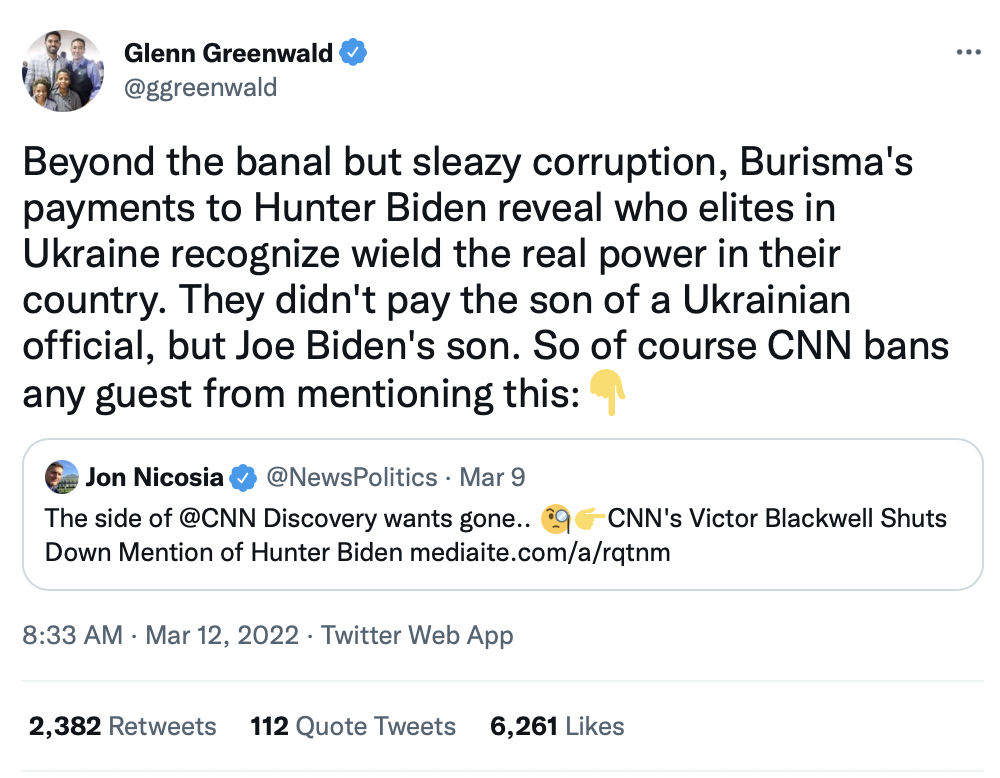
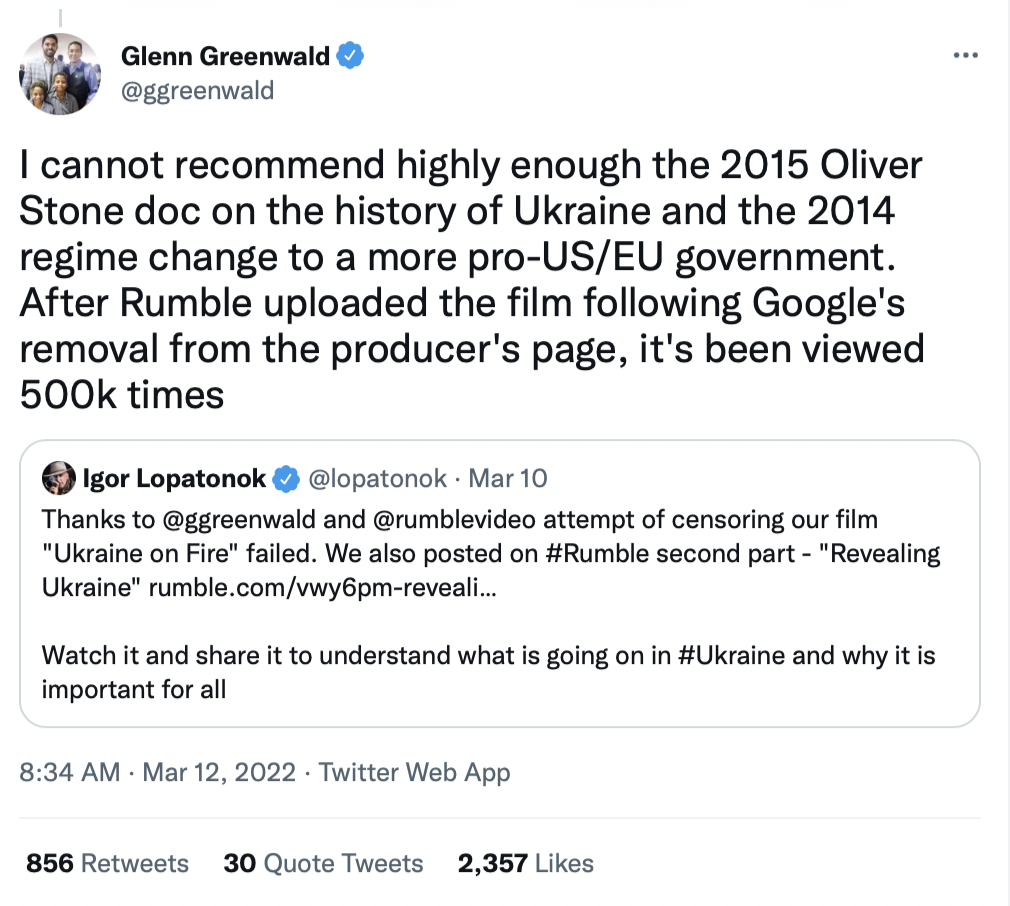
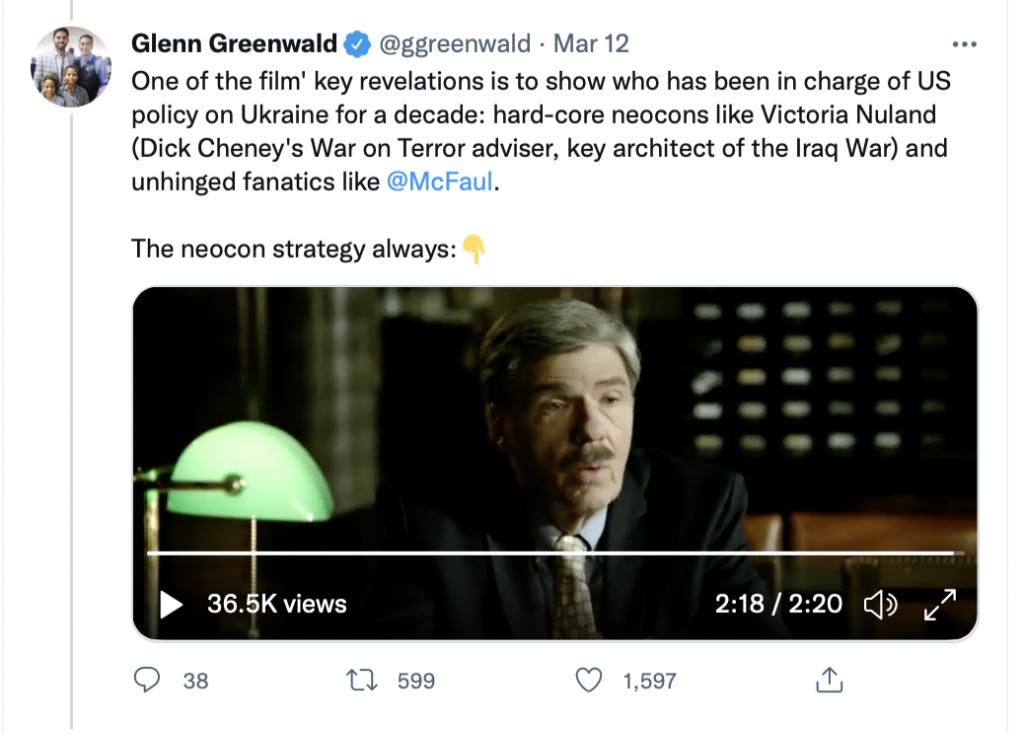
Fascinating thread by Glenn Greenwald. Many topics related to the situation in Ukraine, including Google's decision to take down Oliver Stone's documentary, which discusses the history of U.S. involvement in Ukraine (you can now view it on Rumble).

Many people on the political left would rather feed their brains with DNC-aligned "news." You'll know who they are, because they size up this complex conflict by walking around zombie-eyed uttering things like "Putin is worse than Hitler."  They are getting this "information" from "news" outlets parading out endless streams of retired military generals, all of them beating the war drums to crank up sagging ad revenue in the post-Trump era.  You would think that we would have learned some important and expensive lessons after our Iraq "weapons of mass destruction" post-mortem, but no.

Continue ReadingDozens of Things the Mainstream News Won’t Tell You About Ukraine

The Problem with “Culturally Responsive Education” (CRE) and Other Variants of Neoracism

Dana Stangel-Plowe of the Foundation Against Intolerance and Racism (FAIR) explains:

In our latest video, FAIR’s Dana Stangel-Plowe discusses the issues surrounding a new academic theory called “Culturally Responsive Education.” While intended to connect students with their educational material on a deep level, Stangel-Plowe explains how this new method achieves the opposite by assuming people who superficially look like one another must also think like one another.

[T]he idea of providing kids books that feature characters who look like them feels intuitive as a way to connect them to the material; but building curriculum around students’ skin color, ancestry, or gender raises serious questions about the very purpose of education in our diverse and pluralistic nation.

By making assumptions about what will engage students based on race or immutable traits, CRE is racist. The idea that all people who share the same group identity would also share the same interests, experiences, or beliefs is reductive and demeaning to the unique human beings in that group.

Stangle-Plowe offers a more detailed analysis at FAIR's website:

Despite what some of its proponents would have us believe, CRE is much more than simply a framework for student-centered learning and a celebration of different cultures and cultural ways of knowing. CRE’s focus on “power dynamics,” “social change,” “liberation,” and “equitable outcomes” plainly reveal that critical pedagogy is baked into CRE. Critical pedagogy, popularized by Paolo Freire, is the Marxism-derived school of critical theory applied to education. Thus, it designates K-12 classrooms as the place to start a revolution to dismantle the dominant power structures—meaning our current systems of liberal democracy. Critical pedagogy is explicitly a political ideology—similar to other illiberal ideologies that focus on “liberation” and seek equality of outcomes—aiming to turn students into revolutionary activists.

With CRE becoming widespread, we must consider: Is there a better way to leverage student engagement for success across cultures? And, most importantly, how do we ensure that all students, regardless of their group identities, become “classroom insiders” without dehumanizing them or flattening them into stereotypes—and without replacing learning with activism?

It seems that we are mastering the art of slicing and dicing people culturally in much the same way that Google, Facebook and Amazon are using Billy Ball analytics on their customer bases. I see no problem categorizing people by their interests, such as knitting, pickle ball or art. The problem is with dividing people by irrelevant categories, such as the way they look or (often) the place where they were born. CRE assumes that people are "stuck" in these irrelevant categories and they they want more and more of the same. As Stangle-Plowe states, this is insulting and destructive. I'm proud to say that I am constantly learning many wonderful things from people who look different than me. I'm also proud to say that I don't obsess over what a person looks like. CLE is a well-meaning but destructive to the American Dream that we are one people who can work and play together. E pluribus unum.

Evaluating people based on superficial characteristics is inaccurate and lazy.  We need to avoid all miscategorizations, of course. Because people are extremely complex, it makes no sense to judge them on "race," sex or national origin any more than it would to determine who they are based on astrology.

Our cultural dysfunction based on insanely off-target miscategorizations needs to be cut off at the root, as suggested by Sheena Mason:

FAIR is

a nonpartisan organization dedicated to advancing civil rights and liberties for all Americans, and promoting a common culture based on fairness, understanding and humanity.

In conclusion, I am including FAIR's Principles of Peaceful Change:

FAIR Principles of Peaceful Change

Based on Dr. Martin Luther King Jr.'s Principles of Nonviolence

Exercise Moral Courage. Telling the truth is a way of life for courageous people. Peaceful change cannot happen without a commitment to the truth.

Build Bridges. We seek to win friendship and gain understanding. The result of our movement is redemption and reconciliation.

Defeat Injustice, Not People. We recognize that those who are intolerant and seek to oppress others are also human, and are not evil people. We seek to defeat evil, not people.

Don’t Take the Bait. Suffering can educate and transform. We will not retaliate when attacked, physically or otherwise. We will meet hate and anger with compassion and kindness.

Choose Love, Not Hate. We seek to resist violence of the spirit as well as the body. We believe in the power of love.

Trust in Justice. We trust that the universe is on the side of justice. The nonviolent resister has deep faith that justice will eventually win.

Continue ReadingThe Problem with “Culturally Responsive Education” (CRE) and Other Variants of Neoracism