Bret Weinstein Offers an Explanation for his COVID Disagreements with Sam Harris

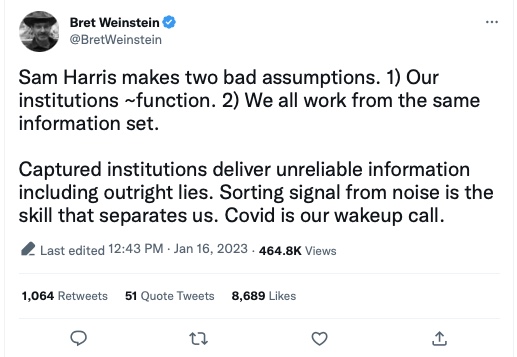
As I see it, Sam Harris, who I have much admired over the years, has somewhat fallen off the rails on COVID, Free Speech and Trump. It happens to all of us, some of the time. I hope he can settle himself and get back in the game. In the meantime, Harris and Bret Weinstein have been struggling to figure out why they have had recent pointed disagreements. Bret's Tweet offers a reason for their disagreements:

Jimmy Dore dissects Sam Harris' recent strange discussion about COVID (starting at hr./min. 2:51). This is about a strange as Sam Harris' recent discussion regarding Hunter Biden's laptop. Glenn Greenwald links to the video clip of Harris and offers this commentary:

All of this stems from the classic mentality of all would-be tyrants: our enemies are so dangerous, their views so threatening, that everything we do – lying, repression, censorship – is noble. That's what made the Sam Harris confession so vital: that's how liberal elites think.

Continue ReadingBret Weinstein Offers an Explanation for his COVID Disagreements with Sam Harris

FIRE Comments on the Forbidden Words of Stanford University

Excerpt from an Article by FIRE (Foundation for Individual Rights and Expression):

By now, much has been written about the words and phrases Stanford removed from its website for their potential to cause harm. “That was insane!” isn’t palatable, because “This term trivializes the experiences of people living with mental health conditions.” What to do when referring to a whitelisted or blacklisted IP address? Try “allowlist/denylist,” because the former terms “[a]ssign value connotations based on color (white = good and black = bad), an act which is subconsciously racialized.” You get the idea. “American,” “dumb,” and “lame” are out, too . . . .

Last week, after the list became public and backlash mounted, Stanford announced it would conduct a review of the guide. The statement from Chief Information Officer Steve Gallagher clarified the website does not represent Stanford University policy. “It also does not represent mandates or requirements,” Gallagher wrote. The list simply provides “suggested alternatives.” “But, we clearly missed the mark,” Gallagher concedes. “We value the input we have been hearing, from a variety of perspectives, and will be reviewing it thoroughly and making adjustments to the guide.”

While FIRE is, of course, relieved to hear these alternatives are not required, the inherent infantilization of steering adults away from words and phrases like “tone deaf” and “mailman” is troubling. By prematurely wading into conversations and deeming words and phrases offensive on behalf of its adult students, Stanford deprives its community members the chance to build resilience and talk through the issues of the day without having to constantly worry about stepping on rakes.

We think institutions of higher education better serve students by not inserting themselves in language debates that are almost certain to produce a “Streisand effect,” occurring when more attention is brought to forbidden words and phrases in the effort to silence them. FIRE recommends a culture of trust, not coddling....

In 2016, Nick Haslam coined the term “concept creep” to describe the tendency for the semantic range of harm-related concepts to expand over time. In other words, the meaning of concepts such as “trauma,” “bullying,” and “violence” has broadened to include ever milder, subtler phenomena.

[More . . . ]

Continue ReadingFIRE Comments on the Forbidden Words of Stanford University

Quotes by Mark Twain & Carl Sagan & Upton Sinclair

Three quotes for Today. Twain and Sagan quotes are quite similar, worth mentioning them both in this day and age. These are three of my favorite quotes:

“It’s easier to fool people than to convince them that they have been fooled” – Mark Twain

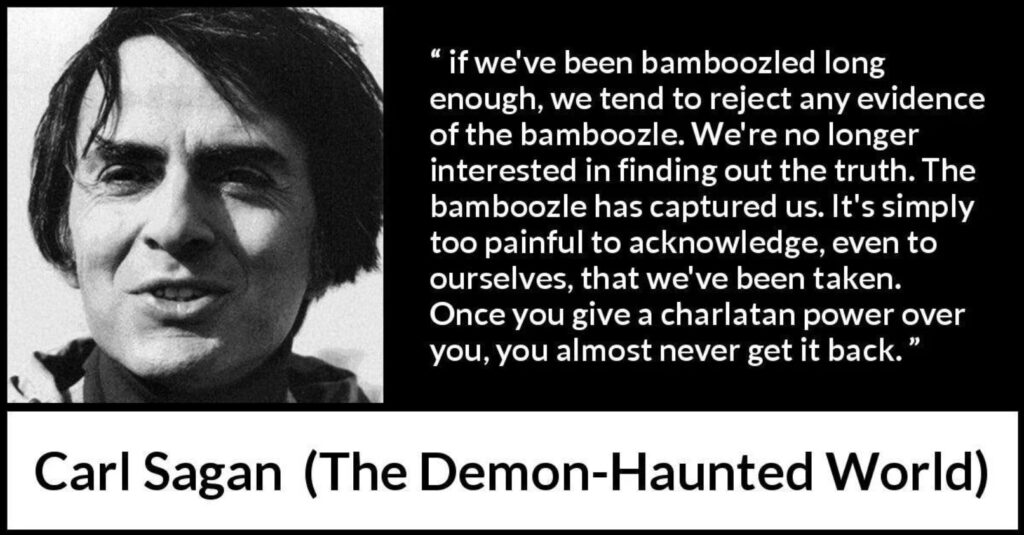
“If we've been bamboozled long enough, we tend to reject any evidence of the bamboozle. It’s simply too painful to acknowledge, even to ourselves, that we’ve been taken. Once you give a charlatan power over you, you almost never get it back.” ― Carl Sagan

“It is difficult to get a man to understand something, when his salary depends on his not understanding it.” - Upton Sinclair

Continue ReadingQuotes by Mark Twain & Carl Sagan & Upton Sinclair

Diagnosing Woke Ideologists

Josh Slouch lost a job he loved. In his current essay, he indicates that a Woke Mob came after him. He writes:

What was my sin? Had I hung a noose from the rearview mirror of my Prius? Did I assault a trans person? Did I don blackface and drop the n-bomb? No. It was more sinister than that. They discovered that I, a gay man, host a conservative podcast.

If you're wondering how a progressive gay liberal became a libertarian conservative, the story of that political transformation will be told on my Substack soon.

I'll be on the lookout for that forthcoming article. In the meantime, Josh has contemplated the types of people who joined the Woke Mob that cost him his job. Here's how he diagnoses them:
I believe part of the answer to this complicated question lies in the normalization of a type of psychology that drives domestic abuse known as Cluster B personality disorders. These include narcissistic personality disorder, borderline personality disorder, histrionic personality disorder, and anti-social personality disorder. The symptoms of these disorders are diverse and overlapping, and people with them engage in conflict, deception, abuse and mistreatment of others (almost always while claiming they themselves are victims).

These are more than “difficult people.” They are impossible, and often dangerous, people. A quick glossary of the Cluster B disorders. There is a lot of overlap in symptoms among them:

Narcissistic Personality Disorder—self-centered, vain, may be a braggart or may be the type that acts like a very special put-upon victim. The world revolves around them, and others are objects to be used, not people to love or respect.

Borderline Personality Disorder—extreme emotional instability, laughing one minute, crying or screaming the next. Borderlines fear abandonment but engineer conflicts with everyone around them until they fulfill their own fear of being rejected. Think “I hate you/don't leave me.”

Histrionic Personality Disorder—Big emotions about everything all the time. Life events are over-dramatized. Minor disagreements become relationship-shattering cataclysms. Histrionics are often sexually seductive and go beyond flirtation in acting out for attention.

Anti-social Personality Disorder—also known as “sociopathy” or “psychopathy.” An absence of conscience or empathy. Antisocials lead a parasitic life draining money and time from others. Many are criminals. Others stay within the law but torment their families and colleagues to get what they want.

Continue ReadingDiagnosing Woke Ideologists