
New Study Regarding Tribalism in Politics

New study by Bernstein, Zambrotta, Martin, & Micalizzi on political tribalism. Disturbing and not surprising to anyone who has eyes and ears. Title is: "Tribalism in American Politics: Are Partisans Guilty of Double-Standards?"

Here is the discussion section:

Across experiments, we found strong evidence for the existence of political tribalism and the application of double-standards. In Study 1, we found that tribalism occurs for the perceived legitimacy of hypothetical election outcomes. When asked whether Donald Trump or Joe Biden would be the legitimate president under three different scenarios, Republicans viewed Trump as more legitimate than Biden while Democrats viewed Biden as more legitimate than Trump. Similarly, in Study 2 Part 1, Republicans supported identical presidential policies and actions more under Donald Trump than Barack Obama while Democrats supported identical policies and actions more under Barack Obama than Donald Trump.

A noteworthy element this study is that each item was, in fact, true under both Presidents, which highlights the study’s real-world importance and is an important contribution over prior experiments. In Study 2 Part 2, we showed that Republicans viewed identical statements attributed to Bill Clinton as more bigoted than those attributed to Donald Trump while Democrats viewed the statements as more bigoted when attributed to Trump instead of Clinton. Further, Republicans viewed a statement advocating colorblindness to be generally not racist when attributed to either Dr. Martin Luther King (MLK) or Donald Trump (though racism scores were slightly higher in the latter condition); Democrats also viewed the statement as low in racism when attributed to MLK, but the racism score increased drastically when attributed to Trump. Taken together, these studies suggest that tribalism permeates many aspects of political life and discourse. Policy agreement differs according to the person enacting the policy. Perceptions of racism and xenophobia depend on the person who utters the statement. Alarmingly, even the perceived legitimacy of elections is dependent upon the winner; that is, people assign different standards for election legitimacy depending upon whether their preferred candidate wins or loses. Moreover, some of these effects are rarely seen in the social or cognitive sciences (e.g., Fs>250 when sample size <150), which suggests that tribalism plays a large role, at least in certain contexts.

Our main interest was in documenting if bias exists among each side of the political aisle. However, the study does invite us to ask which side exhibits greater tribal bias . . . To the degree that our results can help weigh in on this question, there was some indication that bias is higher among Democrats, which we call “left-leaning asymmetry”
Continue ReadingNew Study Regarding Tribalism in Politics

The Paradox of Human Connection

Maria Popova, writing at The Marginalian:

The hardest thing in life isn’t getting what we want, isn’t even knowing what we want, but knowing what to want. We think we want connection, but as soon as contact reaches deeper than the skin of being, we recoil with the terror of vulnerability. There is no place more difficult to show up than where marrow meets marrow. And yet that is the only place where two people earn the right to use the word “love.” Our avoidance of that terrifying, transcendent place holds up a mirror to our most fundamental beliefs about life and love, about what we deserve and what we are capable of, about reality and the landscape of the possible.

Continue ReadingThe Paradox of Human Connection

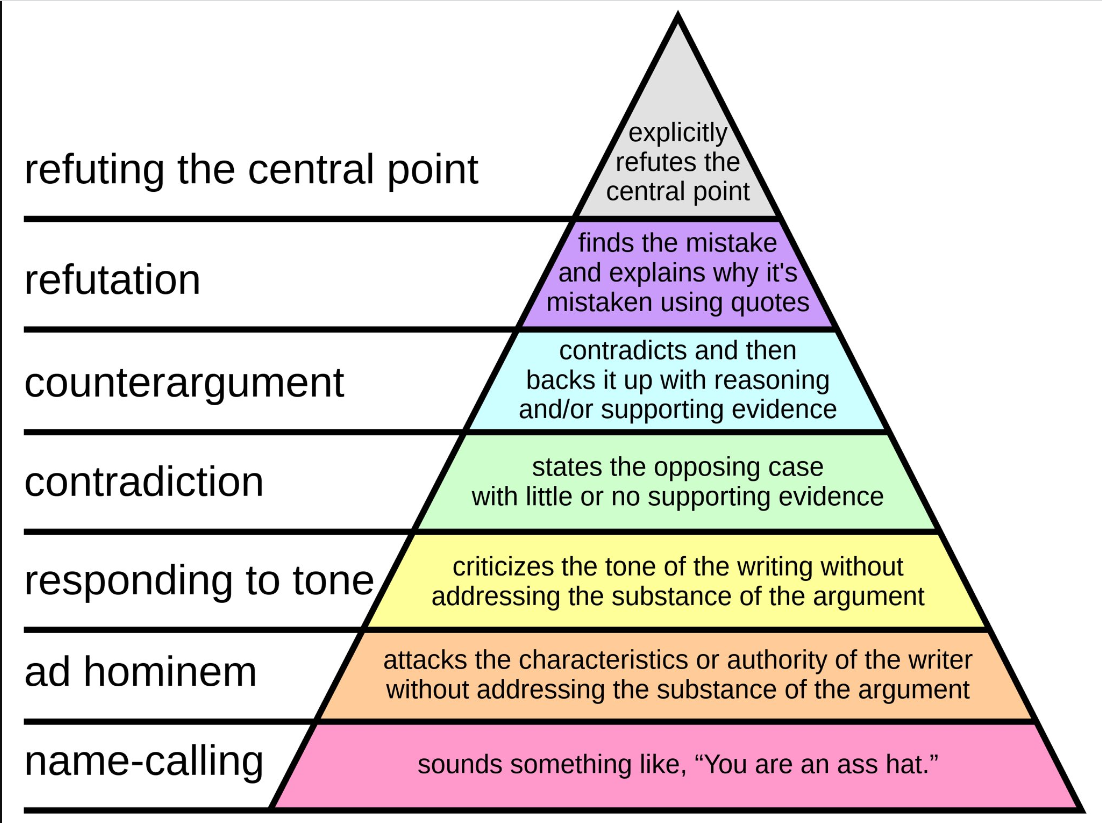
Argument Pyramid: Deploy in Case of Ad Hominem Attacks

This pyramid is an elegant response to shitstorms of ad hominem attacks.

If your response is "this pyramid sucks," it's especially for you.

Credit for this meme goes to Paul Graham, a computer scientist, essayist, entrepreneur, venture capitalist, and author.

Continue ReadingArgument Pyramid: Deploy in Case of Ad Hominem Attacks

The Mental Health Challenges of Liberal Girls

Janathan Haidt, writing at his new Substack:

In conclusion, I believe that Greg Lukianoff was exactly right in the diagnosis he shared with me in 2014. Many young people had suddenly—around 2013—embraced three great untruths:

They came to believe that they were fragile and would be harmed by books, speakers, and words, which they learned were forms of violence (Great Untruth #1).

They came to believe that their emotions—especially their anxieties—were reliable guides to reality (Great Untruth #2).

They came to see society as comprised of victims and oppressors—good people and bad people (Great Untruth #3).

Liberals embraced these beliefs more than conservatives. Young liberal women adopted them more than any other group due to their heavier use of social media and their participation in online communities that developed new disempowering ideas. These cognitive distortions then caused them to become more anxious and depressed than other groups. Just as Greg had feared, many universities and progressive institutions embraced these three untruths and implemented programs that performed reverse CBT on young people, in violation of their duty to care for them and educate them.

See also, this article discussing (among other things) The Coddling of the American Mind, by Haidt and Lukianoff.

Continue ReadingThe Mental Health Challenges of Liberal Girls

TikTok Tics and Social Contagion

Reported by the Daily Wire:

A new paper published earlier this month in Comprehensive Psychiatry proposed that “social contagion” through prolonged social media use can explain why some teens, mostly adolescent females, self-diagnose with rare mental illnesses and personality disorders online.

The paper proposes that social media platforms like TikTok, whose core user base are teen girls, and the popularity of online communities that glamorize mental illness, may act as a “spread vector” for adolescents to adopt various disorders as part of their online personas.

Continue ReadingTikTok Tics and Social Contagion