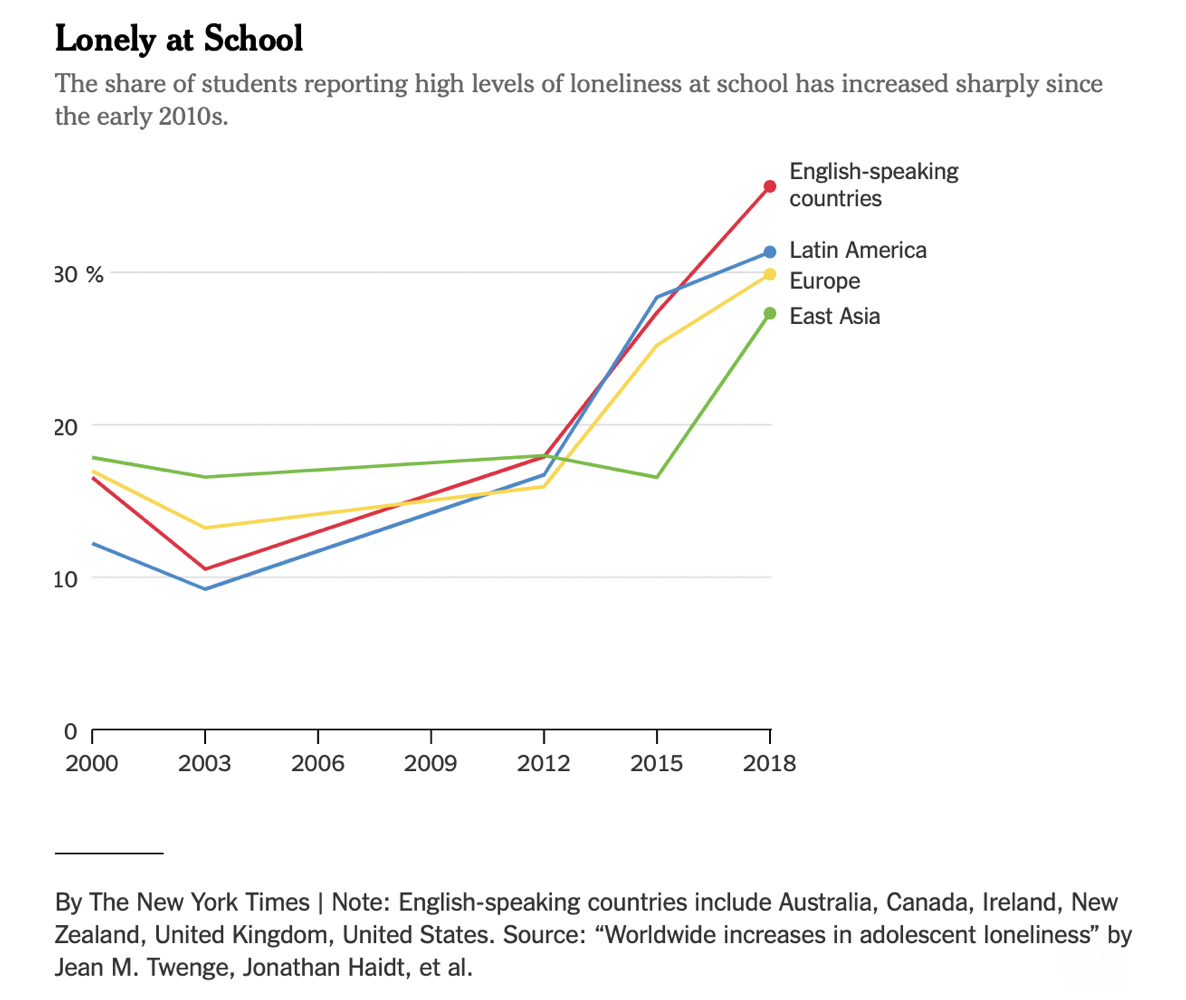
Teenage loneliness was relatively stable between 2000 and 2012, with fewer than 18 percent reporting high levels of loneliness. But in the six years after 2012, rates increased dramatically. They roughly doubled in Europe, Latin America and the English-speaking countries, and rose by about 50 percent in the East Asian countries . . .
All young mammals play, especially those that live in groups like dogs, chimpanzees and humans. All such mammals need tens of thousands of social interactions to become socially competent adults. In 2012 it was possible to believe that teens would get those interactions via their smartphones — far more of them, perhaps. But as data accumulates that teenage mental health has changed for the worse since 2012, it now appears that electronically mediated social interactions are like empty calories. Just imagine what teenagers’ health would be like today if we had taken 50 percent of the most nutritious food out of their diets in 2012 and replaced those calories with sugar.
So what can we do? We can’t turn back time to the pre-smartphone era, nor would we want to, given the many benefits of the technology. But we can take some reasonable steps to help teens get more of what they need.
Christopher Rufo reports on escalating homelessness in San Francisco. As he reports, the city has tried many approaches, yet nothing seems to be working. It is, indeed, an incredibly complex issue that is taxing experts from many specialties. In his article at Real Clear Investigations, Rufo offers many facts and figures, as well as a concern that the currently favored approach, destigmatizing hopelessness and addiction, leads only to more of the same. Here are two excerpts:
The nexus between homelessness, addiction, and crime is clear: According to city and federal data, virtually all of the unsheltered homeless are unemployed, while at the same time, those with serious addictions spend an average of $1,256 to $1,834 a month on methamphetamine and heroin. With no legitimate source of income, many addicts support their habit through a “hustle,” which can include fraud, prostitution, car break-ins, burglaries of residences and business, and other forms of theft.
Boudin’s plan to decriminalize such property offenses – the mirror opposite of the low-tolerance “broken windows” approach adopted in the late 1980s as crime rates began historic declines – has contributed to the sense that he is not holding criminals accountable. In 2019, the city had an incredible 25,667 “smash-and-grabs,” as thieves sought valuables and other property from cars to sell on the black market. The following year, rather than attempt to prevent or even disincentivize this crime, Boudin has proposed a $1.5 million fund to pay for auto glass repair, arguing that it “will help put money into San Francisco jobs and San Francisco businesses.” In literal terms, Boudin is subsidizing broken windows, under the notion that it can be transformed into a job-creation program.
. . .
The final plank of San Francisco’s policy platform is “destigmatization.” Public health experts in the city have gradually abandoned recovery and sobriety as the ideal outcome, preferring the limited goal of “harm reduction.” In a recent task force report on methamphetamine, the San Francisco Public Health Department noted that meth users “are likely to experience high levels of stigma and rejection in their personal and social lives,” which are “often reinforced by language and media portrayals depicting individuals who use alongside images of immorality, having chaotic lives, and perpetual use.”
On the surface, this is a strange contention. If San Francisco’s perilous trifecta is any guide, methamphetamine use is heavily correlated with chaotic lives, perpetual drug abuse, crimes against others, and various transgressions against traditional morality. The harm reductionists’ argument, however, rests on the belief that addiction is an involuntary brain disease, akin to Alzheimer’s or dementia. In this view, addiction is better seen as a disability, and any stigma associated with it is therefore an act of ignorance and cruelty. According to the Department of Public Health, the goal of harm reduction policy is to reduce this unjustified stigma and focus public policy on “non-abstinence-based residential treatment programs,” “supervised injection services,” “trauma-informed sobering site[s],” and “training for staff on how to engage marginalized or vulnerable communities in ways that do not perpetuate trauma or stigma.”
There's a lot of accusations that Americans on both the political right and left are now members of "Cults." What exactly is a cult? After doing a bit of research, I found these helpful descriptions / definitions / traits of Cult Leaders and their followers from the Cult Education Institute. The following material is from the CEI webpage titled "Warning Signs":
Ten warning signs of a potentially unsafe group/leader.
Absolute authoritarianism without meaningful accountability.
No tolerance for questions or critical inquiry.
No meaningful financial disclosure regarding budget, expenses such as an independently audited financial statement.
Unreasonable fear about the outside world, such as impending catastrophe, evil conspiracies and persecutions.
There is no legitimate reason to leave, former followers are always wrong in leaving, negative or even evil.
Former members often relate the same stories of abuse and reflect a similar pattern of grievances.
There are records, books, news articles, or television programs that document the abuses of the group/leader.
Followers feel they can never be "good enough".
The group/leader is always right.
The group/leader is the exclusive means of knowing "truth" or receiving validation, no other process of discovery is really acceptable or credible.
Ten warning signs regarding people involved in/with a potentially unsafe group/leader.
Extreme obsessiveness regarding the group/leader resulting in the exclusion of almost every practical consideration.
Individual identity, the group, the leader and/or God as distinct and separate categories of existence become increasingly blurred. Instead, in the follower's mind these identities become substantially and increasingly fused--as that person's involvement with the group/leader continues and deepens.
Whenever the group/leader is criticized or questioned it is characterized as "persecution".
Uncharacteristically stilted and seemingly programmed conversation and mannerisms, cloning of the group/leader in personal behavior.
Dependency upon the group/leader for problem solving, solutions, and definitions without meaningful reflective thought. A seeming inability to think independently or analyze situations without group/leader involvement.
Hyperactivity centered on the group/leader agenda, which seems to supercede any personal goals or individual interests.
A dramatic loss of spontaneity and sense of humor.
Increasing isolation from family and old friends unless they demonstrate an interest in the group/leader.
Anything the group/leader does can be justified no matter how harsh or harmful.
Former followers are at best-considered negative or worse evil and under bad influences. They can not be trusted and personal contact is avoided.
I recently watched the new documentary, "The Social Dilemma." which has inspired me to cut my usage of Facebook. Rather than simply scold myself to cut FB usage, I decided to create more detailed guidance for myself (and anyone else who finds this useful):
Facebook Safe-Usage Product Warnings
A. Use FB no more than 10 minutes per day (extra time allowed for posting content I create and for exchanging private messages). Set a timer. This limited use will function like the rule many people use for potato chips: Put a handful into a small bowl instead of gobbling them out from the full bag.
B. Before any FB session, remind myself that FB is a valuable and useful platform with serious hidden dangers. Thus, using FB is like using a dangerous consumer product where the manufacturer failed to attach necessary usage warnings.
C. Remind myself that FB has been meticulously designed as a highly-sophisticated manipulation engine. In the short run, FB is addictive. In the long run, FB encourages us to think like teams instead of as individuals and this it is ripping our communities apart.
D. Only use FB intentionally, never out of boredom, out of habit or thoughtlessly. Don’t use FB unless I’m using it consciously. Avoid using FB when I’m tired or fatigued, because these are times when I am especially prone to go down the FB rabbit hole.
E. Before using FB, always ask myself whether there is a better use of my time, such as directly reaching out to a friend or choosing my own next thought process.
F. Do not access FB from my phone.
G. Keep all FB notifications turned off, except for private messages.
H. Use FB for several defined purposes only. If I stray from these purposes, turn FB off.
1. Checking out what is up with people I know well.
2. Interacting with thoughtful people.
3. Reading and sharing interesting, inspiring and light-hearted posts.
4. Connecting with special-interest FB Groups that I have consciously chosen to join.
5. Keeping an eye on FB Events that I might want to attend.
6. Sharing my photography and articles I’ve written at Dangerous Intersection.
7. Sharing well-written articles that I have found outside of FB.
I. Whenever on FB, I should strive to use the same tone and degree of kindness that I use when communicating with someone in person.
J. My FB friends will mostly be feeding me a steady diet of articles that reenforce my existing opinions. Therefore, I need to remind myself to always look beyond FB to seek out diverse sources of information, including news sources that are not in my comfort zone.
K. Repeatedly remind myself that FB’s algorithms delude users into believing that those with differing opinions are idiots who we are entitled to treat rudely.
L. Whenever I sense that I am caught in a cycle of doom-scrolling, I should shut off FB.
M. Always vet articles for accuracy before sharing anything on FB.
N. Remind everyone I meet to watch the important new documentary: The Social Dilemma.
Hello, I invite you to subscribe to Dangerous Intersection by entering your email below. You will have the option to receive emails notifying you of new posts once per week or more often.