Ukraine, U.S. Foreign Policy and the Problem with Whataboutism

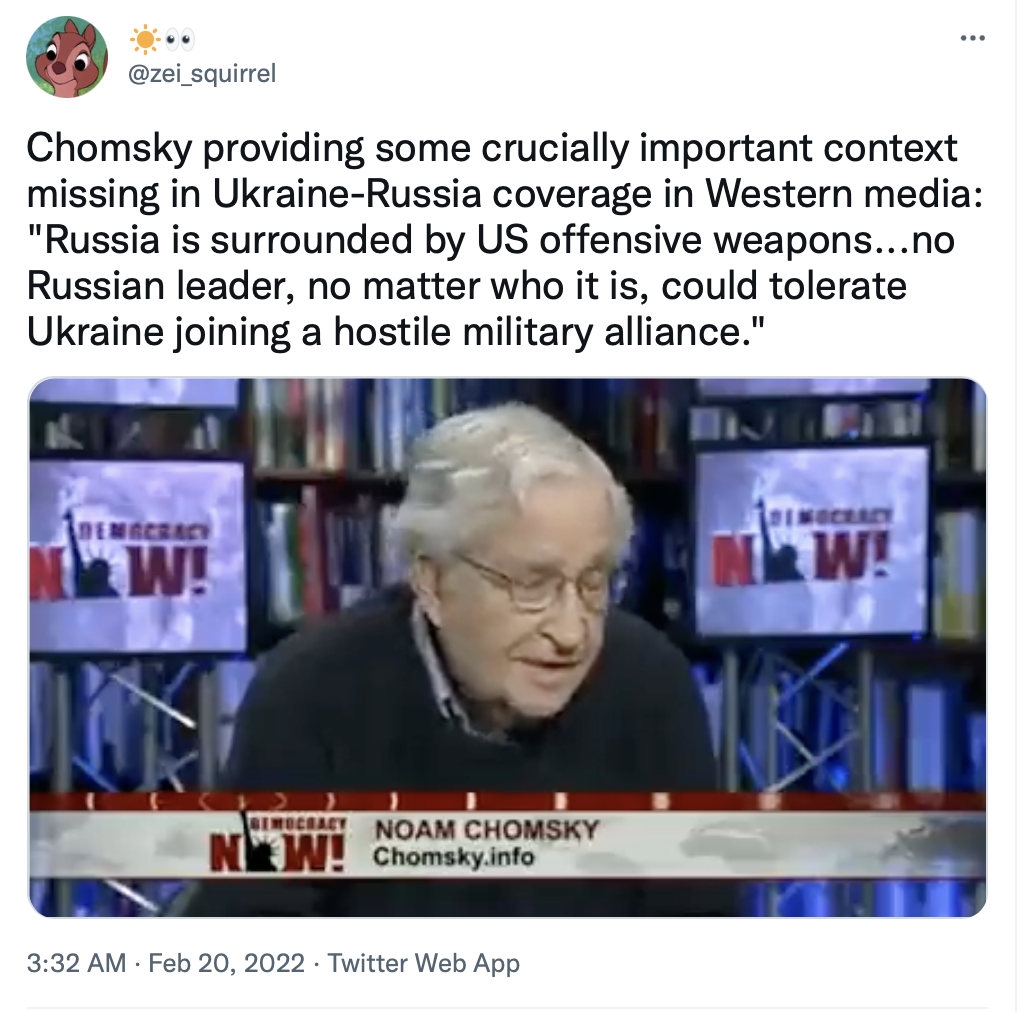
I'll start by saying that Putin is a bad actor who is acting aggressively and killing innocent people. But I also need to add that George W. Bush and Dick Cheney are war criminals. Is there really a problem saying both of these things? Turns out that I'm going light on the United States here. As Noam Chomsky recently stated, the United States thinks that it owns the entire world.

What's good for the goose is good for the gander. Except in today's tribal crazed environment, where the U.S. is entitled to protect its borders through its militarily-enforced hyper-extended sphere of influence but Russia is not allowed to resist NATO's death machines from being parked on its own borders, "because Putin is Hitler." End of Argument. Freddie DeBoer expands on a story about mass hysteria, fact-denial and hypocrisy that risks getting all of us physically roasted in a nuclear holocaust:

The people who say “whataboutism” don’t want to talk about carpet bombing in Cambodia. They don’t want to talk about death squads in El Salvador. They don’t want to talk about reinstalling the Shah in Iran. They don’t want to talk about the murder of Patrice Lumumba in the Congo. They don’t want to talk about giving a hit list to rampaging anti-Communists in Indonesia. They don’t want to talk about the US’s role in installing a far-right government in Honduras. They don’t want to talk about US support for apartheid in South Africa. They don’t want to talk about unexploded ordnance that still kills and maims in Laos. They don’t want to talk about supporting the hideously corrupt drug lord post-Taliban regime in Afghanistan. They don’t want to talk about aiding literal Nazis and Italian fascists in taking over the government in Albania. They don’t want to talk about giving support to the far-right government’s “dirty war” in Argentina. They don’t want to talk about the US-instigated far-right coup in Ghana. They don’t want to talk about our illegal bombing of Yugoslavia. They don’t want to talk about centuries of mistreatment of Haiti, such as sponsoring the coup against Aristide. They don’t want to talk about sparking 36 years of ruinous civil war, and attendant slaughters of indigenous people, in Guatemala. They don’t want to talk about our drone war in Pakistan. They don’t want to talk about how much longer this list could go on. So when do we talk about that stuff, exactly? . . .

Well, OK, fine: I denounce Putin. I denounce his invasion. I support neither and have never suggested I did. Now will you, dear reader, denounce the oceans of blood the United States has spilled in pursuit of its own selfish interests, in the past century? Or do you have some jury-rigged excuse for every American crime I listed above and all the ones I didn’t have space to fit?

If you want the world to operate under the principle of self-determination of countries, you need to start with the country that is the indisputably most powerful and influential country on earth. And if you’re American your first priority and greatest influence lies in America’s government. I will repeat myself in saying that, if you don’t want to acknowledge our role in the world, it’s so much better simply to say, “I’m an American, I think America comes first, I don’t care about the wrong we do, love it or leave it.” That’s not a very enlightened attitude, but it has the benefit of a certain grim integrity, of plainfaced honesty. To insist that you care about self-determination and the principles of non-interference, and to maintain that the United States has the moral authority to opine about them, and to ignore our bloody history… for me, personally, it’s a bridge too far.
Continue ReadingUkraine, U.S. Foreign Policy and the Problem with Whataboutism

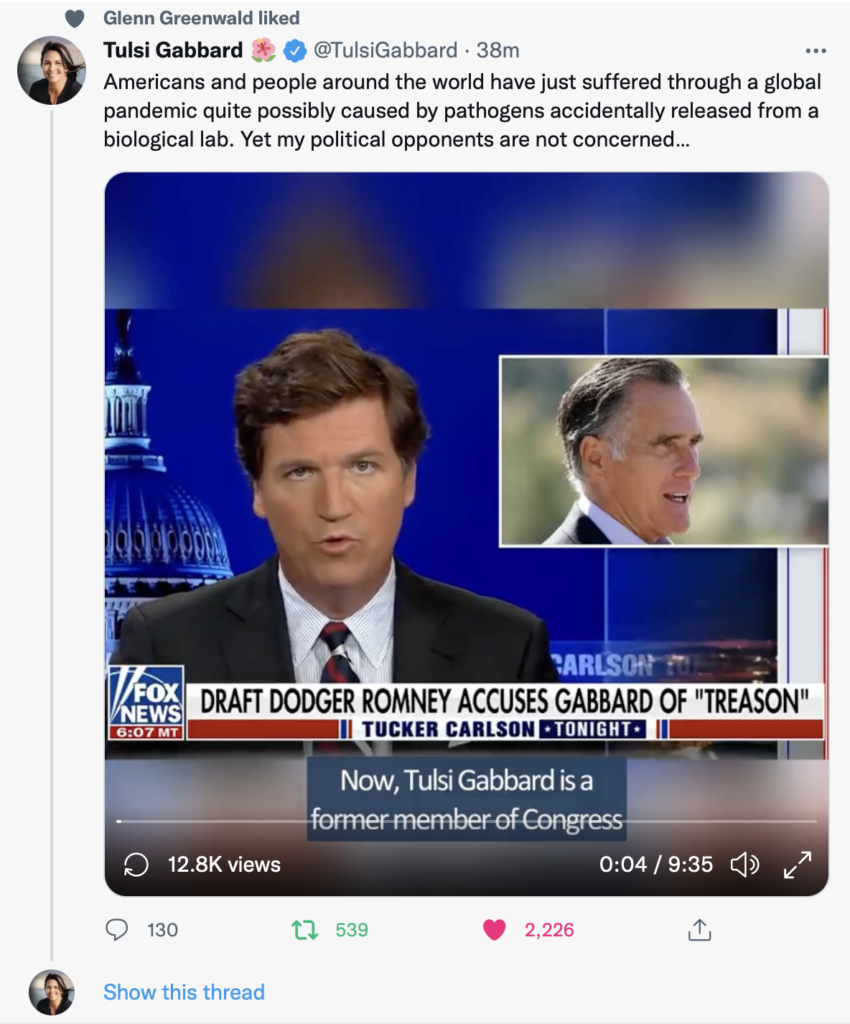
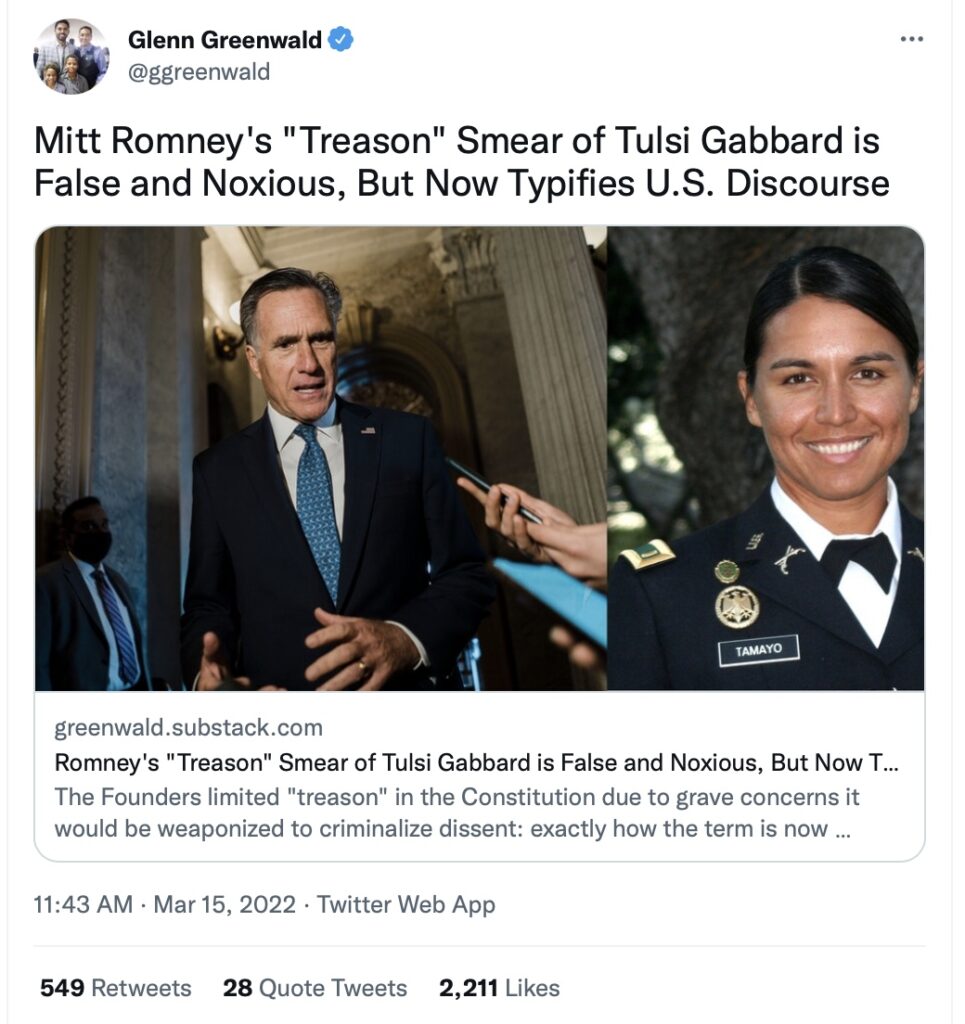
Tulsi Gabbard Accused of Treason After She Expresses Concerns About the Release of Pathogens from Ukraine Biolabs.

This is typical of the insanity that one hears when war is in the air. Mitt Romney and the geniuses at The View shout "Treason!" when Tulsi Gabbard merely expresses concern about the release of pathogens from U.S. affiliated Ukrainian biolabs. I know some people who will be attempted to accuse me of treason for linking to Tucker Carlson's show, but he's right about this issue.

Why aren't these accusers also going after Victoria Nuland, Biden's Under-Secretary of State, who was also concerned about wartime pathogen release from Ukrainian biolabs? The followup to Nuland's admission was darkly comical: Marco Rubio, possibly stunned by Nuland's admission, pushes Nuland to give assurances (based on nothing at all) that if pathogens were released, that it would be solely the fault of Russians.

-- [Added March 15, 2022]

For many people, including many in the news business, civil liberties are quaint and antiquated. No longer the life-blood of the American experiment. Glenn Greenwald gives many examples.

Continue ReadingTulsi Gabbard Accused of Treason After She Expresses Concerns About the Release of Pathogens from Ukraine Biolabs.

Has Russiagate Nudged Us to the Brink of Nuclear War in Ukraine?

Glenn Greenwald warned us about this risk of Russiagate several years ago.

Now that the U.S. is actively engaged in high-stakes brinksmanship with Russia over Ukraine, I can't rule out that Russiagate hysteria has been a significant factor. Admittedly, Russiagate is not the only factor. We are risking civilization-annihilating nuclear war for other reasons too.  For instance, decades of U.S. warmongering and profiteering.  Also, conflict pornography by our "news" networks, right and left wing, which constantly feature war-obsessed military officials and members of the spy state, often without disclosing their conflicts of interest. There is a profit-motive behind this media behavior too.

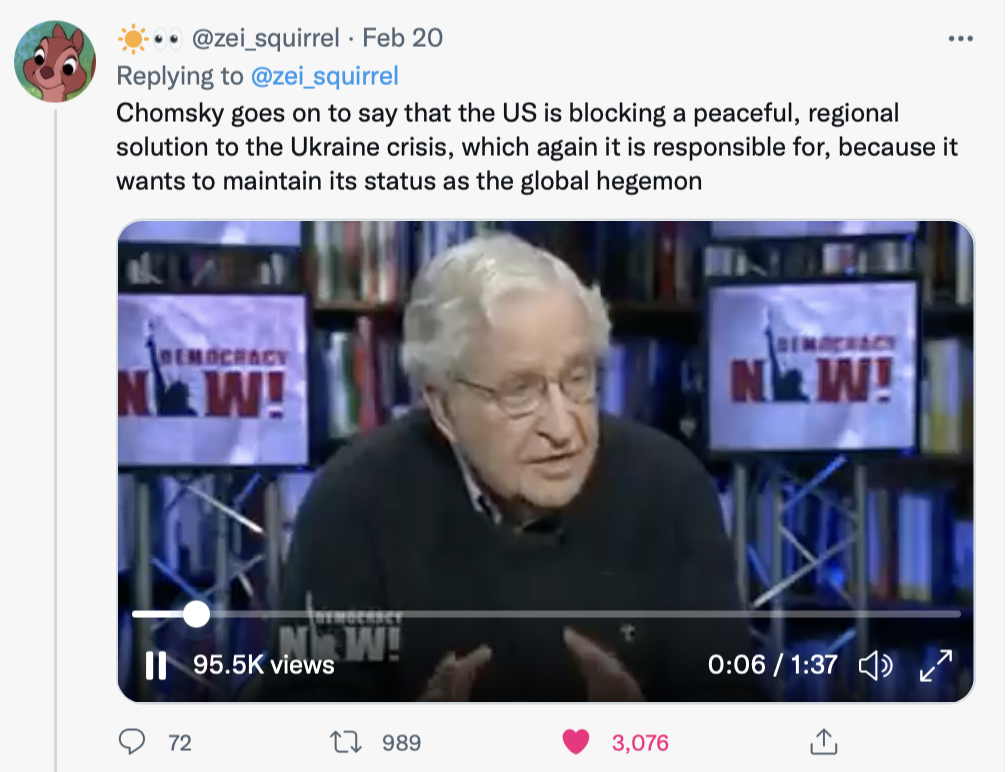
Equally troubling is the failure of our "news" outlets to offer viewpoints criticizing the dominant pro-war narrative. For instance, where are the voices advocating strongly for negotiation and peace?  Viewpoints like those of Noam Chomsky.

Chomsky: "This is part of the concept that [the United States] owns the world"

And how about our ignorance of history? The United States has a well-established track record of using our military to "save" countries by launching invasions that end up destroying countries financially, politically and socially. This is the sad state of U.S. foreign policy and the "news" industry that enables it, IMO.

Continue ReadingHas Russiagate Nudged Us to the Brink of Nuclear War in Ukraine?

How to Be a Human Animal, Chapter 17: Conversations Worth Having

Chapter 17: Conversations Worth Having

Greetings once again, hypothetical newborn baby!  Instead, I'm here once again to teach you another Life Lesson. I had to learn these at the School of Hard Knocks. No, I'm not claiming that you're not as able as me to learn those lessons.  I'm just trying to spare you some pain and frustration.  OK OK!  I admit that this is merely a thought experiment by which I am trying to set forth the most important things I've learned in 65 years. By the way, if you aren’t completely satisfied with these lessons, I’ll refund all of the money you paid for them ! This is Chapter 17 already.  Wow.  Aren't you tired of hearing my voice? No?  OK. Then I'll continue. If you need to review any of the past lessons, can find them all here. 

Today we’re going to talk about conversations. That term doesn’t simply mean talking with someone any more than food is defined as anything you put your mouth. Er, I can already see you drooling at you stare at my car keys. Just settle down now . . . OK, you can suck on your toes while you listen. That’s cool.

There are many types of conversations, but they fall on a continuum from simple factual exchanges on (“Is it raining?” “Yes”) to collaborations in which the parties set out to figure out a complex topic as a joint exercise by celebrating each others’ contributions.

Psychologist Scott Barry Kauffman recently Tweeted:

Imagine what discourse would be like if instead of it being conceptualized as a "match" to see who "wins", discussions were seen as mutual attempts to get at a shared truth or seen as a shared mission to get outside of ourselves and transcend our individual perspectives.

That would be a nice world, the kind I can imagine happening 24/7 at the big house where the philosophers and other "virtuous pagans" hang out just on the other side of Dante's River Acheron. You, however need to live in the world you were handed. You ended up on a Grade A planet in a Grade C era with regard to conversations.

Right now, your interactions will mostly be where some other baby grabs your toy and you cry. Here’s the problem you'll encounter when you get older: Even if you optimistically join a discussion hoping it is of the “Kauffman” variety, that doesn’t guarantee an enlightening and engaging experience. It takes two to tango and many people would rather honk at you (don’t look at ME as I say that!) than celebrate each other’s differing perspectives. Tango is the correct metaphor because, at their best, conversations are like dancing with other people. If either of you are stepping on the others’ feet, neither of you are going to have a good time.

Here's why this era is so fraught for those who want to share complex ideas with others (especially on contentious topics): We live in a time where the so-called news media makes much of its money by stirring up conflict and even hate. It’s the same thing with social media. The companies in charge of these things have decided in their corporate consciences that it's quite simple, actually: no conflict, no money. This has wrecked a pretty decent (though admittedly imperfect) conversational thing we had going on for decades.

Here’s how it so often plays out: Let’s say that you join a conversation in an open frame of mind, interested in freely sharing perspectives on an issue, but the other person is not so inclined. The other person, having been steeped in news media and social media, and now cooked to an extra-fever pitch of loneliness and rage during the pandemic, is committed to scoring points, schooling you and “winning” the discussion. I know, right? Why should there ever be a “winner” to a discussion, but that’s how many people see it these day. And they have plenty of tactic for “winning,” including these: [More . . . ]

Continue ReadingHow to Be a Human Animal, Chapter 17: Conversations Worth Having

Ukraine: Forbidden Discussions

I'm despondent that the mainstream news outlets are so intensely jingoistic, so focused on the logistics of war, so unwilling to look into the mirror. This is not surprising given the vast numbers of retired military and spy state talking heads who now work for the left leaning MSM. It's also unsurprising given that this is how war propaganda always works, illustrated brilliantly by "War Made Easy."

Here are a three snippets of conversation that I with the news media would take much more seriously:

First, this is from Freddie DeBoer's Substack:

[R]ight now, [the United States is] investing hideous amounts of treasure to maintain an order that we can’t afford and that no one really believes we can maintain. Perhaps the Ukrainians will beat back the Russians and they’ll be welcomed into NATO and we can all cheer that the good guys won. But hegemony does not last forever, and sooner or later you’re going to have to ask more adult, more useful questions than, “who’s the goodie, and who’s the baddie?” Otherwise the superpower eventually goes down the hard way.

I find myself considering this quote from a spokeswoman for the Chinese Foreign Ministry.

When the U.S. drove five waves of NATO expansion eastward all the way to Russia’s doorstep and deployed advanced offensive strategic weapons in breach of its assurances to Russia, did it ever think about the consequences of pushing a big country to the wall?

It doesn’t take sympathy for Putin to see that this is a very good question.

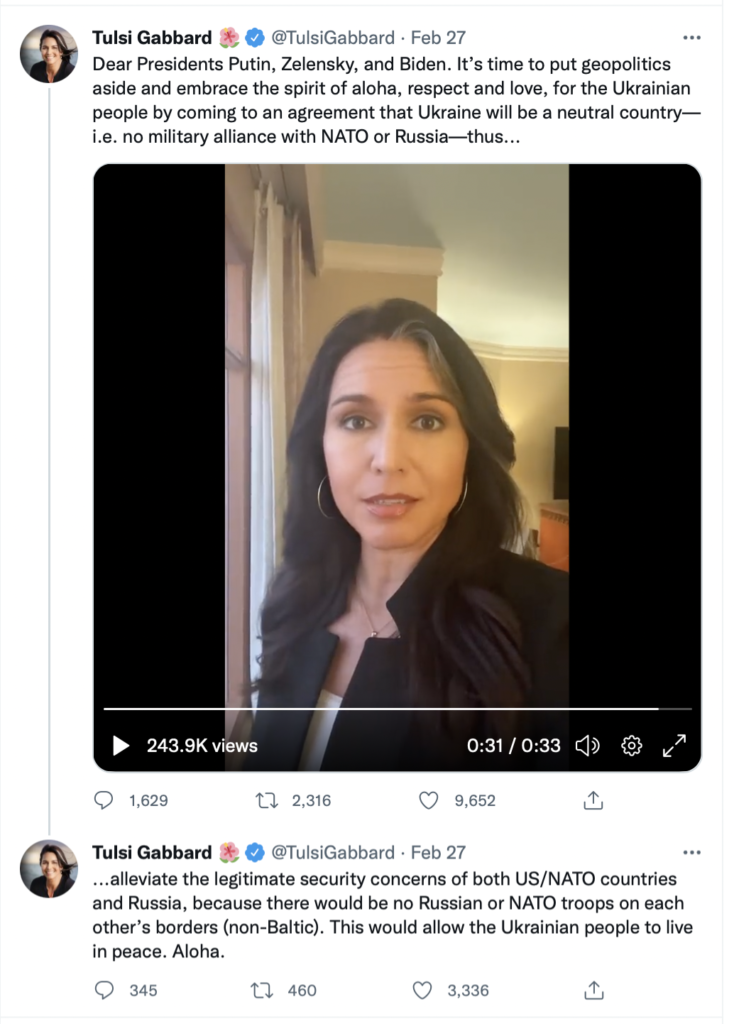
Second, Tulsi Gabbard tweeted this:

Third, Matt Taibbi reminds us that history matters:

I would like to point out that we already tried regime change in Russia. I remember, because I was there. And, thanks to a lot of lurid history that’s being scrubbed now with furious intensity, it ended with Vladimir Putin in power. Not as an accident, or as the face of a populist revolt against Western influence — that came later — but precisely because we made a long series of intentional decisions to help put him there.

Once, Putin’s KGB past, far from being seen as a negative, was viewed with relief by the American diplomatic community, which had been exhausted by the organizational incompetence of our vodka-soaked first partner, Boris Yeltsin. Putin by contrast was “a man we can do business with,” a “liberal, humane, and decent European” of “alert, controlled poise” and “well-briefed acuity,” who was open to anything, even Russia joining NATO. “I don’t see why not,” Putin said. “I would not rule out such a possibility.”

Fourth, this excerpt is from Glenn Greenwald's detailed analysis of our tribal dysfunction that mushroom when that exciting topic of war hits the tabletop:

In the weeks leading up to the Russian invasion of Ukraine, those warning of the possible dangers of U.S. involvement were assured that such concerns were baseless. The prevailing line insisted that nobody in Washington is even considering let alone advocating that the U.S. become militarily involved in a conflict with Russia. That the concern was based not on the belief that the U.S. would actively seek such a war, but rather on the oft-unintended consequences of being swamped with war propaganda and the high levels of tribalism, jingoism and emotionalism that accompany it, was ignored. It did not matter how many wars one could point to in history that began unintentionally, with unchecked, dangerous tensions spiraling out of control. Anyone warning of this obviously dangerous possibility was met with the “straw man” cliché: you are arguing against a position that literally nobody in D.C. is defending.

. . .

There is a reason I devoted the first fifteen minutes of my live video broadcast on Thursday about Ukraine not to the history that led us here and the substance of the conflict (I discussed that in the second half), but instead to the climate that arises whenever a new war erupts, instantly creating propaganda-driven, dissent-free consensus. There is no propaganda as potent or powerful as war propaganda. It seems that one must have lived through it at least once, as an engaged adult, to understand how it functions, how it manipulates and distorts, and how one can resist being consumed by it.

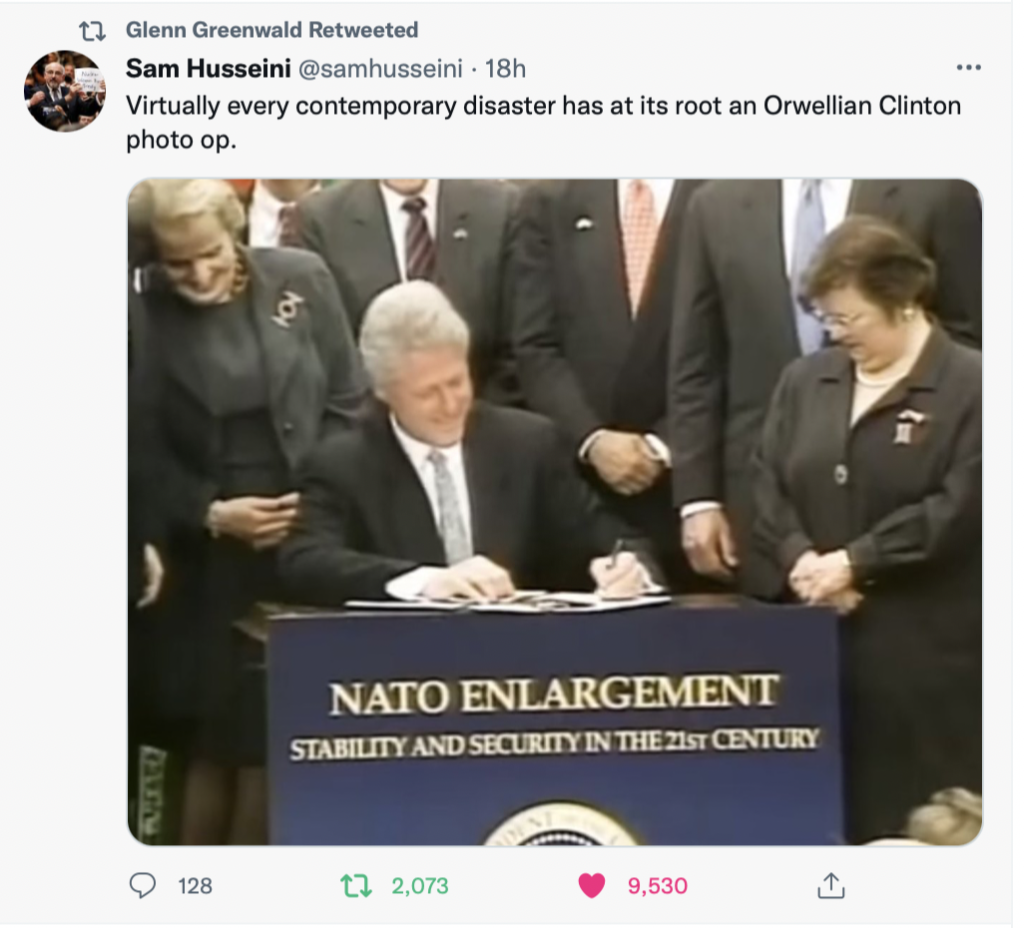
I will end with a photo:

Continue ReadingUkraine: Forbidden Discussions