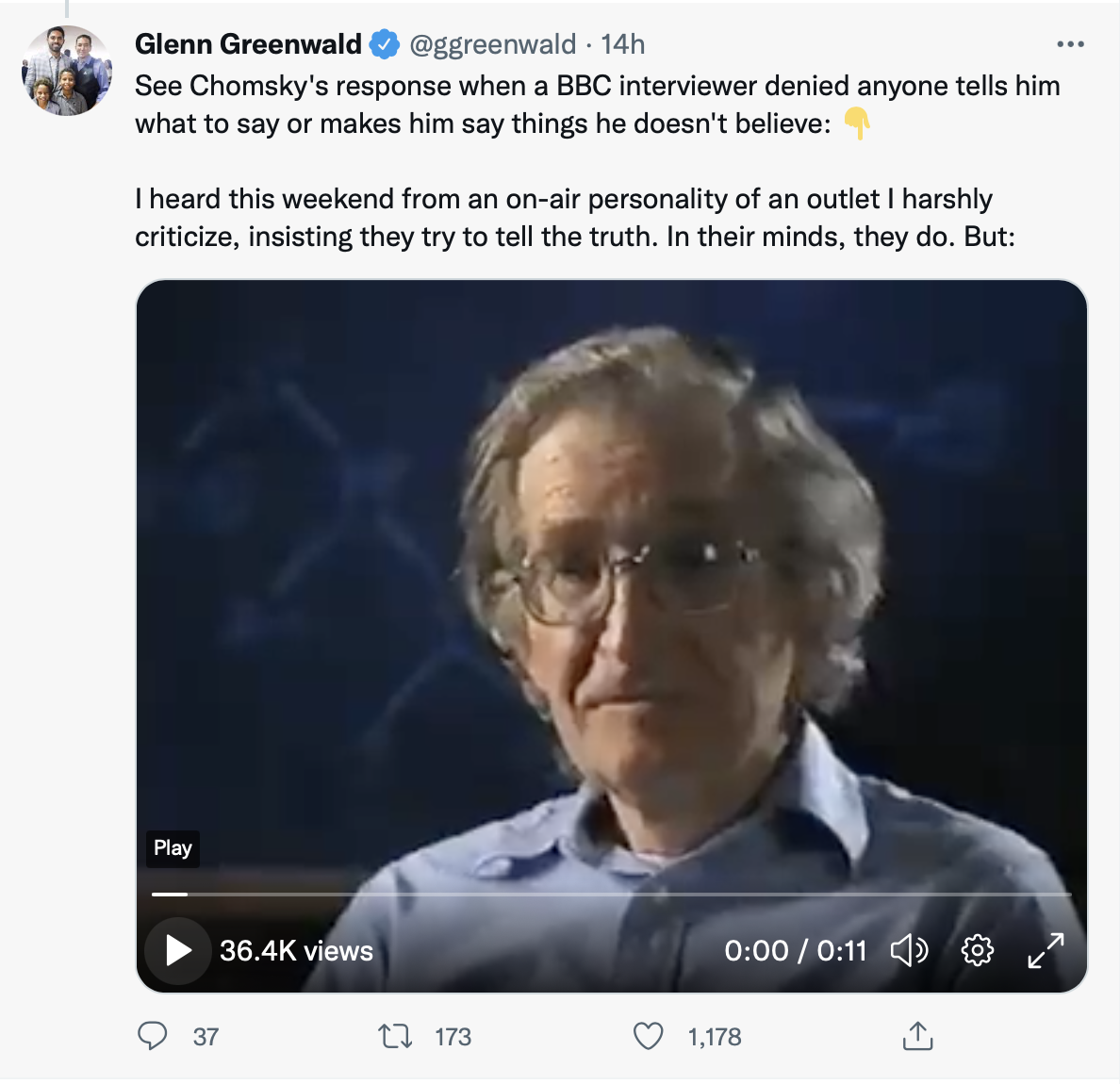
Matt Orfalea’s Military-Industrial Complex Non-Disclosure Mashup

Matt Taibbi, quoting Jeff Cohen of FAIR:

"If you’re listening to CNN, CBS, or PBS, and they introduce someone as a ‘former’ something, they’re lying to you,” he says. “What’s more relevant to the news consumer, that someone was an Undersecretary of Defense eight years ago, or that the same person is a highly paid lobbyist now? It’s obviously the second, but almost never revealed.”

And now, here is Matt Orfalea's Military-Industrial Complex Non-Disclosure Mashup:

Continue ReadingMatt Orfalea’s Military-Industrial Complex Non-Disclosure Mashup

The Conflation Strategy of the Political Far Left

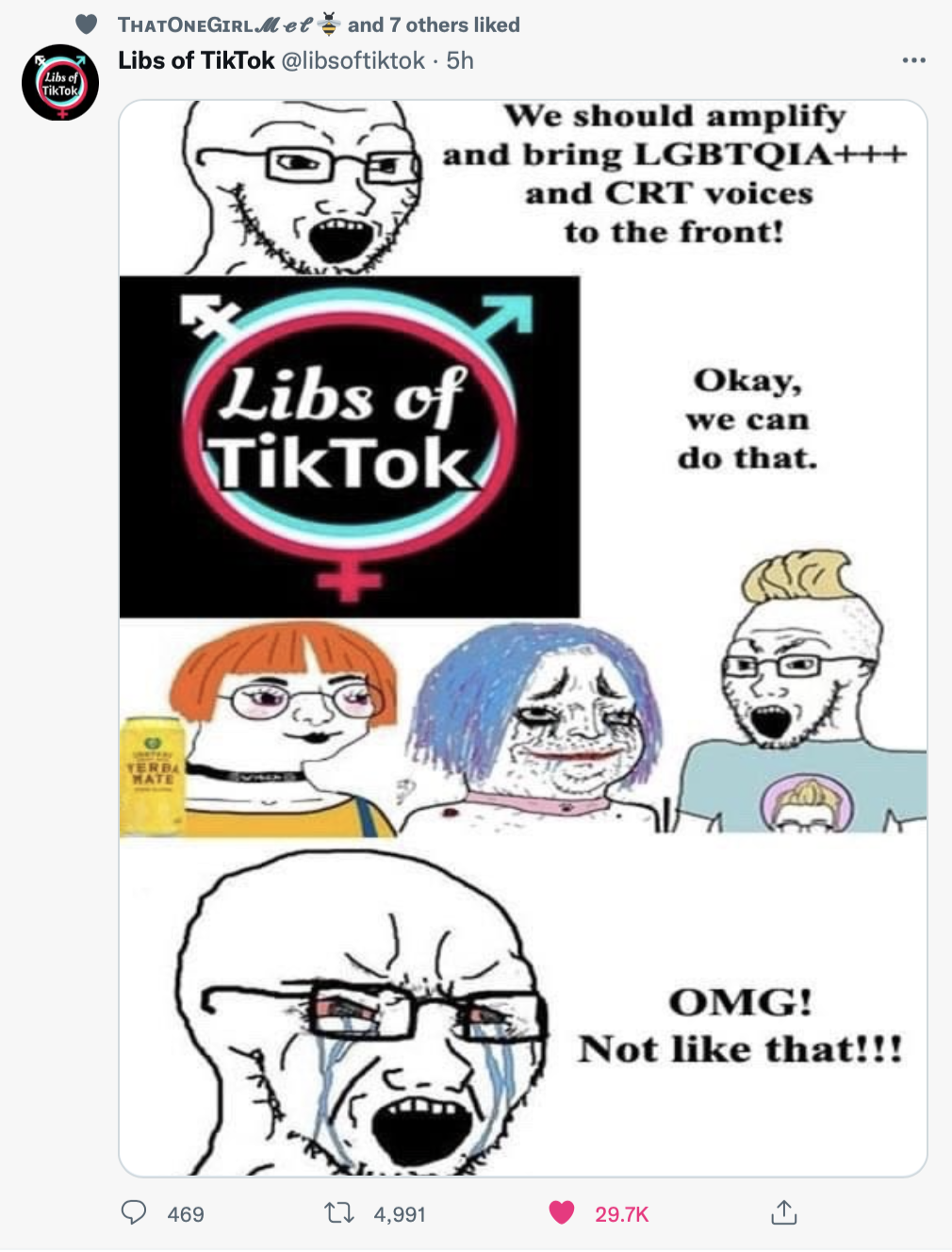
At Real Clear Politics, Batya Ungar-Sargon explains what really going on in the Washington Post's bizarre framing of the Twitter account @libsoftiktok. No, she explains, this is not about Americans trying to gang up on L's, G's, B's or most T's. Here is an excerpt.

The question is why. Why is the left folding in the issues of an extreme minority of transgender activists and teachers into the larger fight for gay rights – one that’s already been won?

It’s a similar case to what’s happened with the conversation of race. After winning the battle against real racism, the left moved the goalpost, redefining what counts as racism to the thing they most like to fight: the exposure of their own privilege.

That’s what’s happening here. A tiny elite that benefits politically and economically from portraying its opponents as bigots is using every tool at its disposal – social media, liberal legacy media, and executive action – to obfuscate the vast distance between their views and the vast majority of middle- and working-class Americans with normal views. Like the view that strangers shouldn’t teach toddlers how to masturbate.

Liberals had many major wins in the past 50 years. There was a time in the not-so-distant past when average Americans in either political party had little appetite for interracial marriage, let alone gay rights. But those days are long behind us. So why is the left pretending we are still in the midst of these fights? Because if you take away the issues that used to divide them from average Americans and no longer do, all you’re left with is what now divides them – the enormous economic, educational, and social capital that sustains the meritocratic liberal elite.

Here's what @libsoftiktok is actually doing: reposting bizarre tiktok videos made by teachers bragging about teaching things to children that are (rightfully) making many parents angry. These are simply completely undoctored reposts and not the tiktoc posters are being shamed for the things they are actually saying online. But they thought they would be left alone in their corner of the world, not thrust into the spotlight for all to see.

Continue ReadingThe Conflation Strategy of the Political Far Left

The History of Modern Stupidity and the Scourge of the Polarized Hidden Sub-Tribes

Jonathan Haidt offers a retrospective and a vision in his recent article: "WHY THE PAST 10 YEARS OF AMERICAN LIFE HAVE BEEN UNIQUELY STUPID. It’s not just a phase."

But first of all, who is making most of the noise in America?

The “Hidden Tribes” study, by the pro-democracy group More in Common, surveyed 8,000 Americans in 2017 and 2018 and identified seven groups that shared beliefs and behaviors. The one furthest to the right, known as the “devoted conservatives,” comprised 6 percent of the U.S. population. The group furthest to the left, the “progressive activists,” comprised 8 percent of the population. The progressive activists were by far the most prolific group on social media: 70 percent had shared political content over the previous year. The devoted conservatives followed, at 56 percent.

These two extreme groups are similar in surprising ways. They are the whitest and richest of the seven groups, which suggests that America is being torn apart by a battle between two subsets of the elite who are not representative of the broader society. What’s more, they are the two groups that show the greatest homogeneity in their moral and political attitudes. This uniformity of opinion, the study’s authors speculate, is likely a result of thought-policing on social media: “Those who express sympathy for the views of opposing groups may experience backlash from their own cohort.” In other words, political extremists don’t just shoot darts at their enemies; they spend a lot of their ammunition targeting dissenters or nuanced thinkers on their own team. In this way, social media makes a political system based on compromise grind to a halt.

Here is a glimmer of hope because we have now identified the problem (and see here):

The story i have told is bleak, and there is little evidence to suggest that America will return to some semblance of normalcy and stability in the next five or 10 years. Which side is going to become conciliatory? What is the likelihood that Congress will enact major reforms that strengthen democratic institutions or detoxify social media?

Yet when we look away from our dysfunctional federal government, disconnect from social media, and talk with our neighbors directly, things seem more hopeful. Most Americans in the More in Common report are members of the “exhausted majority,” which is tired of the fighting and is willing to listen to the other side and compromise. Most Americans now see that social media is having a negative impact on the country, and are becoming more aware of its damaging effects on children.

Will we do anything about it?

Continue ReadingThe History of Modern Stupidity and the Scourge of the Polarized Hidden Sub-Tribes

Jesse Singal: Transgender Puberty Blocker and Hormone Research Fails to Justify Their Use

Jesse Singal analyzes new research regarding puberty blockers and hormones used by researchers to promote their use. He concerned that the researchers have been dishonest. Here is an excerpt from his article: "Researchers Found Puberty Blockers And Hormones Didn’t Improve Trans Kids’ Mental Health At Their Clinic. Then They Published A Study Claiming The Opposite.". Here is an excerpt:

All the publicity materials the university released tell a very straightforward, exciting story: The kids in this study who accessed puberty blockers or hormones (henceforth GAM, for “gender-affirming medicine”) had better mental health outcomes at the end of the study than they did at its beginning.

The headline of the emailed version of the press release, for example, reads, “Gender-affirming care dramatically reduces depression for transgender teens, study finds.” The first sentence reads, “UW Medicine researchers recently found that gender-affirming care for transgender and nonbinary adolescents caused rates of depression to plummet.” All of this is straightforwardly causal language, with “dramatically reduces” and “caused rates… to plummet” clearly communicating improvement over time.

. . .

What’s surprising, in light of all these quotes, is that the kids who took puberty blockers or hormones experienced no statistically significant mental health improvement during the study. The claim that they did improve, which was presented to the public in the study itself, in publicity materials, and on social media (repeatedly) by one of the authors, is false.

It’s hard even to figure this out from reading the study, which omits some very basic statistics one would expect to find, but the non-result is pretty clear from eTable 3 in the supplementary materials, which shows what percentage of study participants met the researchers’ thresholds for depression, anxiety, and self-harm or suicidal thoughts during each of the four waves of the study:

Among the kids who went on hormones, there isn’t genuine statistical improvement here from baseline to the final wave of data collection. At baseline, 59% of the treatment-naive kids experienced moderate to severe depression. Twelve months later, 56% of the kids on GAM experienced moderate to severe depression. At baseline, 45% of the treatment-naive kids experienced self-harm or suicidal thoughts. Twelve months later, 37% of the kids on GAM did. These are not meaningful differences: The kids in the study arrived with what appear to be alarmingly high rates of mental health problems, many of them went on blockers or hormones, and they exited the study with what appear to be alarmingly high rates of mental health problems.

. . .

Despite the fact that two of the authors worked at Seattle Children’s Hospital, where the gender clinic is based, the paper doesn’t include a single word of even informed speculation attempting to explain why some kids accessed GAM and others did not. Nor do the authors seem to notice that by the end of the study, the no-GAM group has dwindled to a grand total of six kids who reported mental health data, as compared to 57 in the group receiving treatment.

Adding intrigue to this situation, the researchers are refusing to release their raw data. Singal does a deep-dive the substantiate his conclusion that the conclusions of the researchers are not substantiated by this research. The problems with this "research" are overwhelming and Jesse Singal offers line and verse on the many questions, lack of questions and holes. Too bad many legacy media outlets lap up unsubstantiated results on this topic produced by so many biased "researchers."

Continue ReadingJesse Singal: Transgender Puberty Blocker and Hormone Research Fails to Justify Their Use