Douglas Murray: Black Lives Matter Started with a Good Cause, Then Turned it Into a Racket

Douglas Murray, writing in the New York Post:, is concerned about the factually defective positions taken by Black Lives Matter as well as its highly questionable financials:

Like the most fraudulent pastors, the heads of BLM take advantage of good people. They present an undeniably good cause. They prey on people’s hopes and fears. After all, who in America does not believe that black lives matter? Who wouldn’t have sympathy with, or support, a group that claims to want to help people fight injustice? But BLM operates like all rackets do.

Firstly, they lie about reality. In the case of BLM, they pretend that black people in the United States in 2022 can be killed at any time by the police. They pretend that racism is a pandemic in this country and that everything and anything must be done to tackle it.

The effects of this work is there for all to see. The American public has been misled about the real state of race in this country. A poll in 2020 asked Americans how many unarmed black men they think are killed by the police in America the previous year. More than a fifth of people who described themselves as “very liberal” said they thought it was over 10,000 unarmed black people in America killed by police every year. Among self-described “liberals,” around 40% said they thought that the figure was somewhere between 1,000 and 10,000. The actual figure was around 10. Meaning that liberals in America were off by several orders of magnitude. They had a completely wrongheaded idea of what America is actually like.

But no wonder. For they had spent years hearing BLM pretend that black people are killed with impunity in this country.

Murray then turns to BLM's financial misdeeds, including recent revelations that BLM purchased a "purchase of a swanky new $5.8 million mansion in Southern California."

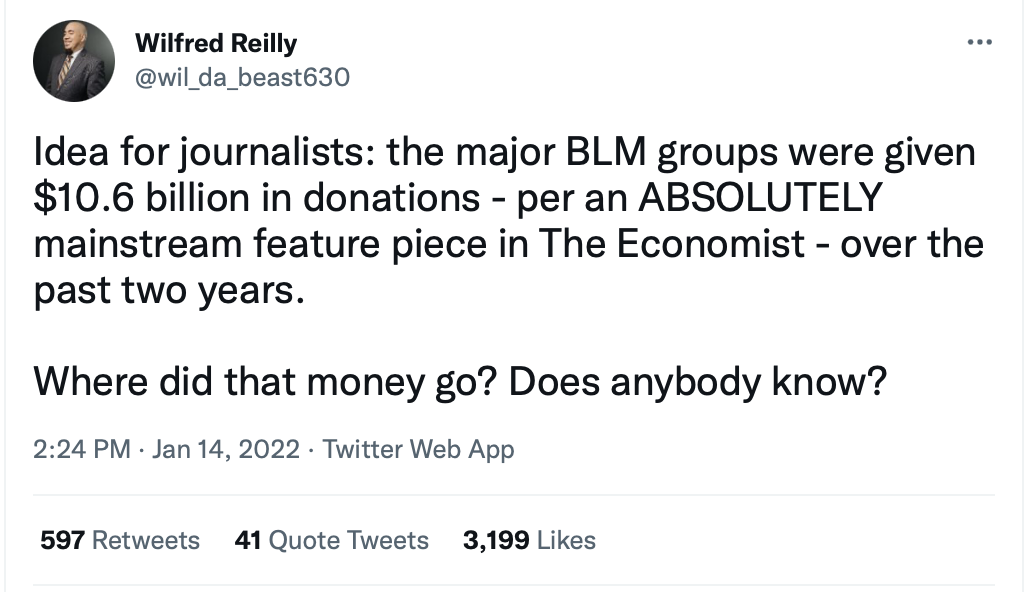
Other commentators have been highly critical of BLM, including Wilfried Riley:
Briahna Joy Gray's podcast featured Sean Campbell, who has taken flack for looking into BLM improprieties.
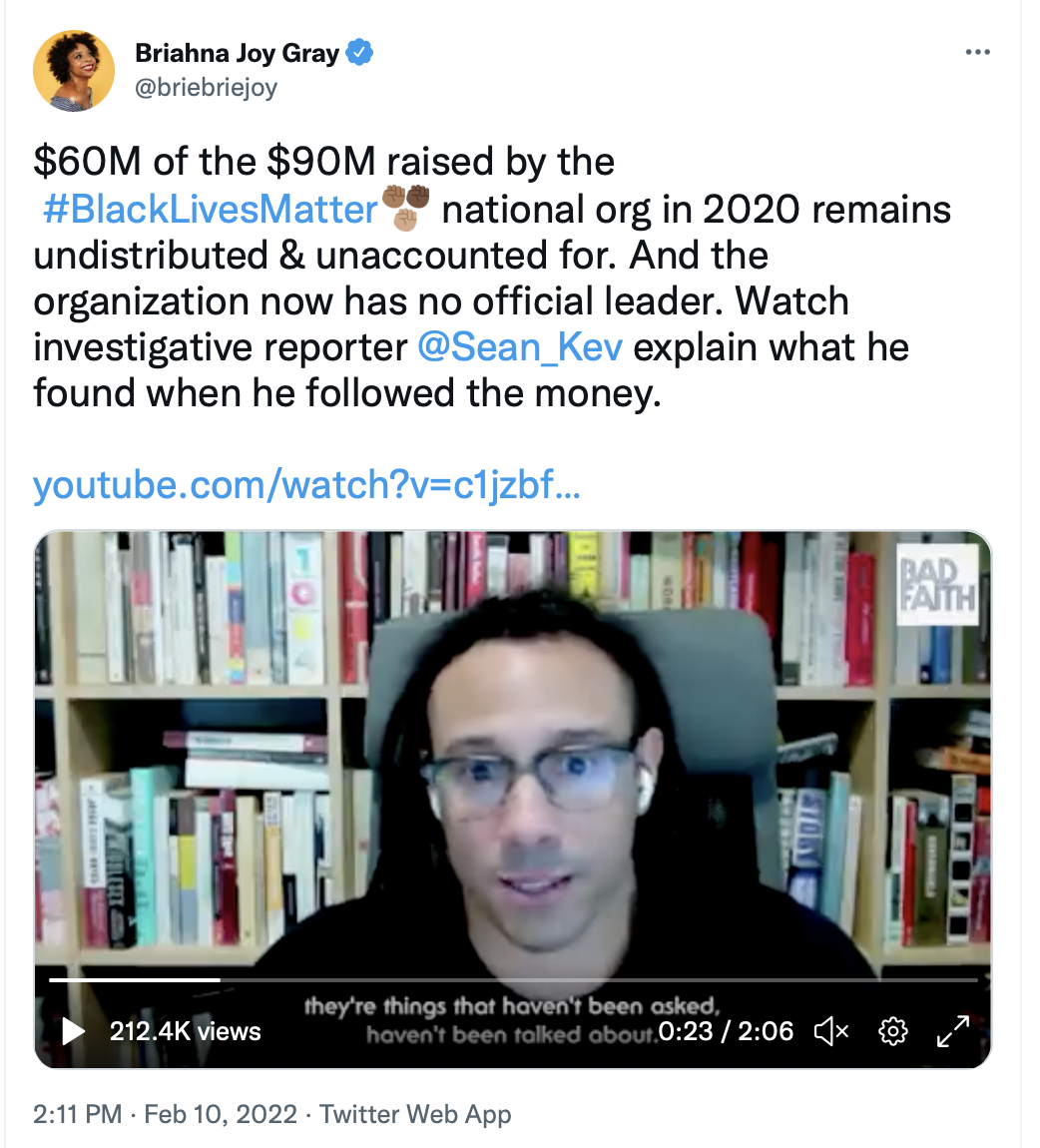
Here is a longer version of this same video:

Freddie DeBoer has written on the topic. His article is "White Journalists Are Terrified of Appearing to Criticize BlackLivesMatter, Obviously"

That pouring billions of dollars into an amorphous social movement could result in mismanagement and corruption is as obvious a thing as I can imagine, and so the need for a watchdog press that helps ensure that money isn’t misspent is also quite obvious. I would analogize the current moment and BLM to the Red Cross after 9/11, when a great deal of scrutiny was justly applied to that organization and its practices. But the media has spent the past year and a half saying almost nothing about BLM and where the money has gone, ceding the ground to conservative publications. It was the right-leaning New York Post that reported that one of the cofounders of the BLM Global Network Foundation had purchased four houses in a short time span, for example. The trouble is that many left-leaning people feel that they can safely disregard anything published in conservative media, and thus a badly-needed conversation hasn't happened. Anyone who has ever been part of a large protest movement understands how desperately such movements need external review for accountability, but if only Breitbart et al. are engaged in critical inquiry, the liberal donor class is not going to be moved.

Susan Woods sounded alarms about BLM's operation back in 2020:
Continue ReadingDouglas Murray: Black Lives Matter Started with a Good Cause, Then Turned it Into a Racket

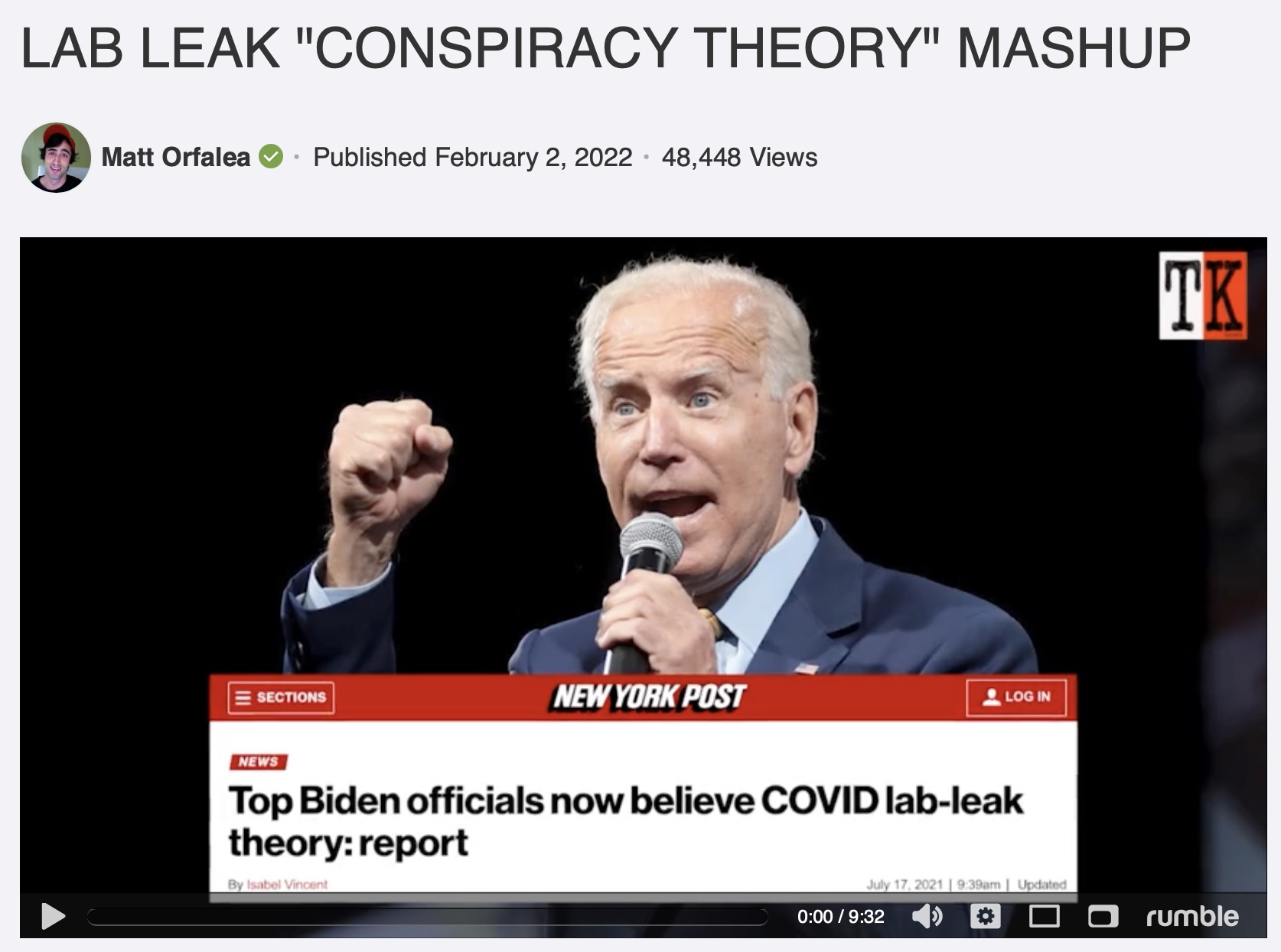
Matt Orfalea’s New Mashup on the “Lab Leak Conspiracy Theory”

My faith that legacy media outlets will take journalism seriously has plummeted in recent years. Matt Orfalea's "conspiracy theory" mashup explores one issue (of many recent issues) where media coverage has been abysmal.

The news outlets kept claiming that the virus could never ever have emerged in a lab, yet they avoided this Peter Daszak video like kryptonite. Whenever they pompously trumpeted that the lab leak was a conspiracy theory, they NEVER mentioned this 2016 video featuring Peter Daszak, president of Eco-Health.

Continue ReadingMatt Orfalea’s New Mashup on the “Lab Leak Conspiracy Theory”

David Sachs’ Response to “Big Tech are Private Companies” and “Go Invent Your Own Internet”

Bari Weiss recently interviewed David Sachs on Common Sense, Bari's Substack. It is an excellent discussion of issues you will not see in legacy media outlets, who would like to see alternative media competition crushed. Here's an excerpt:

BW: The criticism that I hear a ton in response to what you're saying is: David, these are private companies. If I invent YouTube and I pay for the servers of YouTube and I've set up the whole architecture of the company, why can't I do what I want? Same with Facebook. Why don't I get to decide that I don't want some kind of clickbait or fake news or whatever on my thing? I'm going to police it. Who are you to tell me I can't?

DS: I think it's a very disingenuous argument. The same people who say that these social media companies, these big tech companies, should be free to do whatever they want because they're private companies are the same people pushing six bills through Congress right now to restrict and regulate those companies because they see them as monopolies. So they don't even believe their own argument. They all start making these libertarian arguments when these big tech companies are restricting speech in a way that they like. When they agree with the outcome, they want to give these companies the freedom to produce that outcome.

We need to fundamentally understand that free speech in our society has been privatized. The town square has been privatized. When the Constitution was written, the internet didn't exist. Back then, the town square was a physical place that you could go to, and there was a multiplicity of town squares all over the country. There were thousands of them and anybody could put their soapbox down and speak, and anyone could gather around and listen. That’s why, if you look at the First Amendment, it doesn't just protect freedom of speech and of the press. It also protects the right to peaceably assemble.

Well, where do people assemble today? They assemble in these giant social networks that have these gigantic network effects. That is where speech, especially political speech, occurs. And if you are shut out of that digital town square, to what extent do you still even have a First Amendment? To what extent do you have a right to speech? Well, I don't think you do. If you were to grab your soapbox today and go on the courthouse steps, they'll think you're a lunatic. You have no free speech right in this country if you are kicked off of these social networks.

So, I don't think it's good enough to say, well, these are private actors and, therefore, they can do whatever they want. Those private actors have too much power. They have the power to decide whether you, as an American, have an effective free speech right in this country. I think that's unacceptable. I think the Founders, the Framers of the Constitution, would never have permitted that.

...

BW: What do you say to the people who argue: If you don't like the way YouTube conducts itself, if you don't like the way Facebook conducts itself, no problem. Go make another one. Why is that not an acceptable solution to this problem?

DS: This is what you heard when Twitter and Facebook banned Trump. Their argument was: Go to a different app. And then Apple and Google banned Parler, which was the different app. And then the argument was, Well, that's not censorship. Just go create a website. And then Amazon Web Services started banning websites. So, at some point, when are you going to say this is an undue imposition on free speech? What am I supposed to do? Go create my own internet? All I wanted to do was post a tweet. Let’s not be obtuse to the power of these monopolies. I think people are being selectively oblivious to the network effects.

BW: We hear that phrase a lot: network effects. What does it mean?

DS: A network-effect business is one where the value of the service increases with the number of users. So if you think about Twitter or Facebook or the phone company, the more people who are on the service, the more value it has to everybody else. The value actually increases exponentially because the number of connections that can be made increases exponentially every time someone joins the service. If you or I want to create our own Twitter clone, it'll be very, very hard to do that because nobody else will be on it. So you have this huge chicken and egg problem. This is why these social networks are so powerful. They’ve got these huge network effects based on the fact that everybody is already on them, and it gets very, very hard to try and create a competing one.

Continue ReadingDavid Sachs’ Response to “Big Tech are Private Companies” and “Go Invent Your Own Internet”

Tara Henley Describes the Identitarian Left

Who are these people? Here's one tell: You will not find them on the streets actually helping to improve the people they claim they care about. You will not find them in the kinds of colleges that most people attend. You won't find them inviting open-ended discussions with the people they disagree with.

Tara Henley tells us more about the Identitarian Left, whether you call them this or whether you call them Woke Moralists or Social Justice Warriors or whatever:

One term I’ve heard lately that’s helpful in unpacking the new left is “identitarian moralism.” This phrase captures the new left’s puritanical thrust and quasi-religious fervour, along with its festishization of identity, while also signaling its ability to shape-shift to take up the Twitter cause du jour, whether that happens to be pandemic public health policies or, this week, recasting Madeleine Albright as some sort of feminist icon. What remains consistent, across all fronts, is a strident illiberalism.

Let’s be clear: If you do not agree with the new left’s list of approved narratives, it one hundred percent expects you to keep your mouth shut (or, alternatively, to “do the work” of “listening and learning,” ideally on Instagram, so that you can be shunned and shamed in as public a manner as possible).

The goal of the new left is, in fact, explicitly to shut down debate of any ideas deemed “harmful,” so as not to perpetuate the harm. This unfortunately leads to an endless parade of bad faith arguments, since the goal is never to make sense or persuade people, but rather to bring discussions to an abrupt halt.

It also leaves a great number of people politically homeless.

Who is Tara Henley? Someone who lives by her principles. A former decorated reporter with the Canadian Broadcasting Corporation. Here is why she resigned at the end of December 2021:
It used to be that I was the one furthest to the left in any newsroom, occasionally causing strain in story meetings with my views on issues like the housing crisis. I am now easily the most conservative, frequently sparking tension by questioning identity politics. This happened in the span of about 18 months. My own politics did not change.

To work at the CBC in the current climate is to embrace cognitive dissonance and to abandon journalistic integrity.

It is to sign on, enthusiastically, to a radical political agenda that originated on Ivy League campuses in the United States and spread through American social media platforms that monetize outrage and stoke societal divisions. It is to pretend that the “woke” worldview is near universal — even if it is far from popular with those you know, and speak to, and interview, and read.

To work at the CBC now is to accept the idea that race is the most significant thing about a person, and that some races are more relevant to the public conversation than others. It is, in my newsroom, to fill out racial profile forms for every guest you book; to actively book more people of some races and less of others.

To work at the CBC is to submit to job interviews that are not about qualifications or experience — but instead demand the parroting of orthodoxies, the demonstration of fealty to dogma.

Continue ReadingTara Henley Describes the Identitarian Left

The Washington Post has Reckless and Incoherent Joe Biden’s Back

Joe Biden's reckless/incoherent rhetoric could get us all killed. I'm talking about his recent rhetoric. That's on top of the fact that American news media has been pummeling us with non-stop unreflective pro-war messages leading up to the current sorry state of the world. We are where we are not because of a sober cost-benefit foreign policy analysis. This war has turned into theater or, perhaps, the existential version of the Superbowl, where U.S. officials refuse to open up a dialogue with Russia. That would be the thing that grown-ups would do when their conduct is nudging up the nuclear clock which, in 2018, was already at two minutes to midnight.

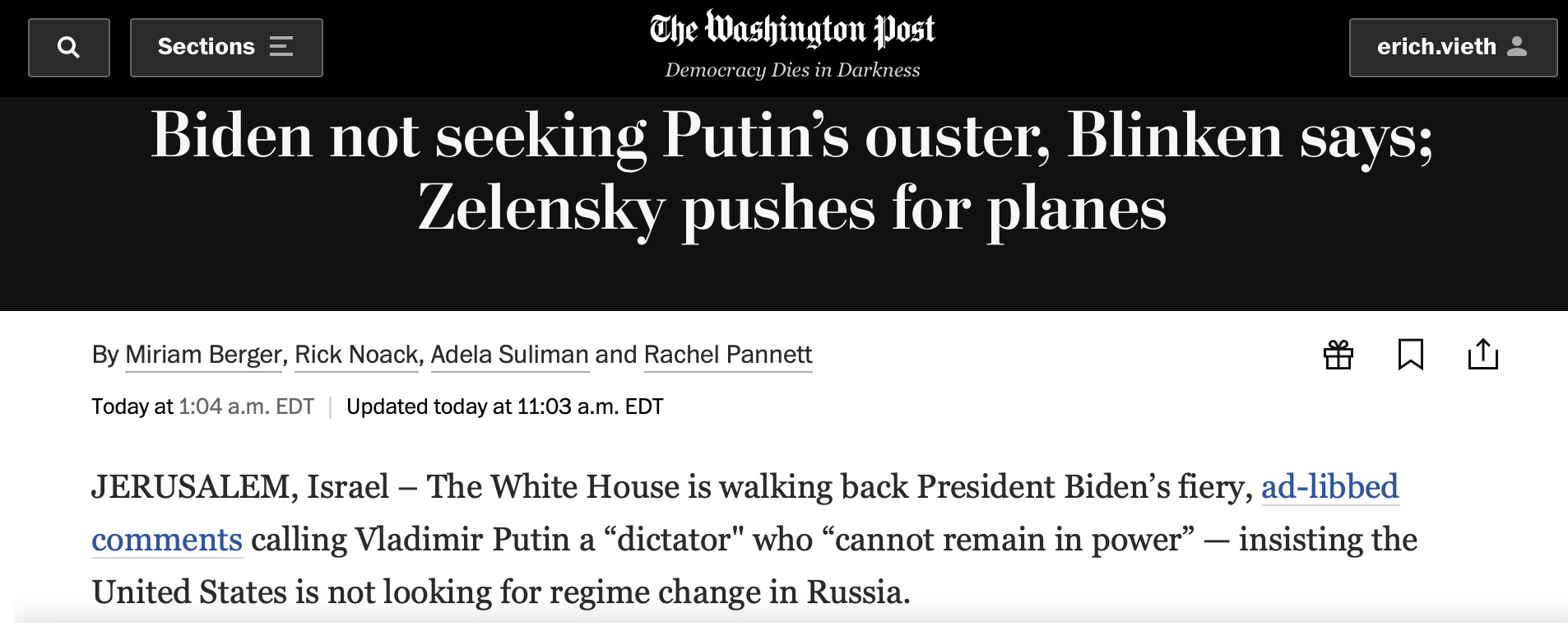
Here's a "solution." In case Joe Biden says something incoherent or reckless, the Washington Post headline writers are there to save the day. You see, Biden didn't mean what he said, that thing that could result in a civilization-ending nuclear holocaust.

Glenn Greenwald:

President Obama's own arguments about a conflict between Russia and Ukraine — namely, that “Ukraine is a core Russian interest but not an American one” and therefore the U.S. should not risk confrontation with Moscow over it — were widely maligned as Kremlin assets if not agents. Others who urged the U.S. to try to avert war through diplomacy — by, for instance, formally vowing that NATO membership would not be offered to Ukraine and that Kyiv would remain neutral in the new Cold War pursued by the West with Moscow — faced the same set of accusations about their loyalty and patriotism.

Most taboo of all was any discussion of the heavy involvement of the U.S. in Ukraine beginning in 2014 up to the invasion: from micro-managing Ukrainian politics, to arming its military, to placing military advisers and intelligence officers on the ground to train its soldiers how to fight (something Biden announced he was considering last November) — all of which amounted to a form of de facto NATO expansion without the formal membership. And that leaves to the side the still-unanswered yet supremely repressed question of what Undersecretary of State Victoria Nuland referred to as the Ukrainians’ "biological research facilities” so dangerous and beyond current Russian bio-research capabilities that she gravely feared they would "fall into Russian hands.” . . .

As a result of the media's embracing of moral righteousness in lieu of debating these crucial geopolitical questions, the U.S. government has consistently and aggressively escalated its participation in this war with barely any questioning let alone opposition.

The central question for Americans from the start of the war in Ukraine was what role, if any, should the U.S. government play in that war? A necessarily related question: if the U.S. is going to involve itself in this war, what objectives should drive that involvement?

Prior to the U.S.'s jumping directly into this war, those questions were never meaningfully considered. Instead, the emotions deliberately stoked by the relentless media attention to the horrors of this war — horrors which, contrary to the West's media propaganda, are common to all wars, including its own — left little to no space for public discussion of those questions. The only acceptable modes of expression in U.S. discourse were to pronounce that the Russian invasion was unjustified, and, using parlance which the 2011 version of Chris Hayes correctly dismissed as adolescent, that Putin is a “bad guy.” Those denunciation rituals, no matter how cathartic and applause-inducing, supplied no useful information about what actions the U.S. should or should not take when it came to this increasingly dangerous conflict.

That was the purpose of so severely restricting discourse to those simple moral claims: to allow policymakers in Washington free rein to do whatever they wanted in the name of stopping Putin without being questioned. Indeed, as so often happens when war breaks out, anyone questioning U.S. political leaders instantly had their patriotism and loyalty impugned (unless one was complaining that the U.S. should become more involved in the conflict than it already was, a form of pro-war "dissent” that is always permissible in American discourse).

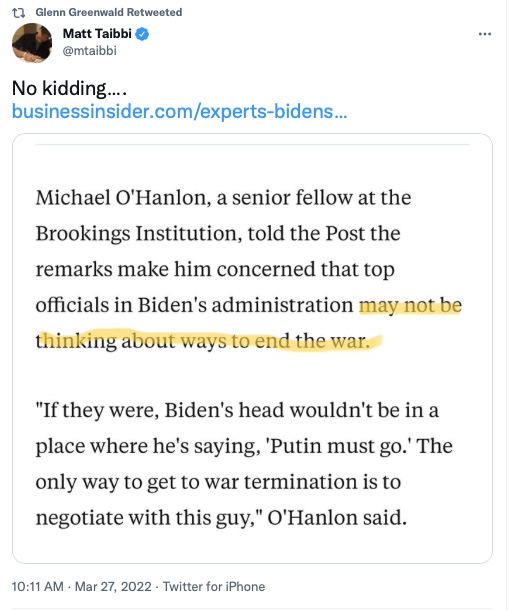
Matt Taibbi knows how to connect the dots:

Continue ReadingThe Washington Post has Reckless and Incoherent Joe Biden’s Back