What Harvard did to Economist Roland Fryer

Glenn Loury introduces a narrative that tells a story about what happens when a person diligently follows the evidence where it leads, but where it leads conflicts with a prevailing cultural-media narrative. In this case, Fryer's research showed police have not been killing unarmed "black" men at a rate greater than they kill unarmed "white" men. Wikipedia's version: "In 2016, Fryer published a working paper concluding that although minorities (African Americans and Hispanics) are more likely to experience police use of force than whites, they were not more likely to be shot by police than whites."

This is the story of the Harvard community reacted to those inconvenient numbers.

Glenn Loury introduces the video:

Roland Fryer is the most gifted economist of his generation. Not the most gifted black economist of his generation, the most gifted economist of his generation. Period.

He was tenured at Harvard at the age of 30, he was awarded the American Economics Association’s John Bates Clark Medal, he received a MacArthur “Genius” grant, his publications appeared in some of the most distinguished journals in the field, and his scholarship was regularly covered in the mainstream media. His research upends many commonly held assumptions about race, discrimination, education, and police violence. It is tremendously creative, rigorous, and consequential scholarship, and it cannot be simply written off because it happens to challenge the status quo.

To do the kind of work Roland does, you have to be more than brilliant. You have to be fearless. And I cannot help suspect that now Roland is paying the price for pursuing the truth wherever it leads. Several years ago, he was accused of sexual harassment by a disgruntled ex-assistant. In my opinion and that of many others, those accusations are baseless. But Harvard has used them as a pretext to shut down Roland’s lab, to curtail his teaching, and to marginalize him within the institution.

I’ll not mince words. Those at Harvard responsible for this state of affairs should be utterly ashamed of themselves. They have unnecessarily, heedlessly tarnished the career of an historically great economist. Again, I can't help but suspect that they have effectively buried vital research not because it was flawed but because they found the results to be politically inconvenient. “Veritas” indeed.

I’m not the only one infuriated by what is happening to Roland Fryer. The filmmaker Rob Montz has made a short documentary about this subject. I’m interviewed in it alongside others who see this fiasco for what it is, some of who have much to lose by publicly coming to Roland’s defense. People need to see this film. They need to know the truth about Roland Fryer. So I ask you to watch and to judge for yourself, and if you feel so moved, to share it as widely as possible.
Continue ReadingWhat Harvard did to Economist Roland Fryer

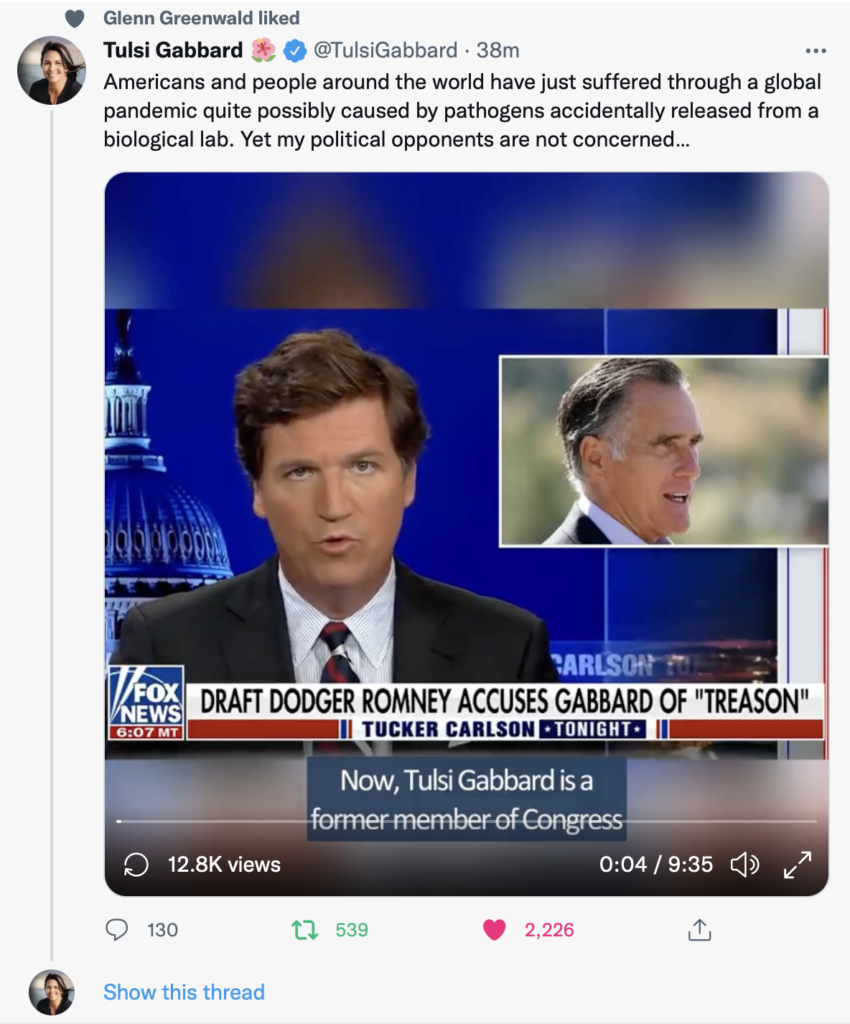
Tulsi Gabbard Accused of Treason After She Expresses Concerns About the Release of Pathogens from Ukraine Biolabs.

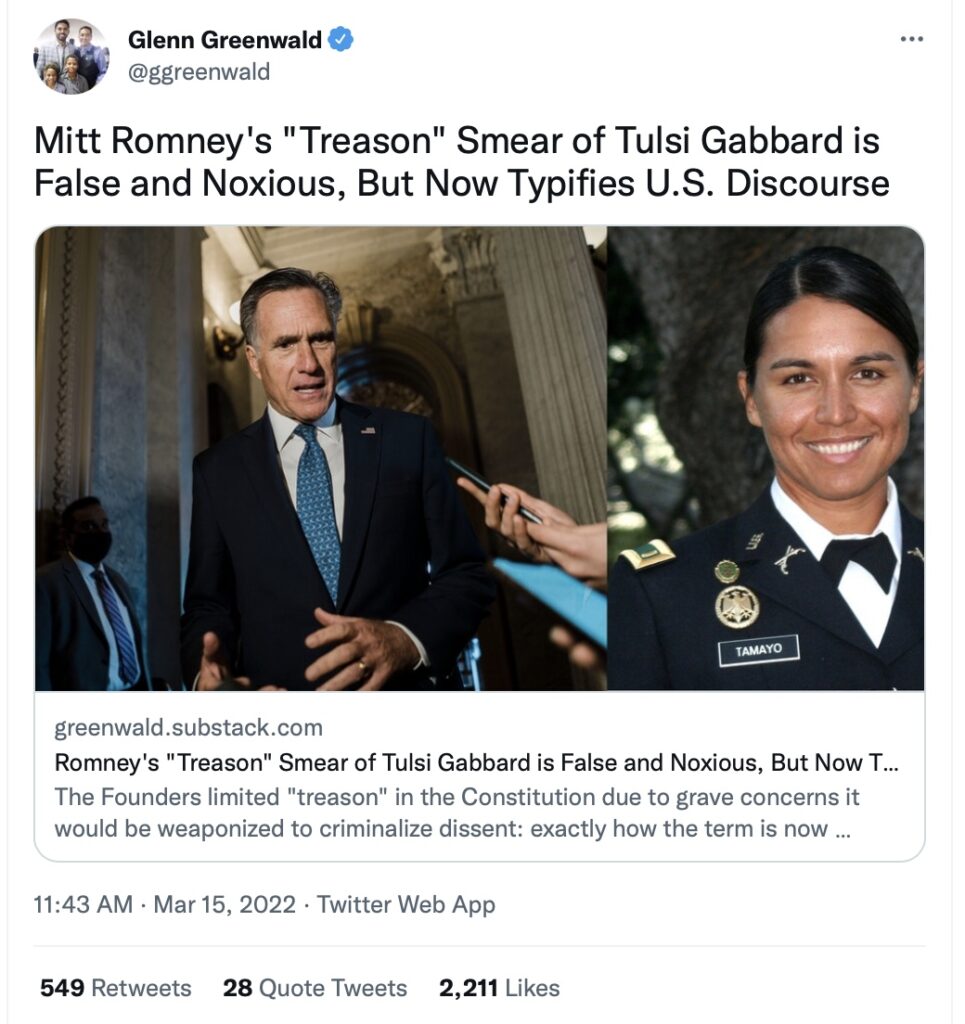
This is typical of the insanity that one hears when war is in the air. Mitt Romney and the geniuses at The View shout "Treason!" when Tulsi Gabbard merely expresses concern about the release of pathogens from U.S. affiliated Ukrainian biolabs. I know some people who will be attempted to accuse me of treason for linking to Tucker Carlson's show, but he's right about this issue.

Why aren't these accusers also going after Victoria Nuland, Biden's Under-Secretary of State, who was also concerned about wartime pathogen release from Ukrainian biolabs? The followup to Nuland's admission was darkly comical: Marco Rubio, possibly stunned by Nuland's admission, pushes Nuland to give assurances (based on nothing at all) that if pathogens were released, that it would be solely the fault of Russians.

-- [Added March 15, 2022]

For many people, including many in the news business, civil liberties are quaint and antiquated. No longer the life-blood of the American experiment. Glenn Greenwald gives many examples.

Continue ReadingTulsi Gabbard Accused of Treason After She Expresses Concerns About the Release of Pathogens from Ukraine Biolabs.

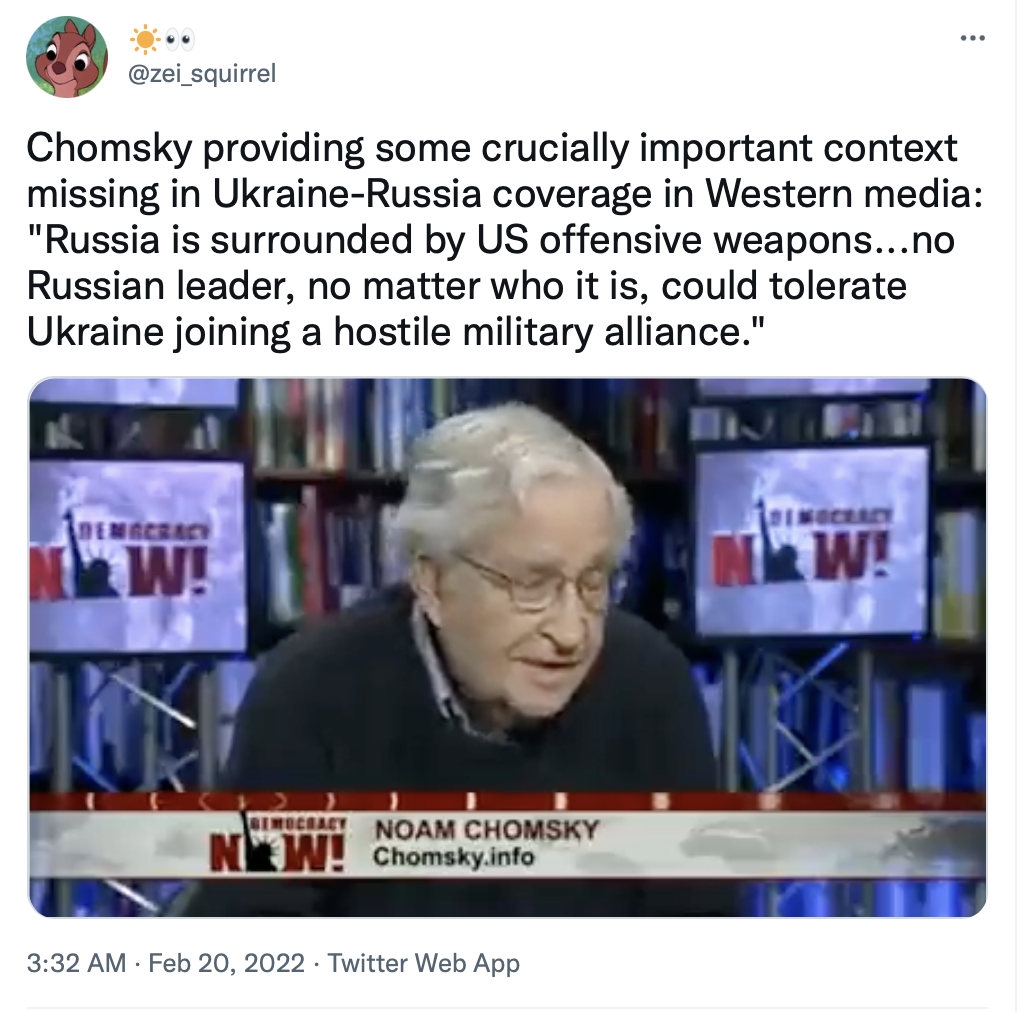
Has Russiagate Nudged Us to the Brink of Nuclear War in Ukraine?

Glenn Greenwald warned us about this risk of Russiagate several years ago.

Now that the U.S. is actively engaged in high-stakes brinksmanship with Russia over Ukraine, I can't rule out that Russiagate hysteria has been a significant factor. Admittedly, Russiagate is not the only factor. We are risking civilization-annihilating nuclear war for other reasons too.  For instance, decades of U.S. warmongering and profiteering.  Also, conflict pornography by our "news" networks, right and left wing, which constantly feature war-obsessed military officials and members of the spy state, often without disclosing their conflicts of interest. There is a profit-motive behind this media behavior too.

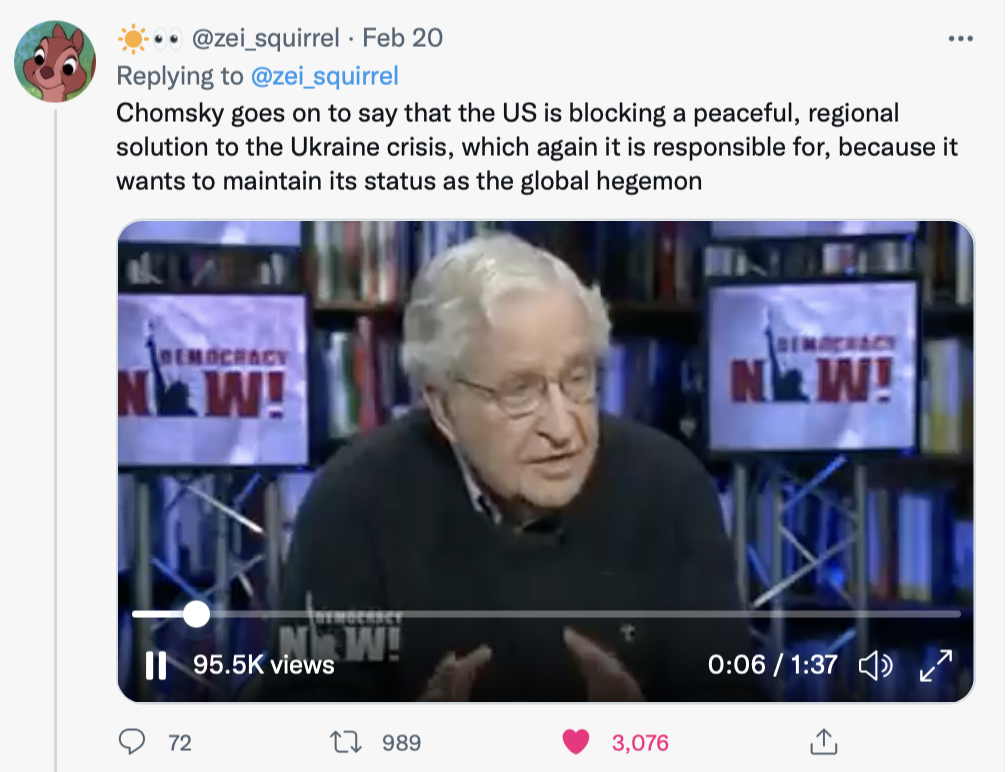
Equally troubling is the failure of our "news" outlets to offer viewpoints criticizing the dominant pro-war narrative. For instance, where are the voices advocating strongly for negotiation and peace?  Viewpoints like those of Noam Chomsky.

Chomsky: "This is part of the concept that [the United States] owns the world"

And how about our ignorance of history? The United States has a well-established track record of using our military to "save" countries by launching invasions that end up destroying countries financially, politically and socially. This is the sad state of U.S. foreign policy and the "news" industry that enables it, IMO.

Continue ReadingHas Russiagate Nudged Us to the Brink of Nuclear War in Ukraine?

How to Be a Human Animal, Chapter 17: Conversations Worth Having

Chapter 17: Conversations Worth Having

Greetings once again, hypothetical newborn baby!  Instead, I'm here once again to teach you another Life Lesson. I had to learn these at the School of Hard Knocks. No, I'm not claiming that you're not as able as me to learn those lessons.  I'm just trying to spare you some pain and frustration.  OK OK!  I admit that this is merely a thought experiment by which I am trying to set forth the most important things I've learned in 65 years. By the way, if you aren’t completely satisfied with these lessons, I’ll refund all of the money you paid for them ! This is Chapter 17 already.  Wow.  Aren't you tired of hearing my voice? No?  OK. Then I'll continue. If you need to review any of the past lessons, can find them all here. 

Today we’re going to talk about conversations. That term doesn’t simply mean talking with someone any more than food is defined as anything you put your mouth. Er, I can already see you drooling at you stare at my car keys. Just settle down now . . . OK, you can suck on your toes while you listen. That’s cool.

There are many types of conversations, but they fall on a continuum from simple factual exchanges on (“Is it raining?” “Yes”) to collaborations in which the parties set out to figure out a complex topic as a joint exercise by celebrating each others’ contributions.

Psychologist Scott Barry Kauffman recently Tweeted:

Imagine what discourse would be like if instead of it being conceptualized as a "match" to see who "wins", discussions were seen as mutual attempts to get at a shared truth or seen as a shared mission to get outside of ourselves and transcend our individual perspectives.

That would be a nice world, the kind I can imagine happening 24/7 at the big house where the philosophers and other "virtuous pagans" hang out just on the other side of Dante's River Acheron. You, however need to live in the world you were handed. You ended up on a Grade A planet in a Grade C era with regard to conversations.

Right now, your interactions will mostly be where some other baby grabs your toy and you cry. Here’s the problem you'll encounter when you get older: Even if you optimistically join a discussion hoping it is of the “Kauffman” variety, that doesn’t guarantee an enlightening and engaging experience. It takes two to tango and many people would rather honk at you (don’t look at ME as I say that!) than celebrate each other’s differing perspectives. Tango is the correct metaphor because, at their best, conversations are like dancing with other people. If either of you are stepping on the others’ feet, neither of you are going to have a good time.

Here's why this era is so fraught for those who want to share complex ideas with others (especially on contentious topics): We live in a time where the so-called news media makes much of its money by stirring up conflict and even hate. It’s the same thing with social media. The companies in charge of these things have decided in their corporate consciences that it's quite simple, actually: no conflict, no money. This has wrecked a pretty decent (though admittedly imperfect) conversational thing we had going on for decades.

Here’s how it so often plays out: Let’s say that you join a conversation in an open frame of mind, interested in freely sharing perspectives on an issue, but the other person is not so inclined. The other person, having been steeped in news media and social media, and now cooked to an extra-fever pitch of loneliness and rage during the pandemic, is committed to scoring points, schooling you and “winning” the discussion. I know, right? Why should there ever be a “winner” to a discussion, but that’s how many people see it these day. And they have plenty of tactic for “winning,” including these: [More . . . ]

Continue ReadingHow to Be a Human Animal, Chapter 17: Conversations Worth Having

“Race,” “News Media” and Shootings

I often use the word "race" in scare quotes because I don't believe that "race" is a useful phrase. In fact, it has caused nothing but mischief, violence and death ever since people began using the term. My position is that there are definitely some racists out there, but there is no such thing as "race." I have put the term "news media" in quotes because I have lost so much respect for so many of those organizations that claim to be bringing us the news based on numerous recent examples of a course of conduct that is more egregious than the negligence standard one might associate with journalism malpractice.

Political Scientist Wilfred Reilly is not afraid to step into the fray to state unvarnished truth. He is a former corporate executive and freedom rider, as well as author of the 2020 book Taboo: 10 Facts [You Can't Talk About].  In his introduction to that book, he states:

Tackling taboos is difficult, but necessary. Very often— MOST often— they are used not to shield strong and valid ideas from pointless attacks, but rather to protect weak ones from worthwhile criticism.

Reilly's statistics-rich discussion is now featured on FAIR's website: His article is titled, "The Broken Mirror: Media Narrative vs. Reality." The "news media" that leans politically to the Left is forcefully pushing a media is making people on the political Left unnecessarily angry (against police officers), but it should be making all of us angry (about the divisive narrative being pushed). Here is an excerpt:

In the representative year of 2018, inter-racial violent crime involving blacks and whites made up approximately 3 percent of all serious crime: there were only about 600,000 victim-reported incidents involving a black perpetrator and a white victim, or vice-versa, out of more than 20,000,000 total crimes. Further, of the violent inter-racial crime that does occur, more than 80 percent of reported incidents involved a black perpetrator and a white victim. The data tables in the 2018 Bureau of Justice Statistics Report include more than 500,000 black-on-white violent incidents, but well under 100,000 violent crimes that were white-on-black. While this finding is not necessarily surprising—there are far more whites than blacks, and whites, on average, have more money to be stolen—it would likely come as a shock to most upper-middle class Americans. As would another piece of data: according to the Washington Post, the total number of unarmed black men killed by police during the most recent year on record (2020) was not 10,000, or 1,000, but 17. That bears spelling out: in the year where America was supposedly inundated with white supremacist violence, where America was in the grips of a “racial reckoning” that included, in no small part, the acknowledgement of the “state-sanctioned murder” of young black men, only SEVENTEEN unarmed black men died at the hands of police officers.

This data leads us to an obvious question: why do so many smart people believe inter-ethnic violence is so much worse than it is? . . .Basic data about inter-racial violence often seem not merely ignored by mainstream media sources, but actively misrepresented.

In Taboo, I point out that about 75 percent of individuals fatally shot by police in a typical year are Caucasian whites or Hispanics. However, national media outlets devote less than 20 percent of their police violence coverage to these cases. A Google search for “well-known police shooting,” conducted in 2020 in connection with the book, turned up articles which covered two police shootings of Latinos, four police shootings of whites, and 36 police shootings of blacks. This level of over-representation of black victims in coverage (2,400 percent) could hardly be the result of anything but very conscious choice—and respected social scientists like John Lott have argued empirically that media treatment of a range of issues, from political extremism to mass shootings, follows a similar troubling pattern.

I'm not going to pretend that I could add anything to Reilly's detailed analysis, but reading his article did cause me to wonder whether part of the media strategy was to stir up conflict and hate, thereby selling ads and rewarding loyal followers. As I read Reilly's statistics, I can't help but think of Matt Taibbi's book, Hate, Inc., in which he argues "that what most people think of as 'the news' is, in fact, a twisted wing of the entertainment business.

At the conclusion of his article, Reilly argues that it's time for the new outlets to step up and do real journalism:

In order for our country to truly address the vestiges of racism that still exist, it’s essential that the media provide a clear and honest picture of racial relations in contemporary America.

Continue Reading“Race,” “News Media” and Shootings