The Newest Neocon Joyride

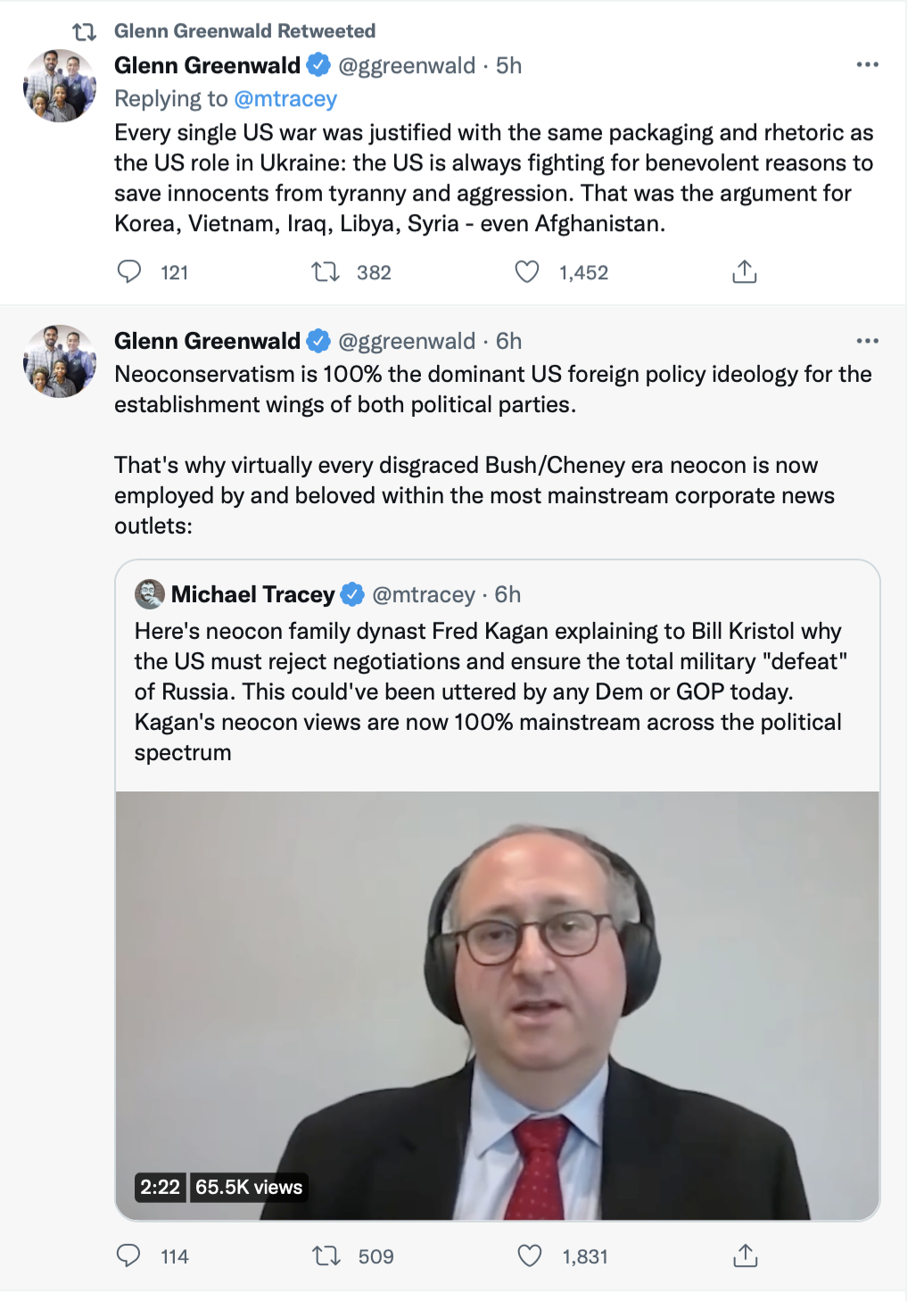
I posted a Tweet of Glenn Greenwald on Facebook today (and see here):

I added some additional commentary by Glenn Greenwald:

The amazing thing is it's the same people, it's David Frum and Nicolle Wallace and Matthew Dowd and Bill Kristol and Max Boot," Greenwald said. "All these neocons back then who were doing this and made themselves the enemy of the country. They ended up in complete disrepute by the end of the second Bush-Cheney term, are now back in the saddle doing it on behalf of Democrats on their cable networks, on their newspapers' op-ed pages. And it's like people have no historical memory, they cheer for these people because they rehabilitated themselves by opposing Trump and that's all they know.

Right on cue, I received this comment:

The invasion of Ukraine is NOT like Vietnam,Korea, etc. and equating it with that is aPutin-friendly talking point. Do you work for FOX now?

To which I responded:

Are you suggesting that because I'm against a war with no stated end-game and no stated benefit to ordinary Americans, a war that is enriching America's vast military-industrial complex, a war that pushes us ever closer to the trigger point of an already extremely dangerous risk of nuclear holocaust, and a war that is sucking up massive financial resources that should be helping desperate Americans,, that I'm pro-Putin and that I work for FOX?

[More . . . ]

Continue ReadingThe Newest Neocon Joyride

Why Liberal (and Conservative) News Media Stays in its Own lane

Tara Henley's newest article is "Meet the press: Why much of the media looks and sounds much the same." She makes some excellent points that apply to liberal news media as well as conservative media. Reporters appears to lost a sense of curiosity. Whatever happened to the childlike curiosity in these well-trained journalists? Has it been snuffed out? Unlikely, because reporters know how to attack viewpoints that threaten their world views. What they lack is motivation to examine bullshit emanating from their own tribe.

Why is this? Sometimes, editors are refusing to allow reporters to following their instincts to be curious. This is happening in many places, resulting in excellent reporters striking out on their own. This group includes Andrew Sullivan, Bari Weiss and Tara Henley.  There is a second less obvious reason: Many reporters feel internalized pressures to not ask certain questions. Henley offers this list of questions left-leaning reporters refuse to pursue:

Ask yourself how many liberal media pieces you’ve seen over the past two years that, say, interrogate COVID restrictions critically (especially early on, with school closures, lockdowns, and mask mandates). Or evaluate Black Lives Matter as a political movement, assessing its strengths and weaknesses. Or offer opposing viewpoints on transgender athletes in women’s sports; or mass immigration; or diversity, equity, and inclusion philosophies, trainings, or policies. Or acknowledge the excesses of #MeToo, or prejudice against the white working class. Or present critiques of identity politics. Or explore downsides of puberty blockers and gender transition surgery for teens; or delve into the growing censoriousness on social media and in education, Hollywood, the arts, and NGOs. Or probe inner city gun violence. Or reflect the positive sides of masculinity. Or talk about God. Or reference anything that’s currently deemed a conspiracy theory in non-derogatory terms (see: the lab leak theory). Or express genuine curiosity on the reasons behind the rise of independent media, whether that’s Joe Rogan or Substack.

Why are so many reporters afraid to be curious?

Often, it’s not a boss telling you what to cover, or how to cover it, but your colleagues, the mood in your newsroom, your competition, your Twitter feed, and, increasingly, your own anxieties. (And, just as important, what you are not being told. As writer Freddie deBoer has put it: “Everyone who works in the industry lives with a dim but persistent feeling that they have committed some kind of faux pas and are paying for it, but never know where, what, or why.”). Thus, consensus is manufactured in myriad small but insidious ways, and if you want to keep working you figure out the unspoken rules.

[More . . . ]

Continue ReadingWhy Liberal (and Conservative) News Media Stays in its Own lane

A Peak into the Dystopian Pro-Censorship Mind of the Washington Post.

This hatchet job aimed at Saagar Enjeti (and Elon Musk) provides a peak into the dystopian pro-censorship mind of the Washington Post. And there are many layers of dysfunction. Saagar and Krystal of Breaking Points offer a detailed analysis.

Continue ReadingA Peak into the Dystopian Pro-Censorship Mind of the Washington Post.

Matt Orfalea’s Military-Industrial Complex Non-Disclosure Mashup

Matt Taibbi, quoting Jeff Cohen of FAIR:

"If you’re listening to CNN, CBS, or PBS, and they introduce someone as a ‘former’ something, they’re lying to you,” he says. “What’s more relevant to the news consumer, that someone was an Undersecretary of Defense eight years ago, or that the same person is a highly paid lobbyist now? It’s obviously the second, but almost never revealed.”

And now, here is Matt Orfalea's Military-Industrial Complex Non-Disclosure Mashup:

Continue ReadingMatt Orfalea’s Military-Industrial Complex Non-Disclosure Mashup

Tara Henley Describes the Identitarian Left

Who are these people? Here's one tell: You will not find them on the streets actually helping to improve the people they claim they care about. You will not find them in the kinds of colleges that most people attend. You won't find them inviting open-ended discussions with the people they disagree with.

Tara Henley tells us more about the Identitarian Left, whether you call them this or whether you call them Woke Moralists or Social Justice Warriors or whatever:

One term I’ve heard lately that’s helpful in unpacking the new left is “identitarian moralism.” This phrase captures the new left’s puritanical thrust and quasi-religious fervour, along with its festishization of identity, while also signaling its ability to shape-shift to take up the Twitter cause du jour, whether that happens to be pandemic public health policies or, this week, recasting Madeleine Albright as some sort of feminist icon. What remains consistent, across all fronts, is a strident illiberalism.

Let’s be clear: If you do not agree with the new left’s list of approved narratives, it one hundred percent expects you to keep your mouth shut (or, alternatively, to “do the work” of “listening and learning,” ideally on Instagram, so that you can be shunned and shamed in as public a manner as possible).

The goal of the new left is, in fact, explicitly to shut down debate of any ideas deemed “harmful,” so as not to perpetuate the harm. This unfortunately leads to an endless parade of bad faith arguments, since the goal is never to make sense or persuade people, but rather to bring discussions to an abrupt halt.

It also leaves a great number of people politically homeless.

Who is Tara Henley? Someone who lives by her principles. A former decorated reporter with the Canadian Broadcasting Corporation. Here is why she resigned at the end of December 2021:
It used to be that I was the one furthest to the left in any newsroom, occasionally causing strain in story meetings with my views on issues like the housing crisis. I am now easily the most conservative, frequently sparking tension by questioning identity politics. This happened in the span of about 18 months. My own politics did not change.

To work at the CBC in the current climate is to embrace cognitive dissonance and to abandon journalistic integrity.

It is to sign on, enthusiastically, to a radical political agenda that originated on Ivy League campuses in the United States and spread through American social media platforms that monetize outrage and stoke societal divisions. It is to pretend that the “woke” worldview is near universal — even if it is far from popular with those you know, and speak to, and interview, and read.

To work at the CBC now is to accept the idea that race is the most significant thing about a person, and that some races are more relevant to the public conversation than others. It is, in my newsroom, to fill out racial profile forms for every guest you book; to actively book more people of some races and less of others.

To work at the CBC is to submit to job interviews that are not about qualifications or experience — but instead demand the parroting of orthodoxies, the demonstration of fealty to dogma.

Continue ReadingTara Henley Describes the Identitarian Left