
About “Insurrections” “Rebellions” and Trump

Section 3 of the Fourteenth Amendment provides as follows:

Section 3 Disqualification from Holding Office No person shall be a Senator or Representative in Congress, or elector of President and Vice-President, or hold any office, civil or military, under the United States, or under any State, who, having previously taken an oath, as a member of Congress, or as an officer of the United States, or as a member of any State legislature, or as an executive or judicial officer of any State, to support the Constitution of the United States, shall have engaged in insurrection or rebellion against the same, or given aid or comfort to the enemies thereof. But Congress may by a vote of two-thirds of each House, remove such disability.

At Reason, Constitutional Law Scholar Eugene Volokh takes a close look at the meanings of "insurrection" and "rebellion," as used in Section 3 of the Fourteenth Amendment to the U.S. Constitution.  Why is this important, even for those of us who are not supporters of Donald Trump?  Volokh notes that several serious legal scholars with solid conservative credentials are proposing a broad interpretation of this constitutional provision and its related enforcement statute:

Congress has enacted a statute, 18 U.S.C § 2383, which covers participation in rebellion or insurrection, and which provides that those found guilty "shall be incapable of holding any office under the United States."

It is noteworthy that not one of the hundreds of people so far prosecuted for their Jan 6 misconduct (not even Donald Trump) has been criminally charged with "insurrection under Section 2383.

Volokh cautions that we should be wary of interpreting these terms loosely, in that they allow political operatives to disqualify their opponents from running, something that we instinctively find to be cringe-worthy when we see it in other countries.

If abused, this is profoundly anti-democratic. "The right to vote freely for the candidate of one's choice is of the essence of a democratic society, and any restrictions on that right strike at the heart of representative government." Reynolds v. Sims, 377 U.S. 533, 555 (1964). The broader and more nebulous the definition of engaging in insurrection, and the fewer the procedural safeguards, the greater the danger.

About the terminology:

Section 3 speaks of "insurrection" and "rebellion." These are demanding terms, connoting only the most serious of uprisings against the government, such as the Whisky Rebellion and the Civil War. The terms of Section 3 should not be defined down to include mere riots or civil disturbances, which are common in United States history. Many of these riots impede the lawful operations of government, and exceed the power of normal law enforcement to control. Are they insurrections or rebellions, within the meaning of Section 3?

I have not done the historical work to speak with confidence, but I would hazard the suggestion that a riot is the use of violence to express anger or to attempt to coerce the government to take certain actions, while insurrections and rebellions are the use of violence, usually on a larger scale, to overthrow the government or prevent it from being able to govern.

I was personally outraged by the January 6 incursion, because I consider the Capitol to be a sacred civic space. Making things even worse, Congress was in session, meaning that the trespassers were directly interfering with the operation of my government. I am happy to see all those involved aggressively prosecuted. That said, I am also highly concerned that the U.S. Government itself, though its law enforcement arms (including the FBI), encouraged the protestors to invade the Capitol. See here and here and here and here.  But then, on July 13, 2022, the NYT, which has generally been horrified by the January 6 incursion,  published this bizarre article sympathetic to Ray Epps, who is on several January 6 videos encouraging protestors to go into the Capitol.  Follow up NYT story on July 14, 2022. Consider the second paragraph to the July 13 NYT story:

Ray Epps has suffered enormously in the past 10 months as right-wing media figures and Republican politicians have baselessly described him as a covert government agent who helped to instigate the attack on the Capitol last year.

Completely befuddled by the slant of this NYT coverage of Ray Epps, Tucker Carlson commented: "It's all very strange. The New York Times is mounting a propaganda campaign on behalf of a self-described Trump voter insurrectionist." Enough of this detour for now. Back to the Constitutional analysis.

Volokh also looks closely at the Constitutional requirement that one "engage in" one of these prohibited activities in order to be barred from office. In Volokh's analysis, barring someone from running for office requires more than applauding on the sidelines:

Moreover, Section 3 uses the verb "engage in," which connotes active involvement and not mere support or assistance. Significantly, Section 3 also uses the term "give aid and comfort to"—but this is reserved for giving aid and comfort to the "enemies" of the United States, which has historically meant enemies in war. Bas v. Tingy (1800). That Section 3 uses both terms, with different referents, strongly suggests that "engage in" means more than just give "aid and comfort" to an insurrection... In the absence of actual engagement in actual insurrection, judged as such by competent authorities, we should allow the American people to vote for the candidates of their choice.
Continue ReadingAbout “Insurrections” “Rebellions” and Trump

The Princeton Principles for a Campus Culture of Free Inquiry: A Roadmap to Get American Universities Back on Track

As seen in some of my posts, more than a few American Universities have decided, officially and/or de facto, that their core mission does not include unbridled learning driven by curiosity. Here is a brief description of how the new Princeton Principles came to be:

On April 14-5, 2023, a group of eminent scholars and practitioners gathered at Princeton University to explore ways to strengthen and rebuild the open, rules-based international order. In the shadow of the COVID pandemic and Russia’s war on Ukraine, they searched for “first principles” and reform ideas for twenty-first century global governance architecture, focusing in particular on rules and institutions for the world economy and great power security cooperation.

The newly published Princeton Principles for a Campus Culture of Free Inquiry seek to "advance free inquiry, honor intellectual merit, and respect the diverse ideas that arise naturally from the pursuit of truth." These are detailed principles that address many of the problems that have bedeviled universities, especially over the past ten years.  Further, these Princeton Principles perfectly complement the Chicago Principles and the Kalven Committee Recommendations. 

Continue ReadingThe Princeton Principles for a Campus Culture of Free Inquiry: A Roadmap to Get American Universities Back on Track

Dramatic Reversal: Democrats Now Trust FBI and CIA

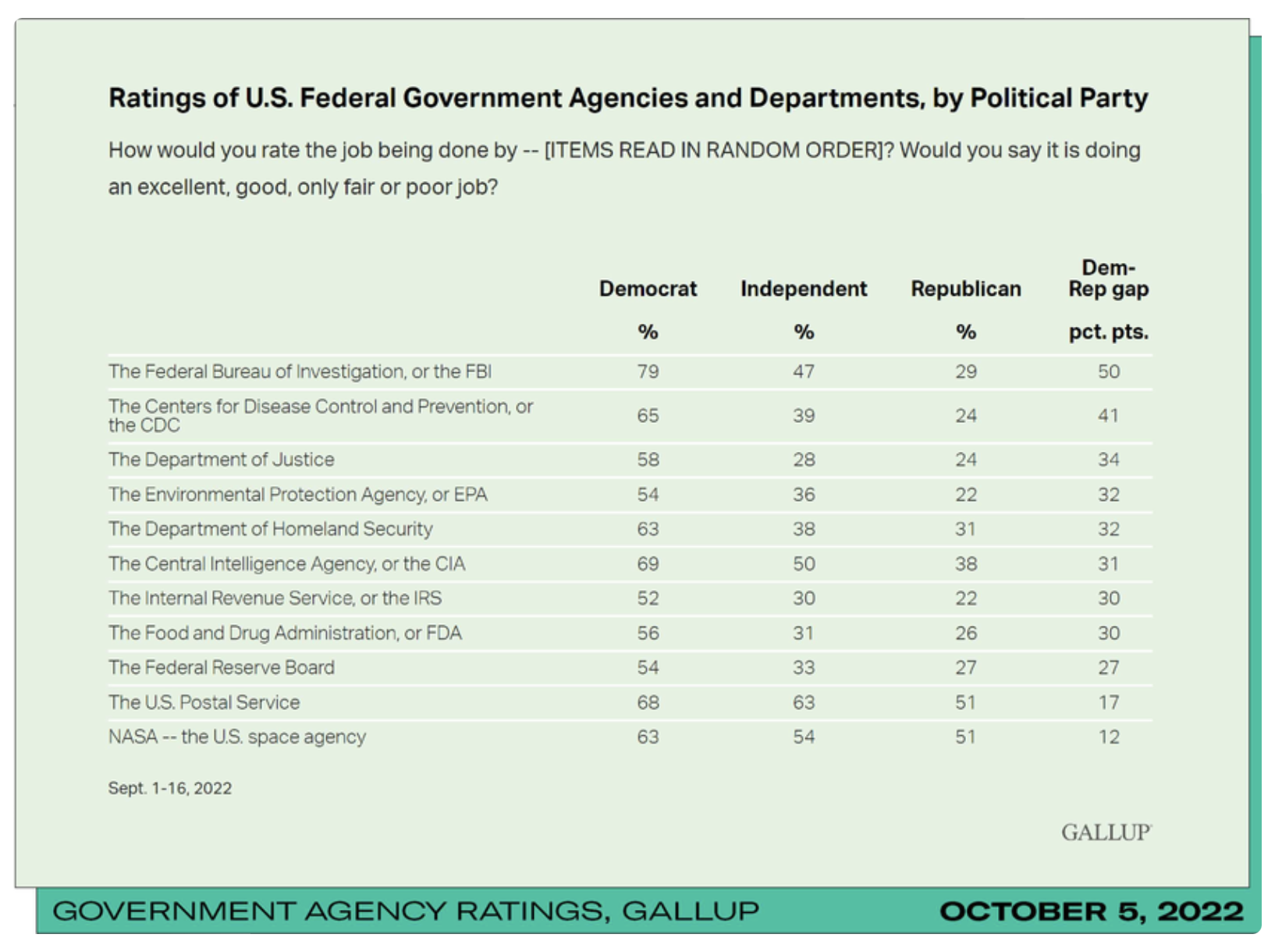
Here are the numbers, a Gallop poll from 2022:

Glenn Greenwald comments on the dramatic change in the attitudes of Democrats:

So, here you see the FBI: 79% of Democrats think the FBI is doing an excellent or good job. For decades, distrust of the FBI and a view that it is a fundamentally corrupted organization pervaded and shaped federal politics. That is gone. Democrats worship the FBI. We report on those hearings all the time in the House where Democratic members of the House, of Congress, stand up and applaud the U.S. security state for censoring the Internet on the grounds that these agencies are benevolent, have nothing but the most patriotic and noble intentions and want to protect us from disinformation. So here you see the FBI with 79% trust among Democrats; among Independents, about half, 47%, and among Republicans, 29%.

So, essentially, the FBI is seen to a purely partisan end or political framework, ideological framework. They have immense powers, they operate in secrecy, they spy on Americans, they investigate crimes and the only people who really trust them are Democrats. Independents are split. Republicans overwhelmingly view them as corrupt.

It's even worse for the Department of Justice. Only 58% of Democrats trust the Department of Justice; 28% of Independents think the DOJ is doing a good job; only 24% of Republicans. So, imagine how much this is going to exacerbate that distrust. These remarkable and extraordinary prosecutions were brought during an election against the leading political opponent of the current government.

And then you have the CIA. When I tell you that opposition to the CIA has long been a central plank of left-liberal politics, I cannot overstate that case. To be on the left meant that it viewed the CIA as a malevolent institution forever, for decades, until 2016, and you see the reversal happen immediately. The reason for it is so disturbing. It's because the CIA – and the FBI – is where Russiagate came from, and liberals started recognizing validly that the CIA and the FBI and Homeland Security and the NSA and the Justice Department were on their side. They were political allies of the Democrats. And so now you have this remarkable reality that 69% of Democrats – 69% – think the CIA is doing a good or excellent job: 69% of Democrats. To be a Democrat is basically to mean that you place a lot of faith and trust in the CIA and even among this 30%, that won't say it; you barely can find opposition to the CIA in mainstream laughable discourse Turn on podcasts or YouTube programs of self-proclaimed leftists. I don't mean real leftists like the kind we have on our show, like the Black Revolutionary Network, but I mean, like the ones in the Democratic Party, the ones who follow Bernie Sanders and AOC. You will not hear a peep of meaningful denunciation of the CIA if they mention them at all. It's very much in passing with no passion, with no concern, because they don't consider the CIA menacing, because they know the CIA is their political ally. The CIA is not supposed to be anyone's political ally. They're not supposed to have anything to do with American politics and yet everyone knows they do. And they have to explain these percentages.

Here you see 50% of independents. So again, independents are split like they are with the FBI; 38% of Republicans have positive views of the CIA, largely from probably decades of Republican politics, the establishment weighing the hawkish wing of the Republican Party that has long viewed the CIA as an important ally. But that has cratered. And here you see the massive partisan split and how these agencies are viewed and the fact that a huge chunk of the country believes that these institutions are politically corrupted and fundamentally and irretrievably broken. It's a massive crisis of institutional authority in the United States. And it's aimed at the agencies that are now the ones responsible for trying to prove that the indictment of President Trump is illegitimate, invalid.

Continue ReadingDramatic Reversal: Democrats Now Trust FBI and CIA

Inconvenient Murderers

From the New York Post:

Our era is obsessed with “hate-crimes.” So much so that it sees them in places where they don’t even happen. Yet last Saturday in Brooklyn was a hate crime. And the media are actually covering it up. All because Sibley’s assailants were not hood-wearing members of the KKK or “MAGA” hat-wearing Republicans.

Instead they come from another group that our media identifies as a victim class. The fact that the men were Muslim is why the media has been actively dishonest in its reporting. Despite the story going around the world.

Continue ReadingInconvenient Murderers

The Hubris that Resides in the Heart of the Censor

Glenn Greenwald, discussing journalism and censorship with Ben Shapiro:

At the heart of the censor resides hubris, more than anything else. If you look at the intellectual history of humanity, it's nothing but trial and error. What people believe in one generation is Absolute Truth. It gets to be regarded by the next generation as a grievous error. That's the way that we advance. That's what makes life exciting: The fact that we err, we're fallible, we're constantly in search of the truth, we're using our reasoning skills and our cognitive abilities to try and figure out what is true and what is false.

There are a lot of things I believe, very, very, very passionately, I honestly have never ever gotten to the point where I felt like what I believe in is so clearly and indisputably and permanently true that I believe it ought to be illegal for anyone to express an opinion different than the one that I had. I couldn't imagine ever finding the hubris necessary to believe that about myself that I now reside above the human history of trial and error. But that's really what these people believe. And I think that is the reason censorship is so appealing: once you convince yourself that you were on the side of objective good, whoever disagrees with you or sees the world differently than you is the enemy of all--evil--and you can only see the world in that kind of binary way. It almost becomes not just tolerable, but necessary to say those people shouldn't be able to speak because they're fonts of falsity, lies and deceit, whereas I am the owner of the truth. I feel extremely uncomfortable believing that about myself, even though there are a lot of things I really strongly believe in and believe are true. I just never have gotten to that point. And can't imagine getting to that point.

Once you adopt a view, your political opponents are no longer people who are misguided and wrong, or even ill-intentioned . . . they're essentially on the level of Hitler and Nazism. That's the single worst evil we could possibly think of. If you really believe that the United States faces a choice between remaining a liberal democracy on the one hand, or succumbing to a Hitlerian, white nationalist dictatorship, if that's something that you actually believe, on some level it becomes rational to say: "I think the evil we're facing is so overarching that anything and everything we do, censoring, lying, sabotaging, cheating and deceiving becomes, again, not just morally justifiable, but morally necessary.

Continue ReadingThe Hubris that Resides in the Heart of the Censor