Luxury Beliefs in Chicago

Rob Henderson coined the term "Luxury Beliefs" as follows:

Luxury beliefs are ideas and opinions that confer status on the upper class while inflicting costs on the lower classes.

Here, Rob offers a more expansive discussion:
In addition to my own experiences with social mobility, my luxury beliefs idea stems from Thorstein Veblen’s work, particularly his 1899 book, The Theory of the Leisure Class. Veblen, a sociologist and economist, described how the elites of his era displayed their status through conspicuous consumption, such as wearing delicate, expensive clothing, carrying pocket watches, or attending lavish ballroom events. While material possessions still play a role in signaling status today, I argue that they have become a noisier indicator of wealth. A century ago, one could easily distinguish the rich from the poor based on appearance alone. However, in our wealthier modern society, where access to goods is more widespread, it’s harder to gauge someone’s wealth at a glance.

Instead, status is increasingly expressed through what I call luxury beliefs, which have largely replaced luxury goods. These beliefs reflect what sociologist Pierre Bourdieu termed cultural capital. Elites invest in attending prestigious schools and universities, where they adopt the mannerisms, vocabulary, habits, and fashionable opinions of the upper class. This process enculturates them into the elite and sets them apart from the broader population. For example, while the conventional view might support law enforcement, someone seeking to signal their elite status might advocate for abolishing the police or reimagining law enforcement with ideas like hiring “violence interrupters.” Such unconventional or avant-garde views serve as a way to distinguish oneself from the masses and signal a superior social position.
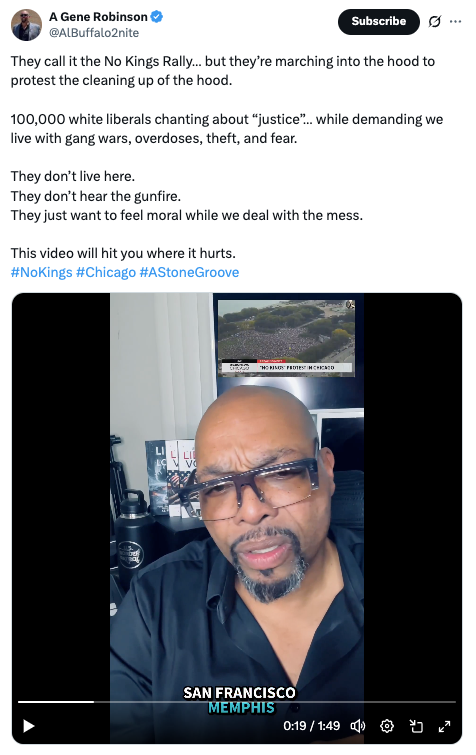
Today, I noticed this post by A Gene Robinson, who doesn't use the term "luxury beliefs," but is angry about non-stop high crime in Chicago contrasted with what he considered the detached cheap signaling of those who participated in the Chicago No Kings Rally:

I asked Grok to compare the economic circumstances of those in Chicago's crime ridden neighborhoods to the circumstances of people who work for corporate media:

Corporate media workers earn 2–5 times more than residents in these Chicago neighborhoods ($60,000+ vs. $25,000–$50,000), enabling comfortable lifestyles with savings, travel, and leisure. They benefit from employer perks like health insurance and flexible time off, contrasting with reliance on public aid in high-crime areas, where poverty rates are 2–3 times higher (40%+ vs. national 12%). Media lifestyles involve professional growth and urban amenities, while these neighborhoods face survival challenges, unemployment-driven desperation, and violence that perpetuates economic stagnation. This disparity highlights broader urban inequalities, where media professionals might even report on these communities from a position of relative privilege.

Then I asked Grok to compare the economic circumstances of those in Chicago's crime-ridden neighborhoods to those who marched in the Chicago no-kings rally:

The economic divide between residents of Chicago's crime-ridden neighborhoods and No Kings rally marchers is stark, highlighting urban inequalities in race, class, and opportunity. Neighborhood residents endure entrenched poverty, with incomes 2–4 times lower than the implied stability of rally participants, who benefit from assets like homes and retirement funds accumulated over decades.

While the former face unemployment, reliance on aid, and violence-linked economic stagnation, marchers—often older, white, and from more affluent backgrounds—enjoy financial security enabling activism without personal economic risk.

This contrast underscores how protests like No Kings may draw from privileged demographics, potentially overlooking the direct economic hardships in the city's most vulnerable areas.
Continue ReadingLuxury Beliefs in Chicago

Dramatic Reversal: Democrats Now Trust FBI and CIA

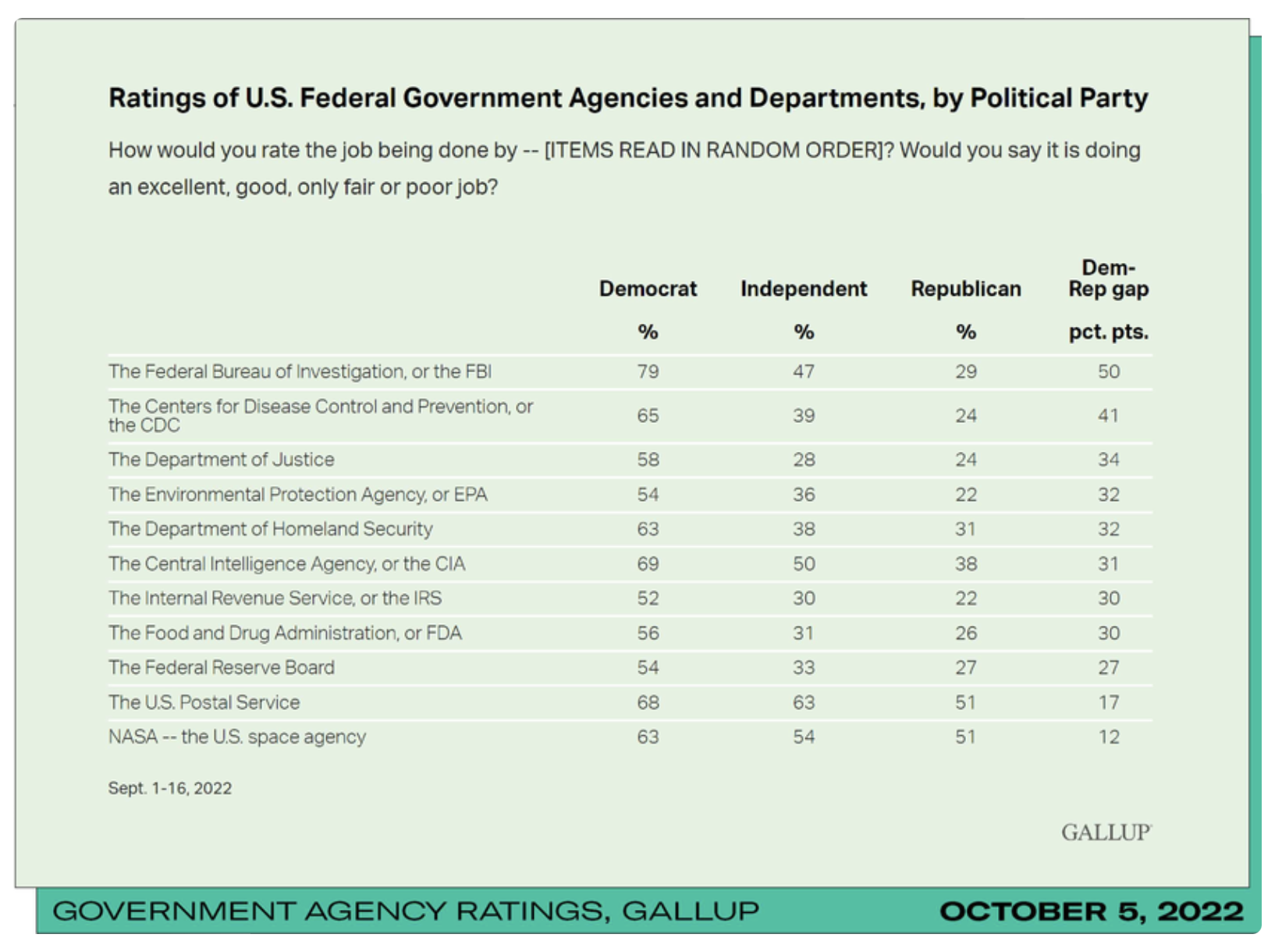
Here are the numbers, a Gallop poll from 2022:

Glenn Greenwald comments on the dramatic change in the attitudes of Democrats:

So, here you see the FBI: 79% of Democrats think the FBI is doing an excellent or good job. For decades, distrust of the FBI and a view that it is a fundamentally corrupted organization pervaded and shaped federal politics. That is gone. Democrats worship the FBI. We report on those hearings all the time in the House where Democratic members of the House, of Congress, stand up and applaud the U.S. security state for censoring the Internet on the grounds that these agencies are benevolent, have nothing but the most patriotic and noble intentions and want to protect us from disinformation. So here you see the FBI with 79% trust among Democrats; among Independents, about half, 47%, and among Republicans, 29%.

So, essentially, the FBI is seen to a purely partisan end or political framework, ideological framework. They have immense powers, they operate in secrecy, they spy on Americans, they investigate crimes and the only people who really trust them are Democrats. Independents are split. Republicans overwhelmingly view them as corrupt.

It's even worse for the Department of Justice. Only 58% of Democrats trust the Department of Justice; 28% of Independents think the DOJ is doing a good job; only 24% of Republicans. So, imagine how much this is going to exacerbate that distrust. These remarkable and extraordinary prosecutions were brought during an election against the leading political opponent of the current government.

And then you have the CIA. When I tell you that opposition to the CIA has long been a central plank of left-liberal politics, I cannot overstate that case. To be on the left meant that it viewed the CIA as a malevolent institution forever, for decades, until 2016, and you see the reversal happen immediately. The reason for it is so disturbing. It's because the CIA – and the FBI – is where Russiagate came from, and liberals started recognizing validly that the CIA and the FBI and Homeland Security and the NSA and the Justice Department were on their side. They were political allies of the Democrats. And so now you have this remarkable reality that 69% of Democrats – 69% – think the CIA is doing a good or excellent job: 69% of Democrats. To be a Democrat is basically to mean that you place a lot of faith and trust in the CIA and even among this 30%, that won't say it; you barely can find opposition to the CIA in mainstream laughable discourse Turn on podcasts or YouTube programs of self-proclaimed leftists. I don't mean real leftists like the kind we have on our show, like the Black Revolutionary Network, but I mean, like the ones in the Democratic Party, the ones who follow Bernie Sanders and AOC. You will not hear a peep of meaningful denunciation of the CIA if they mention them at all. It's very much in passing with no passion, with no concern, because they don't consider the CIA menacing, because they know the CIA is their political ally. The CIA is not supposed to be anyone's political ally. They're not supposed to have anything to do with American politics and yet everyone knows they do. And they have to explain these percentages.

Here you see 50% of independents. So again, independents are split like they are with the FBI; 38% of Republicans have positive views of the CIA, largely from probably decades of Republican politics, the establishment weighing the hawkish wing of the Republican Party that has long viewed the CIA as an important ally. But that has cratered. And here you see the massive partisan split and how these agencies are viewed and the fact that a huge chunk of the country believes that these institutions are politically corrupted and fundamentally and irretrievably broken. It's a massive crisis of institutional authority in the United States. And it's aimed at the agencies that are now the ones responsible for trying to prove that the indictment of President Trump is illegitimate, invalid.

Continue ReadingDramatic Reversal: Democrats Now Trust FBI and CIA

Inconvenient Murderers

From the New York Post:

Our era is obsessed with “hate-crimes.” So much so that it sees them in places where they don’t even happen. Yet last Saturday in Brooklyn was a hate crime. And the media are actually covering it up. All because Sibley’s assailants were not hood-wearing members of the KKK or “MAGA” hat-wearing Republicans.

Instead they come from another group that our media identifies as a victim class. The fact that the men were Muslim is why the media has been actively dishonest in its reporting. Despite the story going around the world.

Continue ReadingInconvenient Murderers

Eighty FBI Agents Telling Americans What They Can’t Say, Using Disappearing Messages

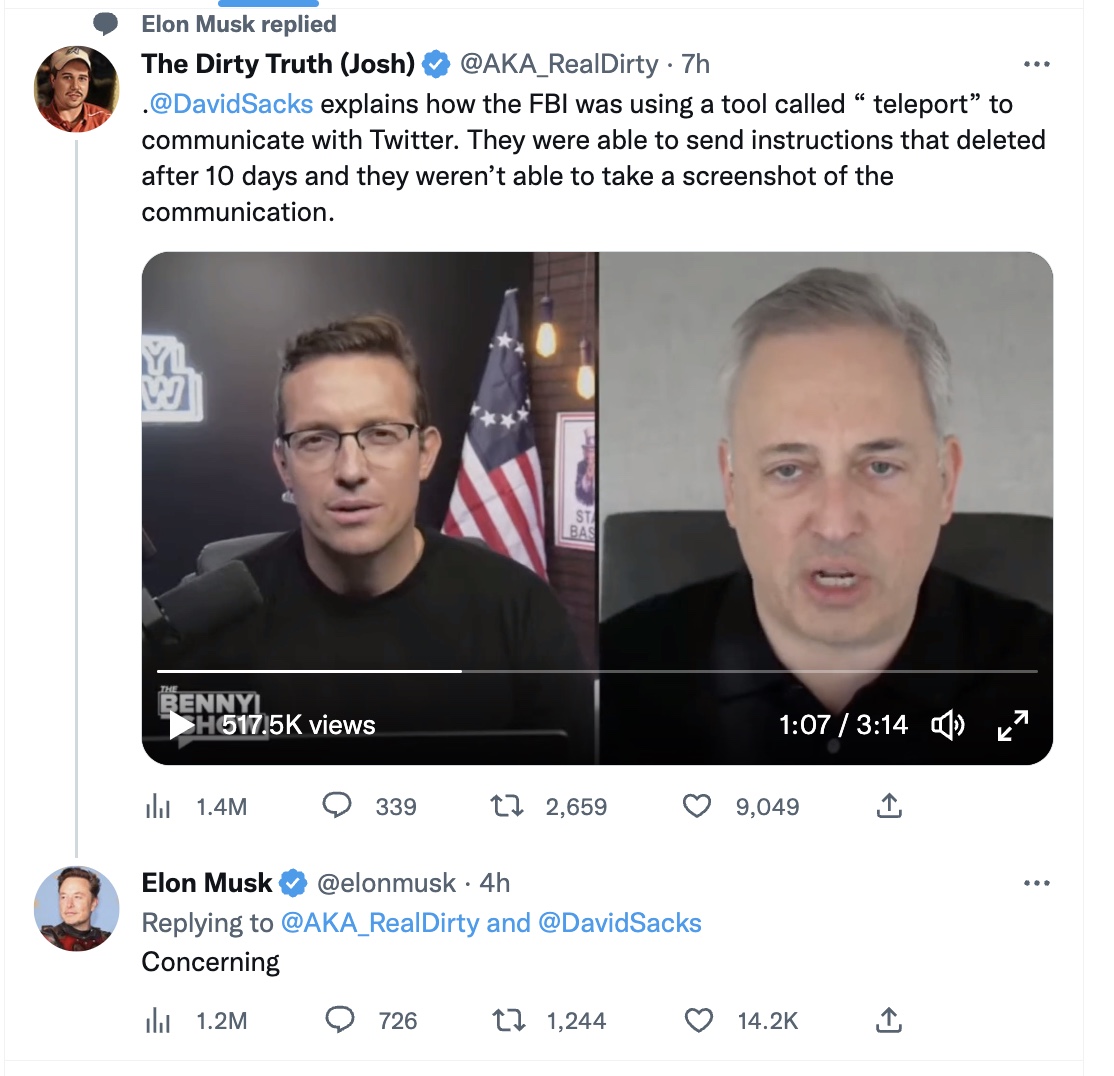
As David Sachs asks, why was the FBI in the business of identifying social media posts to take down? Their job should be to investigate federal CRIMES. There were reportedly 80 FBI agents assigned to identify troublesome posts and they communicated with Twitter with messages that would disappear, not leaving a trace. Is this how a democracy works?

Continue ReadingEighty FBI Agents Telling Americans What They Can’t Say, Using Disappearing Messages