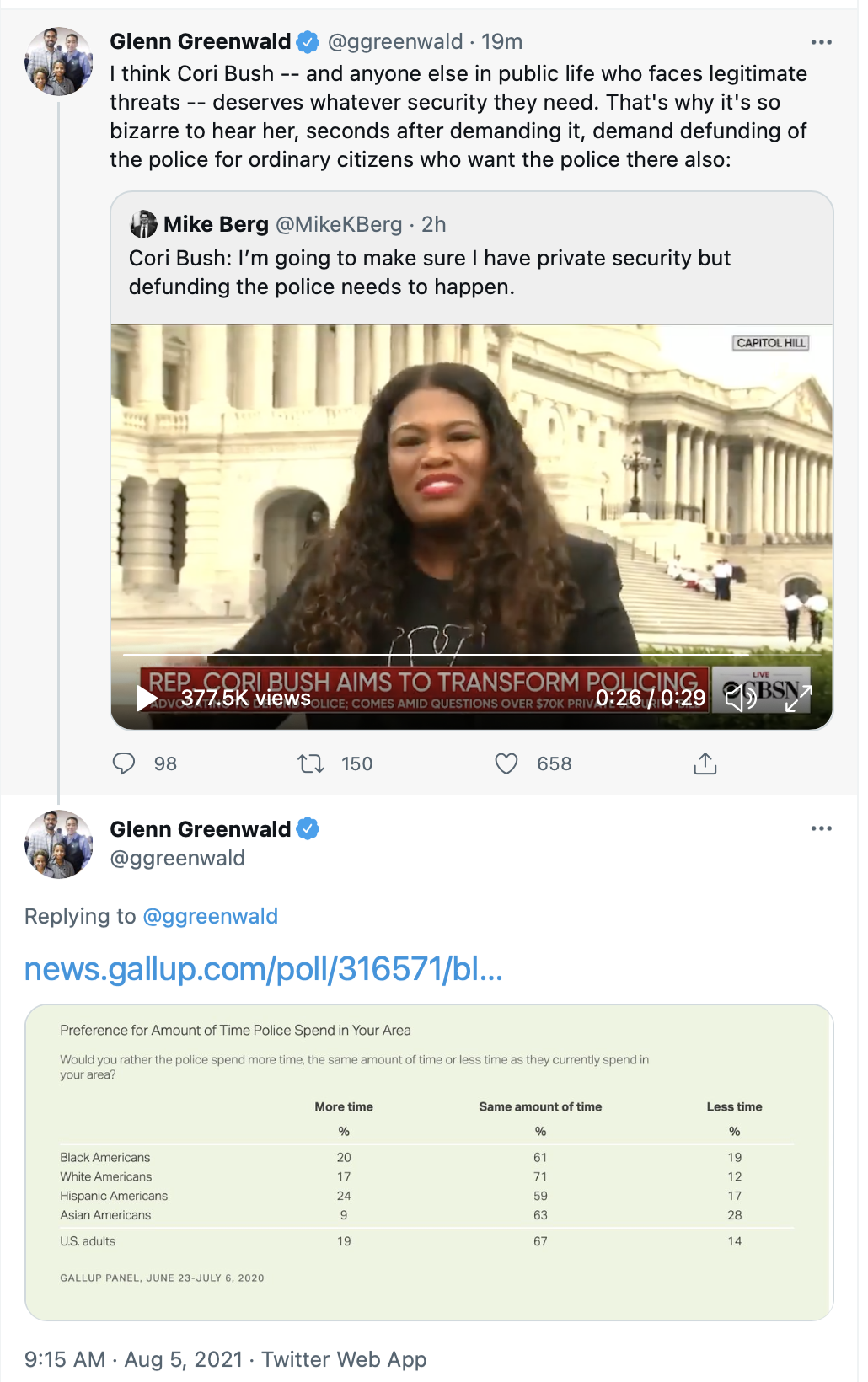
Last week, Philadelphia district attorney Larry Krasner, a prominent criminal justice reform advocate, generated blistering backlash after explicitly dismissing the recent explosion of violent crime in his city:
“We don’t have a crisis of lawlessness, we don’t have a crisis of crime, we don’t have a crisis of violence,” the district attorney told reporters at a Monday press conference when asked if tourists are safe to travel to Philadelphia for the holidays. “It’s important that we don’t let this become mushy and bleed into the notion that there is some kind of big spike in crime.”
The crime stats tell a different story. As of Saturday night, the city tallied 535 homicides, shattering its record 500 homicides set in 1990, the height of the crack epidemic. This summer, the city reached another grim milestone: Philadelphia had the highest murder rate per capita of the country’s 10 largest cities.
Though progressive politicians dismiss growing crime concerns as right-wing “hysteria,” the homicide toll is nearly impossible to exaggerate. More people have died by homicide in Philadelphia in 2021 than in 2014 (248) and 2015 (280) combined. Moreover, the racial inequality in homicide victimization is striking: though black Americans comprise only 41.5% of Philadelphia’s population, they account for 85% of the city’s homicide victims.
Gladwell’s point seems to be that if you ask police to stop millions of cars and pedestrians, and instruct them to look for pretexts to conduct searches of all of them, police will override their “default to truth” and begin to see threats in innocent people everywhere. He’s trying to be understanding about scenes like the Encinia video, by asking readers to look at the policy context underneath that car stop.
The backdrop of the Ferguson, Missouri case, for instance, involved the strained finances of the city. As the Justice Department later found, “City officials routinely urge [police] to generate more revenue through enforcement,” which meant busting people not just for breaking the law but violating municipal order codes...
Individual police got most of the blame, and in some cases deserved it, but it’s politicians desperate for revenue or lower crime numbers who artificially heighten stranger contacts, jack up numbers of bogus summonses and tickets, and push people like Brian Encinia to fudge pretexts for thousands if not millions of stops and searches.
A percentage of those encounters will always go wrong, and when they do, it’s not always all about racism. It’s usually also about political stupidity, greed, and laziness, and a host of other problems our habit of reaching for simplistic explanations prevents us from understanding. Saying it’s all about race or white supremacy isn’t just inaccurate, it lets bad actors off the hook — especially city politicians and their upscale yuppie donors who vote for these interventionist policies, and are all too happy to see badge-wearing social janitors from middle-class towns in Long Island or Westchester take the rap when things go bad.
Gladwell concludes that “Sandra Bland is what happens when a society does not know how to talk to strangers,” but I think that doesn’t put it strongly enough. Bland is what happens when police spend too much time talking to strangers, and when the rest of us talk too little about why that is.
Gladwell opens the above talk (regarding his book) with this:
I wanted to talk a little bit about it a paradox about human communication which i think is extremely important and relatively under-recognized and that is that everything that is good and meaningful and powerful about a human communication has a price as it turns out I think the price is worth paying but I think sometimes we overlook the consequences of the fact that there is this particular consequence to effective communication.
The problem at the heart of the two puzzles is that people assume that they can make sense of others based on relatively simple strategies. But when it comes to strangers, nothing is as simple as it seems.
There are three major strategies that people use to make sense of strangers:
People default to truth.
People assume transparency.
People neglect coupled behaviors.
These three strategies ultimately fail because they operate under the assumption that simple clues are enough evidence of a stranger’s internal thoughts or intentions. We will look at each of these strategies separately to see where they came from and why they often result in failed interactions with strangers.
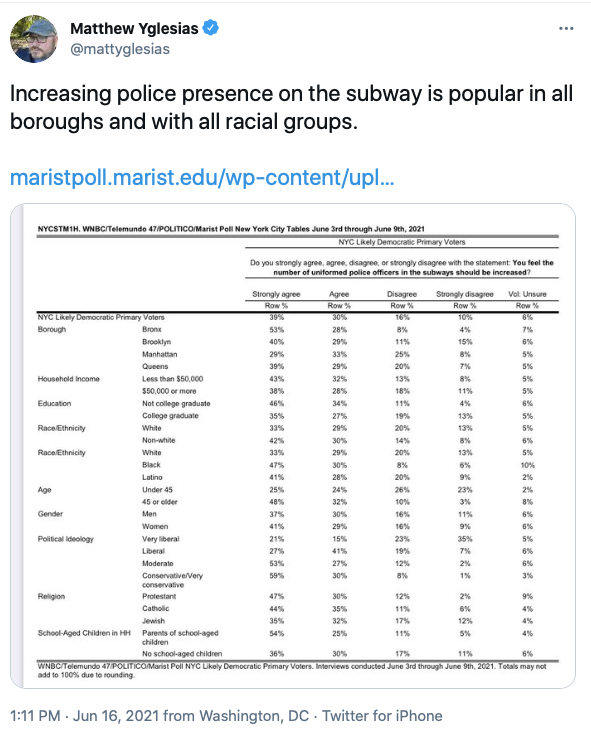
Over the past year, the official narrative has been that police are bad and that we should defund or abolish the police. A recent poll shows us that NYC Democratic primary voters resoundingly disagree. Within this group of voters, it difficult to overlook that the groups most seek more police include self-identified "Blacks" with school-aged children who are non-college graduate earning lower wages. Among those responding, those who most often claim that police should be kept off the subways are self-identified "Whites" who don't have school-aged children who are college graduates earning higher wages. That said, all groups other than those describing themselves as "very liberal" or "under 45" seek more police, not fewer.
I recommend this high-energy thoughtful and challenging conversation between Jordan Peterson and Bari Weiss. Do I need to say that I don't agree with everything mentioned during this long conversation? These days, apparently so. There is so much that is honest and good about this open-ended exchange, where these two strong personalities challenge each other and (contrary to the current U.S. zeitgeist) appreciate each other for these challenges.
Here is one of my favorite parts. Those who are steeped in Wokeness so often want to tear everything down, every aspect of the system, all institutions, assuming that there is something good on the other side that will simply organically bloom. This approach is reminding me of fundamentalist libertarianism and fundamentalist conservatives: many of whom believe that great things will simply happen if we just get government out of the way. As though our institutions, which we have crafted over decades and centuries, are not doing Herculaneum work to (imperfectly) set up curbs and guard rails to give us necessary structure to allow human flourishing. I see our (imperfect and always evolving) institutions much like I see traffic laws. Sometimes these institutions seem arbitrary, but they serve to allow people to interact with each other, often in helpful ways that is captured by the definition of "institution" offered by economist Doug North: “humanly devised constraints that shape human interaction." For North, Institutions not bounded by brick and mortar (or by particular people), but by two kinds of constraints: formal and informal. Together, these constraints comprise what John Drobak and North call “the rules of the game.”
We need a set of basic laws in order to move to the next step, to better things, sometimes to almost-magic seeming levels of complexity. Institutions allow this, but destroyed institutions invite (actually, demand) socio-economic collapse. Society's basic rules (promulgated through our institutions) also remind me of the axioms of geometry. Why assume the truth of axioms? Because if you don't, we can't do geometry!
The tear-it down Woke mentality does not offer any meaningful vision of what is on the other side of tearing it down. There is no real-work path being offered to get from the chaos they preach to anything worth having. These youngsters, many of them from a coddled generation, offer no specifics, only cheap-signaling promises that things will somehow be better. For background on this rather sharp accusation of "coddling," see here, here, here, here and here. Today's young adults have not suffered like many people from prior generations who have seen social-economic collapse. They haven't suffered like many first generation immigrants to the U.S., most of whom are not buying Woke ideology, not for one second. The empty of promises of Woke ideologists remind me of the promises of religious fundamentalists who promise "heaven. The realist in me fills in these empty promises of Woke advocates with things like CHAZ/CHOP (see here, for example) and Evergreen State College. Until I see specifics that convince me otherwise, these two things exemplify the Woke end game.
That is the context for the following excerpt. I have edited only for false starts and to tidy up. The content has not been changed:
Jordan Peterson
There is a concern for the dispossessed, and that's what gives the radicals the moral high ground so often. "We're concerned for the dispossessed, aren't you?" It's like, "Well, yes, as a matter of fact, we are." The wielders of these ideas start out with a moral advantage, but the evidence seems to suggest that the very systems they're attempting to tear down are, in fact, the best antidote to the problems that they're laying out. So then the question pops up again: So if that's the case, why the hell is there so much force behind these ideas? What's driving them? And it's associated with that laughter at the thought of violent bloody revolution,
Bari Weiss
Because we're so removed from violent bloody revolution. That's why. It's a luxury to flirt with these ideas. Let's just take an example, I'm not wearing long sleeves. You could see my collarbone, I could walk down the street here with my wife and go get a falafel at the end of the street and not be stoned to death. Okay, that's the reality. That's a miracle.
Jordan Peterson
That is that's what divides people is whether or not they know that's a miracle.
Bari Weiss
Yes. And if you are so removed from the truth of that miracle, and from gratitude for everyone and every idea, every piece of scaffolding that allows for that to be that my reality, then you will have the foolishness. But it's really the luxury in the decadence to flirt with ideas about doing away with it. I am so curious about why certain people feel in their bones, how thin the veneer of civilization is and why other people are so nonchalant about it. I feel like it's a logical question, but I don't know it.
v
Jordan Peterson
I don't know either. When I was in graduate school, I was obsessed with the finitude of life and with mortality and death. I mean, I wake up every morning and think there's no time. Get to it now! I had friends who I would say were more well-adjusted than me. That's certainly part of it. Like they were more emotionally stable, technically speaking, less prone to depression and anxiety. So that's part of that. It was that those ideas never entered the theater of their imagination. Right? They just weren't a set of existential problems for them. For me, it's always been Paramount.
Hello, I invite you to subscribe to Dangerous Intersection by entering your email below. You will have the option to receive emails notifying you of new posts once per week or more often.