How to Be a Human Animal. Chapter 3: The Most Important Fork in the Road: Approach versus Avoidance

Chapter 3: The Most Important Fork in the Road: Approach versus Avoidance

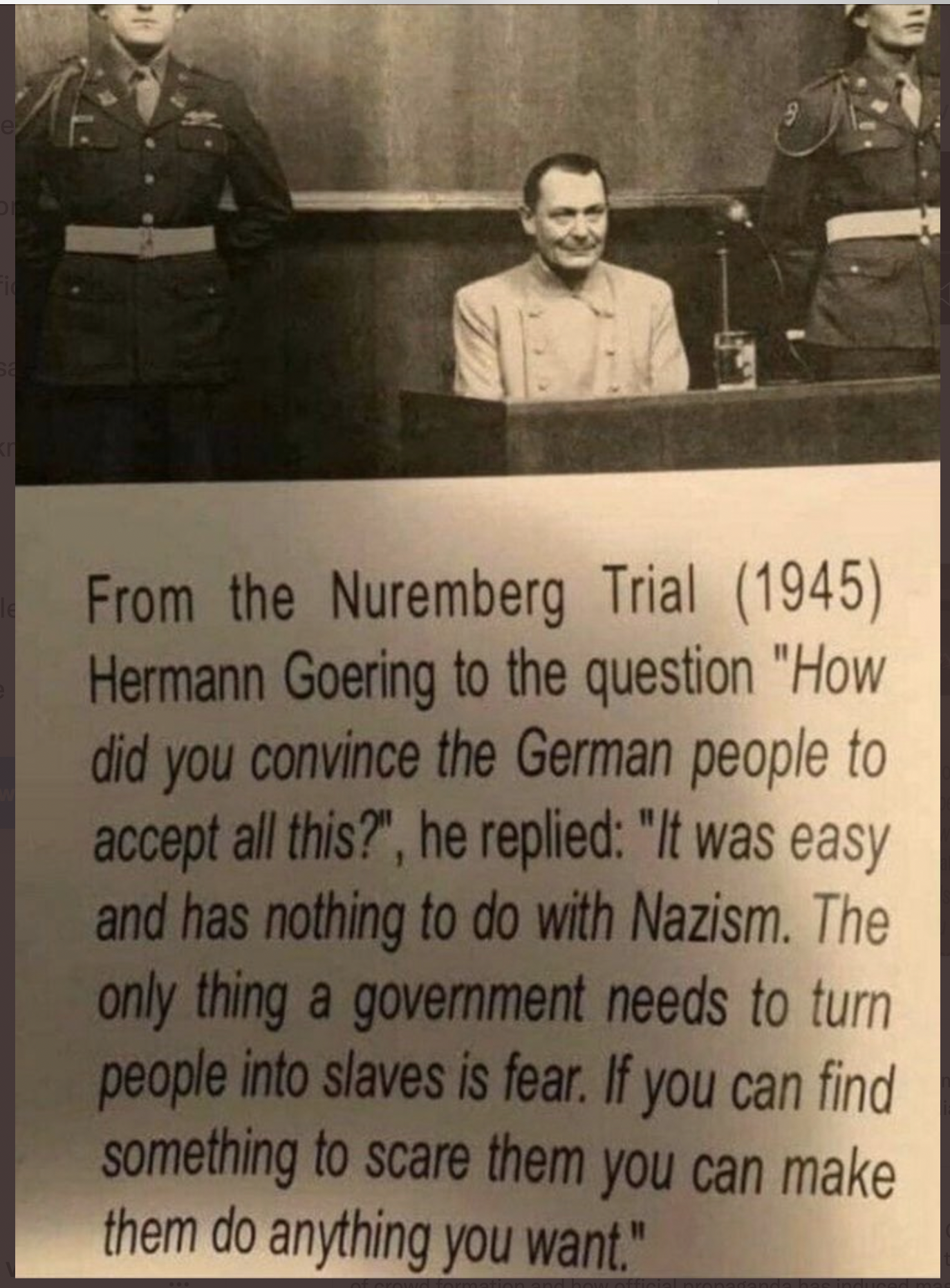
Is the world something to be feared or something to be enjoyed? That is the most important decision you will need to make, day after day. Does the world seem like a scary haunted house or like a big playroom? The stance you take, avoidance versus approach, will have a profound effect, not only on what you accomplish, but on who you turn out to be.

I'll admit that Planet Earth is filled with many dangers, including spiders and snakes, but also automobiles and addictions to dangerous drugs. There are innumerable ways to ruin or lose a life and we are wired to see many of these dangers much more saliently than we see the safe and happy things. Daniel Kahneman teased out this deep instinct with his Prospect Theory. We see risks twice as big as we see benefits.

We have been wired to assume the worst. A snapped twig in the darkness of the forest might be a puppy, but the body’s operating assumption is to run because the joy of finding a puppy whereas the danger of a grizzly bear can kill you. We are wired to run at all of Life’s snapped twigs and metaphorical snapped twigs. Those twigs are everywhere, leading many people to curl up in a fetal position, afraid to leave their houses.

Psychologist Jonathan Haidt characterizes this choice of Approach versus Avoidance as “the fundamental question of life.” This attitude affects almost everything we do, including how we approach education.

As soon as life began moving, as soon as you get little tails on bacteria, you have to have some mechanism for deciding this way or that? Approach or avoid? And all of the rest of the billion years of brain evolution is just commentary on that question.And so the human brain has these gigantic tracts of neurons on the front left cortex, specialized for approach. And then a frontal cortex specialized for avoid. And so all sorts of things go with this. So when we’re in explorer mode, some features of it are, we’re more, we’re curious. We take risks. You might feel like a kid in a candy shop with all these different things to explore. You think for yourself. And the model of a student in this mindset would be whoever grows the most by graduation, or whoever learns the most by graduation wins. If that’s your attitude, boy, are you going to profit from being in college for four years.

Conversely, if you spent most of your college years with your front, right cortex activated, because you’re told everyone’s against you, everyone hates you, you’ll never get ahead. It’s always been this way. Then it always will be this way. If that’s what you believe, you’re in defend mode, threat mode, and then you don’t trust people. Your goal is not to be curious. It’s to be safe. You’re afraid of things. And you think about books in terms of certain speakers in terms of danger versus safety. You see threats everywhere and you will cling to your team. And your motto is: If we defeat them, then we win. And that’s the incoherence that has been with us since 2015. We had an influx of students who were playing a very different game where everything was danger and conflict. And no, that’s not what a university [is]. You’ve misunderstood what we’re about and why you’re here. And so it’s been a tragic waste.

So what is your decision this moment and every other moment yet to come? Are you going to be an explorer, seeking out new worlds with uncertainty and risk? Or are you going to obsessively try to be “safe,” meaning that you will hide away and tremble as life passes you by?

Explorers often fail, they know it and they still explore. They know that failure usually doesn’t hurt you or kill you. They know that failure is a teaching tool and a way to build strong character. Long before Carol Dweck wrote about “growth mindsets,” the famous explorers felt it in their bones. They knew that human animals are antifragile, even though they didn’t know that word: they knew that they would thrive in the world because it is filled with stressors, shocks, volatility, noise, mistakes, faults, attacks, or failures. They understood Nietzsche’s point that “what doesn’t destroy you often makes you stronger.” They fe;t the wisdom of the Stoics in their bones: “The Obstacle is the way.” They would agree with Woody Allen’s observation that showing up is 80 percent of life.

There is one thing that does makes Explorers tremble: The thought that after they die, someone would carve this epitaph on their tombstone: “Here lies _____ ______ , who was afraid to leave the house.”

But what if you are afraid? What if you worry that you will get laughed at or humiliated, or criticized or called a name, much less that you might get hurt or even die? Heroes feel all of these things. There is nothing incompatible about being afraid and simultaneously being a hero. Heroes and explorers make themselves move forward even when they are scared. One of my favorite illustrations of this was noted by Nietzsche:

Sometimes during a battle he could not help trembling. Then he talked to his body as one talks to a servant. He said to it: “You tremble, carcass; but if you knew where I am taking you right now, you would tremble a lot more.”
Nietzsche cited (in The Gay Science, Intro Book V) this quote as an illustration of his own conception of fearlessness (attributed to Henri de la Tour d’Auvergne, Vicomte de Turenne (1611-75) a great French general).

So go hither and explore the world! Try new things. Plan to get knocked down, criticized and ridiculed. And then get up again and again. Channel Cool Hand Luke. Never ever give up.
Continue ReadingHow to Be a Human Animal. Chapter 3: The Most Important Fork in the Road: Approach versus Avoidance

Misdirected Vax Anger Loses Sight of Unmistakable Corporate Looting

Matt Taibbi points out that we are too busy arguing with each other about masks and vaccinations to notice major league corporate theft. His Substack article at TK is titled "Vaccine Aristocrats Strike Again: As yokel-bashing reaches impressive new heights, reports of yet another year of record profits and a widening wealth gap go unnoticed." Here's an excerpt:

[W]ithout constant drumbeats about the treacherous stupidity of anti-vaxxers and “domestic terrorists,” at whom would the bulk of Americans’ anger be directed now?

A good guess would be people like the Fed-fattened private equity takeover artists who were just reported to have swallowed a trillion dollars in companies last year. These are people who force conquered companies to issue reams of new debt to pay them bonuses (taking advantage of a massive public bond-buying program intended as emergency aid) while doing things like cutting shifts for E.R. doctors and nurses in the middle of a pandemic. Even grandfatherly billionaire Warren Buffett’s company Special Metals is currently asking 450 striking steelworkers to accept pay cuts and take on $725 more a month in health premiums, while Buffett himself just floated on our increasingly phony stock market to increase his personal wealth by $1.6 billion in a single day.

. . . “Banks so far have been using profits to invest in technology, pay bonuses and buy back their own stock,” the FT wrote. Meaning, the bulk of this new wealth — most fueled by roughly $5 trillion in Fed spending since the beginning of the pandemic — is being converted into compensation for a handful of executives. Buybacks have also been rampant in defense, pharmaceuticals, and oil & gas, all of which also just finished their second straight year of record, skyrocketing profits. We’re now up to about 745 billionaires in the U.S., who’ve collectively seen their net worth grow about $2.1 trillion to $5 trillion since March 2020, with almost all that wealth increase tied to the Fed’s ballooning balance sheet.

Continue ReadingMisdirected Vax Anger Loses Sight of Unmistakable Corporate Looting

About Mass Formation Hypnosis

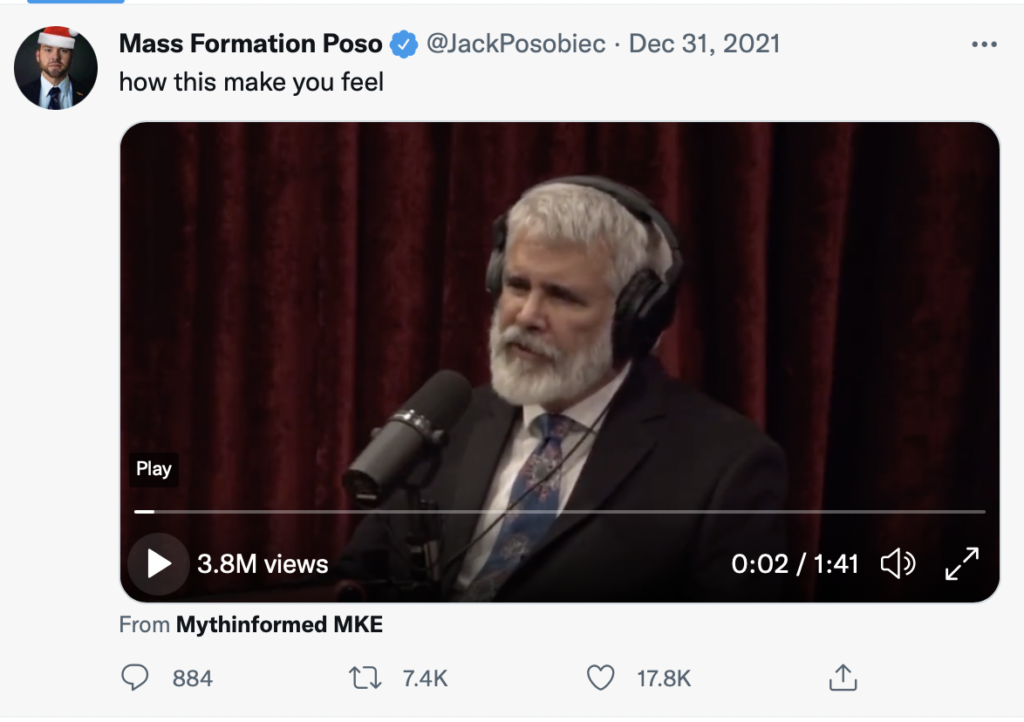
Dr. Robert Malone recently discussed "Mass Formation Hypnosis" on Joe Rogan's show:

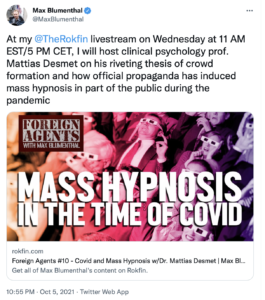
I decided to do a deeper dive into this topic.  Clinical Psychologist Dr. Mattias Desmet discusses Mass Formation Hypnosis with Max Blumenthal in this video:

As Desmet describes at 14 min (and summarizes at 19:45), there are four conditions for MFP:

1. Lack of social bonds

2. Lack of meaning making

3. High levels of free floating anxiety. They don't know why they are anxious and it is very distressing/painful for humans to experience because of the lack of control, resulting in risk of developing panic attack. They actively look for something to which they can attach the free-floating anxiety, something they can control.

4. High levels of free floating frustration and aggression

What happens when these conditions exist? Desmet explains: A narrative is disseminated that A) indicates an object for the anxiety and B) offers a strategy/solution for this object of anxiety. As a result of this narrative, all of the free-floating anxiety attaches to the object of anxiety offered by the narrative, resulting in a over-willingness to participate in the strategy.

In present times, the object of the anxiety is the virus and the strategy is the lockdown, social distancing and other corona measures. MFH allows people to feel that they can control their anxiety by participating in the strategy. When large groups of people participate in the strategy, it leads to a new social bond, new connectedness, a new solidarity, and this leads to a new sense-making in life. In other words, life becomes meaningful through the heroic struggle with the object of anxiety (the virus). COVID led to a new solidarity because everyone participated in a heroic collective battle with the virus. As social beings, we switched from isolation to the new strong social bond (or solidarity) with large masses of other people. This is why people enthusiastically buy into the corona narrative even if it is utterly absurd. For those not caught up in MFH, they are amazed that others so often utter such absurdities.

Those caught up in the narrative don't do so because the narrative (the set of extreme COVID measures) is correct. Rather, they do so because they seek the new powerful social bonds. Many of the measures are not relevant or true, but they function as rituals in which people participate in order to connect to the masses of others caught up in the narrative. The more absurd and unscientific the COVID measures and the more that sacrifice is demanded, the better the measures function as rituals. This fits the general function of rituals: a behavior that you participate in not because it is functional to protect you from the virus, but to show to the tribe/collective that the collective is more important than the individual. You would be in error to think that as COVID measures become more absurd, more people will wake up to the insanity, but that is an illusion. The more absurd the measures become, the more blinded certain people will become.

Mass Formation is a type of hypnosis. In hypnosis, the attention of an individual is hyper-focused on a very small part of reality, making the rest of reality disappear into darkness. People caught up don't realize that in obsessing over the COVID measures, they are losing much else, meaning that they lose interest in cost/benefit analyses. Even substantial losses are a small price to pay in order for one to feel that one is part of the heroic struggle against COVID. This has led to an aggressive stance toward heterodox outsiders, people who question the narrative, such as Dr. Robert Malone. The masses always need a common enemy, which includes the virus as well as the people who don't fall completely in line.

At Min 30, Blumenthal applies the theory to many political movements in sadomasochistic fashion. These phenomenon are always destructive and self-destructive. Desmet adds: The exclusive focus on one part of reality to the neglect of the rest of reality inevitably leads to self-destruction. George Orwell noticed that the masses, the crowd, exists because it has to channel/satisfy its frustration/aggression and it needs to attach its anxiety to a certain object--and once an object of anxiety is destroyed, the crowd seeks a new object of anxiety, which also must be destroyed. Hannah Arendt, in The Origins of Totalitarianism. She noticed the in its effort to keep reattaching its aggression to new objects of anxiety, the masses become a monster and the system destroys itself.

Desmet fears that we are seeing the emergence of a new totalitarian state, exactly as Hannah Arendt predicted, not led by gang leaders but by dull bureaucrats and technocrats, pursuant to her concept of the banality of evil. We can see this by the extreme COVID response in Australia. These measure are palpably absurd to those not caught up in the narrative. Arendt warned: once you accept the starting point, there is no stopping. You feel compelled to accept all the rest.

This theory of Mass Formation Hypnosis would appear to have ubiquitous applications--wherever anxiety is widespread. This theory has screamingly obvious application to the formation of many religions, for example.

Relevant to the above: Joe Rogan's guest, Dr. Robert Malone was recently deplatformed by Twitter, a stunning development, given Malone's credentials:

Dr. Robert Malone is the inventor of the nine original mRNA vaccine patents, which were originally filed in 1989 (including both the idea of mRNA vaccines and the original proof of principle experiments) and RNA transfection. Dr. Malone, has close to 100 peer-reviewed publications which have been cited over 12,000 times. Since January 2020, Dr. Malone has been leading a large team focused on clinical research design, drug development, computer modeling and mechanisms of action of repurposed drugs for the treatment of COVID-19. Dr. Malone is the Medical Director of The Unity Project, a group of 300 organizations across the US standing against mandated COVID vaccines for children. He is also the President of the Global Covid Summit, an organization of over 16,000 doctors and scientists committed to speaking truth to power about COVID pandemic research and treatment.

Continue ReadingAbout Mass Formation Hypnosis

Caitlin Flanagan: What it’s Like to Turn 60 Years Old

Caitlin Flanagan is one of my favorite writers. She just turned 60 years old, which means that it's time to reminisce, celebrate and try to make deep sense of things.

[Y]ou have been on this Earth for a really, really long time. I have a photograph of myself at age 3, standing on the docks of Cork Harbor, about to sail to New York. When I look at the picture of that small child on her sturdy legs in the foggy past, I don’t feel any connection to her. The photograph looks like something I would discover after many days on Ancestry.com. It looks like a snapshot of my own great-aunt. There’s a reason the photograph looks like it’s from another time. Because it is from another time; it was taken more than half a century ago. How can I be in a photograph from that long ago? The math makes sense, but my own life doesn’t.

Continue ReadingCaitlin Flanagan: What it’s Like to Turn 60 Years Old