
Batya Ungar-Sargon: The Political Left Intentionally Cultivate Real Life Violence

Batya Ungar-Sargon makes a strong case that the violent killing of Charlie Kirk is not a "both sides" issue:
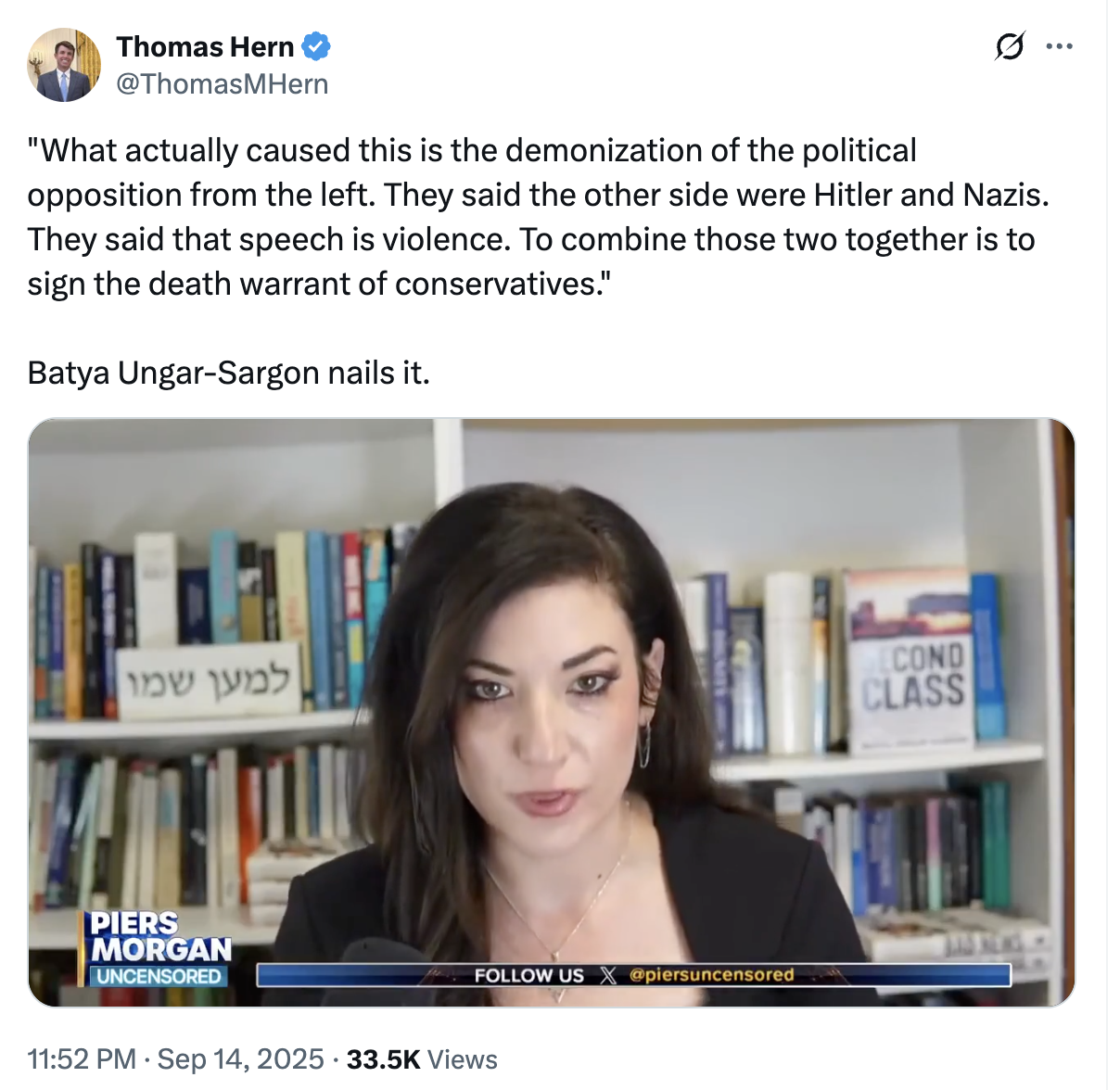
I'm finding myself very caught between, on the one hand, wanting to honor his legacy of unity through debate and coming together to take down the temperature, and then wanting to honor his legacy of telling the truth. And the truth is this is not a both sides issue. The killer killed him, according to police reports, because he found Charlie Kirk to be spreading hate. This is a view shared by every single prominent Democrat.

Yes, there are people on blue sky advocating for violence, but what actually caused this was the utterly quotidian, utterly ubiquitous demonization of the political opposition from the left, and it has just led to violence because they said the other side were Hitler and Nazis. They said that speech is violence. To combine those two things together is to sign the death warrant of prominent conservatives, and that is what we are seeing again and again and again.

And it is utterly facetious to suggest that there is any comparison between political violence on both sides. Every example they bring is not actually showing that, whether it's Governor Shapiro whose attempted assassination was from a free, Palestine leftist, or whether it was the Minnesota assassinations, which were from somebody who said he was operating at the behest of Democrat Governor Tim Walz. There is a culture among Democrats at the highest level to suggest that their political opposition are a danger, and that suggests that their lives are forfeit.

And I want to come together. I do. I love what Shanks said. It brought tears to my eyes. I reached for a tissue while you were playing Charlie's words. But at the same time, we cannot unite with people who are lying to our faces about who we are, who will not take responsibility for the fact that they suggested that we are Nazis because of totally legitimate views that reflect the majority of Americans.

So what I say is, let the left say we were wrong. It is legitimate to vote for Donald Trump. It is legitimate to be pro life. It is legitimate to believe that there are only two genders, and we were wrong to suggest that that was not the case. We were wrong to say that that is hateful. When they say that, I am waiting with open arms to take down the temperature.

Continue ReadingBatya Ungar-Sargon: The Political Left Intentionally Cultivate Real Life Violence

Nellie Bowles Exposes that Left Wing Media is Always About Agenda, not Curiosity

Nellie Bowles, at TGIF:

Here’s MSNBC contributor Matthew Dowd shortly after Charlie was shot: “I always go back to, hateful thoughts lead to hateful words, which then lead to hateful actions.” And: “You can’t stop with these sort of awful thoughts you have and then saying these awful words and not expect awful actions to take place.” And also: “We don’t know if this was a supporter shooting their gun off in celebration, we have no idea.” That makes more sense, right? A right-wing gun nut pointing a gun directly at the guy talking and pulling the trigger to celebrate him—that is definitely the most likely scenario. Later, facing outrage for its coverage, MSNBC apologized for these comments and ended Dowd’s contract.

Well, that’s MSNBC. But CNN? Within a few hours of Charlie’s slaughter, CNN anchor Abby Phillip was calling for the video to be censored, and did her best to do so from her pulpit. “The degree to which the algorithm on this platform is pushing video of the shooting is incredibly disturbing. There has to be some human that can turn the dial down in a situation like this.” Odd how reporters want much, much less reporting. Funny how she didn’t say that about a situation like, I don’t know, George Floyd’s killing. It’s almost like it’s political. ...

And then came the New York Times obituary. A classic. The headline: “Charlie Kirk, Right-Wing Provocateur and Close Ally of Trump, Dies at 31.” Right-wing provocateur. A person trying to provoke, if you think about it. As though there’s no belief system behind it. Just a provocateur. For the sake of it. In the mainstream media worldview, there are two kinds of people: those fighting for left-wing causes, who are described as people of conviction, activists for justice, deep believers in equality. And then there are those fighting for right-wing causes, who are described as provocateurs, cynics, racists, and shills. Archconservatives. They eventually changed the headline. But here’s the New York Times’ obituary: “He was so vocal in his willingness to spread unsupported claims and outright lies—he said that the drug hydroxychloroquine was ‘100 percent effective’ in treating the virus, which it is not—that Twitter temporarily barred him in early March 2020. But that move only added to his notoriety and seemed to support his claim that he was being muzzled by a liberal elite.” Fascinating. A man is murdered in public, in the middle of the day, while practicing his First Amendment rights, and the paper of record decides this must be the perfect moment to do fact-checking about hydroxychloroquine.

What you need to know from this: If your politics are that of a standard normie conservative man, your New York Times obituary will find the various things you said that weren’t exactly right (he got into hydroxychloroquine in 2020! Can you believe that?) and they’ll paint them in the sky. My politics are lib centrist, and these people would certainly celebrate my death, highlight my many errors, and refer to my defense of the SAT as my “repeated advocacy for a return to slavery” or something. What I’m saying is: Just try to stay alive because when you die, a New York Times reporter gets to juice your corpse for likes on Bluesky. MSNBC will invite talking heads on the air to suggest that the shooter could have been your mom who forgot to turn the safety on, we simply don’t know."

Nellie's TGIF column at The Free Press is one of my favorite parts of every week. I highly recommend it.

Continue ReadingNellie Bowles Exposes that Left Wing Media is Always About Agenda, not Curiosity

RFK, JR Death Challenges Us

RFK, Jr.:

When people die, they leave a big hole in you, and that hole really doesn't get any smaller. What our job is is to grow ourselves bigger around the hole by building character. And we do that by taking part of the best virtues of the person who died, and trying to incorporate those into our own character. And that way, we make ourselves larger, and the hole gets proportionally smaller.

Continue ReadingRFK, JR Death Challenges Us

The Characteristics of People who Commonly Engage in Ad Hominem Attacks

I asked Grok: "What characteristics would you attribute to people who refuse to engage on the issues and instead engage in ad hominem attacks?"

Grok's response (I think it's an excellent response):

People who consistently avoid substantive debate on issues and resort to ad hominem attacks—insulting the person rather than addressing their arguments—often exhibit a cluster of psychological, cognitive, and behavioral traits. These aren't universal, as context matters (e.g., stress or cultural norms can play a role), but based on observations from psychology, rhetoric, and social dynamics, here are some common characteristics I'd attribute to them:Intellectual insecurity or defensiveness: They may feel their beliefs or knowledge are under threat, leading them to deflect by attacking the messenger. This stems from a fragile ego or imposter syndrome, where engaging deeply risks exposing weaknesses.

1. Lack of substantive knowledge or preparation: Without strong facts or reasoning to back their position, they fall back on personal jabs as a shortcut. It's easier to call someone "stupid" than to research and counter an argument effectively.

2. Emotional immaturity or high reactivity: Prone to letting emotions override logic, they might have poor impulse control or unresolved anger issues, turning discussions into personal vendettas. This aligns with traits seen in low emotional intelligence (EQ).

3. Cognitive biases in overdrive: Things like confirmation bias (only seeking info that supports their view) or black-and-white thinking make them dismiss opposing ideas outright, viewing disagreement as a personal affront rather than an intellectual challenge.

4. Manipulative or bad-faith tendencies: In some cases, it's a deliberate tactic to derail conversations, common in trolls, propagandists, or those with narcissistic traits who prioritize "winning" over truth-seeking. They might enjoy provoking reactions for entertainment or control.

5. Poor communication or conflict resolution skills: Often stemming from upbringing, education gaps, or social environments that reward aggression over dialogue, they haven't learned (or choose not to use) tools like active listening or constructive criticism.

These behaviors can be self-reinforcing, as they alienate thoughtful interlocutors and surround the person with echo chambers. If it's a habit, it might indicate deeper issues like anxiety disorders or even cluster B personality traits (e.g., borderline or antisocial tendencies), though that's speculative without clinical context. On the flip side, everyone slips into ad hominem occasionally under pressure—it's the refusal to engage that's the red flag.

Continue ReadingThe Characteristics of People who Commonly Engage in Ad Hominem Attacks