Nellie Bowles Exposes that Left Wing Media is Always About Agenda, not Curiosity
Here’s MSNBC contributor Matthew Dowd shortly after Charlie was shot: “I always go back to, hateful thoughts lead to hateful words, which then lead to hateful actions.” And: “You can’t stop with these sort of awful thoughts you have and then saying these awful words and not expect awful actions to take place.” And also: “We don’t know if this was a supporter shooting their gun off in celebration, we have no idea.” That makes more sense, right? A right-wing gun nut pointing a gun directly at the guy talking and pulling the trigger to celebrate him—that is definitely the most likely scenario. Later, facing outrage for its coverage, MSNBC apologized for these comments and ended Dowd’s contract.
Well, that’s MSNBC. But CNN? Within a few hours of Charlie’s slaughter, CNN anchor Abby Phillip was calling for the video to be censored, and did her best to do so from her pulpit. “The degree to which the algorithm on this platform is pushing video of the shooting is incredibly disturbing. There has to be some human that can turn the dial down in a situation like this.” Odd how reporters want much, much less reporting. Funny how she didn’t say that about a situation like, I don’t know, George Floyd’s killing. It’s almost like it’s political. ...
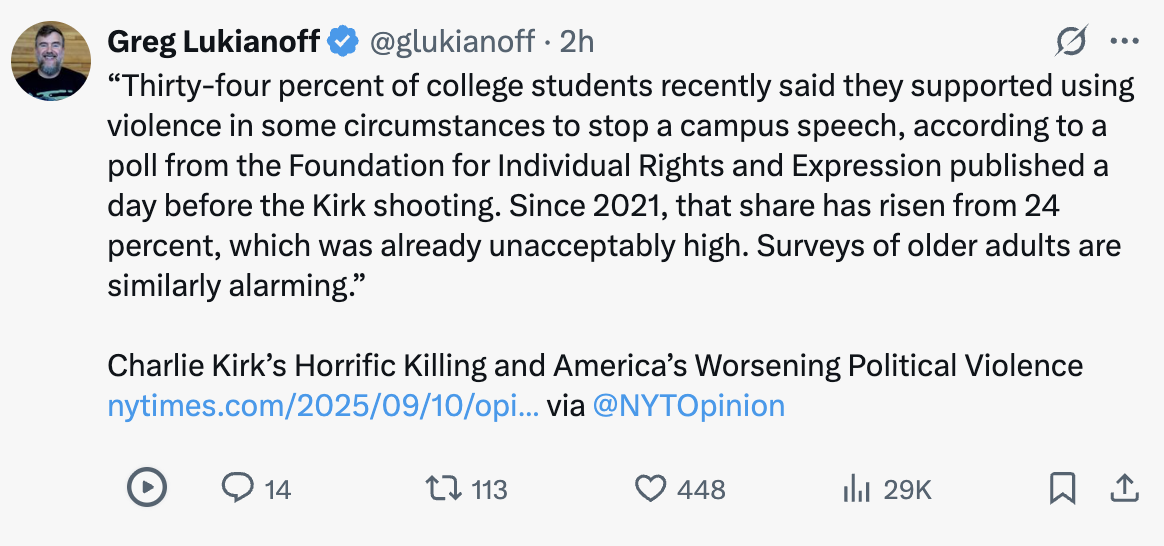
And then came the New York Times obituary. A classic. The headline: “Charlie Kirk, Right-Wing Provocateur and Close Ally of Trump, Dies at 31.” Right-wing provocateur. A person trying to provoke, if you think about it. As though there’s no belief system behind it. Just a provocateur. For the sake of it. In the mainstream media worldview, there are two kinds of people: those fighting for left-wing causes, who are described as people of conviction, activists for justice, deep believers in equality. And then there are those fighting for right-wing causes, who are described as provocateurs, cynics, racists, and shills. Archconservatives. They eventually changed the headline. But here’s the New York Times’ obituary: “He was so vocal in his willingness to spread unsupported claims and outright lies—he said that the drug hydroxychloroquine was ‘100 percent effective’ in treating the virus, which it is not—that Twitter temporarily barred him in early March 2020. But that move only added to his notoriety and seemed to support his claim that he was being muzzled by a liberal elite.” Fascinating. A man is murdered in public, in the middle of the day, while practicing his First Amendment rights, and the paper of record decides this must be the perfect moment to do fact-checking about hydroxychloroquine.
What you need to know from this: If your politics are that of a standard normie conservative man, your New York Times obituary will find the various things you said that weren’t exactly right (he got into hydroxychloroquine in 2020! Can you believe that?) and they’ll paint them in the sky. My politics are lib centrist, and these people would certainly celebrate my death, highlight my many errors, and refer to my defense of the SAT as my “repeated advocacy for a return to slavery” or something. What I’m saying is: Just try to stay alive because when you die, a New York Times reporter gets to juice your corpse for likes on Bluesky. MSNBC will invite talking heads on the air to suggest that the shooter could have been your mom who forgot to turn the safety on, we simply don’t know."
Nellie's TGIF column at The Free Press is one of my favorite parts of every week. I highly recommend it.