The mainstream media attack on Martin Luther King for his criticism of warmongering

Here is a basic rule of American journalism: Don't speak the truth during times of war. Martin Luther King received received harsh treatment by the mainstream media when he dared to speak out about the Vietnam War, even after his many successes in the area of civil rights. The occasion was King's somber Riverside Church speech. Part II of King's speech is here.   King's speech is accurately described as follows at this Youtube page:

By 1967, King had become the country's most prominent opponent of the Vietnam War, and a staunch critic of overall U.S. foreign policy, which he deemed militaristic. In his "Beyond Vietnam" speech delivered at New York's Riverside Church on April 4, 1967 -- a year to the day before he was murdered -- King called the United States "the greatest purveyor of violence in the world today." Time magazine called the speech "demagogic slander that sounded like a script for Radio Hanoi," and the Washington Post declared that King had "diminished his usefulness to his cause, his country, his people.
At the recently concluded National Conference for Media Reform, Amy Goodman of Democracy Now commented on the propensity of the media to become obeisant to warmongering American politicians, and the equal propensity of the media to criticize those who criticize warmongering. To hear Goodman's excellent speech, go to minute 28:00 of the composite video.

Continue ReadingThe mainstream media attack on Martin Luther King for his criticism of warmongering

Early human-neanderthal ancestor remains identified

This is an incredible story. Scientists have identified a 30,000-40,000 year old hominid ancestor whose DNA indicates that it is part Human, part Neanderthal.

If further analysis proves the theory correct, the remains belonged to the first known such hybrid, providing direct evidence that humans and Neanderthals interbred. Prior genetic research determined the DNA of people with European and Asian ancestry is 1 to 4 percent Neanderthal.
Those were amazing times in Europe, where humans and Neanderthals co-existed. One wonders whether this co-existence was at all peaceful. Regardless, apparently I (along with many people of European and Asian ancestry) carry some Neanderthal genetic coding. When I am asked about my "race," I have sometimes (when I would not receive any sort of benefit or privilege for doing so) indicate "African." I've previously argued that we'd all be better off declaring that we are African, because the categories or "race" are as scientifically deficient as they are culturally divisive. But now, thanks to this new finding, I have the option of indicating that my "race" is Part-human, part Neanderthal, out of Africa via Europe, currently living in the U.S. Or something like that.

Continue ReadingEarly human-neanderthal ancestor remains identified

Endless growth on a finite planet

Can we have endless growth (as proposed by many as the solution to our economic woes) on a finite planet? John Atcheson of Common Dreams explains why this idea of endless growth is absurd:

Right now, it takes 1.5 Earths worth of resources to maintain our current economy. By 2050, assuming only moderate growth, we’ll consume nearly 3 Earths worth.

But of course, we only have one planet.

Those extra worlds we consume represents debt – assets taken from our children. In ecologic terms, it is called “overshoot.” And living systems cannot long survive in overshoot mode. The term overshoot comes from ecology, and a classic example of an ecological overshoot might serve to make this concept more real.

So here you go. In 1944, the US Coast Guard released 29 reindeer onto St. Mathew Island. By the summer of 1963, the population had exploded to over 6,000 animals. Quite a success, eh? Not really. By the end of 1963, the population plummeted to fewer than 50 scrawny, starving animals. They’d experienced an ecological overshoot.

Continue ReadingEndless growth on a finite planet

Business as usual at J.P. Morgan Chase

Nothing has changed for the better at J.P. Morgan Chase, as described by Matt Taibbi. It's clearly time to break up the big Wall Street banks.

If you can fight through the jargon, what this basically means is that Chase decided to go into the fiction business and invent a new way to value its crazy-ass derivative bets, using, among other things, a computerized model the company designed itself called "P&L predict" which subjectively calculated the value of the entire fund toward the end of every business day. If this all sounds familiar, it's because it's the same story we've heard over and over again in the financial-scandal era, from Enron to WorldCom to Lehman Brothers - when the going gets tough, and huge companies start to lose money, they change their own accounting methodologies to hide their screw-ups, passing the buck over and over again until the mess explodes into the public's lap. The difference is that Chase is a much bigger and more dangerous company to be engaging in this kind of behavior. An even scarier section of the report regards the reaction of the Office of the Comptroller of the Currency, or OCC, the primary government regulator of Chase. The report exposes two huge problems here. One, Chase consistently hid crucial information from the OCC, including the sort of massive increases in risk the OCC was created precisely to monitor. Two, even when the bank didn't hide stuff, the OCC was either too slow or too disinterested to take notice of potential problems.

Continue ReadingBusiness as usual at J.P. Morgan Chase

The importance of grooming in human animals and the other primates.

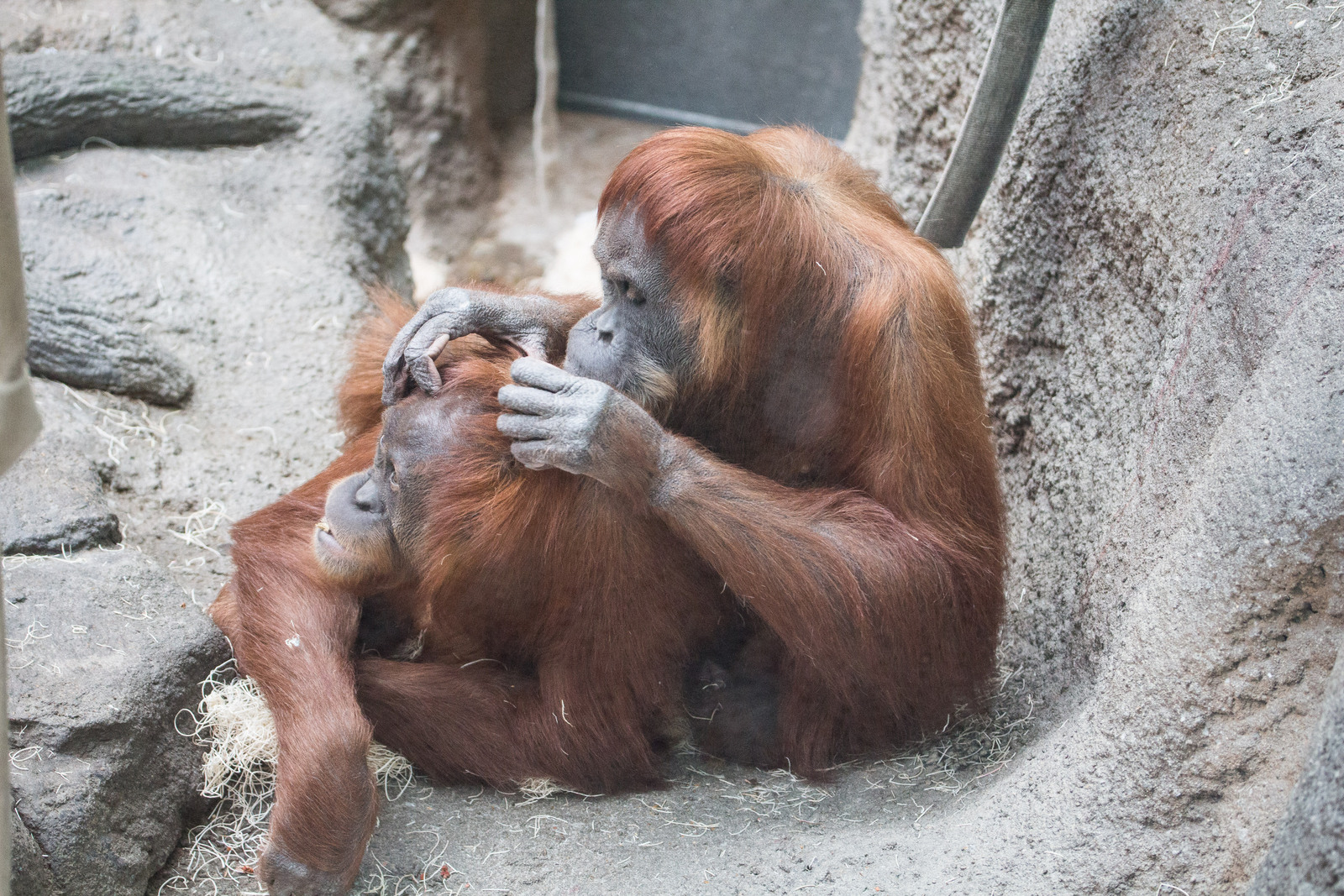
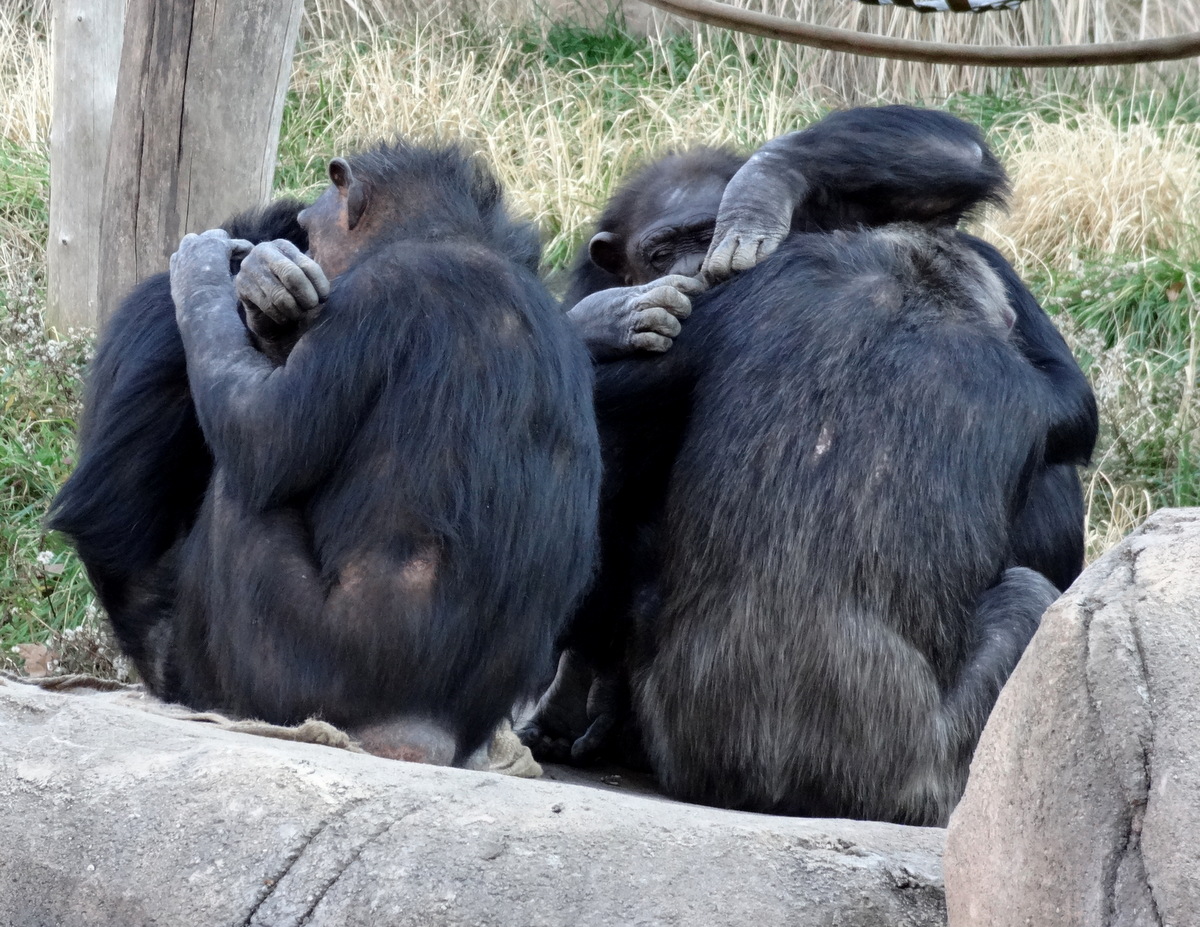
Here are a few photos I took at the St. Louis Zoo over the past few weeks. All of these involve physical grooming by primates, three of them featuring two orangutans and one of them involving a larger group of chimpanzees. This is one of the ways these animals know who is their friend or foe. Orang Grooming Orang grooming II Orang Grooming III chimpanzees grooming We human animals groom for this same purpose, but we generally engage in verbal grooming: gossip. Using words rather than physical grooming we can connect with many more fellow humans at one time than any of those animals limited to physical grooming. I make this claim based on the work of Robin Dunbar.

Continue ReadingThe importance of grooming in human animals and the other primates.