The ten biggest Wall Street lies of 2009

Author Les Leopold sums it up nicely, including the fact that TARP is only the tip of iceberg regarding taxpayer money being poured into Wall Street coffers. Merry Christmas to the big Wall Street banks, who work hard to . . . someone please remind me how these big banks to make the world a better place--what do they do for the economy or for productivity? Please tell me something more convincing than free market fundamentalism.

Continue ReadingThe ten biggest Wall Street lies of 2009

Will the federal government continue coddling AIG?

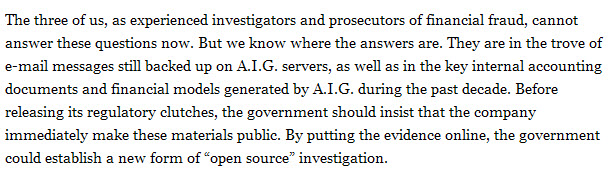
Fascinating Op-Ed in today's NYT, written by three former prosecutors (ELIOT SPITZER, FRANK PARTNOY and WILLIAM BLACK) who are demanding that AIG be forced to release voluminous emails in its possession that would allow the public to understand the economic meltdown that cost taxpayers hundreds of billions of dollars, including 180 billion dollars to AIG. I agree entirely. There is no reason for delay. It's time to turn AIG inside out, that much is clear. The only thing that is unclear is whether the politicians in Washington DC can muster up the courage to represent the taxpayers rather than the big banks. Here's an excerpt from the Op-Ed piece:

aig-emails

Continue ReadingWill the federal government continue coddling AIG?

Time for a national usury law?

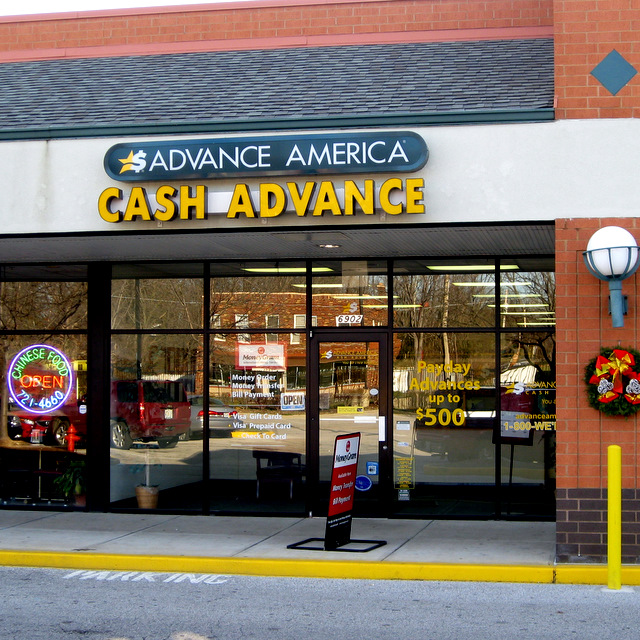
First Premier Bank has just introduced its new 79% interest rate sub-prime credit card. No, that's not a typo, and some experts expect to see more credit cards with sky-high interest. Which makes me again bring up the topic of a national usury cap. Thomas Geoghegan recommended such a cap last year, in his article in The American Prospect. He suggested a credit card interest cap of 12% and a law completely barring payday loans.img_1180 I have filed several class action suits against large payday lenders (here's a post on one of those suits). These lenders often argue that people need these 400% interest loans for short term emergencies. At what cost, though? In my experience, these lenders are commonly stretching out these "short term" loans for many months. People who borrow $500 will pay $2000 in interest over the year and they will STILL OWE THE $500. Many states allow payday lenders to charge in excess of 1000% interest. These loans suck the very life out of working class folks. They amount to financial crack cocaine, because people often end up taking out a second, and a third payday loan in order to pay off the first one. It's a terrible mess and it's ruining lives. That's why 13 states have passed laws making sure that payday lenders cannot operate in those jurisdictions. It's time for the other states, and Congress, to get with the program. To put this all in perspective, remember the stories about "loan sharks?" Those were the good old days. "Simple nominal annual interest rates on extortionate mafia loan shark debts averaged 250%." Syndicate Loan-Shark Activities and New York's Usury Statute, 66 Colum. L. Rev. 167, 167 (1966). And here's another irony. The Bible clearly holds that usury is a sin comparable to murder. Usury is prohibited by Exodus 22:25: "If thou lend money to any of my people that is poor by thee, thou shalt not be to him as an usurer, neither shalt thou lay upon him usury.” Usury is also prohibited by Leviticus 25:35-37. In spite of these Bible quotes, if you want to find lots of payday stores and payday lenders, look for geographical areas where you'll also find conservative Christians. That is the finding of Steven M. Graves and Christopher Peterson, in a law review article entitled "Usury Law and the Christian Right: Faith-Based Political Power and the Geography of American Payday Loan Regulation," 57 Cath. U. L. Rev. 637, 640 (2008):

We conclude, with a high degree of statistical certainty, that states with powerful conservative Christian populations tend to host relatively greater numbers of payday loan locations per capita as well as a greater commercial density of payday lenders. These findings propound a tragic and sad irony. Those states that have most ardently held to their pious Christian traditions have tended to become more infested with the progeny of money changers once expelled by Christ from the Hebrew temple. Legislators in those states, who have effectively used biblical principles to shape their legislative agenda on social and cultural issues, have failed to consistently apply biblical principles to economic legislation.

All it would take for Congress to outlaw payday loans is to write up a bill, have a majority of members of Congress approve of it, and then refer it to the President to sign it. But that can't happen these days because the financial services industry pays our politicians huge amounts of money so that they WON'T sign these sorts of bills. And, of course, with regard to Congress, the banks "frankly own the place."

Continue ReadingTime for a national usury law?

So who wants to be a billionaire?

Clusterstock has detailed and easy-to-follow instructions to making ridiculous amounts of easy money. Start by forming a bank, hire all of your friends as bankers and raising some capital. After those preliminary steps, the hard part is done:

STEP 4: Borrow $9 billion from the Fed at an annual cost of 0.25%. STEP 5: Buy $10 billion of 30-year Treasuries paying 4.45% STEP 6: Sit back and watch the cash flow in. At this spread, you should be earning at least 4% per year on your $10 billion of capital, or $400 million. Sure, there's some risk that the Fed will grow a backbone and raise short rates, but there's not much risk. (They have an economy to fix and banks to secretly recapitalize). And in any event, if the Fed raises short rates, making your $1 billion will just take a bit longer. (And if they REALLY raise rates, causing you to actually lose money, it will be someone else's problem.)

Continue ReadingSo who wants to be a billionaire?

Kelo vs. New London revisited

Remember the case of Kelo vs. New London? Briefly, it was a case in which homeowners including Susette Kelo sued their municipality to stop it from taking their homes using the power of eminent domain. The city wanted to raze the homes and redevelop the area, making it shiny and new to complement the anticipated Pfizer pharmaceutical research facility. After all, one musn't allow the shabby dwellings of the peasantry to mar the image of success and corporate uniformity that one is trying to project:

So, the politicians picked a 24-acre lot and sold it Pfizer for $10, adding on special tax breaks. Also, state and local governments promised $26 million to clean up contamination on the lot and a nearby junkyard. But Pfizer executive David Burnett thought New London needed to do some more cleaning. "Pfizer wants a nice place to operate," the Hartford Courant quoted Burnett in 2001. "We don't want to be surrounded by tenements." The old Victorian houses in the Fort Trumbull neighborhood next door did not match Pfizer's vision - a high-rise hotel or luxury condominiums would be more fitting.

Continue ReadingKelo vs. New London revisited