The Handwriting of Famous Authors
Wonderful post by CLT on X. The handwriting of famous authors. Including this handwriting of George Orwell:


Wonderful post by CLT on X. The handwriting of famous authors. Including this handwriting of George Orwell:
My guiding assumption is that people rationally make decisions based upon the information they digest. Thus, change their informational (media) ecosystem and you will change their beliefs and behavior, yet they will be convinced that they never changed--that they are the same person as always.


Mike Benz explains (credit to Wall Street Apes):
“It was tucked into an NDAA. It was really only discovered by the public after the damage had been done”
“‘US Repeals Propaganda Ban, Spreads Government-Made News to Americans.’ This Anti-propaganda law prevented the US government's mammoth broadcasting arm!from delivering programming to American audiences.”
“In 1948 when the founding fathers of the intelligence state were setting this all up, they were intensely aware of the monster they were making. In 1948, they Congress passed the Smith-Munt Act.
Because again, in 1948 is when all of this was getting established. The CIA was brand new. NSE 10-2 had just come out and Congress said, okay, okay, listen, you guys are creating a monster here. We wanna make sure that we don't build this empire of lies, and that Americans are not being inundated with this sprawl of information control that you are conducting around the world in order to conduct organized political warfare on all countries on planet Earth.
And I think many folks in this room are probably familiar with what happened during the Obama administration, which was this essential safeguard, which had been with us since the moment this all was created in 1948, was repealed with quite little fanfare.
It was tucked into an NDAA. It was really, I think, only only discovered by the public after the damage had been done that the Smith-Munt was modernized. To get rid of that restriction, it was effectively amended.
So the headline here is ‘US Repeals Propaganda Ban, Spreads Government-Made News to Americans’
This Anti-propaganda law prevented the US government's mammoth broadcasting arm, I should say, arms from delivering program programming to American audiences. And mammoth is not a big enough word
— So with hard power ruled out as the dominant means to have an empire, the US transitioned to a soft power empire, which would be dominated by agencies like the Central Intelligence Agency, Democracy Promotion programs at the State Department. Later USAID and the whole Swarm Army we're about to meet.
But even right out the gate, the Central Intelligence Agency immediately moved into the media space to control the messaging that people around the world experienced.”
Don't read this if you want to continue believing in the fundamental goodness of the U.S. Government.
[caption id="attachment_41915" align="aligncenter" width="484"] Screenshot[/caption]
More on Rocky Mountain Laboratory here:

If that wasn't enough, consider that the Pentagon is a major investor in the U.S. music industry.

Can you assume that people believe you merely because they stop debating you? Rob Henderson explains:
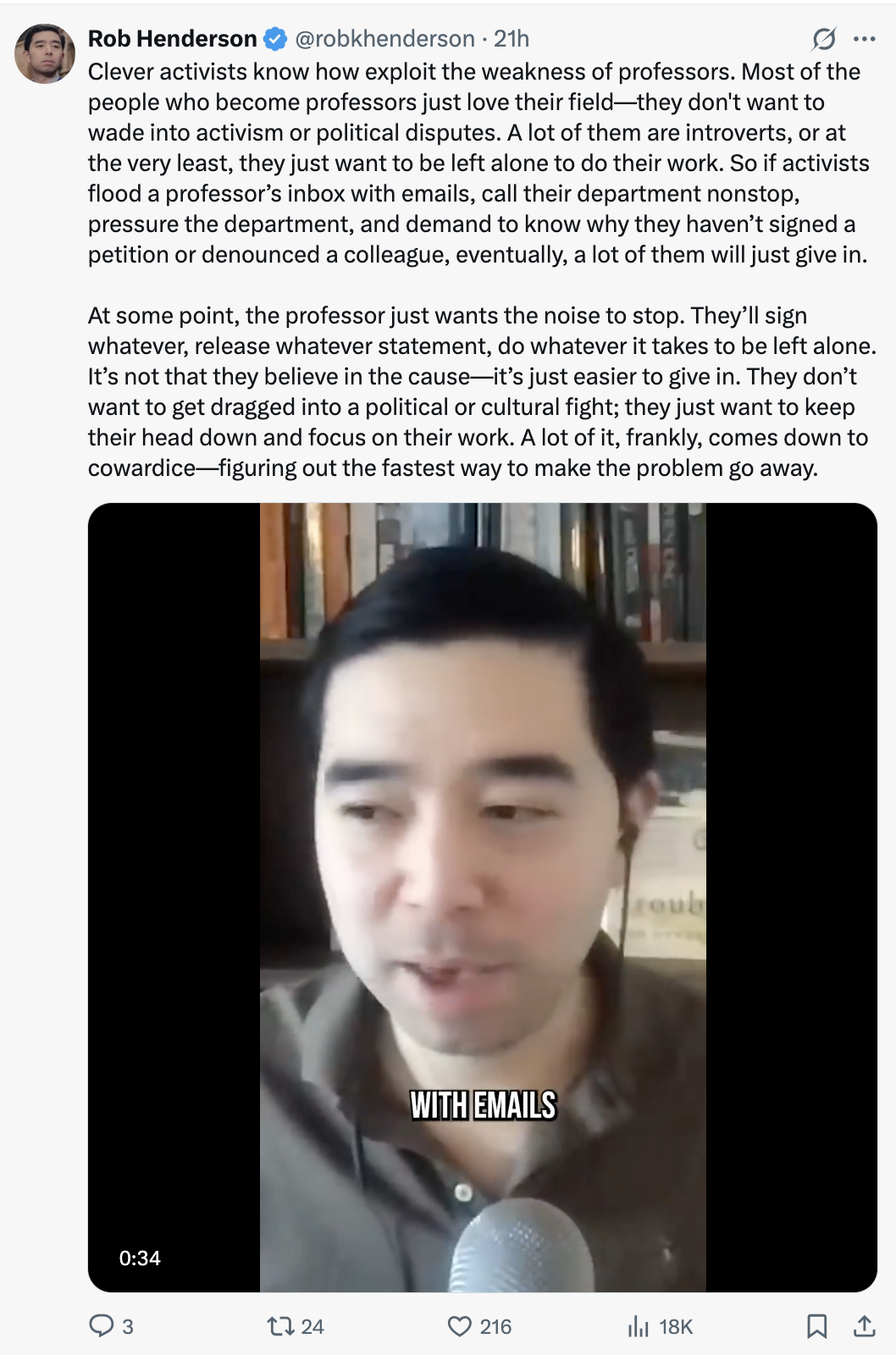
Clever activists know how exploit the weakness of professors. Most of the people who become professors just love their field—they don't want to wade into activism or political disputes. A lot of them are introverts, or at the very least, they just want to be left alone to do their work. So if activists flood a professor’s inbox with emails, call their department nonstop, pressure the department, and demand to know why they haven’t signed a petition or denounced a colleague, eventually, a lot of them will just give in.At some point, the professor just wants the noise to stop. They’ll sign whatever, release whatever statement, do whatever it takes to be left alone. It’s not that they believe in the cause—it’s just easier to give in. They don’t want to get dragged into a political or cultural fight; they just want to keep their head down and focus on their work. A lot of it, frankly, comes down to cowardice—figuring out the fastest way to make the problem go away.