
Mike Benz Explains “Whole of Society” Censorship

Excellent presentation by Mike Benz. Topic is "Whole of Society" Censorship.
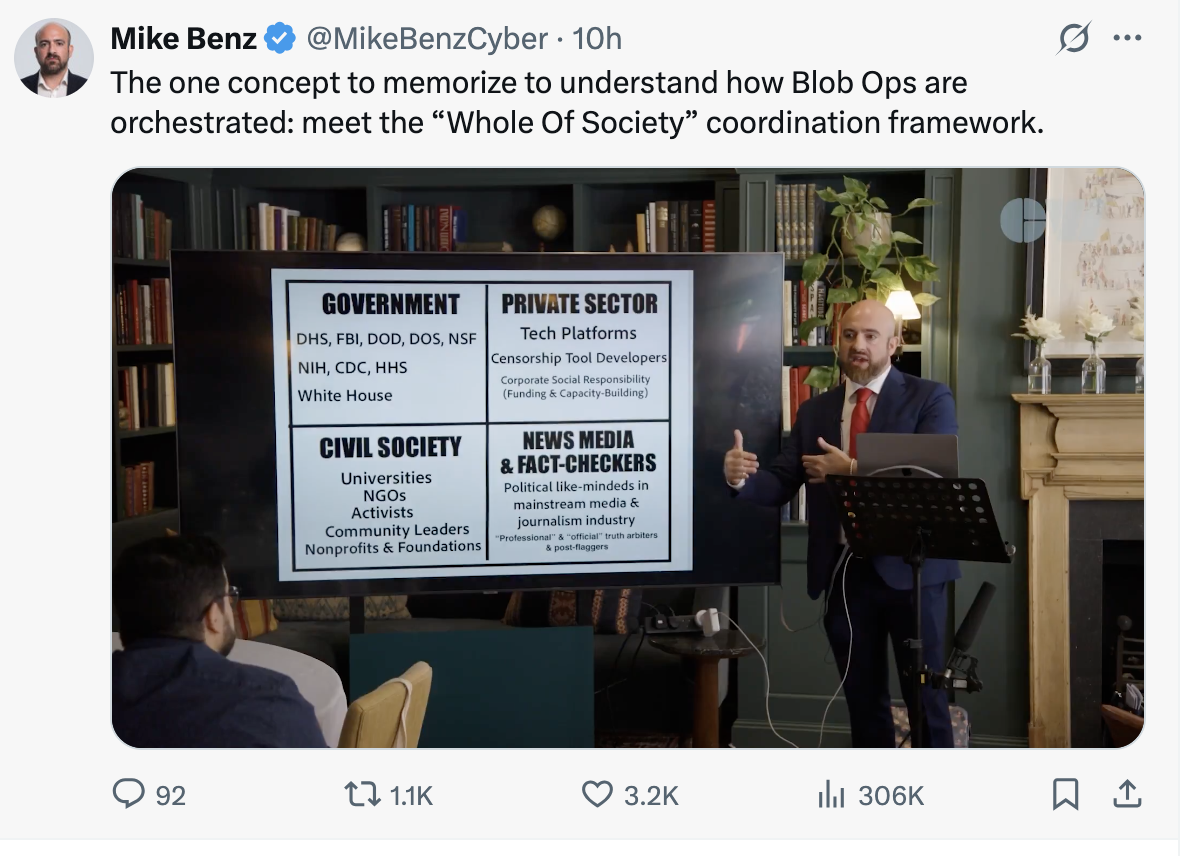
To Supplement, I asked Grok to summarize "Whole of Society" Censorship. Here is Grok's answer:

The "whole of society" censorship approach refers to a coordinated effort involving government, private sector, academia, media, and civil society to control information and suppress certain narratives. It’s characterized by:

* Collaboration Across Sectors: Governments partner with tech companies, universities, NGOs, and media to monitor and restrict content deemed harmful or misleading, often bypassing legal constraints through informal agreements.

* Preemptive Narrative Control: Instead of just reacting to content, this approach shapes narratives proactively, promoting approved messages while marginalizing dissent through algorithms, fact-checking networks, and deplatforming.

* Broad Scope: It targets not only explicit misinformation but also "malinformation" (true information presented in ways that challenge official narratives), affecting political discourse, science, and public health.

* Examples: Documents like the Twitter Files revealed U.S. government agencies working with social media platforms to flag or remove content. The 2021 Stanford Virality Project, involving academics and tech firms, monitored vaccine-related content to counter skepticism. * Mechanisms: Include content moderation, shadowbanning, account suspensions, and funding "trusted" sources to dominate information ecosystems.

Critics argue it stifles free speech and centralizes narrative control, while proponents claim it’s necessary to combat disinformation at scale. The term gained traction in discussions about COVID-19 policy enforcement and election-related content moderation.

Continue ReadingMike Benz Explains “Whole of Society” Censorship

Free Speech Hypocrisy

Nico Perrino (of FIRE) sternly points out the rampant hypocrisy.

Do we actually believe in free speech?

Do we actually believe controversial speakers have a right to speak in America — free from government censorship?

For the past decade, I stood alongside conservatives who loudly — and justifiably — protested when speakers like Ben Shapiro and Charles Murray were prevented from speaking on college campuses, often under the guise of vague appeals to "safety."

Will those same voices rise up now that the boot is on the other foot?

Do we actually believe in free speech as a principle, or merely as an expedient argument when our side is censored?

Do we actually oppose cancel culture?

Do we actually oppose the heckler's veto?

Do we actually oppose vague security rationales for censorship?

I will work with anyone to defend free speech in any scenario, even if doing so means those same people — whether they are the canceled conservatives of the past or the canceled left-wingers of the present — will sometimes abandon free speech when it's their side doing the censoring.

Believing in free speech is as simple as the golden rule: "Do unto others as you would have them do unto you."

Nat Henthoff's book title comes to mind: "Free Speech for me, but not for thee."

Continue ReadingFree Speech Hypocrisy

Walter Kirn: We Are Headed to the Era of Post-Truth

Walter Kirn:

Find something, anything, to be fundamentalist about, ideally something very, very old, because there will be no truth out there soon, none, just an endlessly shifting, windy phantasmagoria. So find a mast and lash yourself to it. Heck, even classical herbalism will do.

Continue ReadingWalter Kirn: We Are Headed to the Era of Post-Truth

NPR Forgets Important Facts Regarding Michael Brown

NPR reports the "News."

Grok Offers this description of an excellent documentary I viewed: "What Killed Michael Brown?" Well worth watching:

What Killed Michael Brown? (2020), written and narrated by Shelby Steele and directed by his son, Eli Steele. Below is an overview based on available information:

Overview

What Killed Michael Brown? is a 1-hour, 49-minute documentary that explores the 2014 shooting of Michael Brown, an 18-year-old Black man, by white police officer Darren Wilson in Ferguson, Missouri. The incident sparked nationwide protests and became a pivotal moment for the Black Lives Matter movement. The film challenges mainstream narratives about the event, particularly the "hands up, don’t shoot" slogan, which it argues is a "poetic truth" not grounded in evidence. Instead, it presents a perspective rooted in Shelby Steele’s conservative viewpoint, emphasizing personal responsibility and questioning systemic racism as the sole explanation for Brown’s death. Key Details

* Director: Eli Steele

* Writer/Narrator: Shelby Steele, a Hoover Institution fellow and noted conservative author who argues that systemic racism is more a strategy than a truth.

[More . . . ]

Continue ReadingNPR Forgets Important Facts Regarding Michael Brown