
The Day Oliver Wendell Holmes Changed his Mind About Free Speech

Here is an illustration of why it is vitally important that we (sometimes) change our minds. This is an excerpt from the famous dissent of Oliver Wendell Holmes in the 1919 case of Abrams v The United States:

Persecution for the expression of opinions seems to me perfectly logical. If you have no doubt of your premises or your power, and want a certain result with all your heart, you naturally express your wishes in law, and sweep away all opposition. To allow opposition by speech seems to indicate that you think the speech impotent, as when a man says that he has squared the circle, or that you do not care wholeheartedly for the result, or that you doubt either your power or your premises.
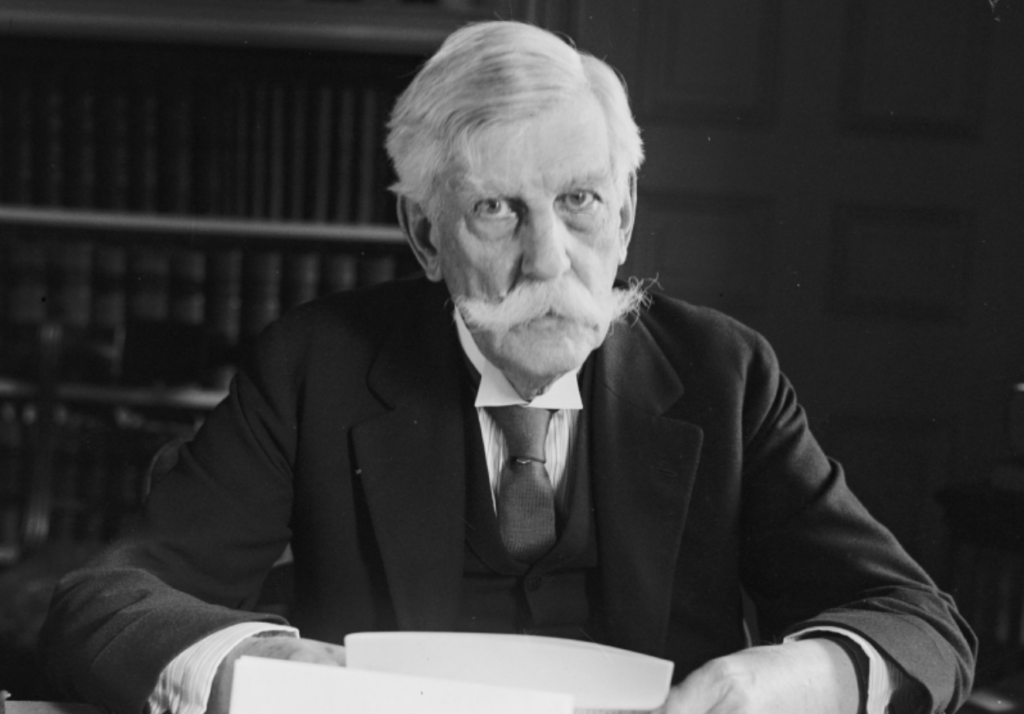
But when men have realized that time has upset many fighting faiths, they may come to believe even more than they believe the very foundations of their own conduct that the ultimate good desired is better reached by free trade in ideas -- that the best test of truth is the power of the thought to get itself accepted in the competition of the market, and that truth is the only ground upon which their wishes safely can be carried out.

That, at any rate, is the theory of our Constitution. It is an experiment, as all life is an experiment. Every year, if not every day, we have to wager our salvation upon some prophecy based upon imperfect knowledge. While that experiment is part of our system, I think that we should be eternally vigilant against attempts to check the expression of opinions that we loathe and believe to be fraught with death, unless they so imminently threaten immediate interference with the lawful and pressing purposes of the law that an immediate check is required to save the country.

Continue ReadingThe Day Oliver Wendell Holmes Changed his Mind About Free Speech

Krystal Ball Discusses the Biggest Lies of 2021

I agree with every bit of Krystal Ball's wrap-up of the major Lies of 2021. She begins her take-down at the 50 minute mark of this video. She and Saagar Enjeti do their homework, week after week, and that is why I financially support them.

Continue ReadingKrystal Ball Discusses the Biggest Lies of 2021

Princeton University Gets an Education: “The university is the home and sponsor of critics; it is not itself the critic.”

Sixty Princeton Students have carefully responded to the declaration of Princeton Dean Amaney Jamal decrying Kyle Rittenhouse’s not-guilty verdict. Here is an excerpt from "Let Students Think for Themselves," published by The National Review:

[Jamal] lamented with a heavy heart the “incomprehensib[ility] . . . of a minor vigilante carrying a semi-automatic rifle across state lines, killing two people, and being declared innocent by the U.S. justice system.” Furthermore, she situated the verdict within the context of the racism embedded “without a doubt . . . in nearly every strand of the American fabric,” thus implying that defenders of a not-guilty verdict are defenders of racism.

Along with 60 of our peers, we sent a letter of concern to the university president, Christopher Eisgruber. We criticized neither the embarrassing factual errors polluting Jamal’s statement nor her position on the trial’s outcome. Rather, we vehemently objected to the fact that she took advantage of her official position to broadcast her own stance on a controversial public issue — a maneuver that can only harm, not aid, a culture of bold, open truth-seeking.

An academic institution committed to truth-seeking and open inquiry should foster an environment in which students feel welcome — even encouraged — to speak up on controversial issues about which reasonable people of goodwill disagree. But as Princeton students and frequent critics of the ideological orthodoxy that pervades our campus, we’ve witnessed our peers retreat from conversations, opportunities, and even friendships out of fear that their deeply held beliefs will cost them academically, socially, and professionally.

A university hinders its truth-seeking mission when it — unintentionally or otherwise — prompts students to think twice before expressing unpopular but reasonable points of view. This can occur when officials violate the basic institutional neutrality required for the university to be a home for the free marketplace of ideas. When an educational institution adopts official stances on controversial issues not directly connected to its core mission, it suggests parameters around an otherwise liberated discourse. This effect is enhanced when such pronouncements are morally tinged; in these cases, the university would appear to have decided that such parameters are morally requisite. By implication, those who defy them are morally suspect.

The “basic neutrality” ideal isn’t new. The most famous defense of the principle was offered by faculty at the University of Chicago during the height of the Vietnam War. Chicago’s Kalven Committee made the point succinctly: “The university is the home and sponsor of critics; it is not itself the critic.” The Kalven Report, long celebrated, is still operative at the University of Chicago. Universities everywhere should consider adopting the report’s guidance, as well as the university’s famed Free Speech Principles, which Princeton formally did in 2015.

Continue ReadingPrinceton University Gets an Education: “The university is the home and sponsor of critics; it is not itself the critic.”

Matt Taibbi Discusses the Modern News Media: An Industry that Fuels Hate for Profit.

The Profitable Siloed-Audience Business Model of Modern "News." Matt Taibbi explains how we got to this point, based on his book, Hate, Inc.

They want to make sure that they can wind you up as much as they can—not just every day, but in the internet era, there's a commercial imperative now to do this every hour, every minute, really every second. It's a moment-to-moment competition and the only way to really compete is to keep riling people up as much as much as you can. They use that CRossfire formula of constant combat to attract audiences and to keep them and addict them to this experience and this can be very damaging to people's mental health, to say nothing of what it does to society.

As a parting thought, I want to leave you all with this idea to recognize that when you watch the news, most people think of this as a public service and in some cases it is. But you really have to understand that it's also a consumer product very much in the same way that blue jeans or cigarettes or twinkies are news products and there are properties that we use to sell our product in the same way that those other kinds of consumer businesses use to sell theirs and what we've learned is that division is the thing that sells most in this current era and you have to understand that just as cigarettes or twinkies can be bad for you the news can also be bad for you. It can be bad for your mental health. It can be addicting in the same way that those products are. So please understand that from our point of view, we've gone from being something that was a business more in the direction of being just about delivering information to being very consumer-oriented, in the current incarnation, and much more about audience and demographic targeting.

Continue ReadingMatt Taibbi Discusses the Modern News Media: An Industry that Fuels Hate for Profit.