The Annual Love-In with the White House and “Journalists”

Have you recently visited any of the left-leaning corporate media outlets to try to find one thing, anything, that they write that is critical of Joe Biden and Democrats? What are the odds that even your favorite politician can do no wrong for 2 1/2 years? But it happens over and over. With only a few notable exceptions (e.g., Tucker Carlson), it also happens on the right.

Well, it's time for those journalists to celebrate with the country's centers of power and you will never hear Glenn Greendald heap such scorn upon other human beings. It's because they are proudly abandoning their mission to be adversaries of the White House, not buddies seeking to get even more friendly. The net result is what you don't see: News accounts that **** badly on the White House. Here's an transcript from Glenn's Rumble show, System Update:

s repulsive as it is to watch corporate journalists make this pilgrimage to the White House that they make every year under the guise of the White House Correspondents Dinner, where they pretend to celebrate their commitment to press freedom and the important role they play in safeguarding our democracy, it actually is important to look at because it is one night where they let the mask drop and reveal who and what they really are. It's become kind of like the Oscars, in the sense that – in many senses, actually, but one important one is that it is not just one night, but many days leading up to it, where they have all kinds of parties that are the buzziest of the ones that they get to attend. But they also spend a lot of time before the event trying to justify to the American people why it is that these people who claim to be our watchdogs, the people who are safeguarding our basic rights, who are holding our government accountable, are instead dressing up like it's the Oscars, in gowns and tuxedos, and appearing with celebrities and the politicians they supposedly hold accountable at the gaudiest and sleaziest event you can possibly imagine held at the White House hosted by Joe Biden, the person whom they're supposed to be adversarially covering.

And so, in the days leading up to the event, they spend a lot of time trying to justify what it is that they're doing and within those justifications reside a great deal of insight into how they actually think. As I said, it's a mask-dropping event. They know what it makes them look like, but they do it anyway because they're so desperate for the self-importance that it provides. It's really why they do their job – to be around power or to be accepted by power, to feel as though they're part of the Royal Court – and so, it's way too valuable to their sense of purpose and self-identity to relinquish it, even though they know that it's one of the most revealing lights that ever get shined on them.

You can view the entire episode here, at Rumble.com

Continue ReadingThe Annual Love-In with the White House and “Journalists”

Michael Shellenberger: Totalitarianism is on the Rise

If I heard anyone saying these things three years ago, I would have thought that person needed help for a mental condition. Based on many things I've read and seen in the past three years, however, I am gravely concerned that Michael Shellenberger is not overstating the problems we face:

Around the world, politicians have either just passed or are on the cusp of passing sweeping new laws, which would allow governments to censor ordinary citizens on social media and other Internet platforms.

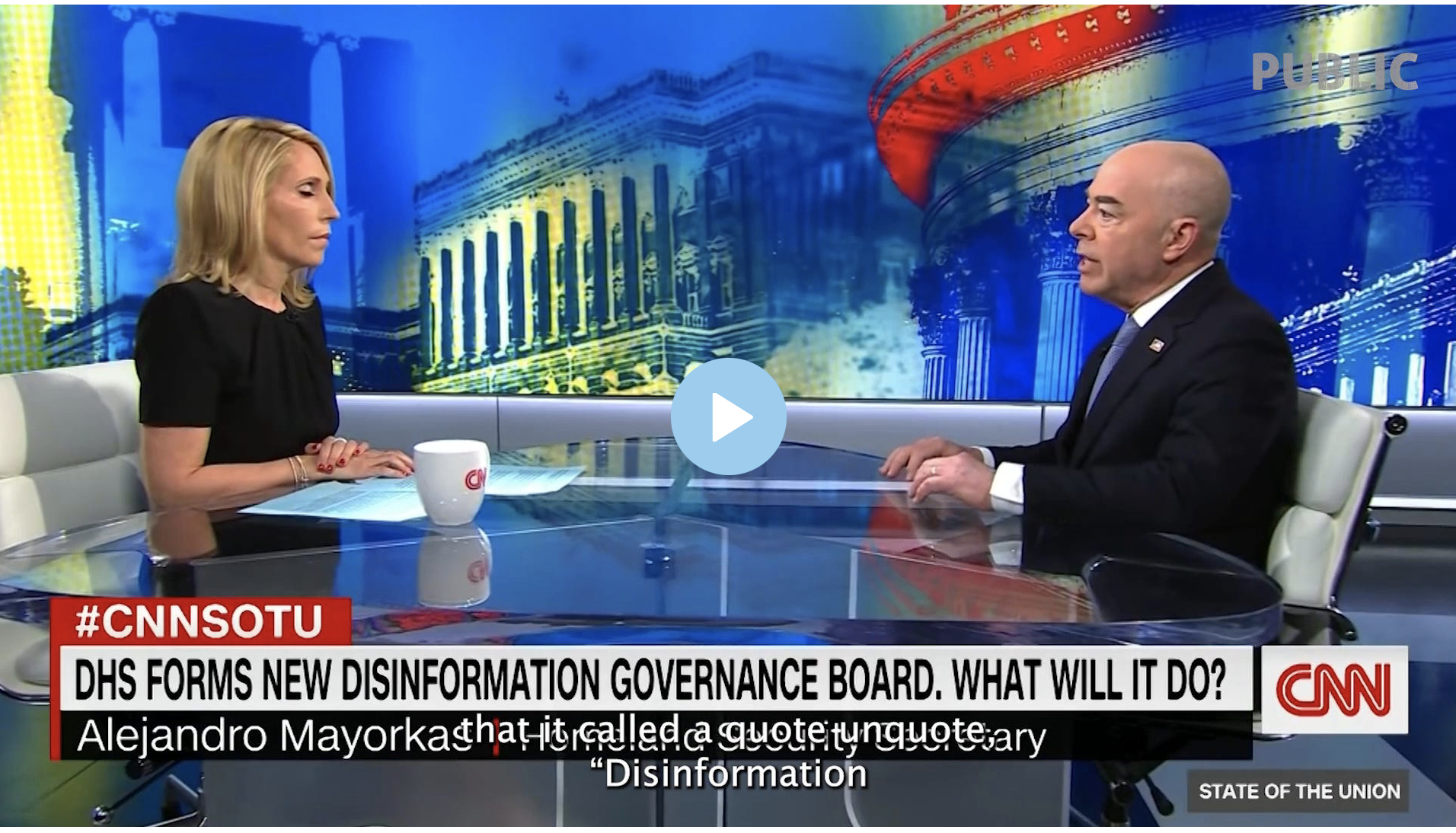
Under the guise of preventing “harm” and holding large tech companies accountable, several countries are establishing a vast and interlinked censorship apparatus, a new investigation by Public finds.

Politicians, NGOs, and their enablers in the news media claim that their goal is merely to protect the public from “disinformation.” But vague definitions and loopholes in new laws will create avenues for broad application, overreach, and abuse.

In Ireland, for example, the government may soon be able to imprison citizens simply for possessing material that officials decide is “hateful.” Under the RESTRICT Act in the US, the government may soon have the authority to monitor the Internet activity of any American deemed a security risk.

Continue ReadingMichael Shellenberger: Totalitarianism is on the Rise

About Countries that Irreversibly Lose Their Way

I increasingly think of Chesterson's Fence:

Chesterton's Fence is a principle that says change should not be made until the reasoning behind the current state of affairs is understood. It says the rash move, upon coming across a fence, would be to tear it down without understanding why it was put up.

Peter McCullough, M.D. was censored during COVID and he has since been proven correct on many of his positions. Yet he didn't become bitter (at least that I could see in public). Rather, he keep trying to communicate where we, as a society, have lost our way. McCullough keeps trying to shed light on the problems he detects, but I detect an ominous undertone in his writings, a sense that we are sustaining too much damage as a society and that we might no longer have the tools, as a society, to repair the damage. I increasingly detect that same feelings in myself. In a recent article, McCullough writes:

Once the belief in a country and institution has been lost, it is very difficult to rejuvenate it. This is the principle reason why most conservative commentators often come off as sounding staid and uninspiring to the young. It’s as though the spirit has departed from the body that no amount of edifying rhetoric can reanimate. As Hegel pointed out in the preface to his Elements of the Philosophy of Law:
Philosophy always arrives too late to teach the world how it should be. As the thought of the world, philosophy appears only in the period after reality has been achieved and has completed its formative process. This lesson, also taught by history, is that only in the late stage of reality does the ideal appear in opposition to this reality, grasping it in the form of an intellectual construct.

When philosophy paints its gray in gray, then a form of life has grown old, and cannot be rejuvenated, but only recognized; the Owl of Minerva takes flight only as the dusk begins to fall.

That feeling that we might have crossed the event horizon has increasingly been expressed by people who inspire me, including (now deceased) George Carlin and Jonathan Haidt.

Excerpt from The Australian --

"'I am now very pessimistic,' Haidt said. 'I think there is a very good chance American democracy will fail, that in the next 30 years we will have a catastrophic failure of our democracy.'"

We might have fucked things up too much to ever fix them. George Carlin gets the last word here.:

Continue ReadingAbout Countries that Irreversibly Lose Their Way

Bill Maher Presents “The Cojones Awards” to Honor Those who Resist Cancel Culture

In this episode, Bill Maher presents “The Cojones Awards. You can imagine what the trophies look like. Maher: “We present these solid brass balls to the individuals and organizations who others have tried to silence, but who answered ‘That's not a rule. Fuck you.’”

Continue ReadingBill Maher Presents “The Cojones Awards” to Honor Those who Resist Cancel Culture

Scientific Journals Mass-Reject Article Promoting Merit in Science

Jerry Coyne and Anna Krylov, writing at the WSJ, "The ‘Hurtful’ Idea of Scientific Merit Ideology now dominates research in the U.S. more pervasively than it did at the Soviet Union’s height." They note: "Merit isn’t much in vogue anywhere these days." This was amply demonstrated in this video narrated by Lawrence Krauss, criticizing woke science and the damage being done to science by DEI departments.

Here is an excerpt from the article by Coyne and Krylov:

Yet a wholesale and unhealthy incursion of ideology into science is occurring again—this time in the West. We see it in progressives’ claim that scientific truths are malleable and subjective, similar to Lysenko’s insistence that genetics was Western “pseudoscience” with no place in progressive Soviet agriculture. We see it when scientific truths—say, the binary nature of sex—are either denied or distorted because they’re politically repugnant.

We see it as well in activists’ calls to “decolonize” scientific fields, to reduce the influence of what’s called “Western science” and adopt indigenous “ways of knowing.” No doubt different cultures have different ways of interpreting natural processes—sometimes invoking myth and legend—and this variation should be valued as an important aspect of sociology and anthropology. But these “ways of knowing” aren’t coequal to modern science, and it would be foolish to pretend otherwise.

In some ways this new species of Lysenkoism is more pernicious than the old, because it affects all science—chemistry, physics, life sciences, medicine and math—not merely biology and agriculture. The government isn’t the only entity pushing it, either. “Progressive” scientists promote it, too, along with professional societies, funding agencies like the National Institutes of Health and Energy Department, scientific journals and university administrators. When applying for openings as a university scientist today, job candidates may well be evaluated more by their record of supporting “social justice” than by their scientific achievements.

But scientific research can’t and shouldn’t be conducted via a process that gives a low priority to science itself. This is why we wrote our paper, which was co-authored by 27 others, making for a group as diverse as you can imagine. We had men and women of various ages, ethnicities, countries of origin, political affiliations and career stages, including faculty from community colleges and top research universities, as well as two Nobel laureates. We provided an in-depth analysis of the clash between liberal epistemology and postmodernist philosophies. We documented the continuing efforts to elevate social justice over scientific rigor, and warned of the consequences of taking an ideological approach to research. Finally, we suggested an alternative humanistic approach to alleviating social inequalities and injustices.

But this was too much, even “downright hurtful,” as one editor wrote to us. Another informed us that “the concept of merit . . . has been widely and legitimately attacked as hollow.” Legitimately?

In the end, we’re grateful that our paper will be published. But how sad it is that the simple and fundamental principle undergirding all of science—that the best ideas and technologies should be the ones we adopt—is seen these days as “controversial.”

Continue ReadingScientific Journals Mass-Reject Article Promoting Merit in Science