The Woke Endgame: Evergreen State College

I didn't want to be spending so much time writing about Wokeness, but it has become clear to me that this is an ideology that reverses many of the hard-earned gains we have made through the Civil Rights Movement and that Wokeness ideology leads to endless societal dysfunction. Because human flourishing important to me, I have no choice but to speak out, at a time where many of my friends and acquaintances have the exact same concerns I do, but are afraid to speak out. Their fears is are based on these things:

1. They don't want to get into yelling matches with activists, which they see as inevitable;

2. They fear being called names like "racist"  for things that are not racist.

3. They fear mobs of people following them, threatening them and their families or damaging their property;

4. They fear loss of their reputations based on false accusations by mobs, and

5. They fear the loss of their jobs and/or careers based upon mass-cancellation techniques.

I realize this all sounds hyperbolic, but my conclusions are based on the many dozens of occurrences on which I have written about at this website, as well as many other articles by many other writers. Common responses to my writings have been A) ad hominem attacks, B) scoldings that I have no right to discuss certain topics, as though only certain people have the right to talk about certain things, and C) Whataboutism - Why am I not writing about something else that they would rather I write about, e.g., white supremacist groups? In response to this last point, I already see widespread ridicule over white supremacy. It is not taking root in any of our sense-making institutions such as schools (including prestigious colleges), media outlets (including STEM journals and magazines) and government offices.

I see the opposite happening with Wokeness, and it seems to be spreading logarithmically with only scattered voices having the courage to stand up and cry out, "Emperor Has No Clothes." Those voices include Andrew Sullivan, Matt Taibbi, Seerut K. Chawla, Glenn Greenwald, Brett Weinstein, Heather Heying, Eric Weinstein, Bari Weiss, Sam Harris, Jesse Singal, Jordan Peterson, Jonathan Haidt, Helen Pluckrose, James Lindsay, Benjamin BoyceJonathan Kay, Claire Lehman, John McWorther, Glenn Loury, Caitlin Flanagan, Heterodox AcademyColin Wright, Joe Rogan, Buck Angel, Peter Boghossian, Coleman Hughes, Bill Maher, Peter Rufo, The 40 Black Intellectuals who recently spoke out against the racism by Smith College, and the plucky crew at Quillette Magazine. There are others out there and I am not excluding any of them intentionally.  Most of these people lean significantly to the left on many social issues, yet Woke advocates commonly call them "conservatives," which is a modern version of an attempted ad hominem attack.

I want to give special attention to James Lindsay's excellent Woke Encyclopedia at New Discourses, so very helpful in that the Woke onslaught always involves long streams of highly suspect terminology.

What provoked this article?  I just finished watching several episodes of "The Complete Evergreen Story," by Benjamin Boyce.  As described by James Lindsay, 

Benjamin Boyce was a student at The Evergreen State College as it melted down, thanks to the applications of critical race Theory on campus. There, not only did he have a first-person view of the mayhem the campus descended into as it happened, he was responsible for filming and documenting a great deal of the footage that has since come to light and found a home in documentaries. Ever since, he has been on a quest to further understand what happened at Evergreen and to document it in full, not to mention similar issues as they crop up in the surrounding Washington state communities.

Boyce has presented this Evergreen tragedy in 23 chapters. His story covers the destruction of what was, and what could still be, an excellent college. What happened in 2017, however, left Evergreen in intellectual and social shambles and resulted in dramatic reductions in the number of students attending Evergreen.

It turns out that students aren’t clamoring for the privilege of paying for an education in such a hostile environment. Evergreen accepts 97% of applications, but enrollment dropped to 2,854 full-time students last fall, compared to 3,810 the semester of the protests. Enrollment increased over the same period at other Washington universities.

The story of Evergreen College was entirely ignored by most left leaning media powerhouses.  The New York Times has yet to write a single word about the 2017 Woke-triggered implosion at Evergreen College.

I am writing this article to provide the above links to the writers I have found most informative and instructive about the Woke movement.  I am linking to these writers with the hope that those who are fearful of speaking out can read these works as an aid to finding their own voice.  I am also writing this article as a warning and a prophecy that Evergreen State College was not simply an occurrence but a vision for where we are headed unless we all find the spine to stand up and draw a line in the sand.  Unless we do these things together, everything will become Evergreen State.

Here are episodes 1, 2 and 3 of Benjamin Boyce's comprehensive documentary regarding Evergreen State.

I'll end with some deep pessimism. I fear that conversation is no longer productive with the Woke. This is clear in many places today as I have documented at this website. it is abundantly clear in the Evergreen videos, as numerous students demonstrated that they are incapable of having a meaningful conversation with the clear-headed, patient, politically liberal Evergreen College biology professor, Brett Weinstein.
Continue ReadingThe Woke Endgame: Evergreen State College

Peter Boghossian: Don’t Mistake Criticism of Ideas for Harassment of People

Professor Peter Boghossian of Portland State has been called a "bully" and accused of harassment by a colleague, Dr. Jennifer Ruth, professor of film studies and vice president of grievances and academic freedom at Portland State University. Ruth set forth her accusations in a paywalled article published by the Chronicle of Higher Education. Boghossian recently responded with a detailed letter to the editor at the same publication. Boghossian's response takes aim at a set of recurring problems, all of them related to Woke Ideology. These problems are currently exploding into view at many American universities. I am quoting Boghossian at length because his letter succinctly identifies Ruth's hypocrisy--her unwillingness to subject her ideas to meaningful criticism in a meaningfully public venue.

As Boghossian points out, this dispute exhibits multiple iterations of ironic hypocrisy in that the topic of Ruth's alleged distress is that she should be able to attack people and ideas, face no meaningful pushback, at an institution dedicated to dissecting and critiquing ideas, at which she serves as a VP of "grievances."  And she has chosen to protect her original accusations against Boghossian (and is colleague, Dr. Bruce Gilley) behind a paywalled article. Gilley has written his own response here. Intellectual dysfunction doesn't get any better than this.  Boghossian does a great job of setting forth some basic principles common sense at his publicly available article:

By claiming that criticism of published ideas and pedagogical models is harassment, and by creating institutional mechanisms that erect barriers to wholly appropriate critique, entire lines of scholarship become exempt from scrutiny. The academic process depends on having the freedom not only to state ideas but also to criticize other ideas. Limiting criticism in academia is tantamount to telling potters they can make all the clay pots they want so long as they never use clay. This is particularly disturbing because the claims in question — almost always about race, gender, and sexual orientation — are presented as knowledge and then used to influence public policy.

It is worth noting that criticism is framed as harassment only by academicians working in certain domains of thought that are in Critical Theory’s orbit. Civil engineers are not claiming that criticism of truss bridge design is harassment. Physicists are not claiming they’re being persecuted when their contributions to quantum theory are criticized. Philosophers are not claiming victimization when their arguments about free will are scrutinized. Claiming criticism is harassment occurs when a discipline’s North Star is not Truth, but ideology.

The internal rationale for calling criticism “harassment” is as simple as it is absurd: because these Critical Theories are believed to proceed from one’s “social position” as an occupant of some “identity category,” the person and her ideas are treated as though they overlap. They do not. Thinking they do is a dangerous mistake for anyone to make, not least institutions that are nominally devoted to Truth. The backbone of rational thought is separating people from ideas to protect the dignity of the former while being free to criticize the latter. . .

One reason I use Twitter is to inform the public of what is going on in university classrooms and in what counts these days as academic scholarship. Academics who disagree with my ideas also frequently criticize them on Twitter. This is of value for nonacademic onlookers who can compare our arguments. Extramural criticism is one of the few avenues left now that academic journals have become echo chambers that reinforce and promote specific ideological lenses. . .

There’s a dual irony in Ruth’s accusations. First, if there’s an institutionalized rule that criticism of academic work is harassment, how would Critical Theory, which is entirely predicated on criticizing existing systems, have emerged? It would not have.

For yet other perspectives on this dispute at Portland State, consider this article at DI and this article by Bruce Gilley: Silenced by the Sheep: Academia’s New Censorship.

Continue ReadingPeter Boghossian: Don’t Mistake Criticism of Ideas for Harassment of People

Counterweight: New Organization Helps Individuals Fend Off Impositions of Critical Race Theory

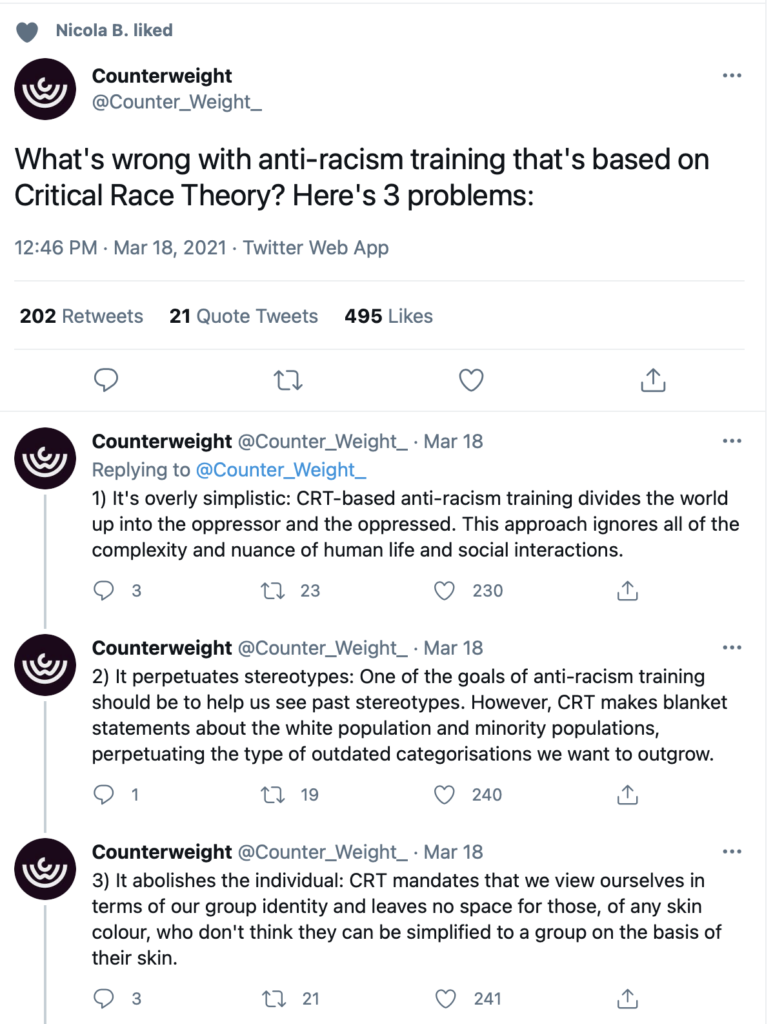
One of my favorite writers, Helen Pluckrose, is one of the founders of a promising new organization called Counterweight. The mission is to help individuals resist the imposition of Critical Social Justice (CSJ) in their day to day lives. Here's one of the organization's first Tweets: What is wrong with anti-racism training that's based on Critical Race Theory?

Continue ReadingCounterweight: New Organization Helps Individuals Fend Off Impositions of Critical Race Theory

Intentional Misunderstandings, for Better or Worse

In my work as an attorney I often encounter opposing attorneys who object to my written questions (interrogatories), insisting that they are "vague."  Opponents often make these objections in an attempt to avoid answering my questions or to slow down the progress of the lawsuit. I remind my law students that they will often encounter this unfortunate behavior when they graduate.  When it is convenient for them, the people we communicate with often give us the least charitable readings of our words. This common occurrence is one of my least favorite parts of being an attorney. It eats up a lot of time and money trying to force motivated opponents to acknowledge common and ordinary meanings of words.

This isn't just a problem for attorneys.  Whenever any of us communicate, the attitude of the other person often determines whether we will get a responsive answer or no meaningful answer. Word meanings can easily be bent and twisted and it often happens when there is no ill-intent. Consider too the existence of contronyms, words that have some opposite or contradictory meanings, such as "bolt," "dust" or "out."

There is also a fun side to unreasonable misunderstandings. It can make for good comedy.  Here's an example from Monty Python's "Holy Grail":

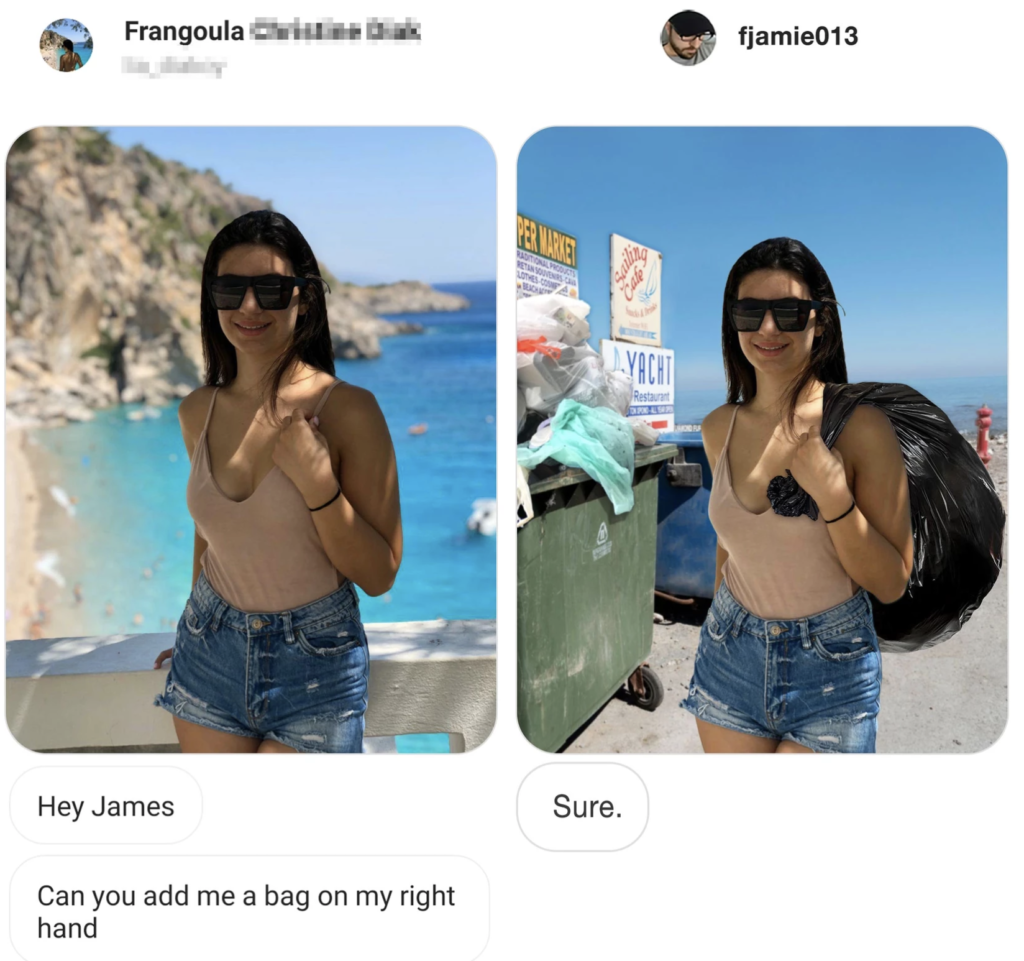
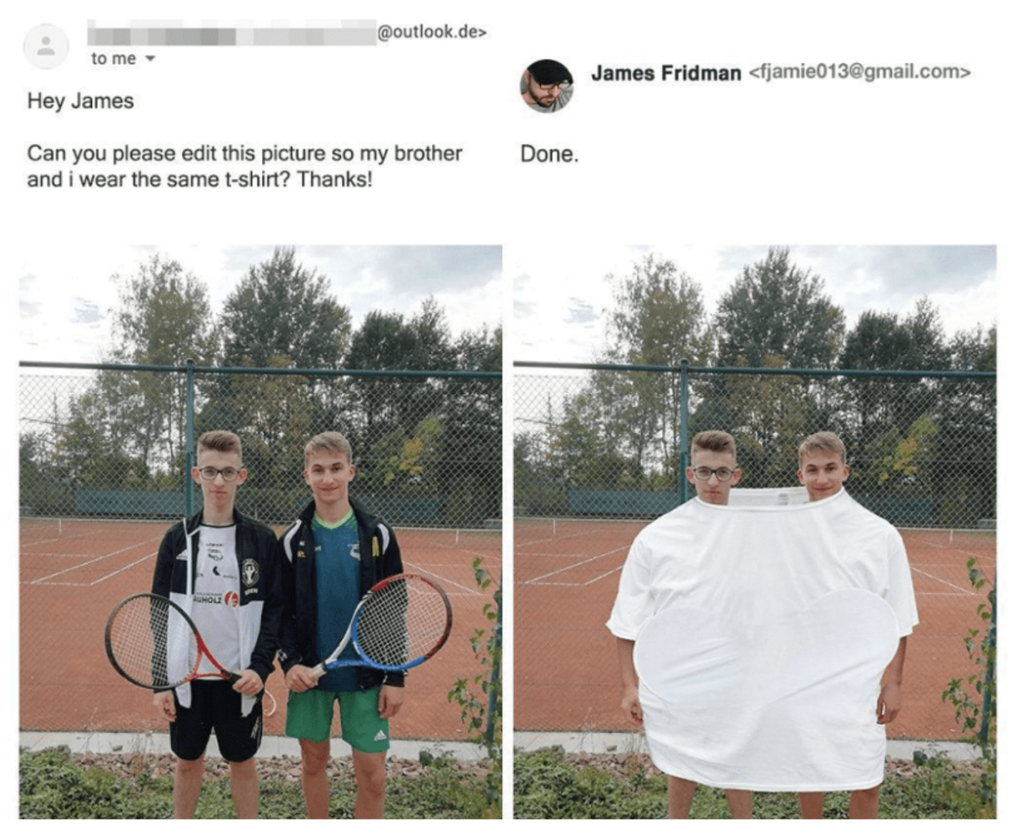
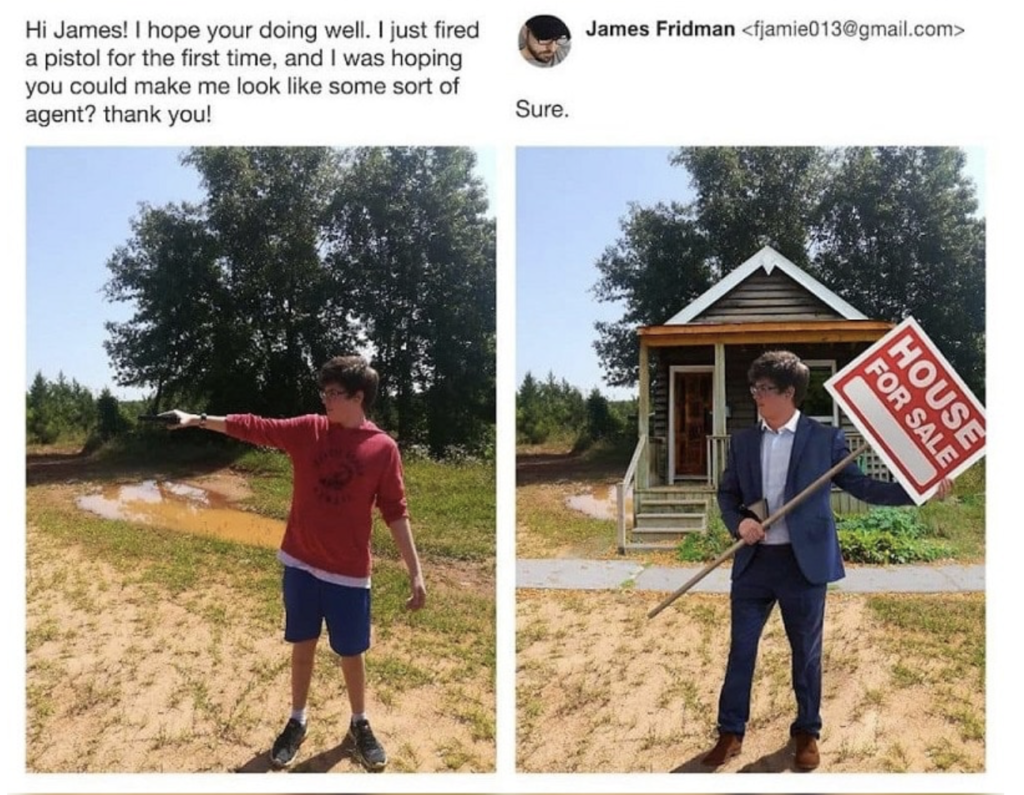
One of the most entertaining uses of intentional misunderstanding is found in the work of photoshop artist James Fridman. Many people send James requests to improve their photos and James intentionally misunderstands their requests. Over and over. Here are a few examples of Fridman's work:

and here . . .

Check out many more examples of Fridman's work here.

Continue ReadingIntentional Misunderstandings, for Better or Worse

To What Extent Can the Government Prosecute Liars?

To what extent can the government prosecute lies? First Amendment Law Professor Eugene Volokh has written an excellent article considering many angles. Here's an excerpt:

Surprisingly, the Supreme Court has never resolved the question. It hasn’t resolved the big-picture question: When can the government punish lies? It hasn’t resolved the medium-size question: Can the government punish lies in election campaigns? And it hasn’t resolved the particular question: Can the government punish lies about the mechanisms of voting, and in particular about how to vote?

[T]he court considered the case of Xavier Alvarez, a local government official in an LA suburb; he had lied about getting the Congressional Medal of Honor, and was prosecuted under the Stolen Valor Act, a statute that bans such lies about military decorations. Unconstitutional, six justices said. There was broad agreement that “Laws restricting false statements about philosophy, religion, history, the social sciences, the arts, and other matters of public concern … would present a grave and unacceptable danger of suppressing truthful speech.” “The point is not that there is no such thing as truth or falsity in these areas or that the truth is always impossible to ascertain, but rather that it is perilous to permit the state to be the arbiter of truth.” (That’s from the dissent, but the concurrence endorsed it, and the plurality’s opinion was even more speech-protective than the others.)

Yet when it came to more specific lies, whether about one’s own medals or something else, there was no majority opinion.

Continue ReadingTo What Extent Can the Government Prosecute Liars?