The Bedrock of Classic Liberalism

Andrew Sullivan, summarizing some of the core concepts of the new book by Jonathan Rauch, The Constitution of Knowledge.:

[J]onathan Rauch lays out some core principles that liberal societies rely upon. These are not optional if liberal society is to survive. And they are not easy, which is why we have created many institutions and practices to keep them alive. Rauch lists some of them: fallibilism, the belief that anyone, especially you, can always be wrong; objectivity, a rejection of any theory that cannot be proven or disproven by reality; accountability, the openness to conceding and correcting error; and pluralism, the maintenance of intellectual diversity so we maximize our chances of finding the truth.

The only human civilization that has ever depended on these principles is the modern West since the Enlightenment. That’s a few hundred years as opposed to 200,000 or so of Homo sapiens’ history, when tribalism, creedalism, warfare, theocracy or totalitarianism reigned.

The genius of liberalism in unleashing human freedom and the human mind changed us more in centuries than we had changed in hundreds of millennia. And at its core, there is the model of the single, interchangeable, equal citizen, using reason to deliberate the common good with fellow citizens. No ultimate authority; just inquiry and provisional truth. No final answer: an endless conversation. No single power, but many in competition.

In this open-ended conversation, all can participate, conservatives and liberals, and will have successes and failures in their turn. What matters, both conservatives and liberals agree, is not the end result, but the liberal democratic, open-ended means. That shift — from specifying a single end to insisting only on playing by the rules — is the key origin of modern freedom.

My central problem with critical theory is that it takes precise aim at these very core principles and rejects them. By rejecting them, in the otherwise noble cause of helping the marginalized, it is a very seductive and potent threat to liberal civilization.

Continue ReadingThe Bedrock of Classic Liberalism

Long Form Podcasts as a Remedy for Tribal Thinking

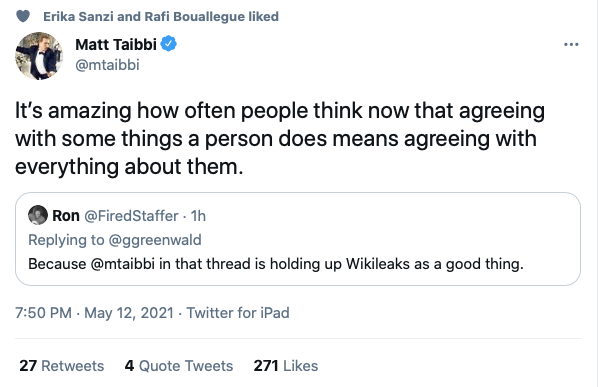
A friend is quite perturbed at me for (as I view it) not adopting the top-to-bottom progressive platform. The friend found it disturbing that I would get some of my information from sources that the friend considered to be the other team. I told this friend: "You are the 1,000th person to get frustrated with me for wanting to get my facts straight without reference to the prevailing narratives of political tribes. I am prepared to die on this hill."

I am wired to make sense of things as best I can, letting the chips fall, regardless of whether I offend people in the process (with rare exceptions).  I was prepared for this way of learning during a childhood where my father force-fed me buckets of religious dogma, resulting in this five-part essay.

I am willing to get useful information from anyone who has information that seems useful.  I'm working hard to not divide the world into "good" people and "bad" people.  Good people often say untrue things and bad people often say things that make sense. Everyone has a batting average. Everyone is flawed. It is my act of faith that we need to listen to all of it and then pretend that we are emotionally detached Martian anthropologists in order to decide what is accurate. In other words, we need to pay close attention to John Stuart Mill, who is as relevant as ever.

Hence, I reject any Manichean outlook. I fear that our two main political tribes and their respective news silos (amplified by social media) are poisoning our national dialogue. In fact, ruining our national dialogue to the point where, truly, our de facto national motto is getting to be "Fuck e pluribus unum!"  It's gotten to the point where people are hating other people for ideas, whereas I think we can hate the idea but must always love the person. I am not religious, but I think that Jesus' "Love your enemy" is one of the most radical, brave and brilliant things ever said.

We need to listen to people that others call the "enemy" because sometimes they are right--sometimes it takes years for it to become apparent that they are correct. I have long been ridiculed for listening "to the enemy." That is, and will forever be, my plight, because the world is complex, not a cartoon, and no tribe has it completely right. We need to actively listen to each other and test each others' claims without feeling like this is a threatening thing to do, in order to make good sense of our world. Without each other, we are all prone to become ideologues who "win" all of our arguments because we refuse to consider competing views (and in fact many of us actively work to muzzle competing views). Hard earned, carefully distilled facts first to prepare the way for meaningful opinions, is the only way to make sense. Whenever we do the opposite, indulging in thinking and opinion-vomiting as a team sport, we are poisoning all dialogue and shutting down human flourishing.

I believe that real conversation (not the pundits barking at each other on CNN, or regular folks on the street, imitating the pundits) will dissolve many of the differences we see in each other. That brings me to an inspiring dialogue I recently heard: a discussion involving Joe Rogan and Glenn Greenwald. This is an odd couple in many ways. At the beginning of the show they both admitted that, in prior years, they weren't each others' favorite people. But they reached out, sat down for three hours and had a riveting conversation that covered many issues, including whistle-blowers, corruption in Brazil, Hunter Biden. My favorite part is where Joe and Glenn discussed the importance of reaching out to people who think differently in order to understand them and to better understand yourself.

Rogan and Greenwald both tout the long-form podcast as one of the best ways to dissolve the pundit-coating that people construct around themselves and to then get down to some interesting conversation--the kind of conversation where people learn interesting things about each other and about themselves. You can be a politician for a short session on FOX or NPR, maybe even 30 or 40 minutes, but you can't hide it for several hours. Rogan mentions that he stumbled upon this powerful revelation because he was too lazy to edit his long podcasts, but then he started to appreciates incredible power of the long-form podcast to reveal who people really are.  This conversation between two wide-open complex minds is pure gold, and I invite you to listen to the entire podcast, but especially from 118 min mark to the 140 min mark.  You can also read along here (beginning at 2:01:38).

Continue ReadingLong Form Podcasts as a Remedy for Tribal Thinking

Andy NGO Discusses ANTIFA, Including Media Coverage

Earlier this month, independent journalist Andy Ngo gave a talks at Hillsdale College. I saw images and videos I hadn't before seen, including massive disruption and violence in downtown Portland, Oregon. Until I saw this, I only had a vague notion of the goals and history of ANTIFA. Ngo's account is the only detailed account I have heard, so I won't pretend that anyone should stop their research after watching this one presentation.

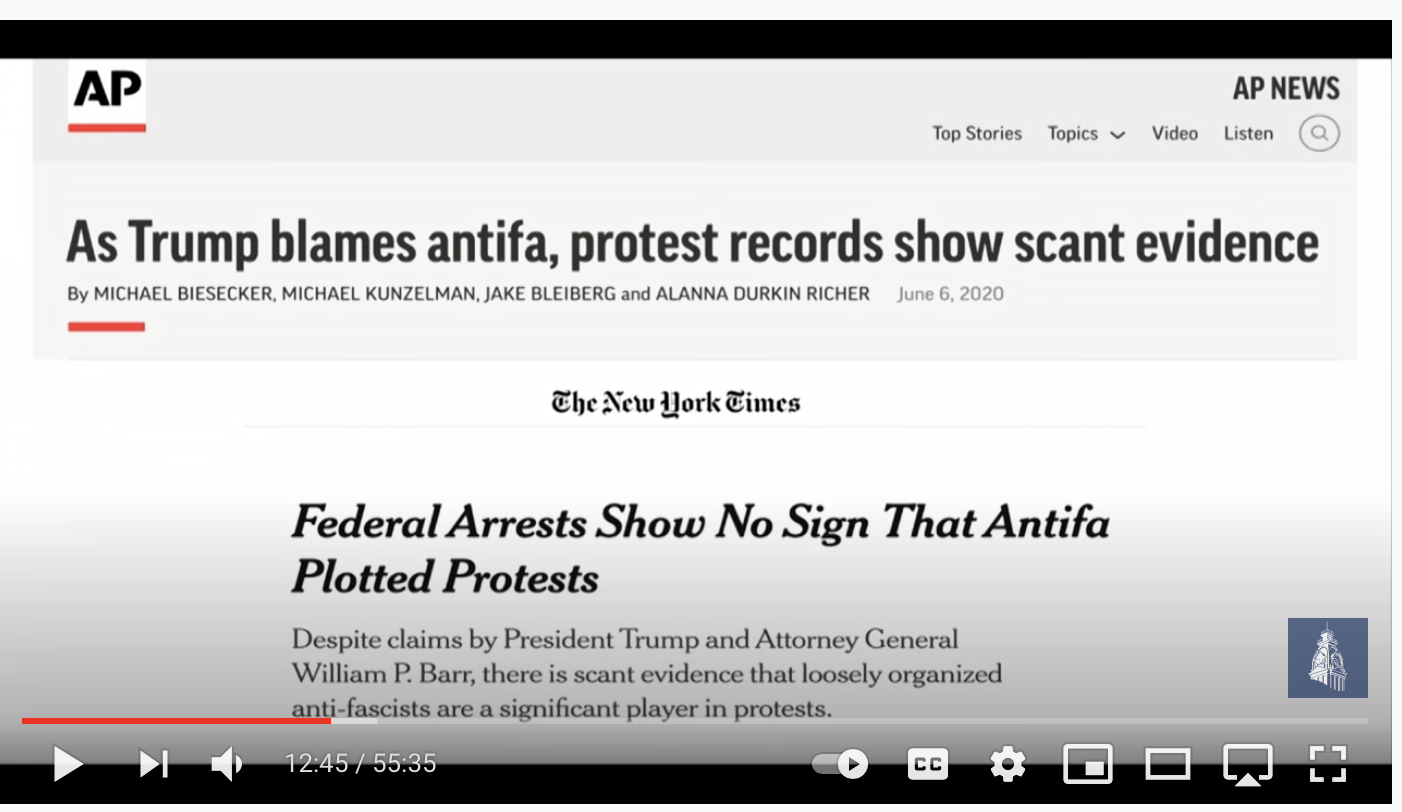
That said, Ngo's account of ANTIFA provided considerable detailed information I had not heard before, even though I had often heard the term ANTIFA. Mostly, I had heard the term ANTIFA as part of a dispute of whether the group even exists. Ngo showed the audience these headlines:

My reason for sharing this video is twofold. Andy Ngo presents detailed information about an ideology (Ngo explains it is not one cohesive group) about which I hadn't before heard detailed information.

Much more interesting and concerning to me is the legacy media's almost total shutdown of selected events. I invite you to visit NPR/NYT/WP and word search for the terms "ANTIFA," "Portland" or "riot" and compare the threadbare on-the-ground news coverage of what happened on the streets with the vast and intense news coverage you will see for "Capitol Riot." I was disturbed by both of these incidents. I see them both as attacks on my government. These were both attempts to invoke a feeling of chaos and loss of confidence in the social order. In Portland, I see a federal courthouse under attack, night after night, forcing police into a defensive shell, hopelessly waiting it out. As I watch these videos and photos it repeatedly occurs to me that Courthouse are where our Civil Rights Laws are often enforced, where people abused by government action find a remedy. Yet the images show repeated attempts to damage or destroy it. The attacks on Portland (and Seattle) lasted for weeks, and they included substantial violence and destruction of property, far more than the damage down the our DC Capitol. The violence in Minneapolis amounted to a half-billion in uninsured property losses, substantial amount of this falling on fledgling businesses and immigrant shopkeepers.

I can think of no better evidence proving that the left-leaning media consciously embraces its chosen narrative every bit as much as FOX does on the political right. This is important to see, at a time when numerous left-leaning people I know insist that there is no such thing bias on the left. I personally know dozens of people who deny media bias on the left, people who hunker down only with NPR/NYT/WP and assume that they are getting the full story.

Continue ReadingAndy NGO Discusses ANTIFA, Including Media Coverage

The Many Problems with the Concept of “Microagressions”

If you would like to explore the many ways that the modern usage of the term "microagressions" has fallen off the tracks at the hands of modern "anti-racists," consider reading a soon-to-be published law review article by an attorney and a psychologist, Edward Cantu & Lee Jussim, Ph.D. Their article is titled: MICROAGGRESSIONS, QUESTIONABLE SCIENCE, AND FREE SPEECH.

I'll begin with their conclusions:

When scientists speak, people listen, even if the science is unscientific. If scientists are going to declare a broad and indeterminate number of acts inherently subtly racist, and a critical mass of those in positions of power and influence are ideologically inclined to believe them, it is imperative that the claims not be grossly exaggerated and that they be grounded in solid scientific methodology. The [current micro aggression construct- "CMC"] fails in this regard. After critical analysis, the CMC appears to be a project in attempting to retroactively validate initial ideological hunches; or, at best, to give voice to POC by substituting the scientific method for the perceptions of some of them. Whichever it may be, it is clear that, at this point, nobody—neither diversity administers, academics, or journalists—should take currently propagated lists of microaggressions as representative of anything meaningful. We assert this not to be gratuitously insulting to CMC researchers, but to forestall the harms that the CMC we fear may cause.

The authors acknowledge that the concept of "microagressions" is a worthy subject of study (beginning with the research by psychologist Chester Pierce in the 1970s), but they find  that the list of words and phrases that might have some legitimacy as racial slights have now been coupled, through concept creep, with numerous expressions that are innocent or even complimentary (see their Appendix for many examples). In step with this concept creep, the Overton Window has been slammed down to forbid numerous verbal expressions that are A) not problematic to the great majority of those who are purported to be victims of these slights and/or B) depend for their meaning almost entirely upon the intent of the speaker and the context in which the words are spoken.

The authors warn that current "anti-racist" ideology refuses to take into account the intent of the speaker. This tactical use of microaggressions, combined with sloppy "science" is harming society socially, by shutting down needed conversation:

Yet, we fear that microaggression researchers via their alleged insights are increasingly teaching POC that they are under constant assault; that they are being conditioned to be constructively offended—that is, offended because they’re taught that they’re supposed to be—in situations that do not implicate racism.

The research regarding microagressions has increasingly been motivated to find something invisible to attempt to explain (often simplistically) observable racial disparities:

Although the civil rights legislation of the 1960s ended legal racial discrimination, inequality still persists almost 60 years later. Why? Many have concluded it must be because of something secret, subtle, hidden, and underground. But what? By the 1970s, the social sciences were on a quest to find these supposedly hidden, camouflaged, or unconscious forms of racism. Those efforts generated a slew of concepts, such as “modern”  or “symbolic racism,” “implicit bias,” and “stereotype threat.” Interestingly, just as is the case with microaggressions, each of these areas have been characterized by a wave of initial enthusiasm including many publications, followed by critical reviews highlighting weaknesses, flaws, confounds and alternative explanations that consistently indicated that the initial enthusiasm was largely unwarranted.

The term "microaggressions" has been given an ideologically-laced strategic labeling to dramatically increase the perceived threat-level, creating an inverse-Trojan-horse: The term "microaggressions" puts us all on edge, even in the absence of a rigorous scientific foundation for the commonly-made claims regarding microaggressions. In recent years, the number of words and phrases allegedly encompassed by "microaggressions" has exploded (again, see the Appendix of the article) to the extent that ordinary conversation is increasingly feared as a social minefield:

Interestingly, just as is the case with microaggressions, each of these areas have been characterized by a wave of initial enthusiasm including many publications, followed by critical reviews highlighting weaknesses, flaws, confounds and alternative explanations that consistently indicated that the initial enthusiasm was largely unwarranted. intentionality, and less directly but atmospherically, oppression and domination. Rarely if ever would the lay person label an act committed with benign conscious intent a form of “aggression.” But consistent with tactical concept creep, this is the term chosen, even with the knowledge that use of the term means imputing to well-meaning actors a state of mind normally associated with culpability.

Psychologist Jonathan Haidt has written about the phenomenon of concept creep specifically in the context of microaggressions. In lamenting that psychology is “becoming a tribal moral community bound together by moral commitments to social justice and progressive ideals,” 95 Haidt noted that psychologists are incentivized “to find new ways in which members of allegedly victimized groups are harmed by current practices”; 96 hence the creeping expansion of the concept of harm. Particularly on point, Haidt also described as a “central innovation[] of microaggression theory” the disposal of a mens rea predicate for concepts such as “abuse” and “discrimination” “in ways that make it ever harder for anyone to defend themselves against ugly moral charges.”

Cantu and Lee Jussim have written a long, carefully researched, balanced and important article that will provide many of us the the confidence to raise our hands when we are next compelled to attend "anti-racist" training where the concept of "microaggressions" is blithely bandied about (as it often is). The authors were at least somewhat motivated to do this research because they were witnessing good-hearted people being chewed up in the current ideological juggernaut of "anti-racism."  Their article will help all of us to speak up whenever we are told to assume that "microaggressions" A) are ubiquitous and B) that labeling dozens of taboo expressions as taboo obviates the need to do real work to determine the mindset of those who speak.

The modern use of the concept of "microaggressions" is the equivalent of doing surgery with a chainsaw. All good and decent people know that we can't off-load human complexity to a simplistic list of taboo phrases assembled ad hoc by (often well-intentioned) ideologues.  Human beings are much more complex than that. Good-hearted people earnestly and make charitable case-by-case holistic determinations about whether people who are engaged in speech are being ignorant and rude or whether they are well-intentioned and kind-hearted (or something in between). I applaud the work done by Cantu and Lee because it will allow us to have more meaningful conversations going forward.

Continue ReadingThe Many Problems with the Concept of “Microagressions”