Woke Food Fights

I just finished reading today's NYT article, "Food Is Identity. For Korean Chefs Who Were Adopted, It’s Complicated. Koreans raised by American families are exploring a heritage they didn’t grow up with through restaurant cooking — and finding both fulfillment and criticism." Here is an excerpt:

As Korean food continues to influence American dining, with Korean fried chicken and bibimbap appearing on all types of menus, a variation on that interplay is unfolding in the kitchens of chefs with backgrounds like Mrs. Hong — Korean adoptees who came to the United States in the 1970s and ’80s. These chefs are coming to terms with a heritage they didn’t grow up with. And they are enthusiastically expressing it through the very public, and sometimes precarious, act of cooking for others.

In the process, they’re finding fulfillment — and sometimes attracting criticism from other Korean Americans that their cooking isn’t Korean enough.

An estimated 200,000 Koreans have been adopted globally since 1953, roughly three-quarters of them by parents in the United States, said Eleana J. Kim, an associate professor of anthropology at the University of California, Irvine, and the author of “Adopted Territory: Transnational Korean Adoptees and the Politics of Belonging.”

Yes, let's keep dividing people against each other and publishing articles pretending that this finger-wagging attitude is worth discussing at the NYT (or anywhere). How about this alternative? We should honor people who cook well, regardless of their immutable characteristics or upbringing. How incredibly stupid and destructive have some of us become regarding this idea of cultural appropriation? Check out this article by Jonathan Turley: "White Owners Of Mexican Food Truck Shut Down After Being Accused of Cultural Appropriation." Here's an excerpt:

Kali Wilgus and Liz “LC” Connelly thought that they had realized their dream when they opened Kooks Burritos in Portland Oregon. They were even more excited when the local newspaper Williamette Week decided to do a feature article on their new business. The two women recounted how they watched Mexican women making tortillas on a trip to Baja California and adopted what they saw. That admission however led to furious accusations that the two white women were guilty of “cultural appropriation.” They eventually shutdown their food truck.

And, of course, let's keep dividing people into two--count'em--two "colors." After all, it has been such an incredibly successful strategy for the U.S. so far. If you think I'm exaggerating, take a look at the "anti-racist" teaching materials common in many of our schools. They are all over the internet, though most legacy media outlets won't give you links to these poisonous materials. Those who embrace these newish "anti-racist" teaching materials apparently forgot who Martin Luther King was.

As Matt Taibbi pointed out in his book, "Hate,Inc., "[W]hat most people think of as 'the news' is, in fact, a twisted wing of the entertainment business."

Continue ReadingWoke Food Fights

U.S. Gun Violence by the Numbers

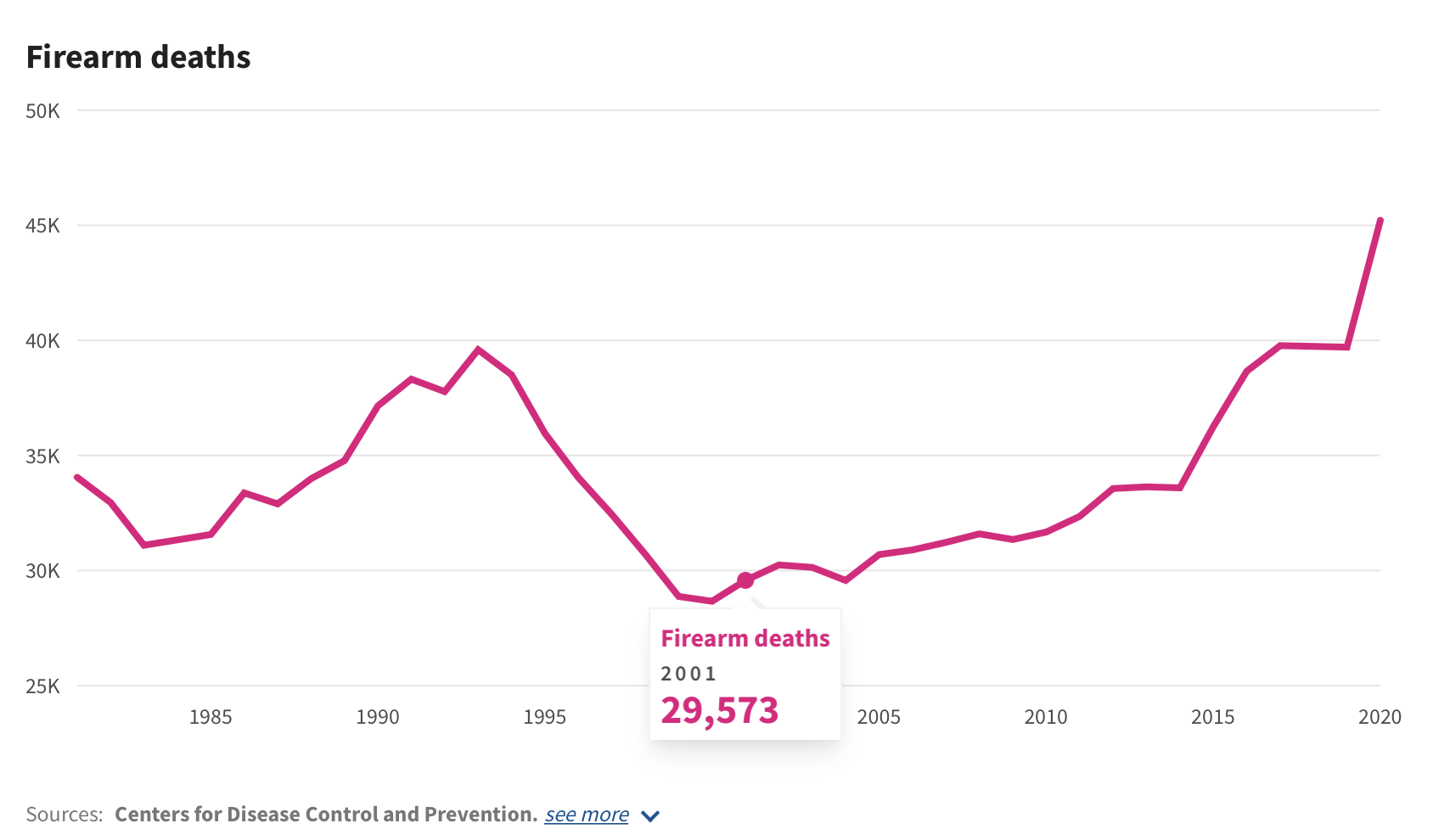
From USA Facts, horrifying numbers.

Firearm deaths include all deaths involving guns, such as homicide, suicide, and accidents. More people in the US die from suicide involving a firearm than homicides or accidents. There were a total of 45,222 firearm deaths in the US in 2020, an increase of 14% or 5,155 firearm deaths from 2019.

Continue ReadingU.S. Gun Violence by the Numbers

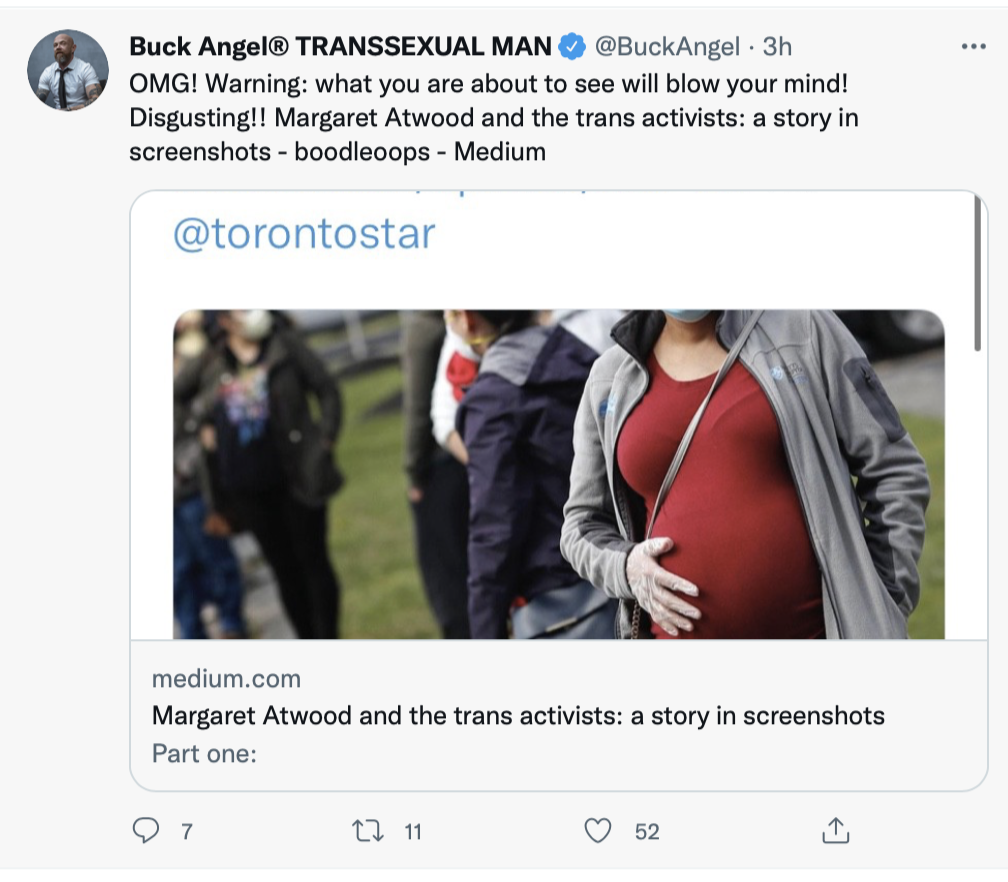
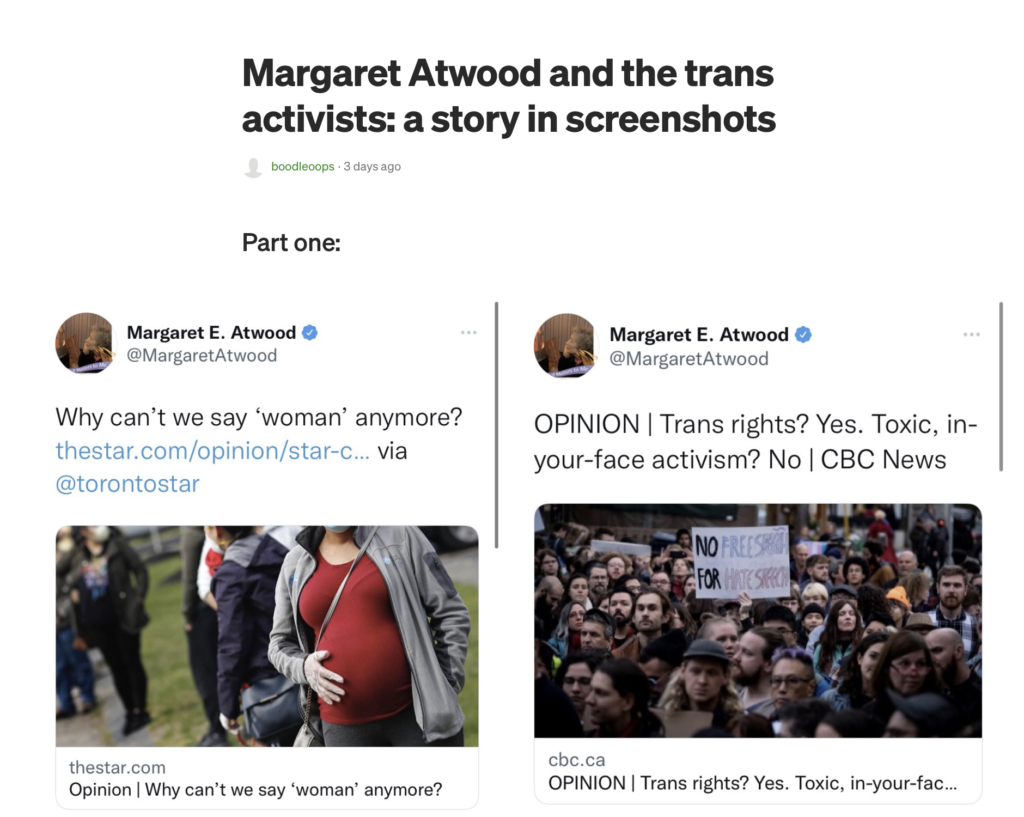
Margaret Atwood Tries to have a Conversation with Trans Rights Activists

The resulting vomit of coarse and disrespectful language shocks even Buck Angel.  Click the images if you are not easily offended by extremely crude language.

Continue ReadingMargaret Atwood Tries to have a Conversation with Trans Rights Activists

About Police Officers Aggressively Talking to Strangers. Why This has been Encouraged and What Can Go Wrong.

Matt Taibbi has reviewed Malcom Gladwell's book, published in 2019, prior to the George Floyd incdent. The title of Gladwell's book is Talking to Strangers: What We Should Know About the People We Don’t Know. Taibbi's article is "The Overlooked Factors in Police Abuse CasesCops take most of the blame, often deservedly, but the single-minded media furor of the last year has let other bad actors off the hook." Taibbi cautions that when things go wrong between police and those who identify as black, it's often about far more than race, and we need to consider the role of the politicians who encourage these frequent contacts between police and strangers. Sometimes, as in Ferguson, what is motivating these contacts is for profit policing.

Gladwell’s point seems to be that if you ask police to stop millions of cars and pedestrians, and instruct them to look for pretexts to conduct searches of all of them, police will override their “default to truth” and begin to see threats in innocent people everywhere. He’s trying to be understanding about scenes like the Encinia video, by asking readers to look at the policy context underneath that car stop.

The backdrop of the Ferguson, Missouri case, for instance, involved the strained finances of the city. As the Justice Department later found, “City officials routinely urge [police] to generate more revenue through enforcement,” which meant busting people not just for breaking the law but violating municipal order codes...

Individual police got most of the blame, and in some cases deserved it, but it’s politicians desperate for revenue or lower crime numbers who artificially heighten stranger contacts, jack up numbers of bogus summonses and tickets, and push people like Brian Encinia to fudge pretexts for thousands if not millions of stops and searches.

A percentage of those encounters will always go wrong, and when they do, it’s not always all about racism. It’s usually also about political stupidity, greed, and laziness, and a host of other problems our habit of reaching for simplistic explanations prevents us from understanding. Saying it’s all about race or white supremacy isn’t just inaccurate, it lets bad actors off the hook — especially city politicians and their upscale yuppie donors who vote for these interventionist policies, and are all too happy to see badge-wearing social janitors from middle-class towns in Long Island or Westchester take the rap when things go bad.

Gladwell concludes that “Sandra Bland is what happens when a society does not know how to talk to strangers,” but I think that doesn’t put it strongly enough. Bland is what happens when police spend too much time talking to strangers, and when the rest of us talk too little about why that is.

Gladwell opens the above talk (regarding his book) with this:

I wanted to talk a little bit about it a paradox about human communication which i think is extremely important and relatively under-recognized and that is that everything that is good and meaningful and powerful about a human communication has a price as it turns out I think the price is worth paying but I think sometimes we overlook the consequences of the fact that there is this particular consequence to effective communication.
The following excerpt is from a summary of Gladwell's book.
The problem at the heart of the two puzzles is that people assume that they can make sense of others based on relatively simple strategies. But when it comes to strangers, nothing is as simple as it seems.

There are three major strategies that people use to make sense of strangers:

People default to truth. People assume transparency. People neglect coupled behaviors.

These three strategies ultimately fail because they operate under the assumption that simple clues are enough evidence of a stranger’s internal thoughts or intentions. We will look at each of these strategies separately to see where they came from and why they often result in failed interactions with strangers.

Continue ReadingAbout Police Officers Aggressively Talking to Strangers. Why This has been Encouraged and What Can Go Wrong.

The Many Problems with the Concept of “Microagressions”

If you would like to explore the many ways that the modern usage of the term "microagressions" has fallen off the tracks at the hands of modern "anti-racists," consider reading a soon-to-be published law review article by an attorney and a psychologist, Edward Cantu & Lee Jussim, Ph.D. Their article is titled: MICROAGGRESSIONS, QUESTIONABLE SCIENCE, AND FREE SPEECH.

I'll begin with their conclusions:

When scientists speak, people listen, even if the science is unscientific. If scientists are going to declare a broad and indeterminate number of acts inherently subtly racist, and a critical mass of those in positions of power and influence are ideologically inclined to believe them, it is imperative that the claims not be grossly exaggerated and that they be grounded in solid scientific methodology. The [current micro aggression construct- "CMC"] fails in this regard. After critical analysis, the CMC appears to be a project in attempting to retroactively validate initial ideological hunches; or, at best, to give voice to POC by substituting the scientific method for the perceptions of some of them. Whichever it may be, it is clear that, at this point, nobody—neither diversity administers, academics, or journalists—should take currently propagated lists of microaggressions as representative of anything meaningful. We assert this not to be gratuitously insulting to CMC researchers, but to forestall the harms that the CMC we fear may cause.

The authors acknowledge that the concept of "microagressions" is a worthy subject of study (beginning with the research by psychologist Chester Pierce in the 1970s), but they find  that the list of words and phrases that might have some legitimacy as racial slights have now been coupled, through concept creep, with numerous expressions that are innocent or even complimentary (see their Appendix for many examples). In step with this concept creep, the Overton Window has been slammed down to forbid numerous verbal expressions that are A) not problematic to the great majority of those who are purported to be victims of these slights and/or B) depend for their meaning almost entirely upon the intent of the speaker and the context in which the words are spoken.

The authors warn that current "anti-racist" ideology refuses to take into account the intent of the speaker. This tactical use of microaggressions, combined with sloppy "science" is harming society socially, by shutting down needed conversation:

Yet, we fear that microaggression researchers via their alleged insights are increasingly teaching POC that they are under constant assault; that they are being conditioned to be constructively offended—that is, offended because they’re taught that they’re supposed to be—in situations that do not implicate racism.

The research regarding microagressions has increasingly been motivated to find something invisible to attempt to explain (often simplistically) observable racial disparities:

Although the civil rights legislation of the 1960s ended legal racial discrimination, inequality still persists almost 60 years later. Why? Many have concluded it must be because of something secret, subtle, hidden, and underground. But what? By the 1970s, the social sciences were on a quest to find these supposedly hidden, camouflaged, or unconscious forms of racism. Those efforts generated a slew of concepts, such as “modern”  or “symbolic racism,” “implicit bias,” and “stereotype threat.” Interestingly, just as is the case with microaggressions, each of these areas have been characterized by a wave of initial enthusiasm including many publications, followed by critical reviews highlighting weaknesses, flaws, confounds and alternative explanations that consistently indicated that the initial enthusiasm was largely unwarranted.

The term "microaggressions" has been given an ideologically-laced strategic labeling to dramatically increase the perceived threat-level, creating an inverse-Trojan-horse: The term "microaggressions" puts us all on edge, even in the absence of a rigorous scientific foundation for the commonly-made claims regarding microaggressions. In recent years, the number of words and phrases allegedly encompassed by "microaggressions" has exploded (again, see the Appendix of the article) to the extent that ordinary conversation is increasingly feared as a social minefield:

Interestingly, just as is the case with microaggressions, each of these areas have been characterized by a wave of initial enthusiasm including many publications, followed by critical reviews highlighting weaknesses, flaws, confounds and alternative explanations that consistently indicated that the initial enthusiasm was largely unwarranted. intentionality, and less directly but atmospherically, oppression and domination. Rarely if ever would the lay person label an act committed with benign conscious intent a form of “aggression.” But consistent with tactical concept creep, this is the term chosen, even with the knowledge that use of the term means imputing to well-meaning actors a state of mind normally associated with culpability.

Psychologist Jonathan Haidt has written about the phenomenon of concept creep specifically in the context of microaggressions. In lamenting that psychology is “becoming a tribal moral community bound together by moral commitments to social justice and progressive ideals,” 95 Haidt noted that psychologists are incentivized “to find new ways in which members of allegedly victimized groups are harmed by current practices”; 96 hence the creeping expansion of the concept of harm. Particularly on point, Haidt also described as a “central innovation[] of microaggression theory” the disposal of a mens rea predicate for concepts such as “abuse” and “discrimination” “in ways that make it ever harder for anyone to defend themselves against ugly moral charges.”

Cantu and Lee Jussim have written a long, carefully researched, balanced and important article that will provide many of us the the confidence to raise our hands when we are next compelled to attend "anti-racist" training where the concept of "microaggressions" is blithely bandied about (as it often is). The authors were at least somewhat motivated to do this research because they were witnessing good-hearted people being chewed up in the current ideological juggernaut of "anti-racism."  Their article will help all of us to speak up whenever we are told to assume that "microaggressions" A) are ubiquitous and B) that labeling dozens of taboo expressions as taboo obviates the need to do real work to determine the mindset of those who speak.

The modern use of the concept of "microaggressions" is the equivalent of doing surgery with a chainsaw. All good and decent people know that we can't off-load human complexity to a simplistic list of taboo phrases assembled ad hoc by (often well-intentioned) ideologues.  Human beings are much more complex than that. Good-hearted people earnestly and make charitable case-by-case holistic determinations about whether people who are engaged in speech are being ignorant and rude or whether they are well-intentioned and kind-hearted (or something in between). I applaud the work done by Cantu and Lee because it will allow us to have more meaningful conversations going forward.

Continue ReadingThe Many Problems with the Concept of “Microagressions”