A Moment of Unity Slipped Through Our Fingers

I feel like we let a moment of unity slip through our fingers. It seems that when we collectively watched the killing of George Floyd, we were all horrified. I have friends across the political spectrum, and even those I most disagree with – the die hard Trump supporters – were as outraged by that murder as anyone. And then came the first peaceful protest, and it seemed that everyone was absolutely behind it. For a moment.

Protesters gather in downtown Minneapolis. Unrest in Minneapolis over the May 25th death of George Floyd.

Then on the fringes of the peaceful, heartfelt protests came the fringe elements – the violence, vandalism, looting. Even then, for a moment, it seemed that the facts and the narrative were that this was a few bad actors and a few bad cops causing a disturbance at an otherwise peaceful demonstration.

And then very quickly our politicians and the media, jumped in to divide us again. Inadvertently perhaps, but now we're not just divided, we're fractured. Now there are multiple "camps" within the left and right, all disagreeing with each other.

I believe this is because we have gotten so accustomed to having quick, easy answers to what's going on. We need to determine, before we have any facts, who is responsible for the rioting and looting. We demand to know and the media is compelled to fill the airwaves with something, anything, to fill our need to know. And politicians are eager to point blame at whatever entity will help to score points with their base. We collectively want to blame one group of people for this, and assign a single motive. That makes it easy.

  • Angry black people fed up with the way they're treated
  • White people who want to instigate and turn the protest violent to make black people seem out of control
  • Undercover police who want to further the narrative that these protesters should be handled with violence
  • Opportunistic people of any race who want to take advantage of the situation for whatever reason<
  • Radical left wingers who want to destroy our country
  • Radical right wingers who want to destroy our country

Maybe it's all of the above. Maybe there are far more reasons for it than we've heard. But it's still a small number of people amongst the masses of peaceful protesters. But now, because our focus is on the violence, that's the narrative. Now when we say "protester" we think burning buildings and looting. That's so not fair.

It is not fair to anyone, and detrimental to our unity, when we see some photos of white looters, and conclude that all the looters are white. It's not fair to anyone, to see images of black people looting and decide that all the looters are black. It's not fair to see images of cops being brutal to peaceful protesters and conclude that all cops are out of control. It's not fair to see images of some police kneeling with protesters and conclude that all cops are good and want to connect with their diverse communities.

All of that is happening, all at once. We have to open our minds to the idea that this is not something that we can wrap up in a neat package, put a label on it, and feel good that we have the answer. We don't. None of us do. This is complicated. We need to unify to resolve it.

Continue ReadingA Moment of Unity Slipped Through Our Fingers

Post-Riot Damage to a Small Business

Anyone failing to see problems (or at least moral nuance) with the rioting is intentionally blind. I've noticed several of these videos showing the post-riot consequences for small business owners and it is, indeed, heartbreaking.

Continue ReadingPost-Riot Damage to a Small Business

Martin Luther King Opposed Riots. Full Stop.

The death of George Floyd was horrific and revolting, as was the purported "cause of death" contained in the criminal complaint. A newly released private autopsy now verifies what we all saw with our own eyes: George Floyd was murdered by the police. And now, riots are spreading across the United States.

Reading social media over the last few days, one would get the impression that Martin Luther King would approve of this destructive rioting we are witnessing in Minneapolis and many other American Cities.  What I am seeing on social media is that rioting is justified because it supposedly results only in property damage or that insurance will pay for all the damage. Here is the money quote in which MLK purportedly justified riots: "But in the final analysis, a riot is the language of the unheard."  Even MLK's son Martin Luther King III deceptively uttered his father's quote and he was promptly corrected with much vigor on Twitter.  The pro-rioting crowd is unhinged. As though it is necessary to destroy property, livelihoods and even lives in order to exercise the First Amendment. As though "rioting is speech" any more than "money is speech." As though destroying businesses, burning the property of innocent third parties or smashing the skulls of human beings constitutes speech any more than funneling corrupt money to political candidates.  For these folks, why stop at riots? War is now speech too, right? It appears that left now meets right: we've politically come full circle.

Along with the riots, we are thus witnessing selective and deceptive quote-mongering in an attempt to turn Martin Luther King's teachings upside down. He never condoned rioting and he opposed riots for specific carefully articulated reasons. Here are MLK's 1967 and 1968 statements on rioting:

It is as necessary for me to be as vigorous in condemning the conditions which cause persons to feel that they must engage in riotous activities as it is for me to condemn riots. I think America must see that riots do not develop out of thin air. Certain conditions continue to exist in our society which must be condemned as vigorously as we condemn riots. But in the final analysis, a riot is the language of the unheard. And what is it that America has failed to hear? It has failed to hear that the plight of the Negro poor has worsened over the last few years. It has failed to hear that the promises of freedom and justice have not been met.

. . . .

Let me say as I’ve always said, and I will always continue to say, that riots are socially destructive and self-defeating. I’m still convinced that nonviolence is the most potent weapon available to oppressed people in their struggle for freedom and justice. I feel that violence will only create more social problems than they will solve. That in a real sense it is impracticable for the Negro to even think of mounting a violent revolution in the United States. So I will continue to condemn riots, and continue to say to my brothers and sisters that this is not the way. And continue to affirm that there is another way.

. . . .

And I would be the first to say that I am still committed to militant, powerful, massive, non­violence as the most potent weapon in grappling with the problem from a direct action point of view. I’m absolutely convinced that a riot merely intensifies the fears of the white community while relieving the guilt. And I feel that we must always work with an effective, powerful weapon and method that brings about tangible results. But it is not enough for me to stand before you tonight and condemn riots. It would be morally irresponsible for me to do that without, at the same time, condemning the contingent, intolerable conditions that exist in our society. These conditions are the things that cause individuals to feel that they have no other alternative than to engage in violent rebellions to get attention. And I must say tonight that a riot is the language of the unheard. And what is it America has failed to hear? It has failed to hear that the plight of the negro poor has worsened over the last twelve or fifteen years.

. . . .

Finally,
Now what I'm saying is this: I would like for all of us to believe in non-violence, but I'm here to say tonight that if every Negro in the United States turns against non-violence, I'm going to stand up as a lone voice and say, "This is the wrong way!"

If you really truly believe that riots are justified in response to the death of George Floyd, let's not pervert the teachings of Martin Luther King in the process.  You are not preaching violence in kinship with MLK.  If you are reveling the ongoing joyride of violence through America's city centers, stop (if you can) to remember that facts are not negotiable.  For his entire life, MLK never wavered from the path of non-violence. He never approved of rioting, even where the injury was egregious, as it was in the case of George Floyd.

I was provoked to write this article after reading an article on the same topic. See "No, Martin Luther King Was Not Pro-Riot" at the National Review.

Continue ReadingMartin Luther King Opposed Riots. Full Stop.

If Only There Were a Well-Funded Peace Lobby as a Counterweight to the Military Industrial Complex

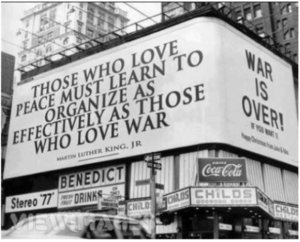
If only there were an industry of businesses that manufactured goods and services specifically geared to maintaining the peace (something more profitable and focused than libraries). Then there would be a weighty lobby to counterbalance the military-industrial complex. This Peace Lobby could sponsor NFL half-time shows. Instead of showing pretty photos of missiles taking off, they could show what happens to human beings when those missiles land. And they could sponsor research to explore the extent to which U.S. articulates meaningful objectives regarding its wars and also set forth detailed metrics to show whether U.S. wars actually achieve those objectives, using (as one example) the 20-year war in Afghanistan.

They could investigate the extent to which the U.S. government has been honest with the citizens regarding the need for each war. They could have teams of analysts assess the risks and benefits of going to war or not going to war. They could warn us that many media outlets uncritically and gullibly join in whenever politicians beat the drums to go to war. They could also explore the effect on diverting massive U.S. tax resources to war, and they could run campaigns showing the lost benefits of failing to spend those tax resources on peaceful uses, such as decaying U.S. infrastructure. They could also educate Americans of the dangers of the sunk cost fallacy.

Related Thought: If only were were better incentives for Hollywood to produce storylines where war was averted. Unfortunately, scripts permeated with visual violent conflict sells, especially visual conflict involving physical fighting.  I wonder about the filtering that likely occurs when Hollywood script-writers and producers want the cooperation of of the military to use military resources in their movies (e,g., military hardware and access to military ships, planes and bases). If only we had the following data: How often does the U.S. military turn down cooperation of a movie-maker because the script puts the military in a bad light or makes war look like a bad idea?

Continue ReadingIf Only There Were a Well-Funded Peace Lobby as a Counterweight to the Military Industrial Complex

Drivers of expensive cars tend to drive their privilege

My gut feeling borne out . . . Drivers of expensive cars are more likely to drive like jerks. These studies explore driver behavior in four-way intersections.

A research team including Berkeley psychologists Paul Piff and Dacher Keltner have been examining the way social status and wealth affects morality. Their findings — which are getting a lot of media attention — broadly show that wealthier, higher-status individuals are, essentially, more likely to cheat.
I've explored this topic previously here. John Nichols and William McChesney gathered enough evidence on this topic of wealth privilege to fill an entire book: Dollarocracy: How the Money and Media Election Complex is Destroying America. Also, check out the new podcast of Michael Lewis, Against the Rules. I've only heard the intro podcast so far ("Ref, You Suck"), but this is podcasting at its best.

The study at the top, involving an simple traffic intersection with simple well-known rules, seemed like an especially good illustration that a disproportionate number of wealthy people feel and act out their privilege, even out in the open.

Continue ReadingDrivers of expensive cars tend to drive their privilege