
Sharyl Attkisson is a five-time Emmy Award winner and recipient of the Edward R. Murrow award for Investigative Reporting. She’s the author of two New York Times bestsellers including “The Smear How Shady Political Operatives and Fake News Control What You See, What you Think and How you Vote.” For 30 years Attkisson was a correspondent and anchor at CBS News, PBS, CNN and local news and she is now the host of a weekly show, “Full Measure,” which focuses on investigative and accountability reporting. Excerpt from her discussion with Steve Kirsch.
Steve Kirsh: How are people being misled and how can we tell when people are telling you the truth?
Sharyl Attkisson : I think some important trends started in the past 15 to 20 years and have become more visible as time has gone on. Now you have to dig deeper. When you hear a prevalent narrative on the news, if you understand how the news has been co opted–like virtually every source of information that we use–you have to almost think two layers beyond what they’re trying to tell you.
Number one, you have to assume that when everybody’s on the same narrative, typically, if they’re using the same language, interviewing the same experts all on board saying everybody knows something, then that’s your cue that there’s probably a really important piece of the puzzle that’s being hidden by some important interest that would suffer if we knew the truth. So as you hear these narratives, your first thought should be “Who wants me to believe this and why?” And I know that ordinary people, including me, when I’m just leading my normal life, we don’t have time to deeply research, every question that arises. We are used to counting on the news to help us do that. But I’m telling you today, you kind of have to rely on yourself, because there are very few sources you can go to where you can trust the information as being unfettered and dual-sided, presenting all viewpoints.
A lot of it is just purely strategic for the past five or six years, dishonest, not just even out of context, but completely false. But you’ll never know if you’re trusting your traditional source that we used to look to for such things.
This has never been truer than when we look at the COVID pandemic and the vaccines. And I certainly didn’t know at the front end of the pandemic, what the truth was any more than anybody else did about how effective the vaccines might be, how bad the pandemic would be. But as time went on, this began to take on hallmarks of every other scandal that I’ve covered, including many non-medical scandals, where there are important interests, trying very hard to shape and censor information, trying to control the landscape where we get all of our information online, on the news, any source that we have. And I think it resulted in a lot of harm, number one, but number two, maybe irreparable damage to the credibility of the institutions that we rely on political institutions, medical institutions, law enforcement, whatever you’re looking at, Department of Justice, media. People, by and large as a good chunk of the population, don’t believe–nor should they–take at face value, what comes out of their mouths in terms of advice, and their fact checks, and so on.
Steve Kirsch: So what is your trusted sources that you rely on today?
Well, I look at some of the same physicians that at the time, and when I first started talking to them, and I was talking to many of them, I look at the ones that things rang true based on my experience in coverage…. Those people prove right in retrospect and other people saying different things proved wrong. That helps you as a journalist know who to keep going back to people like Dr. Jay Bhattacharya, who was spot-on. There are some people that I don’t want to name for obvious reasons who work in the government and who have worked on the vaccine, who early on guided me with some principles and ideas about the pandemic and the vaccines that all turned out to be factually accurate. We reported on my TV show full measure that someone who knew very well the RNA vaccines, and the end the pathology of how they do or don’t work, set from the start, the reason we’ve never had an outbreak of a vaccine approved before, for AIDS, for example, though they’ve been working on one for decades is because RNA vaccines don’t work very well and don’t last very long. …
Steve Kirsch: Okay, but you didn’t answer my question, which is, I’m asking about mainstream news sources like or the CNN, Fox News, like is anything mainstream? …
Sharyl Attkisson: I can’t think of one off the top of my head, I don’t get my news from new sources I tried to go. What I’ve done is I look at all the news, I don’t believe very much at face value for the reasons that we’ve discussed even when they come from sources that may be new sources, right on some things. I know enough, I know better than to just accept something I’ve heard. And I try before I report or comment on something with any sort of knowledge at all, I tried to go to an original source, one of my favorite things to do is to go to C-Span because they are a great place where they will have a whole hearing a whole discussion, a whole news conference, where you can actually read the entire thing, I will look at an entire study for myself and read it because you can bet when something is spun with a headline from some kind of study that wants you to think or believe something I have dug into those studies myself and found sometimes the very opposite of what the headline may show, is written there in the data, when you read the actual study. And even the studies as we know, and I’m writing a book on this now are often not to be believed, based on the testimony from top journal editors in chief like Dr. Marcia Angell, from the New England Journal of Medicine, like Richard Horton from the British journal Lancet, who acknowledged that medicine has been so co opted, there’s a whole another layer you have to do when you go to looking into studies as to what to believe from them. So it’s quite a process. But I try to either not comment on something with any definitive nature as if I know. Or I may just give a thought and say I don’t have deep knowledge on it. Or I hopefully have done some due diligence and been able to find some good sources and look at firsthand, firsthand sources or my own.
Steve Kirsch: Okay, so based on what, you know, if I asked you the question COVID vaccine safe and effective agree or disagree, what do you say?
Sharyl Attkisson : I would say, Umm, not very, Not very for anybody, because even for the people for whom it has proven not unsafe, so far as we know, it is certainly not very effective for anybody by CDC’s own acknowledgment. You know, when they say you need a booster, that’s another way of saying that original shot you had doesn’t work anymore. And when you need 2, 3, 4, or 5 shots. And these are only working, maybe working. If they’re working at all, they’re showing some effectiveness of producing these titers, or whatever you call them for a very short period of time. But if you balance that against the risk that you’re adding on every time you get an additional shot, it’s not a one-time risk. It’s a cumulative risk. If they say there’s a one in a 100,000 chance you’ll get x from a vaccine, but you take five doses, you’ve incrementally increased your chance of a side effect. So I would say, I don’t think this vaccine would have been approved if it had gone through the normal approval process. I am quite confident based on the studies how long it does or doesn’t last and the side-effect profile if this had come in through the regular process.
[Supp Feb 17 2026]
Sharyl Atkisson:
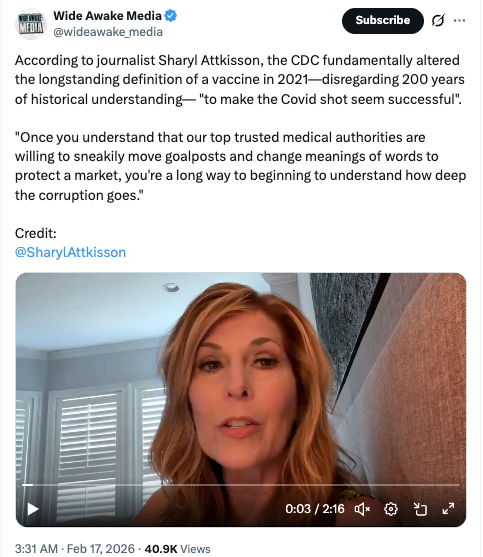
Sometimes getting and keeping a vaccine on the market requires sleight of hand. The Center for Disease Control, our premier infectious disease federal health agency is happy to give a little help to its vaccine industry partners, or as the CDC calls them, stakeholders, the agency’s best and brightest can even adjust the veritable meaning of the word “vaccines,” quite simply, as agents that prevent disease.
But in 2021 that had to be changed. It became undeniable that covid vaccines didn’t prevent the disease or transmission or even illness. Logic might suggest that the covid vaccines would have to be withdrawn from the market. After all, they didn’t even meet the definition of a vaccine. Instead, the CDC quietly redefined the word vaccine to make the covid shot seem successful after all.
On the CDCs vaccine webpage sometime between September 1 and September 2, 2021, somebody removed a key phrase from the definition. On September 1, The CDC defined a vaccine as “a product that stimulates a person’s immune system to produce immunity to a specific disease, protecting the person from that disease.” But on September 2, the phrase “protecting the person from that disease” was removed like it never even happened. Now, the CDC says vaccines merely stimulate the body’s immune response.
Think of it, the CDC unilaterally redefined 200 years of the world’s understanding of what constitutes a vaccine without so much as an explanation, public discussion, hearing or vote. Once you understand that our top trusted medical authorities are willing to sneakily move goal posts and change meanings of words to protect a market, you’re a long way to beginning to understand how deep the corruption goes.
Pre-Change Definition (in effect through at least late August 2021, based on the page’s last review date of May 16, 2018)
Vaccine: “A product that stimulates a person’s immune system to produce immunity to a specific disease, protecting the person from that disease.”
Vaccination: “The act of introducing a vaccine into the body to produce immunity to a specific disease.”
Immunization: Often used interchangeably with vaccination (a process by which a person becomes protected against a disease through vaccination).
This version had been in place since around 2015 (with an even earlier pre-2015 version focused on injecting a killed or weakened organism to prevent disease).
Post-Change Definition (implemented ~September 1, 2021, and referenced in contemporaneous reports)
Vaccine: “A preparation that is used to stimulate the body’s immune response against diseases.”
Vaccination: “The act of introducing a vaccine into the body to produce protection from a specific disease.”
The CDC described this as a minor wording update for accuracy and transparency. Officials noted that the prior language (“produce immunity”) could be misinterpreted as implying 100% effectiveness, which no vaccine achieves, and that the new phrasing better reflects how modern vaccines (including mRNA ones) work by stimulating an immune response rather than guaranteeing full “immunity.” The overall meaning remained consistent: vaccines help the body respond to and protect against specific diseases.
Current Status (as of 2024–2026)
The original “Immunization Basics” page appears to have been retired or moved (it now returns a “Page Not Found” on the CDC site). However, the CDC continues to provide formal definitions in glossaries and technical documents:In the Vaccine Glossary (updated as recently as September 2024): A vaccine is described as “a suspension of live (usually attenuated) or inactivated microorganisms… or genetic material… administered to induce immunity and prevent infectious diseases…”
In best-practices glossaries (e.g., 2023 Appendix for immunization providers): Similar technical language emphasizing induction of immunity or immune responses, with “vaccination” as the physical act of administering a vaccine.
Other CDC resources (e.g., Health, United States) define vaccination as “the process of using a vaccine to stimulate the immune system to provide protection against a disease.”These align with the post-2021 emphasis on immune response/protection while using more precise scientific terminology. No major further revisions to the core public definition of “vaccine” itself have been widely reported since 2021 (though “up to date” vaccination status for COVID-19 surveillance and schedules has been updated multiple times for operational reasons, such as in 2023–2026 for new formulations and recommendations).
The 2021 update was widely discussed at the time in fact-checks (e.g., by AP, USA Today, and others), which confirmed it via Wayback Machine archives and CDC statements but noted it was not a substantive overhaul prompted by any specific failure of COVID-19 vaccines. Definitions have evolved gradually over decades to reflect advances in vaccine technology (e.g., from whole-pathogen to subunit/mRNA approaches).

