
Martin Luther King Opposed Riots. Full Stop.
The death of George Floyd was horrific and revolting, as was the purported "cause of death" contained in the criminal complaint. A newly released private autopsy now verifies what we all saw with our own eyes: George Floyd was murdered by the police. And now, riots are spreading across the United States.
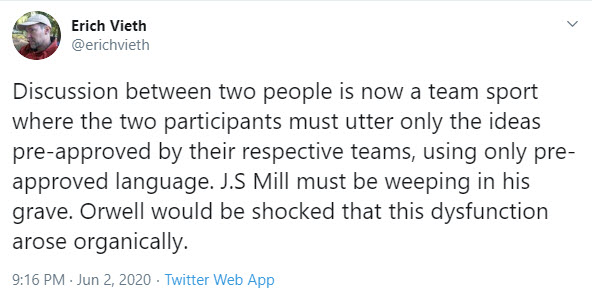
Reading social media over the last few days, one would get the impression that Martin Luther King would approve of this destructive rioting we are witnessing in Minneapolis and many other American Cities. What I am seeing on social media is that rioting is justified because it supposedly  results only in property damage or that insurance will pay for all the damage. Here is the money quote in which MLK purportedly justified riots: "But in the final analysis, a riot is the language of the unheard." Even MLK's son Martin Luther King III deceptively uttered his father's quote and he was promptly corrected with much vigor on Twitter. The pro-rioting crowd is unhinged. As though it is necessary to destroy property, livelihoods and even lives in order to exercise the First Amendment. As though "rioting is speech" any more than "money is speech." As though destroying businesses, burning the property of innocent third parties or smashing the skulls of human beings constitutes speech any more than funneling corrupt money to political candidates. For these folks, why stop at riots? War is now speech too, right? It appears that left now meets right: we've politically come full circle.
Along with the riots, we are thus witnessing selective and deceptive quote-mongering in an attempt to turn Martin Luther King's teachings upside down. He never condoned rioting and he opposed riots for specific carefully articulated reasons. Here are MLK's 1967 and 1968 statements on rioting:
It is as necessary for me to be as vigorous in condemning the conditions which cause persons to feel that they must engage in riotous activities as it is for me to condemn riots. I think America must see that riots do not develop out of thin air. Certain conditions continue to exist in our society which must be condemned as vigorously as we condemn riots. But in the final analysis, a riot is the language of the unheard. And what is it that America has failed to hear? It has failed to hear that the plight of the Negro poor has worsened over the last few years. It has failed to hear that the promises of freedom and justice have not been met.
. . . .
Let me say as I’ve always said, and I will always continue to say, that riots are socially destructive and self-defeating. I’m still convinced that nonviolence is the most potent weapon available to oppressed people in their struggle for freedom and justice. I feel that violence will only create more social problems than they will solve. That in a real sense it is impracticable for the Negro to even think of mounting a violent revolution in the United States. So I will continue to condemn riots, and continue to say to my brothers and sisters that this is not the way. And continue to affirm that there is another way.
. . . .
And I would be the first to say that I am still committed to militant, powerful, massive, nonviolence as the most potent weapon in grappling with the problem from a direct action point of view. I’m absolutely convinced that a riot merely intensifies the fears of the white community while relieving the guilt. And I feel that we must always work with an effective, powerful weapon and method that brings about tangible results. But it is not enough for me to stand before you tonight and condemn riots. It would be morally irresponsible for me to do that without, at the same time, condemning the contingent, intolerable conditions that exist in our society. These conditions are the things that cause individuals to feel that they have no other alternative than to engage in violent rebellions to get attention. And I must say tonight that a riot is the language of the unheard. And what is it America has failed to hear? It has failed to hear that the plight of the negro poor has worsened over the last twelve or fifteen years.
. . . .
Finally,Now what I'm saying is this: I would like for all of us to believe in non-violence, but I'm here to say tonight that if every Negro in the United States turns against non-violence, I'm going to stand up as a lone voice and say, "This is the wrong way!"
If you really truly believe that riots are justified in response to the death of George Floyd, let's not pervert the teachings of Martin Luther King in the process. You are not preaching violence in kinship with MLK. If you are reveling the ongoing joyride of violence through America's city centers, stop (if you can) to remember that facts are not negotiable. For his entire life, MLK never wavered from the path of non-violence. He never approved of rioting, even where the injury was egregious, as it was in the case of George Floyd.
I was provoked to write this article after reading an article on the same topic. See "No, Martin Luther King Was Not Pro-Riot" at the National Review.
New Model Code of Student Conduct by FIRE: A Guide for College and University Administrators
FIRE (FOUNDATION FOR INDIVIDUAL RIGHTS IN EDUCATION) recently released its "Model Code of Student Conduct," a guide for college and university administrators for governing student life while protecting student rights. I've read through the entire Code and I'm impressed. Much thought has gone into this code. FIRE has done a good job of striking balances among the rights and duties of the many parties affected by this Code at colleges and Universities.
Here is FIRE's description of the CODE:
FIRE’s Model Code of Student Conduct is a guide for college and university administrators for governing student life. Its provisions are a distillation of FIRE’s experience and expertise gained through over two decades of studying college and university disciplinary systems and responding to daily requests for assistance from students, faculty members, and administrators nationwide.
In sum, this Code is an embodiment of FIRE’s belief that protecting student civil liberties is a necessary prerequisite for preparing our democracy’s next generation for successful leadership and engaged citizenship. FIRE looks forward to discussing these principles and assisting educational institutions in adopting the Code’s provisions.
How Careful are Americans in the Age of Covid-19? How we Engage in Other Activities Serve as Proxies
"Feb. 29, 2020: 1st death reported in United States."
I'll use that date as my start date. Today is Day 87 of COVID-19 here in the U.S., and it is bringing out the best and the worst of Americans. Behold who we are! Lots of careful people mixed in with others willing to take risks. On average, it appears that individual Americans are responding to COVID-19 with the same degree of care that we display when we A) drive our cars, B) take care of our bodies C) nurture the environment and D) fill our brains with TV shows.
Why would we expect anything different?
Masks and Distance: The Limits of Cheap Political Virtue Signaling
Today on FB, I displayed this photo of Joe Biden and made this comment:
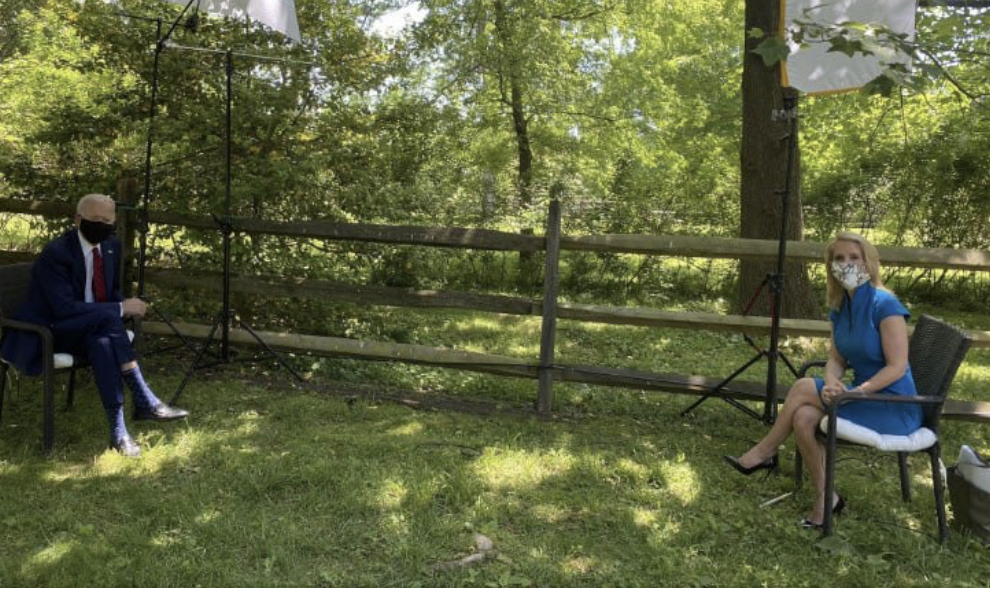
I'm all for wearing a mask when you need to be near other people, but really? A Twitter comment (see the comments here): "Virtue Signalling knows no distance."
The post drew considerable criticism that caused me to better explain my concern. I did that as an addendum to the original post, as follows:
Biden's job is to either have Trump voters switch over to him or to convince them that they don't care enough that they simply won't vote for Trump (I know 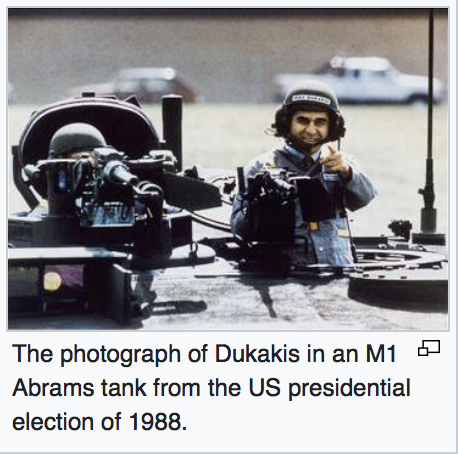 several Republicans of this latter type). I don't want this election to be a repeat of Michael Dukakis riding in the tank. I fear that this type of image is going to be repeatedly and effectively exploited by Republicans to make the argument that Biden is not a strong and courageous leader.
The CDC has repeated and strongly warned that we maintain a distance of six feet from other people. CDC further "advises" that people wear homemade masks. I fear that this type of image of Biden sitting 15 feet apart AND wearing a mask is going to be repeatedly and effectively exploited by Republicans to make the argument that Biden is not a strong and courageous leader. There are many other images that will be used by Trump, including images where Biden and his wife are wearing masks where no other people are nearby.
Those of us who have the strength and courage to unplug from the political matrix instantly realize that this exploit that will certainly be used by Trump will be effective when compared to "fearless" images of Trump NOT wearing a mask. Who do you want as the leader of the United States? The man who worries about invisible germs that kill only 1% of people? Or a courageous man like Trump? That will be the argument and (based on the rhetoric of the clamor-to-reopen-crowd) this argument will siphon votes away from Biden.
Biden will get the votes from his base, more or less, no matter what he does between now and November, despite his many flaws. Further, his base will forgive him the "sin" of not wearing a mask while sitting 15 feet from one other person outdoors. And, as one of the commenters on my FB page indicated, Biden took off his mask for the actual interview. Good. But this image will live on in isolation from the fact that he took off the mask to conduct the interview, as will thousands of similar images of Biden. Unfortunately, there are real consequences in the balance. Should Biden be 99% safe or 99.99999% safe? It's not a decision for me to make, but while prudent mask-wearing is absolutely a good thing, mask-wearing that looks weak and paranoid will hurt Biden's chances in November. It is my concern that the cheap version of virtue signaling suggested by this image will be quickly sniffed and identified as such by all voters who aren't already for Biden. Many of the people who are already strongly for Biden might will be oblivious to this serious problem.
I'll add one more thing. We need to be sensitive to the difference between cheap virtue signaling and expensive virtue signaling. What looks impressive when done by people we believe to be on our team can look terrible when done by members of the other team. There a lot going on under the hood and it includes confirmation bias and displaying of "badges" of in-group membership. This difference is explained by Geoffrey Miller in this definitional section from his new book, Virtue Signaling: Essays on Darwinian Politics and Free Speech (2020):
We all virtue signal. I virtue signal; you virtue signal; we virtue signal. And those guys over there, in that political tribe we don’t like – they especially virtue signal. (Just as they believe that we do.) Let’s not pretend otherwise. We are humans, and humans love to show off our moral virtues, ethical principles, religious convictions, political attitudes, and lifestyle choices to other humans. We have virtue signaled ever since prehistoric big-game hunters shared meat with the hungry folks in their clan, or cared for kids who weren’t their own.
There’s virtue signaling, and then there’s virtue signaling. This book is about both kinds. On the one hand, there’s what economists call ‘cheap talk:’ signals that are cheap, quick, and easy to fake, and that aren’t accurate cues of underlying traits or values. When partisans on social media talk about political virtue signaling by the other side, they’re usually referring to this sort of cheap talk. Virtue signaling as cheap talk includes bumper stickers, yard signs, social media posts, and dating app profiles. The main pressure that keeps cheap talk honest is social: the costs of stigma and ostracism by people who don’t agree with your signal. Wearing a ‘Make America Great Again’ hat doesn’t cost much money, but it can cost you friendships. On the other hand, there’s virtue signaling that’s costly, long-term, and hard to fake, and that can serve as a very reliable indicator of underlying traits and values. This can include volunteering for months on political campaigns, making large, verifiable donations to causes, or giving up a lucrative medical practice to work for Doctors Without Borders in Haiti or New Guinea. The key to reliable virtue signals is that you simply couldn’t stand to produce them, over the long term, if you didn’t genuinely care about the cause.
[V]irtue signaling can … be the worst of human instincts. It drives most of partisan politics, especially on social media. It drives the demands to censor, fire, cancel, and ostracize people who express the wrong opinions. It drives moral panics about satanic ritual abuse, ‘rape culture,’ and ‘porn addiction.’ It drives white nationalists to run over protesters. It drives antifa to beat up journalists. … Some of this is cheap talk, but some of it is reliable signaling. What distinguishes good virtue signaling from bad virtue signaling isn’t just the reliability of the signal. It’s the actual real-world effects on sentient beings, societies, and civilizations.
[I attempted to find the source of the photo, which I spotted on Twitter, but was unsuccessful]
- Go to the previous page
- 1
- …
- 560
- 561
- 562
- 563
- 564
- 565
- 566
- …
- 2,093
- Go to the next page