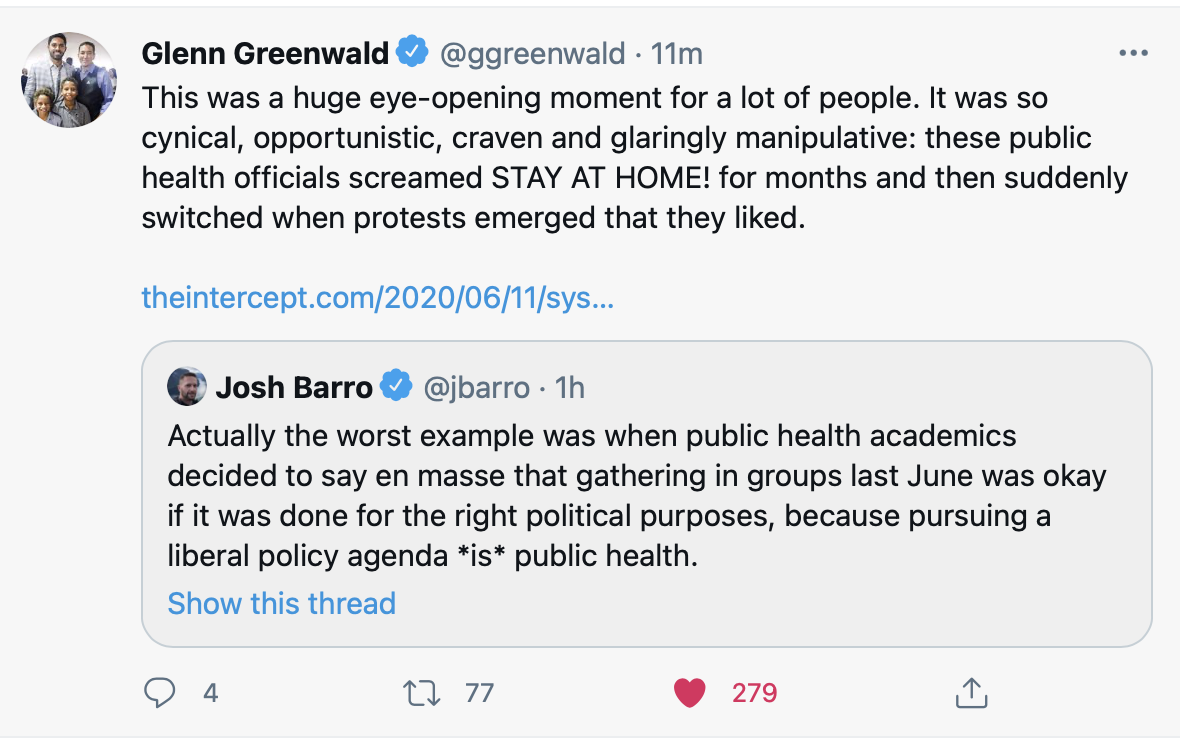
Insight-filled article by Ross Douthat of the NYT: "How Michel Foucault Lost the Left and Won the Right." When institutional sense-making power shift, tactics shift. Douthat persuasively identifies this shift. An excerpt:
The impulse to establish legitimacy and order informs a lot of action on the left these days. The idea that the left is relativistic belongs to an era when progressives were primarily defining themselves against white heteronormative Christian patriarchy, with Foucauldian acid as a solvent for the old regime. Nobody watching today’s progressivism at work would call it relativistic: Instead, the goal is increasingly to find new rules, new hierarchies, new moral categories to govern the post-Christian, post-patriarchal, post-cis-het world.
To this end, the categories of identity politics, originally embraced as liberative contrasts to older strictures, are increasingly used to structure a moral order of their own: to define who defers to whom, who can make sexual advances to whom and when, who speaks for which group, who gets special respect and who gets special scrutiny, what vocabulary is enlightened and which words are newly suspect, and what kind of guild rules and bureaucratic norms preside.
Meanwhile, conservatives, the emergent regime’s designated enemies, find themselves drawn to ideas that offer what Shullenberger calls a “systematic critique of the institutional structures by which modern power operates” — even when those ideas belong to their old relativist and postmodernist enemies.
This is a temptation I wish the right were better able to resist. Having conservatives turn Foucauldian to own the libs doesn’t seem worth the ironies — however rich and telling they may be.
I repeatedly encounter people who identify on the political left who insist that the Laptop found at a computer shop in October, 2020 was not Hunter Biden's laptop and that it was a Russian ploy to interfere with the U.S. Presidential election. The fact that these beliefs persist tells a sad story about the power the news media has to defraud its trusting audience.
This CBS Report from April 3, 2021 is recent confirmation of my belief that the laptop really was Hunter Biden's laptop. April 2021, long after the election was decided, was a politically convenient time and place for Hunter to deny that the laptop was his, but he didn't deny it. October, 2020, when the NY Post initially reported on the laptop, prior to the election, was also the perfect time for Hunter Biden to deny that it was his laptop, but he didn't deny it then either. He has never denied that it was his laptop. In fact, in the above CBS interview Hunter Biden stated that it is possible that it might have been his laptop. Watch the CBS video excerpt and observe Hunter Biden's demeanor. Is this the sort of person who would use his father's name to cut lucrative self-serving deals with foreign powers? Is that the sort of person who would write the emails found on the laptop. Seems apparent to me.
If this laptop and payoff had been about any of Trump's degenerate children, the media would have been all over it. The failure to cover this story is stunning jour - - - I almost wrote "journalistic malpractice," but it was far worse. It was an intentional and deliberate ongoing muti--news-outlet conspiracy to keep citizens from knowing something important that might affect their views on an upcoming election. Full disclosure: I voted for Biden and I was horrified by the thought that Trump might win a second term. There are more important principles at play, however, than the result of any one election. See Russell Brand's interview with Glenn Greenwald on this topic:
In the final months of the heated 2020 presidential race, The Post revealed a trove of emails from Hunter Biden’s laptop that raised questions about his then-candidate father’s ties to his son’s foreign business ventures, including Burisma, a Ukrainian natural gas company linked to corruption.
The emails revealed that the younger Biden introduced a top Burisma executive to his father, then vice president, less than a year before the elder Biden admittedly pressured Ukrainian officials into firing a prosecutor who was investigating the company.
The never-before-revealed meeting is mentioned in a message of appreciation that Vadym Pozharskyi, a Burisma board adviser, sent Hunter on April 17, 2015.
An image of Hunter Biden found on the laptop at the center of The Post exposé
The water-damaged MacBook Pro — which bore a sticker from the Beau Biden Foundation — was dropped off for repair at a Delaware computer shop in April 2019, but the individual who dropped it off never returned to pick it up.
. . .
In addition to his Ukrainian connections, other emails on the computer showed Hunter discussing potential business deals with China’s largest private energy company. One deal seemed to spark considerable interest with the younger Biden, who called it “interesting for me and my family.”
. ..
Hunter Biden’s position with the reportedly corrupt energy company — which paid him “as much as $50,000 per month” — “created an immediate potential conflict of interest” because his father was involved in US policy toward Ukraine, the report stated.
What do you get when you combine the complexity of the life-sustaining digestive process of mammals with the Internet's ever-churning entropic exploration into the far corners of informational state space? You get the "Four C's of Poop."
I encountered Bart Ehrman many years ago, when I encountered his excellent book, Misquoting Jesus. Today I learned that Ehrman writes at his own website, The Bart Ehrman Blog. Yesterday he published an article that makes sense out of a confused topic: the difference between agnostics and atheists? Erhman holds that the difference is not a matter of degree, a common misunderstanding. The title of Ehrman article is "On Being an Agnostic. Or Atheist?" Here's an excerpt:
. . . I think it is possible to be both an agnostic and an atheist. And that’s how I understand myself. So, in this newer view of mine, agnosticism is a statement about epistemology – that is, about what a person *knows*. Do I know whether there is a God in the multiverse? Nope. I really don’t. How could I know? I’m just a peon on a very big planet, circling around a very big star, which is one of some 100 billion stars in this galaxy, which is only one of anywhere from 100 billion to 2 trillion galaxies in this universe, which may be only one of trillions (infinite number?) of universes. So, well, I don’t have a broad perspective on the question. So I don’t know. I’m agnostic.
Atheism, on the other hand, (in my way of thinking) is not about knowledge but about belief. Do I *believe* that there is a God? No I don’t. I especially do not believe in the biblical God, or in the traditional God of Jews and Christians (and Muslims and so on). I simply do not believe that there is a God who created this world (it is the result of forces beyond my comprehension, but it goes back to the Big Bang, and we are here because of evolution, and I exist only because of some pretty amazingly remote chances/circumstances…); I don’t think there is a divine being who is sovereign over this world who interacts with it and the people in it, who answers prayer, who brings good out of evil. I don’t believe it. So I’m an atheist.
So I’m an agnostic atheist. Or an atheistic agnostic. Take your pick!
I like this approach. No one knows whether there is a god hiding behind a distant star. It's possible that there is such a lurking god, even though I'll never be able to prove or disprove such a claim. This inability to prove or disprove god is an epistemic challenge, according to Ehrman. I am forced to live a life of ignorance about many things, including shy gods hiding in outer space (or in my toaster, or wherever). Ehrman would attach the word "agnostic" to that epistemic predicament. Fair enough.
And in the meantime, I need to either act as though god does exists or that god doesn't exist. As I see it, this is a question of where I'm setting my default for belief. Some people set the bar low and they believe in all kinds of mystical claims and conspiracy theories. I am extremely skeptical about claims about gods (and many other things). This might also be seen as how I set up my "burden of proof," as we might say in a courtroom. Those of us who are highly skeptical need extraordinary evidence for extraordinary claims.
I consider the question of whether god exists to be an extraordinary claim, but others might set the bar much lower. Some of them believe with with nothing more than a hope and a duty old book of apocryphal tall tales. What do I believe when I (a person who sets the bar for proof high) don't see any evidence of a god and yet I can't disprove the existence of god? Shall I act "as if" or not "as if" there is a god? A lack of belief in a god is what Ehrman calls "Atheism." This nomenclature makes sense to me.
I will give this some more thought, but I'm inclined to join Ehrman as new member of the church of Atheist Agnostics.
As Matt Taibbi indicates in his article, he is not taking a position on whether the "lab origin" theory is true. That said, in his article on "fact-checking," he describes what goes for serious reporting on a most urgent topic in modern day America:
Fauci’s new quote about not being “convinced” that Covid-19 has natural origins, however, is part of what’s becoming a rather ostentatious change of heart within officialdom about the viability of the so-called “lab origin” hypothesis. Through 2020, officials and mainstream press shut down most every discussion on that score. Reporters were heavily influenced by a group letter signed by 27 eminent virologists in the Lancet last February in which the authors said they “strongly condemn conspiracy theories suggesting that COVID-19 does not have a natural origin,” and also by a Nature Medicine letter last March saying, “Our analyses clearly show that SARS-CoV-2 is not a laboratory construct.”
The consensus was so strong that some well-known voices saw social media accounts suspended or closed for speculating about Covid-19 having a “lab origin.” One of those was University of Hong Kong virologist Dr. Li-Meng Yan, who went on Tucker Carlson’s show last September 15th to say “[Covid-19] is a man-made virus created in the lab.” After that appearance, PolitiFact — Poynter’s PolitiFact — gave the statement its dreaded “Pants on Fire” rating.
. . .
Fact-checking was a huge boon when it was an out-of-sight process quietly polishing the turd of industrial reportage. When companies dragged it out in public and made it a beast of burden for use in impressing audiences, they defamed the tradition.
We know only a few things absolutely for sure, like the spelling of “femur” or Blaine Gabbert’s career interception total. The public knows pretty much everything else is up for argument, so we only look like jerks pretending we can fact-check the universe. We’d do better admitting what we don’t know.
Hello, I invite you to subscribe to Dangerous Intersection by entering your email below. You will have the option to receive emails notifying you of new posts once per week or more often.