Robert Malone on Vaccines and Autism

Rabbitt Malone has recently written an article on vaccines and autism: Neuroscience, Vaccines, and Autism: "What Science Actually Says and Doesn’t Say: An honest look at vaccine biology, autism research, and a hypothesis that may offer real hope for families of nonspeaking children."

He sums up the current situation:

WHERE THE QUESTION REMAINS GENUINELY OPEN

Regressive autism is different. Roughly 20 to 30 percent of autistic children appear to develop typically and then lose skills, often language and social engagement, somewhere between 12 and 24 months of age. This regression is real, documented, and poorly understood. Its timing does overlap with the vaccine schedule. And it is worth saying plainly: the parents who report watching their child change in the days and weeks following vaccination are not, as a group, confused or misremembering. Regression happens. The timing they describe is real. The unresolved scientific question is not whether the regression occurred but what caused it.

This distinction matters. For too long, the response from the medical establishment has been to challenge the parents’ account rather than to engage the mechanism. That is not good science, and it has damaged trust in ways that will take a long time to repair. The honest position is to acknowledge the reported pattern, take it seriously as an observation, and invest in the research needed to understand it.

Autistic brains, examined postmortem, show neuroinflammatory signatures, activated microglia, elevated cytokines, and white matter abnormalities [4,5]. These findings are consistent with what you might expect from microvascular injury, though they almost certainly have other explanations as well. The point is not that vaccines caused these findings, but that the brain biology of autism involves immune and vascular components that researchers are still working to understand.

We do not fully understand regressive autism. Ruling out postnatal contributions on political rather than scientific grounds would itself be a failure of honest inquiry.

The most credible narrow claim, and it is narrow, is that in a subgroup of children with underlying immune or metabolic vulnerabilities, a strong immune activation event, possibly including vaccination, could act as a trigger for neurological regression in children already on a susceptible developmental trajectory. This has not been demonstrated. It has not been ruled out.

Continue ReadingRobert Malone on Vaccines and Autism

Democrats No Longer the Party of the Working Class

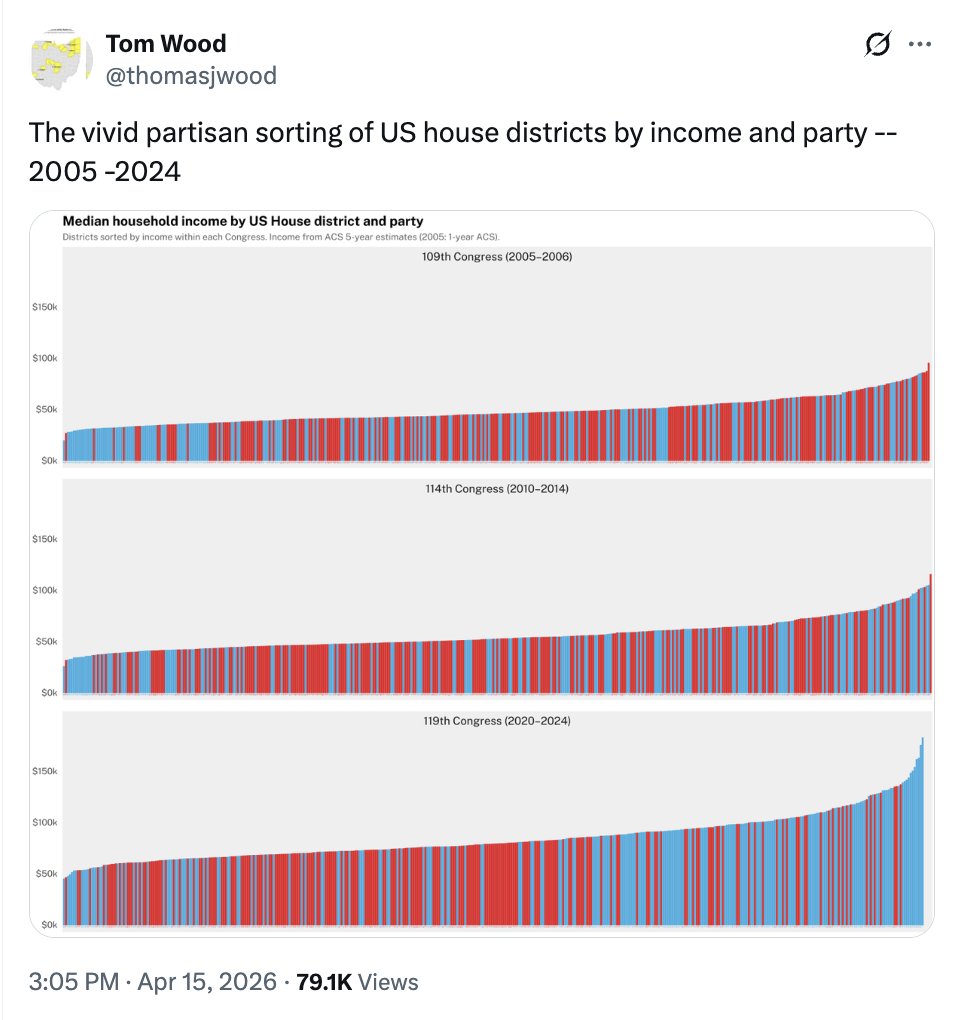
Used to claim that they were the party of the working class. That is not true anymore based on the following graph.

But to be fair, I'm not sure that either party is the party of the working class. I would think that virtually all of the issues that the working class would vote for overwhelmingly are being resoundingly rejected by both parties, Democrats and Republicans. As George Carlin noted, they don't care about us at all.

Continue ReadingDemocrats No Longer the Party of the Working Class

Facilitated Communication: Another Version of Make Shit Up “Medicine”

Many people I know who got the COVID shots absolutely refuse to come to groups with the fact that US public health authorities and "experts" got almost everything wrong about Covid. Almost everything.

How could it be that someone who is highly educated to get something so completely wrong?

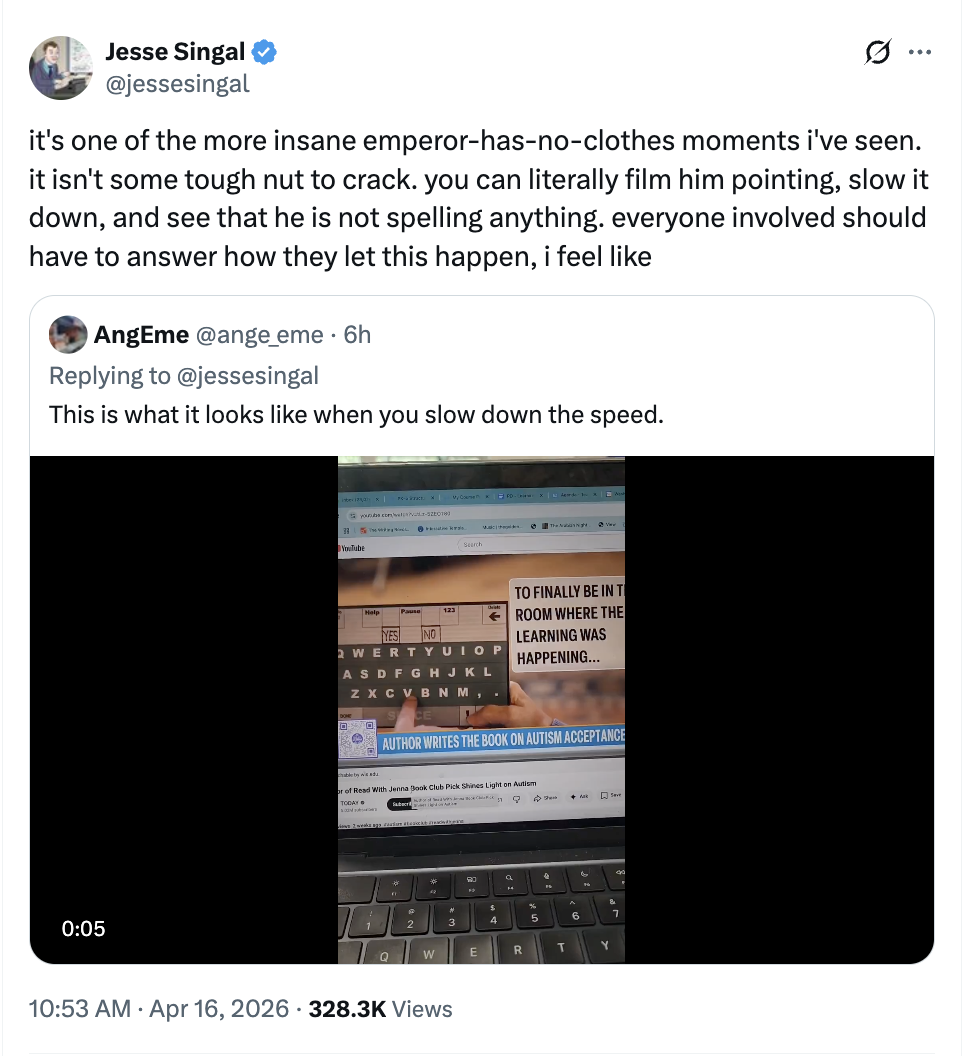
Here's another example from the early 1990s: "Facilitated Communication" for people who are autistic. I saw a documentary on this technique about 20 years ago and I couldn't believe what I was saying. Stuart Vyse describes it in detail in this article:

"When Silence Speaks: The Harmful Pseudoscience of Facilitated Communication: The Stubblefield case in ‘Tell Them You Love Me’ highlights the wide array of potential victims who can be harmed by promoting pseudoscientific methods of communication." Here's an excerpt:

The early results [of facilitated communication] were astonishing. People who had never spoken a complete sentence were suddenly writing poetry and novels with the assistance of their facilitators, and FC began to spread like wildfire. However, the involvement of another person in the process—the facilitator—raised obvious questions about who was really typing. Peer-reviewed studies using simple blinding techniques began to emerge, and the results were devastating.

In a typical experiment, researchers placed the non-speaking individual and the facilitator at a table with a barrier between them so that each could be shown pictures of familiar objects, but they could not see each other’s pictures. When both saw the same picture, such as a shoe, all was fine, and “s-h-o-e” was typed. However, when shown different images, the typed word invariably matched what the facilitator, not the nonspeaking person, had seen. Across hundreds of trials, there were virtually no correct responses independently made by the nonspeaking individuals. People who had supposedly been writing sophisticated essays through FC could not identify everyday objects in controlled tests, revealing that the facilitators were the actual authors of the typed messages.

Were the therapists lying when they claim that the patient was actually in charge? Not quite:

Ideomotor effects have been implicated in hypnosis, dowsing, automatic writing, and several other phenomena. Finally, these unconscious actions are reinforced by the philosophy advocated by the FC/RPM/S2C community. Decades ago, Douglas Biklen coined the slogan “presume competence.” In an effort to show respect for people with disabilities, Biklen suggested that all people should be approached with the assumption that they are intelligent and literate. While this may sound like an admirable philosophy, this assumption introduces an explicit bias.

Continue ReadingFacilitated Communication: Another Version of Make Shit Up “Medicine”