
Many people I know who got the COVID shots absolutely refuse to come to groups with the fact that US public health authorities and “experts” got almost everything wrong about Covid. Almost everything.
How could it be that someone who is highly educated to get something so completely wrong?
Here’s another example from the early 1990s: “Facilitated Communication” for people who are autistic. I saw a documentary on this technique about 20 years ago and I couldn’t believe what I was saying. Stuart Vyse describes it in detail in this article: “When Silence Speaks: The Harmful Pseudoscience of Facilitated Communication: The Stubblefield case in ‘Tell Them You Love Me’ highlights the wide array of potential victims who can be harmed by promoting pseudoscientific methods of communication.” Here’s an excerpt:
The early results [of facilitated communication] were astonishing. People who had never spoken a complete sentence were suddenly writing poetry and novels with the assistance of their facilitators, and FC began to spread like wildfire. However, the involvement of another person in the process—the facilitator—raised obvious questions about who was really typing. Peer-reviewed studies using simple blinding techniques began to emerge, and the results were devastating.
In a typical experiment, researchers placed the non-speaking individual and the facilitator at a table with a barrier between them so that each could be shown pictures of familiar objects, but they could not see each other’s pictures. When both saw the same picture, such as a shoe, all was fine, and “s-h-o-e” was typed. However, when shown different images, the typed word invariably matched what the facilitator, not the nonspeaking person, had seen. Across hundreds of trials, there were virtually no correct responses independently made by the nonspeaking individuals. People who had supposedly been writing sophisticated essays through FC could not identify everyday objects in controlled tests, revealing that the facilitators were the actual authors of the typed messages.
Were the therapists lying when they claim that the patient was actually in charge? Not quite:
Ideomotor effects have been implicated in hypnosis, dowsing, automatic writing, and several other phenomena. Finally, these unconscious actions are reinforced by the philosophy advocated by the FC/RPM/S2C community. Decades ago, Douglas Biklen coined the slogan “presume competence.” In an effort to show respect for people with disabilities, Biklen suggested that all people should be approached with the assumption that they are intelligent and literate. While this may sound like an admirable philosophy, this assumption introduces an explicit bias.
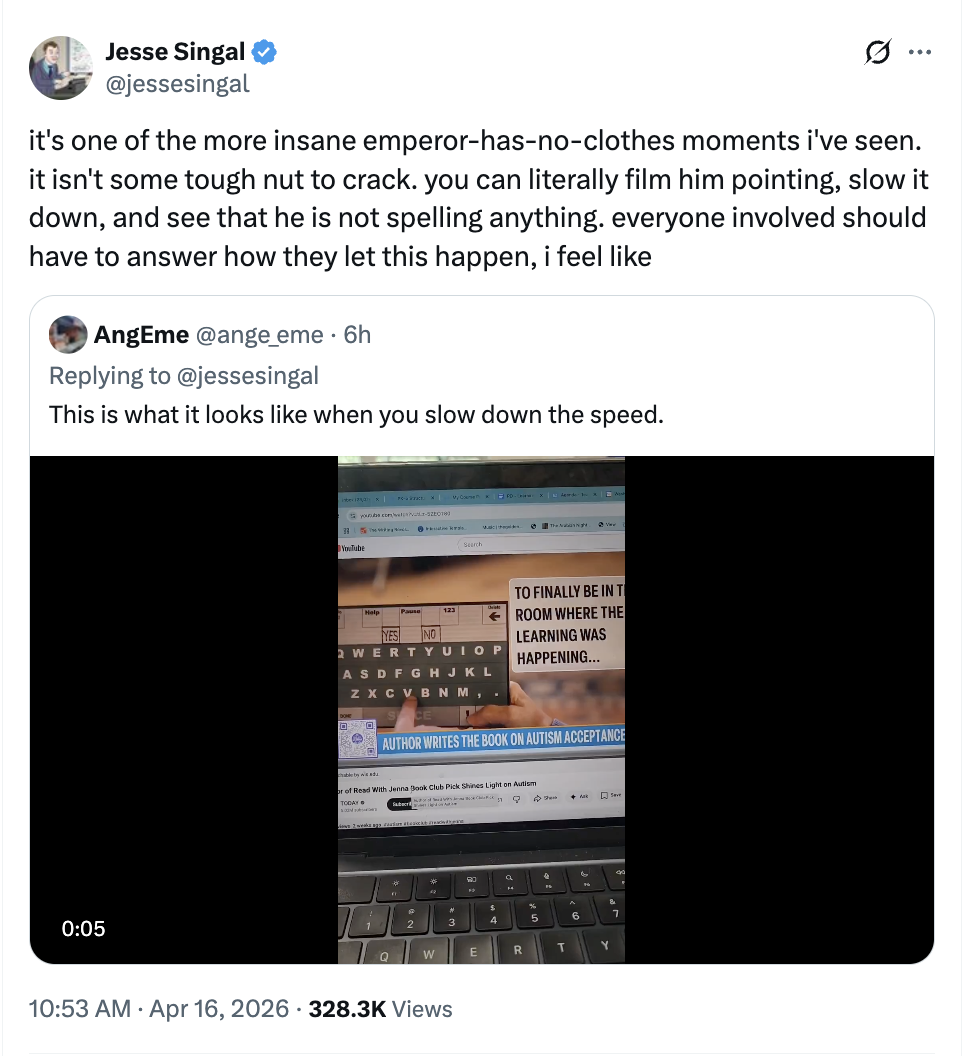
[Supp April 17, 2026]
I’ll let Alex Berenson introduce a NYT article that started this topic recently:
Sometimes the truth is no fun.
On March 30, the New York Times gave the world the inspiring tale of Woody Brown, a 28-year-old California man whose debut novel, “Upward Bound,” captures the lives of autistic people in adult day care. The twist: Brown is himself severely autistic. The novel draws on his own experiences.
Inspiring indeed. In fact, Brown is not merely autistic, he is essentially non-verbal. You might wonder how he wrote his novel.
Good question.
Throughout the following article in the NYT, the severely autistic young man was quoted in a way that made him sound verbally eloquent. There’s no indication in the NYT piece, however, that Woody communicated directly or independently with the interviewer. The reviewer, Alexandra Alter, describes meeting Woody at his parents’ home in Monrovia, Calif., where he “tapped letters on a board with his right index finger, while Mary [his mother], who was seated next to him on the couch, followed his finger taps and repeated the words aloud.” That’s the only method shown for any of his “responses” in the article. There’s zero mention of Woody typing/responding without his mother present, no double-blind testing, no independent verification, and no discussion of whether he could answer questions when the mother couldn’t see the board or hear the prompts. The quotes attributed to him (like “That’s how Mom figured out that I was listening to everything”) all come through this mother-as-interpreter setup using the letter board, a physical spelling board, not a digital keyboard.
[For a video of Woody “communicating,” check out this piece on “Today.” Notice that at various times, he is.not even looking at the letter board while his mom talks. ]
Here’s the link to the NYT article: “I Thought I Would Be Caged My Whole Life’: Doctors believed that Woody Brown would never be able to speak or process language. He went to graduate school and is publishing his debut novel.”
Excerpt:
As a toddler, Woody was diagnosed with severe autism. Doctors concluded he couldn’t process language, and said it was pointless to explain things to him or talk to him in complex sentences. Whenever Woody spoke, it sounded like shrieks and gibberish. . . . .
And then some magic happened:
After getting an English degree from the University of California Los Angeles, from which he was the first nonverbal autistic person to graduate, Woody received a masters in creative writing from Columbia University. This month, he is publishing his debut novel, “Upward Bound,” which centers on the lives of disabled people at an adult day care center in Southern California. The novel, which Woody spelled out at a rate of one paragraph a day, has drawn enthusiastic advance reviews and praise from writers like Paul Beatty, Roddy Doyle and Mona Simpson.
In graduate school at Columbia, Woody continued to work on “Upward Bound,” which took around two and a half years to write. His teachers and classmates quickly adjusted to Woody and his mom’s presence — Mary attended classes as his communication aide — and his tendency to have an iPad playing with the sound on mute.
I see this article not only as a fraud, but a case study in motivated reasoning that leads many people in many areas of society to pretend, to make believe. To make up facts because we want to feel good or we want to make someone else feel good or we want people in a particular group to feel good. It is the story of our unhinged craving to feel good about things that aren’t really happening and about the news media’s willingness to buy into this grift to sell advertisements.
Robert Malone has recently written on letter boards:
Facilitated communication, in which a facilitator physically supports a person’s hand while they point to letters, has been shown in controlled research to reflect the facilitator’s output rather than the communicator’s [8]. The facilitator is not consciously fabricating; the mechanism is the ideomotor effect, the same phenomenon behind Ouija boards. This is not a fringe finding. It is a well-replicated result, and FC (facilitated communication) has caused real harm to families through false accusations and misdirected hope.
But there are newer approaches that operate differently in principle. The Rapid Prompting Method (RPM) and Spelling to Communicate (S2C) explicitly work toward independent pointing, with the goal of fading physical support entirely. Some practitioners conduct message-passing tests to verify independence. Some individuals using these methods have transitioned to fully independent communication and gone on to write books, give public talks, and advocate for themselves in ways that could not plausibly be attributed to a facilitator.

